
TL;DR:
- The Oxbridge tutorial method emphasizes argument, reasoning, and iterative challenge over simple correct answers. Implementing this approach in schools requires structured workflows, small-group interactions, and fostering a classroom culture of intellectual vulnerability. Sustained success depends on embedding feedback cycles across sessions, teacher support, and promoting equitable access for all students.
Picture this: one of your brightest students answers a question confidently in class. You push back gently, asking them to explain their reasoning. They freeze. They know the answer, but they cannot defend it. This moment reveals exactly the gap that Oxbridge admissions expose. Most classrooms reward correct answers; Oxbridge rewards the ability to argue, revise, and think out loud. This guide gives you a step-by-step approach to teaching the Oxbridge tutorial method in secondary school settings, with practical frameworks, honest classroom solutions, and strategies to support every student, regardless of background.
Table of Contents
- Understanding the Oxbridge tutorial method
- Core elements: designing Oxbridge-style sessions for schools
- Developing critical thinking and articulation in students
- Addressing common challenges and ensuring equity
- What most guides miss about the Oxbridge method in schools
- How to take your Oxbridge-method teaching further
- Frequently asked questions
Key Takeaways
| Point | Details |
|---|---|
| Tutorial model essentials | Small-group learning with ongoing preparation, argument, and review drives Oxbridge’s impact. |
| Adaptable school framework | Educators can replicate Oxbridge cycles by structuring lessons around preparation, challenge, and reflection. |
| Feedback and equity matter | Ongoing feedback and inclusive scaffolding ensure all students benefit from Oxbridge-inspired approaches. |
| Common pitfalls to avoid | Isolated 'tutorial-style' lessons without iteration fail to deliver lasting gains. |
Understanding the Oxbridge tutorial method
The Oxbridge tutorial is unlike anything most students experience before they arrive at university. As Oxford's tutorial system is structured around recurring small-group meetings, with students presenting prepared work and a tutor leading rigorous discussion aimed at defending and refining arguments, the emphasis is never simply on being right. It is on being able to show your thinking, handle challenge, and adapt your position when the evidence demands it.
This is fundamentally different from a standard classroom Q&A, where a teacher asks a question, a student gives an answer, and the lesson moves on. In the tutorial model, the discussion is the lesson. Students are expected to have done substantive preparation beforehand, often writing an essay or working through a problem set, and then to hold their ideas up to scrutiny in real time.
"The tutorial is not a lecture delivered backwards. It is a space where ideas are stress-tested, not simply transmitted." This distinction matters enormously when you are designing learning experiences for students who want to stand out in Oxbridge admissions.
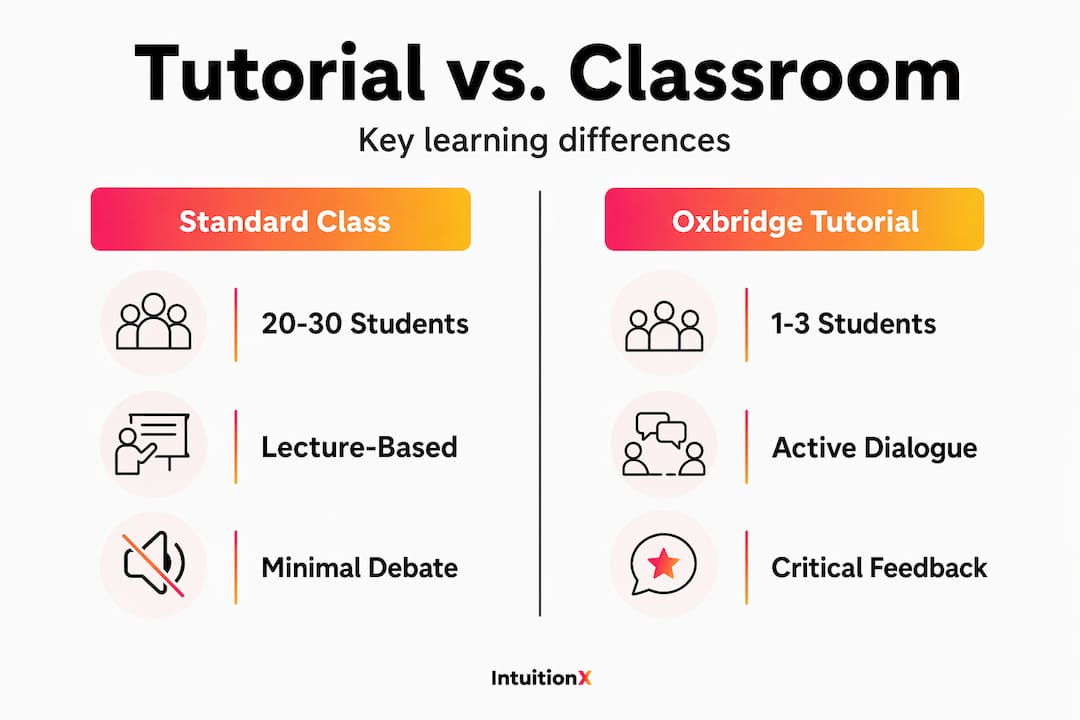
The intimacy of the format, typically one tutor and one to three students, means nowhere to hide. Every student must engage. Compare that to a class of thirty, where a quiet student can coast through an entire lesson without once articulating their own reasoning. That is the structural problem most secondary teachers are working against.
| Feature | Standard classroom | Oxbridge tutorial |
|---|---|---|
| Group size | 20 to 30 students | 1 to 3 students |
| Primary focus | Content delivery | Argument and reasoning |
| Student role | Passive or reactive | Active and accountable |
| Feedback timing | End of unit | Every session |
| Revision expectation | Homework tasks | Built into the cycle |
Understanding this contrast helps you see why Oxbridge-style learning cannot simply be bolt-on enrichment. It requires a genuine shift in how you structure classroom time and what you expect from students each session.
Core elements: designing Oxbridge-style sessions for schools
Now that the defining traits are clear, let us translate them into practical structures any teacher can use. The good news is that you do not need a tutorial room or a staff-to-student ratio of one to three. You need a repeatable process.
The most effective approach follows a four-stage workflow. As the Oxford tutorial model shows, designing sessions around a "prep, present, be challenged, revise" cycle is what makes the method work for teachers in practice. Here is how that looks in a secondary school context:
-
Preparation. Assign a focused task ahead of the session. This might be a short argumentative essay, a set of structured notes on a controversial question, or a position paper on a scientific or ethical dilemma. Be specific about the standard expected. Students should come ready to defend their ideas, not just summarise them. Building effective engagement routines into this stage helps students treat preparation as a genuine intellectual exercise rather than homework to be completed at minimum effort.
-
Presentation. Give students a structured two to four minutes to present their argument or findings to a small group or the class. The goal here is not polished performance. It is clear articulation of reasoning. Encourage students to say "I argued this because..." rather than simply reading their notes aloud.
-
Challenge. This is the heart of the method. Peers and teachers ask probing questions: "What would someone who disagrees with you say?" or "Does that still hold if you change one of your assumptions?" The aim is not to embarrass anyone. It is to model the intellectual rigour that university entry skills require at the highest level. Good questioning techniques are essential here. Open-ended, layered questions that invite elaboration rather than yes or no answers work best.
-
Revision. Students have time, either within the session or before the next one, to revise their original argument in light of the discussion. This might mean a brief written reflection, an annotated version of their original work, or a verbal summary of how their thinking changed.
| Stage | Teacher role | Student role | Time allocation |
|---|---|---|---|
| Preparation | Set task, clarify expectations | Research, write, outline | Before session |
| Presentation | Facilitate, time-keep | Articulate argument clearly | 3 to 5 minutes |
| Challenge | Model questioning, invite peers | Respond, defend, adapt | 10 to 15 minutes |
| Revision | Give structured feedback | Revise argument in writing | 10 minutes or homework |
Pro Tip: Rotate the role of "challenger" among students so that questioning becomes a shared responsibility, not something students only expect from the teacher. This builds a classroom culture where intellectual pushback is normalised and welcomed.
Developing critical thinking and articulation in students
With a workflow in place, the focus shifts toward developing the mindsets and capabilities students need to thrive. The workflow is only as good as the thinking it draws out.
Implementing tutorial-style teaching well means ensuring students can articulate their reasoning, not just produce answers, designing tasks that force counterexample handling, and building feedback loops so students revise ideas between sessions. Each of these is a distinct skill that needs deliberate practice.
Here are the most effective classroom strategies for developing these capabilities:
-
Socratic questioning as a daily habit. Do not save probing questions for special occasions. Ask "Why do you think that?" and "What would change your mind?" regularly, even in routine lessons. Students need to experience challenge as a normal part of learning, not as a signal that they are wrong.
-
Counterexample assignments. Set tasks that explicitly require students to find and address the strongest objection to their own argument. This is a direct simulation of what happens in a tutorial, and it forces students to think beyond confirmation bias. For example: "Write your argument, then write the best possible counterargument, and then explain why your original position still holds or needs adjusting."
-
Peer review with structured criteria. Unstructured peer feedback tends to be vague and unhelpful. Give students a clear framework: "Identify the main claim. Does the evidence support it? Is there a counterexample they have not addressed?" This turns peer review into a genuine analytical exercise.
-
Low-stakes verbal reasoning practice. Many students who are strong writers freeze when asked to articulate reasoning under pressure. Build short, low-stakes verbal exercises into lessons. Ask students to explain their answer to a partner before sharing it with the class. Active learning approaches consistently show that verbalising reasoning deepens understanding in ways that silent reading and note-taking do not.
-
Metacognitive reflection. After discussion sessions, ask students to write two sentences: "My thinking changed in this way..." and "The question I am still uncertain about is...". This simple habit builds metacognition, the ability to monitor and evaluate one's own thinking, which is a core competency for Oxbridge interviews.
Personalised support strategies matter enormously here. Some students will take to verbal challenge naturally; others will find it deeply uncomfortable at first. The key is creating a classroom culture where intellectual vulnerability is treated as a strength, not a weakness. Students need to know that changing their mind in light of evidence is something to be proud of, not embarrassed by. This is also excellent preparation for university preparation at any high-ranking institution.
Pro Tip: When a student revises their position after a challenge, make a point of acknowledging it positively in front of the group. Say something like, "That is exactly what good thinking looks like." This reframes intellectual flexibility as a marker of strength, not weakness.

Addressing common challenges and ensuring equity
Even with the right intellectual strategies, implementing the Oxbridge method in real schools brings unique institutional and student-centred challenges. Let us be honest about those.
The first issue is access and opportunity. Not all schools have the same resources, staff expertise, or ethos that makes this kind of teaching easy to sustain. As research shows, Oxbridge admissions outcomes can be uneven across colleges, with structural barriers affecting applicants from certain schools and backgrounds. This means that simply teaching the method is not enough. Schools need to think carefully about which students are being given access to Oxbridge-style teaching, and whether those opportunities are being actively extended to first-generation applicants and students from underrepresented communities.
Here are the most common practical challenges and how to address them:
-
Large class sizes. Most secondary teachers are working with twenty-five to thirty students, not one to three. The solution is breakout groups. Organise students into groups of three or four for the challenge phase, and rotate the teacher's attention so each group receives direct input across a series of sessions. Student engagement is significantly higher in small-group formats, even within larger classes.
-
Student anxiety. Verbal challenge can feel threatening, especially for students who are not used to having their ideas questioned. Start with anonymous written challenges before moving to live discussion. This gives students time to build confidence before being put on the spot.
-
Uneven preparation quality. If some students arrive well-prepared and others do not, the session becomes unbalanced. Set clear, scaffolded preparation tasks with explicit success criteria. Consider using a short written check-in at the start of each session to ensure everyone has done the groundwork before discussion begins.
-
Supporting underrepresented applicants. First-generation Oxbridge applicants often lack the informal cultural knowledge that helps more privileged peers navigate the process. Make the implicit explicit: explain what Oxbridge tutors are actually looking for, share examples of strong and weak responses, and create structured opportunities to practise interview-style discussion. Check entry requirements guidance to ensure your students understand the full picture of what applications involve.
-
Wellbeing and rigour. Rigorous intellectual challenge should never tip into unnecessary stress. Frame challenge as collaborative inquiry, not interrogation. Establish clear norms: we challenge ideas, not people.
What most guides miss about the Oxbridge method in schools
Here is something most articles on this topic will not say directly: the vast majority of Oxbridge-inspired teaching initiatives in schools fail not because the method is wrong, but because it is treated as an event rather than a culture.
A one-off "tutorial-style lesson" does not change how students think. Neither does a six-week pilot programme that quietly disappears after the novelty wears off. Real transformation happens when iterative feedback becomes embedded in the everyday rhythm of school life, when students expect to revise their thinking regularly, and when teachers model intellectual humility by publicly changing their own positions in light of good argument.
The evidence is clear on this point. As Oxford tutorials are explicitly described as a continuous cycle of preparation and feedback, not a one-off discussion, the power of the method lies entirely in its repetition. It is not the individual session that builds capability; it is the accumulation of sessions over time.
This also means that teacher training and support matter just as much as student development. Teachers need to feel confident using Socratic questioning, comfortable with the uncertainty that open-ended discussion produces, and supported by school leadership when they move away from the comfortable safety of content delivery. Sustainable active learning approaches require school-wide buy-in. One enthusiastic teacher working alone cannot create a tutorial culture. Leadership needs to understand why this matters and what it looks like in practice.
The uncomfortable truth is that this kind of teaching is harder and messier than traditional instruction. But it is also far more effective at producing the kinds of thinkers that both Oxbridge and the wider world genuinely need.
How to take your Oxbridge-method teaching further
You have got the framework. You understand the challenges. Now the question is: how do you keep the momentum going without burning out or working in isolation?

That is exactly where IntuitionX comes in. Our AI tutor, Omniscience, is built on the Oxbridge tutorial philosophy: Socratic questioning, rigorous challenge, and iterative feedback, available to your students around the clock. Rather than replacing the thinking you do in the classroom, IntuitionX supports students between sessions, helping them prepare more deeply, articulate their reasoning more clearly, and arrive to your tutorials ready to engage at a genuinely higher level. Backed by Sir Anthony Seldon and built on the expertise of Oxford and Cambridge first-class graduates, IntuitionX gives every student access to the kind of intellectual challenge that was once reserved for the very few. Explore what IntuitionX can offer your school at intuitionx.ai.
Frequently asked questions
What are the main components of the Oxbridge tutorial method?
It consists of small-group sessions with assigned preparation, student-led presentations, debate and feedback, and revision cycles. As Oxford tutorials are built around recurring meetings where students have prepared work and the tutor leads rigorous discussion, the method is defined by its cyclical, iterative structure.
How can large classes adapt the Oxbridge tutorial model?
Teachers can use breakout groups, peer review cycles, and rotating mini-tutorials to simulate the method at scale. Tutorials are typically hour-long sessions with one to three students, but the core dynamic of preparation and challenge can be replicated in smaller clusters within a larger class.
What common mistakes should schools avoid?
Avoid treating the method as a one-off event and ensure feedback and revision cycles are genuinely built into the process. As Oxford's approach makes clear, tutorials are a continuous cycle of preparation and feedback, and the repetition is precisely what makes them effective.
How can teachers help students struggling with the Oxbridge method?
Offer regular, low-stakes opportunities to articulate reasoning, reinforce supportive peer review, and provide incremental feedback on both strengths and areas for growth. Building in structured feedback loops between sessions ensures that students revise and strengthen their ideas progressively rather than feeling overwhelmed by a single high-stakes discussion.