

TL;DR:
- Bridging educational gaps requires targeted strategies based on specific student weaknesses.
- Creating a supportive environment and consistent routines enhances effective learning.
- Regular progress tracking and fostering a sense of belonging boost motivation and results.
Your teenager is putting in the hours. They're sitting at their desk, working through past papers, attending every lesson. Yet somehow, the grades aren't reflecting the effort. Sound familiar? For many parents of A-Level students across the UK, this gap between effort and outcome is one of the most frustrating experiences imaginable. The truth is, working harder isn't always the answer. Working smarter, with the right strategies and support in place, is what actually closes the gap. This guide gives you practical, research-backed steps to do exactly that.
Table of Contents
- Understanding educational gaps at A-Level
- Laying the groundwork: prerequisites for bridging gaps
- Step-by-step strategies to bridge educational gaps
- Checking progress and staying on track
- A fresh perspective on bridging educational gaps
- How our solutions support your gap-bridging journey
- Frequently asked questions
Key Takeaways
| Point | Details |
|---|---|
| Environment matters most | A structured, distraction-free space and emotional support are essential to closing learning gaps at A-level. |
| Routine beats expense | Short, focused study routines with consistent progress tracking work better than costly tutoring alone. |
| Evidence-based strategies | Retrieval practice and minimal distractions have proven impact on exam results for secondary students. |
| Parental role is crucial | Parents are most effective when they create the right conditions and offer accountability without pressure. |
Understanding educational gaps at A-Level
Now that you understand the stakes, let's examine what educational gaps really mean and why they emerge.
An educational gap at A-Level isn't simply a matter of missing a few lessons. It refers to a measurable disconnect between where a student's knowledge and skills currently sit, and where they need to be to perform well in their examinations. These gaps can be narrow or wide, recent or long-standing, and they affect confidence just as much as grades.
Several common causes drive these gaps. Some are structural, some personal, and some entirely outside a student's control.
- Lost foundational knowledge from GCSE that was never fully consolidated
- Inconsistent teaching quality, particularly in oversubscribed sixth forms
- Resource disparities, where students without private tutoring fall behind peers who have it
- Pandemic learning loss, which left many students with significant gaps in core subjects
- Mental health pressures that reduce a student's ability to retain and apply knowledge
The consequences go beyond exam results. Students who experience persistent gaps often lose confidence, disengage from learning, and make university or career choices based on underperformance rather than genuine ability. Understanding educational gaps and equity helps frame why targeted interventions matter so much at this stage.
The data paints a telling picture:
| Factor | Impact on A-Level students |
|---|---|
| Foundational gaps from GCSE | Lower baseline understanding in core topics |
| Limited access to tutoring | Reduced ability to address individual weaknesses |
| Disrupted routines | Inconsistent revision and poor retention |
| Low engagement | Passive learning with minimal knowledge transfer |
One of the most encouraging findings in recent research is that targeted learning strategies genuinely work. Retrieval practice and distraction minimisation have been shown to improve exam scores significantly for secondary students. This isn't about dramatic overhauls. Small, consistent changes to how your teen studies can produce real, measurable results.
"The gap isn't always about intelligence. More often, it's about method, environment, and whether a student feels supported enough to keep going."
Laying the groundwork: prerequisites for bridging gaps
Before diving into solution strategies, it's essential to prepare the right environment and mindset.
Even the best strategy will struggle in the wrong conditions. Before you introduce any new learning approach, it's worth asking whether the basics are in place.
What students need:
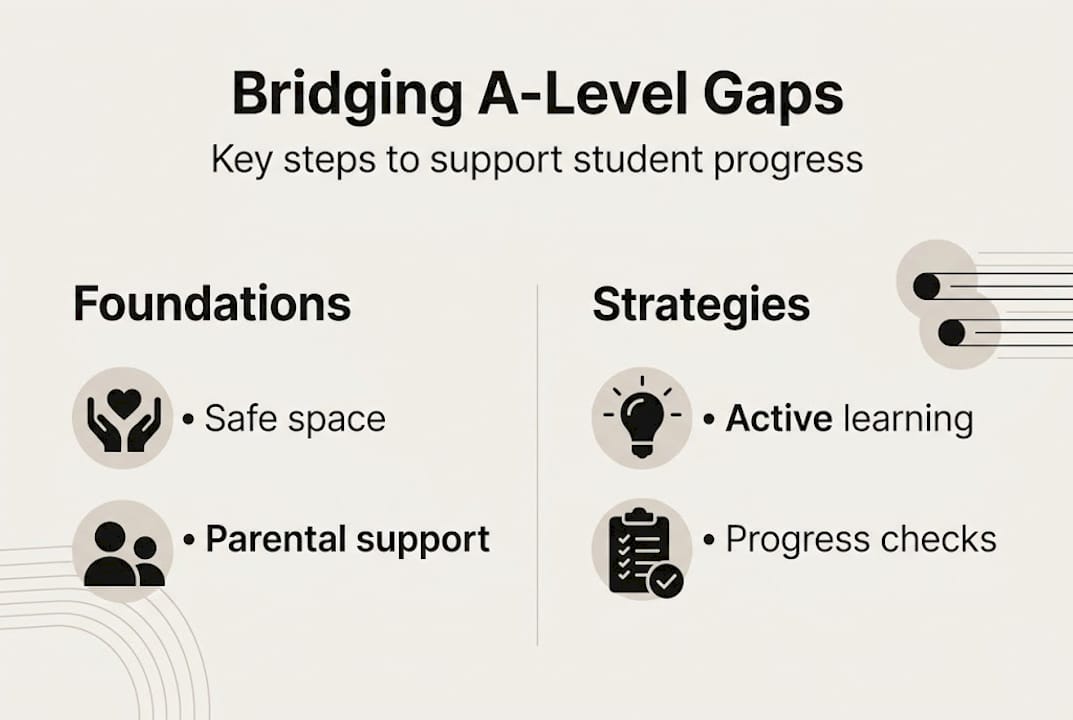
- A quiet, consistent study space with minimal interruptions
- A stable daily or weekly revision routine they can rely on
- Access to quality resources, whether online platforms, textbooks, or past papers
- A genuine sense of motivation and belonging within their school or study group
- Attention to mental health, since anxiety and low self-esteem are major barriers to learning
What parents can do:
| Supportive action | Why it helps |
|---|---|
| Provide a quiet, dedicated study space | Reduces distractions, signals that studying is valued |
| Help establish a weekly routine | Builds consistency and reduces decision fatigue |
| Offer accountability without pressure | Encourages ownership without creating anxiety |
| Ask open questions about progress | Keeps communication open and non-confrontational |
Parental involvement in learning, such as providing a quiet space and supporting routine, is consistently linked to better learning outcomes. This doesn't mean hovering over every revision session. It means making it easier for your teen to show up, settle down, and focus.

Student readiness is equally important. A teenager who feels disconnected from their studies, or who is carrying significant stress, will struggle to benefit from even the most evidence-based approach. Acknowledging that and addressing it first is not a soft consideration. It's a practical one. Exploring affordable educational resources can also help families who are concerned about costs.
Pro Tip: Ask your teen to rate their confidence in each A-Level topic out of ten. It takes five minutes and instantly reveals where to focus without any pressure or judgement.
Step-by-step strategies to bridge educational gaps
With the right foundation in place, you can move on to concrete steps that make a measurable difference.
This is where the real work begins. The good news? The most effective strategies are not expensive or complicated. They are consistent, focused, and grounded in how the brain actually learns.
-
Identify the specific gaps. Don't work from a vague sense that your teen is struggling. Review past papers, look at teacher feedback, and ask your teen directly which topics feel weakest. Specificity matters here.
-
Create a targeted action plan. Once gaps are identified, map out a plan that addresses them one at a time. Trying to fix everything at once leads to overwhelm. Prioritise the topics that appear most frequently in examinations.
-
Schedule short, focused sessions. Research consistently supports shorter, regular revision sessions over long, exhausting marathons. Aim for 25 to 45 minute blocks with clear learning objectives for each session.
-
Implement retrieval practice. Instead of re-reading notes, encourage your teen to actively recall information without looking. Flashcards, practice questions, and self-testing are all forms of retrieval practice. Retrieval practice and minimising distractions are proven to improve outcomes in secondary students.
-
Minimise distractions during study time. Phones off or in another room, notifications silenced, and a clear start and end time for each session. This sounds obvious, but it makes a profound difference to how much information is actually retained.
-
Balance learning approaches. Teacher-led sessions remain the most effective, but pairing them with self-directed study and occasional peer discussion creates a well-rounded approach. Look into effective learning strategies that work across different subjects.
-
Track and celebrate small wins. Progress in gap-bridging can feel slow. Celebrating small improvements, a better quiz score, a topic that now feels clear, keeps motivation alive.
For more on how to apply these approaches practically, active learning for A-Levels and personalised learning approaches offer excellent starting points.
Pro Tip: Encourage your teen to teach a topic back to you in plain language. If they can explain it simply, they understand it. If they can't, that's the gap to focus on next.
Checking progress and staying on track
Following your action steps, it's important to continuously monitor progress and fine-tune your approach.
One of the most common mistakes parents make is treating gap-bridging as a one-off project rather than an ongoing process. You put strategies in place, and then you check, adjust, and keep going.
How to track learning progress effectively:
- Regular low-stakes quizzes or self-tests on recently covered material
- Reviewing marked assessments together and identifying patterns in errors
- Weekly check-ins where your teen rates their own understanding of each topic
- Comparing performance on timed past paper questions over time
- Requesting written feedback from teachers on specific areas of weakness
Signs that a strategy needs adjusting include persistent confusion on the same topics, declining motivation despite consistent effort, and a sense of going through the motions without genuine understanding.
When that happens, the answer isn't to push harder. It's to change approach. Boost your teen's learning workflow with practical tools that help them take ownership of their own progress.
Encouraging student ownership is one of the most powerful things a parent can do. When teenagers feel in charge of their own learning journey, their resilience during setbacks increases significantly. They stop seeing a poor quiz result as failure and start seeing it as information.
"Short weekly sessions with progress tracking and parental accountability, without pressure, consistently outperform intensive cramming approaches."
Setbacks are normal. They are not signs that the strategies aren't working. Acknowledging this with your teen, and framing difficulties as part of the process rather than evidence of inability, matters more than any revision technique.
A fresh perspective on bridging educational gaps
Beyond direct strategies, it helps to adopt a broader view of what really works to close gaps.
Here's something many parents don't expect to hear: the most transformative factor in your teen's academic recovery may not be a tutor, a revision guide, or an extra two hours of study per week. It may be whether they feel they belong.
Research into educational outcomes consistently shows that a student's sense of connection, to their school, their peers, and their own identity as a learner, is a powerful predictor of whether gap-bridging strategies actually stick. A teenager who feels like an outsider in their academic environment will struggle to engage, regardless of the resources around them.
There's also a quiet danger in over-scheduling. Parents who are rightly concerned about their child's progress sometimes respond by filling every spare hour with revision, tutoring sessions, and structured activities. This can backfire. Teenagers need processing time, rest, and space to consolidate what they've learnt.
Consider too whether online resources can genuinely close gaps in a way that feels accessible and engaging rather than overwhelming. The best interventions are those your teen will actually use consistently, not the most expensive or intensive ones available.
Support your teen's sense of belonging. Keep the home environment warm, not pressured. And trust that small, steady improvements, compounded over weeks and months, will add up to something significant.
How our solutions support your gap-bridging journey
If you're ready for extra support, the right digital companion can make bridging gaps easier and more affordable.
Everything we've covered in this guide, from retrieval practice to progress tracking to personalised support, is built into what IntuitionX offers as an AI tutor. Our Socratic approach means your teen isn't just given answers. They're guided to think through problems themselves, which builds genuine understanding rather than surface-level familiarity.

Backed by Sir Anthony Seldon, one of Britain's most respected educationalists, and designed on Oxbridge-level pedagogical principles, IntuitionX is available 24/7 at a fraction of the cost of private tutoring. Explore what IntuitionX can do for your teen's A-Level journey today. Affordable, evidence-based, and built to genuinely close gaps.
Frequently asked questions
What are the first steps for parents to identify learning gaps?
Start by reviewing recent assessments with your teen, discussing which topics feel unclear, and asking their teachers for feedback. This gives you a specific, honest starting point rather than a vague sense of concern.
Does expensive tutoring guarantee gap closure?
No. Routine, focused sessions and supportive home routines consistently outperform high-cost tutoring when it comes to sustained improvement.
How soon can improvements be seen after starting these strategies?
Many A-Level students show noticeable improvement within a few weeks, particularly when retrieval practice and distraction minimisation are applied consistently. Short-term interventions have been shown to produce measurable exam score gains.
Are digital AI tutors effective for bridging gaps?
Yes, well-designed digital AI tutors provide personalised support, practice opportunities, and progress tracking that complement home-based revision strategies effectively.
What role should parents play in daily learning?
Parents should focus on structure, a quiet environment, and accountability without pressure. Micromanaging or adding stress tends to reduce motivation rather than improve it.