
TL;DR:
- Student engagement has four dimensions: behavioral, cognitive, emotional, and agentic.
- Deep engagement significantly improves academic success and wellbeing but can be hidden or misunderstood.
- Supporting genuine engagement involves fostering autonomy, belonging, meaningful purpose, and using personalized digital tools.
Students who feel genuinely engaged in learning are more likely to excel academically and report better wellbeing, yet many parents misread what real engagement actually looks like. You might assume a quiet teen who rarely raises their hand is switched off. Or that the child glued to a YouTube revision video is learning deeply. Neither is necessarily true. Engagement is far more layered than we typically give it credit for, and understanding it properly could be the single most impactful thing you do to support your teenager's education right now.
Table of Contents
- What does engagement in education really mean?
- How engagement drives academic achievement and wellbeing
- The hidden barriers to student engagement
- Effective ways parents and schools can foster authentic engagement
- Our perspective: Why engagement is necessary but not a cure-all
- Unlock greater engagement with smart digital tools
- Frequently asked questions
Key Takeaways
| Point | Details |
|---|---|
| Engagement is multidimensional | True engagement comes in behavioural, emotional, cognitive, and agentic forms, each playing a unique role. |
| Boosts performance and wellbeing | Engaged students have higher grades and healthier mindsets, making engagement vital for academic and personal success. |
| Barriers can be subtle | Loss of belonging, anxiety, or forced participation can quietly undermine student engagement, regardless of ability. |
| Support matters most | Teacher encouragement, autonomy, and family support fuel genuine motivation and learning. |
| No one-size-fits-all | Tailoring engagement strategies to each student's needs ensures that all learners can thrive. |
What does engagement in education really mean?
Most parents, understandably, judge engagement by what they can see. Is your teen paying attention in class? Are they completing their homework? Are they asking questions? These are all reasonable signals, but they only scratch the surface of what educational engagement explained by researchers actually involves.
Engagement in education is widely understood to have four distinct dimensions. Researchers confirm that student engagement has behavioural, cognitive, emotional, and agentic components, each of which plays a different role in how a student learns and thrives.
Here is what each dimension actually means in practice:
- Behavioural engagement: Attending class, completing tasks, following rules. The most visible form, but not always the deepest.
- Cognitive engagement: Putting in mental effort, using strategies, thinking critically about material. Often invisible from the outside.
- Emotional engagement: Feeling a sense of belonging, interest, or enthusiasm. A student who enjoys learning will persist when it gets tough.
- Agentic engagement: Actively contributing to and shaping one's own learning experience, asking for resources, seeking challenges, driving the process.
| Type of engagement | Visible to others? | Linked to deep learning? | Boosts wellbeing? |
|---|---|---|---|
| Behavioural | Yes | Partially | Partially |
| Cognitive | Rarely | Strongly | Moderately |
| Emotional | Sometimes | Moderately | Strongly |
| Agentic | Sometimes | Very strongly | Strongly |
"A student who sits quietly but is mentally wrestling with a complex idea is far more engaged than one who volunteers answers without really thinking them through."
This distinction matters enormously. A student who appears attentive might be going through the motions. A student who seems reluctant to speak up in class might be processing information deeply and productively. When you understand the four dimensions, you start looking for different signals entirely.
How engagement drives academic achievement and wellbeing
Now that the different forms of engagement are clear, let us examine why it makes such a noticeable difference for students.
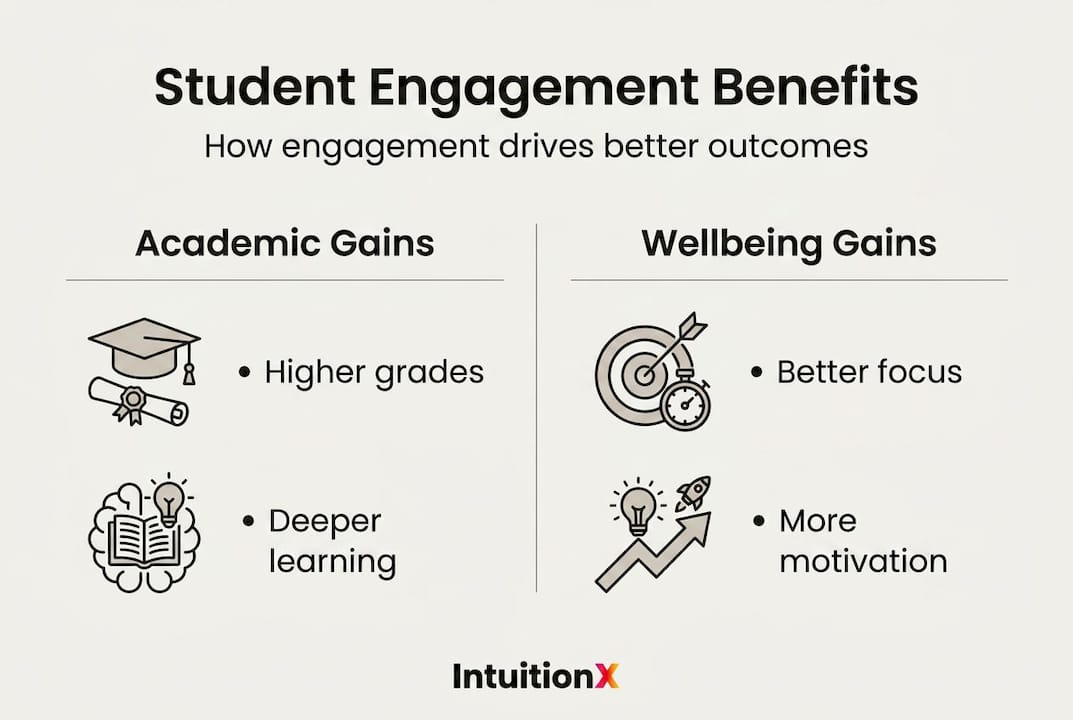
The evidence here is striking. A meta-analysis of 652 effect sizes from 62 studies confirmed that student engagement significantly improves academic performance, psychological wellbeing, and reduces the risk of dropping out. This is not a minor effect. It is one of the strongest predictors of student success that researchers have identified.
What drives engagement in the first place? A systematic review of 13 studies found that teacher support, psychological needs such as autonomy, competence, and relatedness, and positive peer relationships are among the most powerful factors. This means the classroom environment, the relationships your teen builds at school, and the degree of independence they feel all shape how engaged they are day to day.
The measurable impact of engagement on student outcomes:
- Higher academic grades. Engaged students consistently outperform their peers because they invest cognitive effort rather than passive attendance.
- Greater resilience. When students feel emotionally connected to their learning, they are more likely to push through challenges rather than give up.
- Stronger mental health. Engagement correlates with reduced anxiety and higher self-esteem, particularly when students feel a sense of belonging.
- Better social skills. Peer relationships that support engagement also build communication and collaboration abilities.
- Lower dropout risk. Students who feel connected to their school community are significantly less likely to disengage entirely.
Explore effective learning strategies that can further reinforce these outcomes at home. You might also find it useful to review a practical learning workflow guide to see how structure and habit support engaged learning over time.
The key insight for parents? Engagement is not a luxury or a nice-to-have. It is directly tied to the outcomes you care most about. And it can be actively cultivated.
The hidden barriers to student engagement
While the benefits are clear, many students and parents encounter barriers that can undermine even well-designed engagement efforts. And some of these barriers are far less obvious than you might expect.

It is tempting to assume a disengaged student is lazy, unmotivated, or simply not interested. But research tells a more complicated story. According to recent findings, engagement often declines before academic performance drops, and the root cause is frequently a sense of not belonging, not a lack of ability or effort.
This is sometimes called the "belonging gap." When students feel like outsiders in their school community, whether because of cultural background, learning differences, social anxiety, or just not fitting in with classroom norms, they begin to withdraw emotionally long before the grades fall. By the time the academic warning signs appear, the disengagement has been building for months.
Common barriers to genuine engagement include:
- Social anxiety: 91% of US students report feeling nervous about asking questions in class. That anxiety silences curiosity and shuts down agentic engagement.
- Boredom: 80% of US students describe feeling bored at school. Boredom is not laziness. It is a signal that learning is not connecting.
- Belonging issues: Feeling different, excluded, or misunderstood, especially for neurodiverse or introverted students.
- Mismatched expectations: Teachers and parents rewarding visible participation whilst penalising quiet but deep engagement.
- Over-reliance on generic tools: Generic AI that writes essays for students bypasses learning entirely and creates the illusion of progress.
"Forcing participation on a student who feels anxious or out of place does not boost engagement. It deepens avoidance."
This point, supported by research on engagement misconceptions, is crucial. Active participation is not always deep learning, and in some cases, pressuring quieter or neurodiverse students to perform engagement can actively backfire.
Pro Tip: If your teen seems disengaged, resist the instinct to immediately push harder. Instead, ask open questions about how they feel in the classroom, who they connect with, and whether they feel they belong. The answers will often reveal the real barrier.
Addressing equity in engagement is also critical. Students from less privileged backgrounds face additional structural barriers, from underfunded schools to a lack of personalised support, that compound the engagement problem. And while AI tools for learning can help bridge some of these gaps, the quality of those tools matters enormously.
Effective ways parents and schools can foster authentic engagement
Given these hidden challenges, what can parents and schools do to ensure engagement is both genuine and sustainable?
The good news is that meaningful change is possible, and you do not need to overhaul your teen's entire school life to make a difference. Research shows that teacher support and self-efficacy are key drivers of student engagement, and methods like flipped learning and feedback-rich environments can be highly effective when they keep students at the centre.
Equally important, as psychologists studying learning have noted, is that purpose, meaning, and self-control matter far more than flashy methods or constant entertainment. A student who understands why they are learning something is significantly more motivated than one who is simply entertained by it.
Here is a practical roadmap for parents:
- Build autonomy at home. Let your teen have a say in how and when they study. Self-direction is one of the most powerful drivers of agentic engagement.
- Prioritise belonging conversations. Ask regularly about friendships, classroom dynamics, and how your teen feels in different subjects. Emotional engagement often starts there.
- Focus on progress, not performance. Celebrate effort, curiosity, and improvement. Students who feel competent are more willing to take intellectual risks.
- Create space for curiosity. Encourage questions, discussions, and debates at home. Make it normal to not know the answer and to want to find it.
- Communicate with teachers. Ask how your teen is engaging cognitively and emotionally, not just whether they are completing work.
- Use feedback actively. Help your teen see feedback as information, not judgment. Feedback-rich environments are consistently linked to deeper engagement.
Pro Tip: Try asking your teen, "What was the most interesting thing you thought about today?" rather than "What did you learn?" The phrasing shifts the focus from output to curiosity, which is the real driver of cognitive engagement.
For introverted or neurodiverse learners, adapt these strategies rather than forcing a one-size-fits-all approach. Explore personalised learning strategies and active learning strategies that are designed to meet students where they are, not where we expect them to be.
Our perspective: Why engagement is necessary but not a cure-all
With effective strategies clarified, it is important to acknowledge where engagement has its limits, and what a truly informed approach looks like.
We believe engagement is one of the most important factors in student success. But we also think the conversation around it is often too simplistic. Here is the uncomfortable truth: visible engagement can be deceptive. Research confirms that active participation does not guarantee deep learning and can even disadvantage students who engage differently.
At IntuitionX, we work with students who have been labelled disengaged by their schools but who, given the right environment, demonstrate extraordinary cognitive and agentic engagement. The student who quietly works through a problem, revises their thinking, and seeks out additional resources is engaged in every way that matters. They just do not fit the visible participation model that many classrooms reward.
We are also cautious about the trend of using entertainment as a proxy for engagement. Gamified apps, flashy content, and passive video watching can feel engaging but often bypass the kind of effortful thinking that leads to real learning. Our approach, built on Socratic questioning and the pedagogical methods of Oxbridge educators, is designed specifically to make students think, not just feel stimulated.
We believe every student deserves the kind of education that recognises how they engage individually. That means respecting the quiet thinker, the divergent learner, and the student who finds meaning in exploring ideas rather than performing understanding. Technology, used thoughtfully, can help. Explore how empowering student learning through conversational AI can personalise that experience in ways a standard classroom simply cannot.
Engagement is not a destination. It is an ongoing relationship between a student and their learning. Your role as a parent is to protect and nurture that relationship, even when it does not look the way you expected.
Unlock greater engagement with smart digital tools
For those ready to support sustained student engagement using proven technology, there are practical next steps you can take today.
IntuitionX is a 24/7 Socratic AI tutor built on Oxbridge-level expertise, designed to foster the kind of genuine, deep engagement that translates into real academic progress and lasting confidence. Unlike generic AI tools that write essays and bypass learning, IntuitionX asks the right questions, adapts to each student, and builds the habits that matter.
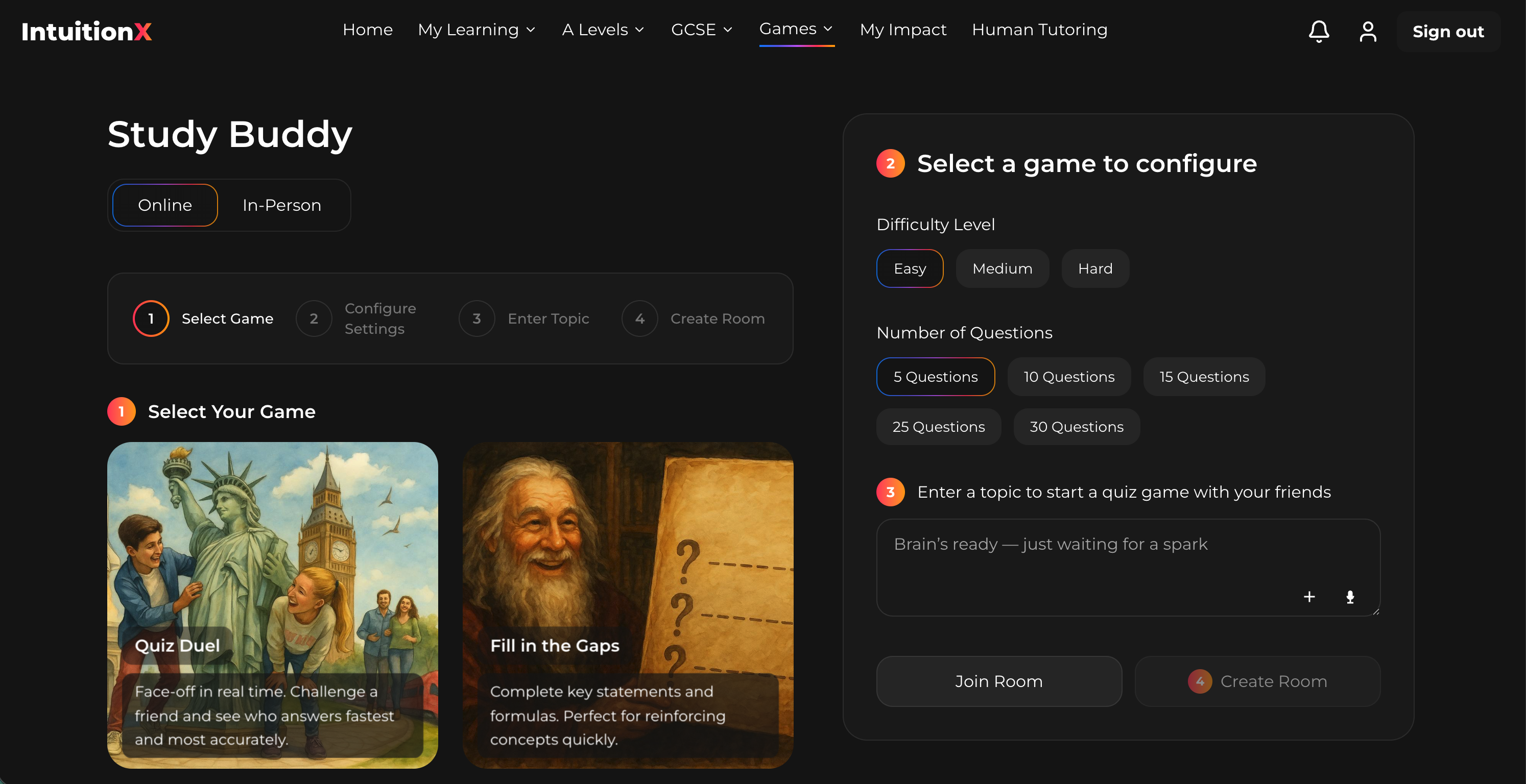
Backed by Sir Anthony Seldon, one of Britain's most respected educationalists, and committed to funding education in crisis regions through our partnership with the International Rescue Committee, we are here for every learner. Whether your teen is bored, anxious, or simply not reaching their potential, IntuitionX offers a smarter, more personal path forward. Start the journey today.
Frequently asked questions
How can you spot genuine engagement in your teen beyond class participation?
Look for signs like setting personal learning goals, reflecting on feedback, or showing curiosity outside the classroom. Genuine engagement spans behavioural, cognitive, emotional, and agentic dimensions, all of which extend well beyond visible classroom participation.
Why might a high-performing student appear disengaged?
Some high achievers process deeply in quiet ways or prefer independent learning, meaning their engagement is internal rather than visible. Research confirms that active participation is not always a reliable indicator of deep learning or genuine understanding.
Do digital tools actually improve student engagement and learning?
Digital tools can enhance engagement meaningfully if they encourage autonomy, rich feedback, and genuine curiosity rather than passive screen time. Feedback-rich, student-centred learning approaches are consistently the most effective when used well.
What should parents do if their child disengages despite support?
Begin by exploring underlying causes such as social belonging or unseen stressors, then work with teachers to tailor support to your teen's specific needs. Engagement often declines before academic performance does, so catching the emotional signs early makes a real difference.
Is constant excitement or fun needed to keep teens engaged?
No. Helping teens find purpose in their learning and develop self-control is far more effective than relying on novelty or entertainment. Purpose and meaning consistently outperform flashy, stimulation-based approaches when it comes to lasting engagement and retention.