

TL;DR:
- Genuine learning engagement involves behavioral, cognitive, and emotional dimensions working together.
- Active teaching methods backed by research improve short-term engagement but may have limited long-term retention.
- Personalised, adaptive AI tutoring helps bridge engagement gaps by aligning with individual interests and learning needs.
You've sat through every lecture. You've highlighted your notes. You've even joined the group chat. But when the exam arrives, it feels like the knowledge simply isn't there. Sound familiar? Here's the uncomfortable truth: being present and being engaged are two very different things. In fact, research suggests that some of the most "active" classroom experiences can create a false sense of mastery, leaving students more confident but no better prepared. This guide cuts through the confusion, explains what genuine learning engagement actually looks like, and gives you practical, evidence-backed strategies to make every study session count.
Table of Contents
- Defining learning engagement: dimensions and misconceptions
- Active learning methodologies: evidence and practical approaches
- Short-term engagement vs. long-term retention: the balancing act
- Personalising engagement: UK vs. US educational context
- What most guides miss about learning engagement
- Transform your academic results with innovative tutoring
- Frequently asked questions
Key Takeaways
| Point | Details |
|---|---|
| Engagement is multidimensional | True learning engagement combines behaviour, cognition, and emotion—not just participation alone. |
| Active learning boosts performance | Evidence shows collaborative methods and AI tutoring significantly improve engagement and marks. |
| Retention balance matters | Short-term engagement may fade; traditional lectures sometimes support longer-term retention. |
| Personalised strategies outperform | Tailored approaches suit different student needs in both UK and US settings. |
Defining learning engagement: dimensions and misconceptions
Now that we've set the stage, let's unpack exactly what learning engagement means and why it's more nuanced than it appears.
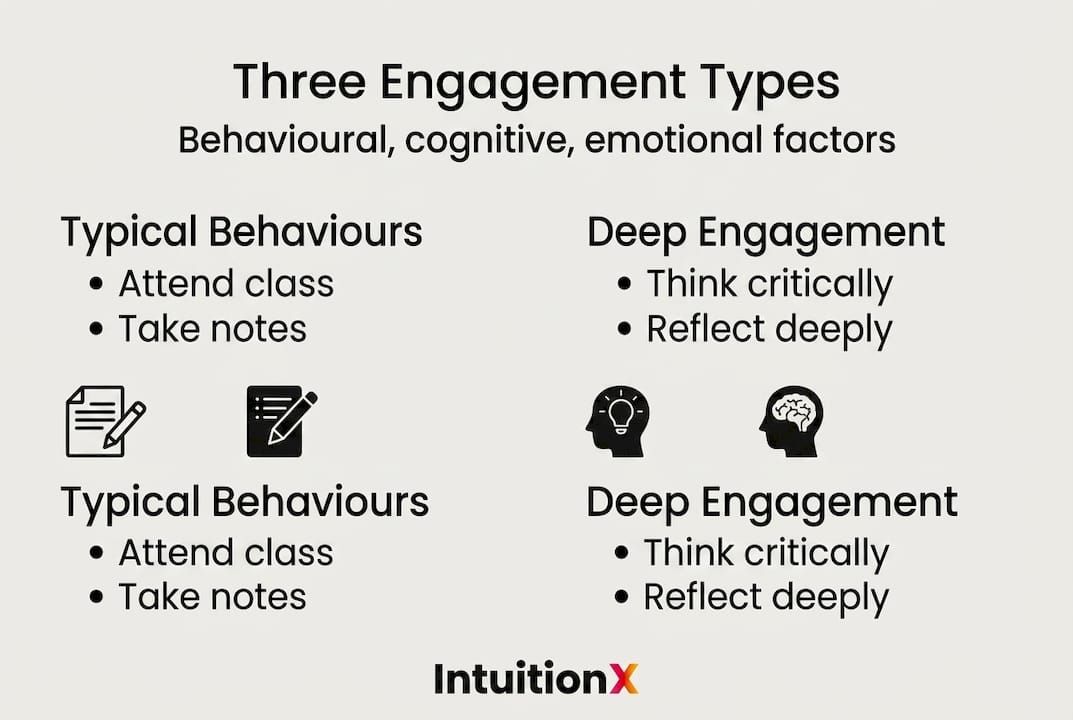
Most students think engagement simply means paying attention or putting your hand up. It's far more layered than that. Researchers describe three intertwined dimensions: behavioural (your observable actions, like attending class and completing tasks), cognitive (the depth of your thinking, including self-regulation and metacognition), and emotional (how you feel about learning, whether curious, valued, or motivated). All three need to be firing for real learning to happen.
Here's how the three dimensions compare in practice:
| Dimension | What it looks like | What it is not |
|---|---|---|
| Behavioural | Completing tasks, attending sessions, taking notes | Copying without thinking |
| Cognitive | Questioning assumptions, making connections | Rereading passively |
| Emotional | Feeling curious, valuing the subject | Performing enthusiasm |
The problem is that most students focus almost entirely on behavioural engagement. They show up, they participate, they look engaged. But cognitive and emotional engagement are what actually move the needle on performance.
One of the most important misconceptions to challenge is the idea that participation equals understanding. It does not. You can discuss a topic confidently in a seminar and still fail to retrieve that knowledge a week later. This is what psychologists call the illusion of learning: the feeling of confidence that comes from familiarity, not from genuine mastery. It's dangerously easy to mistake fluency in a discussion for the ability to apply knowledge independently.
Common misconceptions students hold about engagement:
- "If I enjoy the lesson, I'm engaged." Enjoyment is part of emotional engagement, but without cognitive depth, it doesn't translate to retention.
- "Active participation means I'm learning." Speaking in class activates behavioural engagement but not necessarily cognitive processing.
- "If I feel confident after a revision session, I've learned it." Confidence after re-reading or passive review is one of the least reliable indicators of mastery.
"Engagement can create an illusion of learning, where confidence is mistaken for mastery. Prioritising meaning and purpose over mere participation is what separates surface-level activity from genuine understanding."
To boost learning engagement that actually sticks, you need all three dimensions working together. That means not just showing up, but actively questioning, connecting ideas, and finding genuine reasons to care about what you're learning.
Active learning methodologies: evidence and practical approaches
With definitions clarified, let's explore the practical side and how evidence-based methods drive real learning engagement.
The shift away from passive note-taking towards active methodologies is not just a trend. It's backed by solid empirical research. Active methodologies boost immediate engagement and performance with an overall effect size of d=0.50, which is considered a moderate to strong educational impact. More strikingly, AI tutoring yields an effect size of 0.63 to 1.3 standard deviations better than in-class active learning, with consistently higher engagement ratings from students.

Here's a breakdown of the most widely used methods and their measured impact:
| Method | Key benefit | Effect on engagement |
|---|---|---|
| Collaborative group work | Peer accountability and dialogue | Moderate, behavioural and emotional |
| Flipped classroom | Pre-learning frees class time for application | High, cognitive |
| Project-based learning | Real-world relevance builds intrinsic motivation | High, all three dimensions |
| Gamification | Immediate feedback loops and reward | High short-term, variable long-term |
| AI tutoring | Adaptive, personalised, and available 24/7 | Very high across all dimensions |
Here's how to apply these methods in practice:
- Use the flipped classroom model. Watch or read new material before a session, so you arrive ready to apply and question rather than just receive. This shifts you from passive recipient to active thinker.
- Build project-based challenges into your revision. Instead of rewriting notes, challenge yourself to create something: a short essay, a lesson plan for a topic, or a diagram that explains a concept to someone else.
- Leverage AI tutoring for adaptive feedback. Unlike generic revision tools, a well-designed AI tutor asks you Socratic questions, identifies gaps in your understanding, and responds to your specific needs rather than delivering a one-size-fits-all explanation.
- Use gamification carefully. Apps and quizzes are great for motivation, but pair them with deeper reflection to avoid surface-level engagement.
- Practise retrieval, not review. Closing your notes and testing yourself on what you know is consistently one of the most powerful active learning strategies available.
Pro Tip: Don't rely on just one method. The most effective students blend strategies, using retrieval practice for memorisation, project-based work for conceptual understanding, and AI tutoring for immediate, personalised feedback. Explore effective learning strategies across different subjects to find combinations that work best for you.
The evidence is clear: passive learning is the least efficient use of your study time. But here's where it gets interesting. Not all active methods work equally well for all students or all subjects. Understanding that nuance is critical.
Short-term engagement vs. long-term retention: the balancing act
Active methods are powerful, but what happens when the excitement fades? Here's what the research tells us about engagement over time.
This is where things get genuinely surprising. While active methodologies reliably improve immediate engagement and short-term performance, active methods may actually underperform traditional lectures in long-term retention, with control groups sometimes outperforming active learning participants after just one month. That's a finding most engagement guides simply do not mention.
Why does this happen? A few reasons:
- Cognitive overload. Highly interactive sessions demand a lot of mental effort. When attention is split between the activity and the content, deep encoding can suffer.
- Novelty wearing off. The motivational boost from gamification or group activities fades over time. Without intrinsic motivation, retention drops.
- Low-interest students disengage differently. Research shows that students with low prior interest in a subject actually benefit more from structured, non-interactive teaching for long-term retention. The interactive format can feel overwhelming or distracting rather than empowering.
Key insight: Engagement in the moment does not guarantee knowledge that lasts. The goal is not just to feel engaged; it's to encode information deeply enough to retrieve it weeks or months later.
So who benefits most from each approach?
- High-interest students tend to thrive with active, collaborative, and project-based methods, as intrinsic motivation sustains the effort required.
- Low-interest or anxious students often perform better with clearer structure, well-organised explanations, and guided practice before open-ended tasks.
- Students studying highly technical subjects (like mathematics or sciences) may need more traditional worked examples before active problem-solving becomes productive.
The National Survey of Student Engagement (NSSE) uses specific Engagement Indicators including Higher-Order Learning, Reflective and Integrative Learning, and Collaborative Learning to measure these outcomes across institutions. These benchmarks reveal a consistent pattern: the most engaged students use a mix of strategies rather than relying on one approach.
Pro Tip: Match your engagement strategy to the subject and your level of existing interest. For subjects you find difficult or dull, start with structured revision and worked examples before shifting to active recall or group discussions. This builds the cognitive scaffolding needed for active methods to actually work.
Personalising engagement: UK vs. US educational context
With long-term outcomes in mind, let's see how engagement tactics adapt depending on educational context, whether in the UK or US, and what makes a tutoring solution truly effective.
The UK and US education systems look very different on the surface. In the UK, A-Level and GCSE students specialise early, studying three or four subjects in significant depth. In the US, the breadth model means students carry a heavier and more varied academic load, with extracurricular activities often factored into university applications. Yet despite these structural differences, both systems face similar disengagement issues, with students across both countries reporting boredom, anxiety about asking questions, and a sense that school does not feel relevant to their lives.
In the UK:
- Depth and specialisation create pressure to achieve mastery in fewer subjects. Disengagement here often looks like passive memorisation for high-stakes exams rather than genuine understanding.
- Students frequently report anxiety about asking questions in class, limiting the emotional and cognitive dimensions of engagement.
- The tutorial and seminar model at university level can support deeper engagement, but only if students arrive prepared.
In the US:
- Breadth and extracurricular pressure mean students are often stretched thin. Engagement suffers when students are managing too many competing demands.
- Research consistently shows 80% of US students feel bored in class, with 91% nervous about asking questions publicly.
- The compliance-focused classroom model, where engagement means sitting quietly and following instructions, runs directly counter to what the evidence says actually works.
Both contexts point to the same solution: student-centred, adaptive tutoring that prioritises personalisation over one-size-fits-all instruction. The AI tutoring process is uniquely positioned to bridge this gap because it responds to the individual student rather than the average of a class.
Practical ways to personalise your engagement:
- Identify whether you learn best through dialogue, worked examples, or independent exploration. Then seek out resources that match your preferred mode.
- If you're a UK student focused on A-Level depth, use adaptive AI tools that can go deep on a specific topic rather than broad revision apps.
- If you're a US student juggling multiple subjects, prioritise retrieval-focused strategies that consolidate knowledge efficiently across your workload.
- Don't wait for your teacher to personalise learning for you. Personalised education is something you can actively pursue through the tools and strategies you choose.
The key insight here is that engagement is not a fixed state. It shifts depending on your interest level, the subject, the format, and the teaching approach. A truly effective tutoring solution recognises and adapts to all of these variables in real time.
What most guides miss about learning engagement
That brings us to the big picture: what really counts as engagement and what does everyone get wrong?
Most guides treat engagement as a method problem. Use the right technique, follow the right steps, and engagement will follow. But that framing misses something fundamental. Engagement is ultimately a meaning problem. Students who feel genuine purpose in what they're learning, whether because it connects to their goals, their identity, or their curiosity, consistently outperform those who are simply following engagement strategies by rote.
The illusion of learning is the real danger here. Feeling busy, feeling active, feeling confident in a group discussion; none of these guarantee that deep cognitive work is happening. Without adaptive feedback, you can stay in that comfortable illusion for months without realising it. That's why smarter tutoring with AI matters so much: it interrupts that illusion, challenges your assumptions, and forces the kind of productive struggle that actually builds mastery.
Genuine engagement demands that you ask hard questions, sit with uncertainty, and be willing to find out what you don't yet know. That's uncomfortable. But it's also where real learning lives.
Transform your academic results with innovative tutoring
Ready to apply these engagement strategies in your studies? Discover how specialised AI tutoring can help.
If you've recognised yourself in any of this, whether it's the illusion of confidence, the struggle to engage across multiple subjects, or simply the frustration of feeling like your study time isn't translating into results, you're not alone. The gap between effort and outcome is exactly what IntuitionX was built to close.
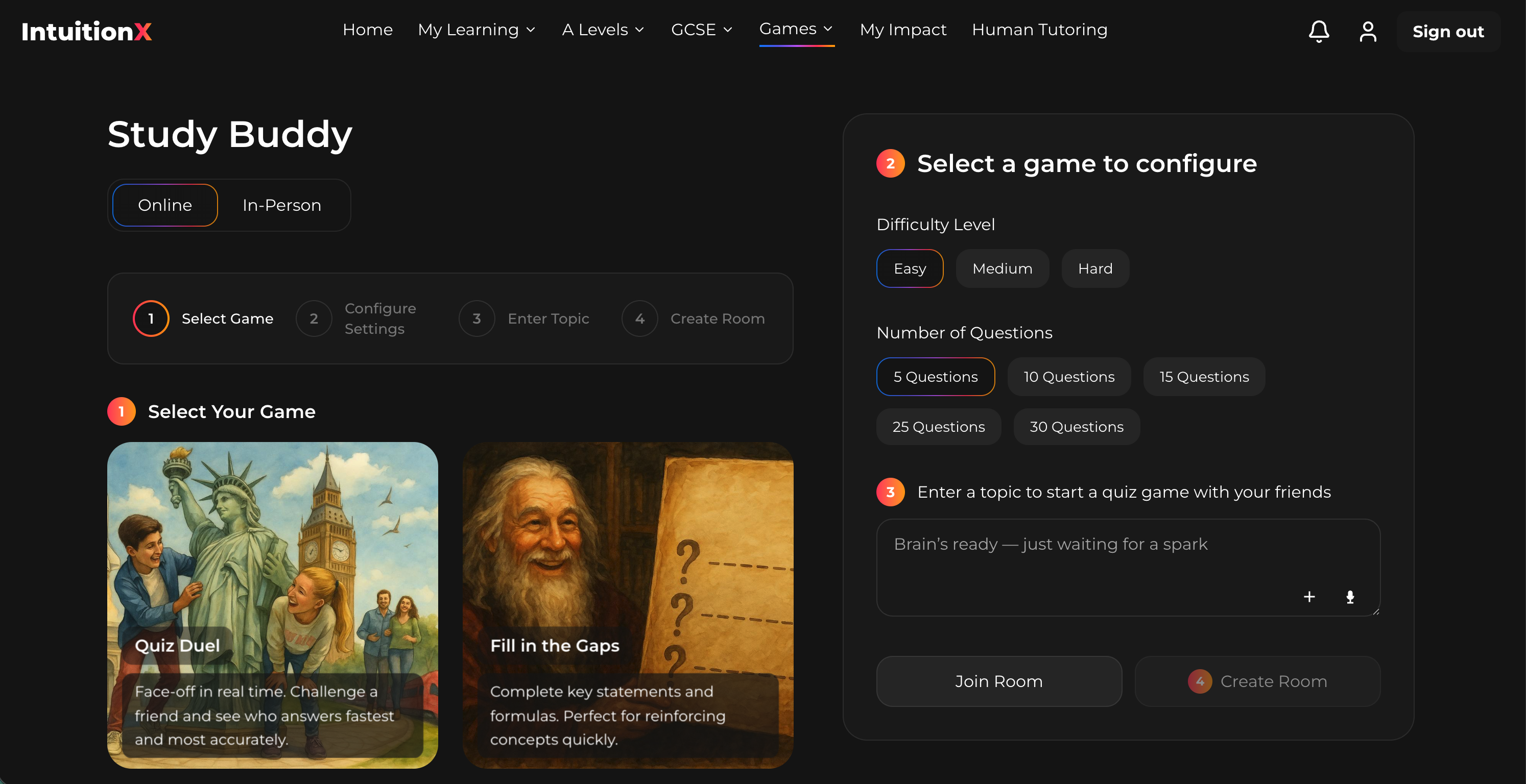
IntuitionX AI tutor combines Oxbridge-level academic rigour with the Socratic questioning and personalised pedagogy that elite private tutors use, and makes it available to every student, 24 hours a day. Built on the insights of academics who earned A*s and Firsts from Oxford and Cambridge, IntuitionX doesn't just answer questions. It teaches you how to think, challenges your assumptions, and adapts to your unique learning needs. Whether you're preparing for GCSEs, A-Levels, or university assessments, this is the thinking partner that keeps you genuinely engaged and genuinely learning.
Frequently asked questions
How can I tell if I am truly engaged in learning?
True engagement spans all three intertwined dimensions: behavioural, cognitive, and emotional. If you're only showing up and participating without actively thinking deeply or feeling a connection to the material, you may be engaged on the surface but not where it counts.
Which engagement strategies work best for GCSE and A-Level students?
Active learning methods such as retrieval practice, project-based tasks, and AI tutoring consistently show the strongest results. Active methodologies boost engagement and performance with meaningful effect sizes, making them far more effective than passive revision for most subjects at this level.
Does higher engagement always mean better test scores?
Not always. While engagement generally supports performance, active methods may underperform traditional lectures for long-term retention, particularly for students with lower prior interest in a subject. The best approach blends strategies to support both short-term engagement and lasting retention.
How is engagement measured in UK and US education?
Institutions often use validated frameworks such as the National Survey of Student Engagement, which includes Engagement Indicators like Higher-Order Learning and Collaborative Learning. These benchmarks allow meaningful comparisons across different institutions and educational systems.