

TL;DR:
- Research shows that strategic questioning enhances learning outcomes across subjects, especially in humanities. Asking well-formed, interpretive, and evaluative questions promotes deep understanding, critical thinking, and long-term retention. Developing reflective questioning habits and utilizing AI tutors like IntuitionX can foster genuine curiosity, self-regulation, and academic growth.
Most students think asking questions signals weakness. That they don't know enough. That it's better to stay quiet and figure it out later. But here's what the research actually shows: strategic questioning improves learning outcomes measurably, consistently, and across subjects. Questioning isn't a sign that you're behind. It's proof that your brain is doing exactly what it should. For students in the humanities especially, the ability to ask the right question at the right moment can be the difference between surface-level recall and genuinely transformative understanding.
Table of Contents
- Why questioning is essential for deep learning
- How question-asking develops and impacts learning outcomes
- Strategic questioning for motivation and self-regulation
- Questioning in the humanities: compelling questions and classroom practice
- When questioning works and when it might not
- Our perspective: What most learners and parents miss about questioning
- Enhance learning with AI-powered questioning support
- Frequently asked questions
Key Takeaways
| Point | Details |
|---|---|
| Strategic questioning boosts achievement | Students who use well-crafted questions perform better, especially in complex, open-ended tasks. |
| Quality of questions matters | Refined, domain-specific questions drive deeper understanding more than simple or high-volume questioning. |
| Self-regulation is enhanced | Questioning supports motivation and strategic planning, fostering resilient and independent learners. |
| Fit questioning to context | The benefits of questioning depend on task type—open-ended work is best supported, not all test formats. |
Why questioning is essential for deep learning
Think about the last time you truly understood something. Not just memorised it, but actually got it. Chances are, a question was involved. Either you asked one, or someone posed one that made you stop and think differently.
Strategic questioning improves learning outcomes and can even be used as a direct educational intervention. That's a significant finding. It means question-asking isn't just a nice habit; it's an active tool you can use to learn better right now.
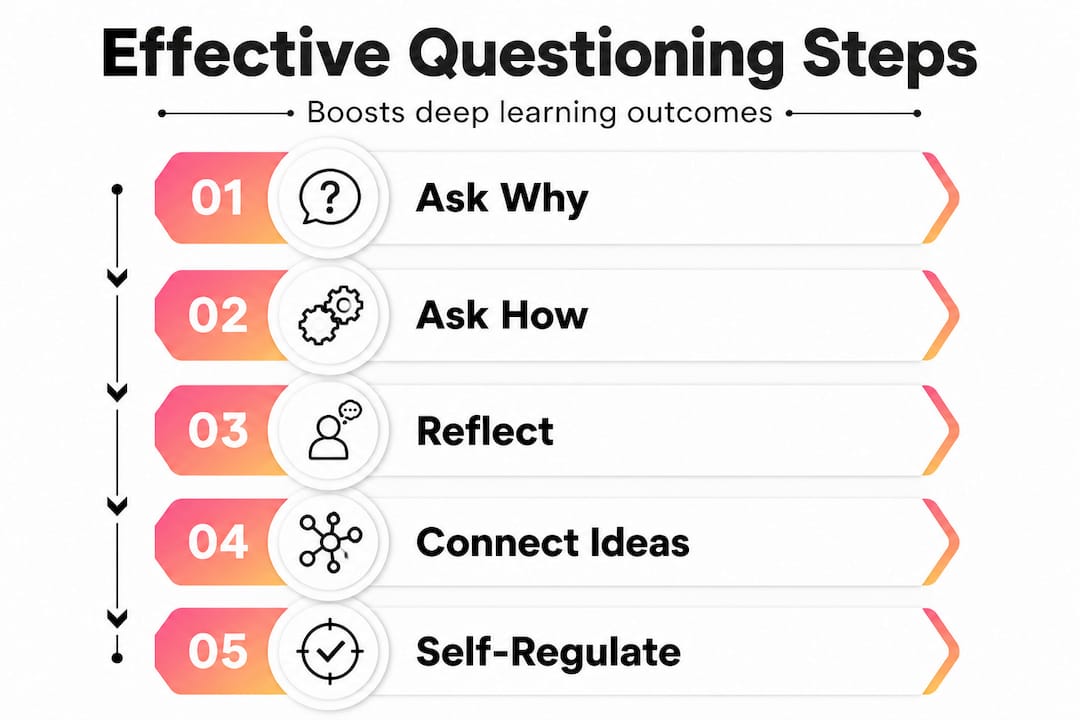
One of the most powerful mechanisms behind this is metacognition, which simply means thinking about your own thinking. When you ask yourself "do I actually understand this, or am I just recognising familiar words?", you're engaging in metacognition. Questioning forces that process. It makes you step back, evaluate your own knowledge gaps, and identify exactly where understanding breaks down.
Research also links the importance of student engagement to better long-term retention and academic performance. Questioning is one of the most direct routes to genuine engagement.
Here are some of the key benefits that come from making strategic questioning a habit:
- Clarifying misunderstandings before they become entrenched
- Promoting curiosity and genuine interest in the subject matter
- Improving retention by connecting new information to existing knowledge
- Supporting self-regulation, meaning you manage your own learning more effectively
- Building confidence to tackle unfamiliar or complex problems
"Strategic questioning is not just a study technique. It's a thinking habit that transforms how students relate to knowledge itself."
The cognitive payoff is real. When you ask questions, you create mental hooks that new information can attach to. That's what separates students who cram and forget from those who understand and remember.
How question-asking develops and impacts learning outcomes
Question-asking isn't a fixed skill. It evolves. The more content knowledge you build in a subject, the more sophisticated and targeted your questions become. A Year 9 student studying the causes of the First World War might ask "who started it?" A student who has studied the period deeply might ask "to what extent did alliance systems make escalation structurally inevitable?" That second question doesn't just show more knowledge. It shows a fundamentally different relationship with the material.
This matters enormously for understanding learning outcomes in humanities subjects, where assessment frequently rewards analysis, argument, and interpretation rather than simple recall.
Domain-specific question-asking predicts performance on open-ended learning tasks more reliably than on closed, multiple-choice assessments. In other words, if you're preparing for essays, debates, or extended projects, building your questioning skills is directly tied to your results.
The table below illustrates how question quality relates to different types of assessment:
| Question type | Assessment type | Likely impact |
|---|---|---|
| Factual recall ("what happened?") | Multiple-choice | Moderate alignment |
| Interpretive ("why did this happen?") | Short-answer essays | Strong alignment |
| Analytical ("how do these factors interact?") | Extended essays | Very strong alignment |
| Evaluative ("which argument is most convincing?") | Coursework/projects | Strongest alignment |
The pattern is clear. The more complex and domain-specific your questions, the stronger your performance on the kinds of open-ended tasks that define humanities assessment.
Pro Tip: Build a "question ladder" for each topic you study. Start with factual questions at the base ("what?"), move to interpretive questions in the middle ("why?" and "how?"), and aim for evaluative questions at the top ("to what extent?" and "which argument holds up best?"). This scaffolded approach, which you can explore further through effective learning strategies, helps you develop richer thinking progressively rather than jumping straight to conclusions.
Here's how to build that progression step by step:
- Start with comprehension questions to confirm you understand the basic facts and events.
- Move to explanatory questions that ask for causes, reasons, and relationships.
- Shift to interpretive questions that invite multiple perspectives and evidence.
- Reach for evaluative questions that require you to weigh arguments and reach a reasoned position.
- Reflect on your reasoning by asking what evidence would challenge your current view.
Each rung of the ladder builds on the last. Skip steps and your thinking becomes shaky. Work through them and your arguments become genuinely robust.
Strategic questioning for motivation and self-regulation
Here's something that surprises a lot of students and parents: questioning doesn't just improve what you know. It changes how you feel about learning. And that emotional dimension matters far more than most people realise.

Strategic questioning supports self-regulation and goal achievement, particularly when questions prompt learners to plan, justify, and reflect on their own strategies. Self-regulation is essentially the ability to manage yourself as a learner. It includes setting goals, monitoring your progress, adjusting your approach when something isn't working, and pushing through when things feel difficult.
Students who regularly use strategic questions tend to feel more in control of their learning. That sense of control builds motivation. And motivation sustains effort over time, which is what actually produces results.
Here are the types of questions that support self-regulation most effectively:
- Planning questions: "What do I need to understand before I can tackle this?" or "What's my goal for this study session?"
- Monitoring questions: "Am I actually following this argument, or am I just reading the words?" or "What have I understood so far?"
- Reflection questions: "What confused me today, and why?" or "What would I do differently next time?"
- Evaluating questions: "Did my approach work?" or "What evidence supports my conclusion?"
Pro Tip: Make "why", "how", and "what if" your three go-to question starters for strategic reflection. "Why does this matter?" keeps you connected to purpose. "How does this work?" drives understanding. "What if this were different?" sparks creative and critical thinking. Using all three regularly during study sessions, as suggested in guides to active learning, is a practical way to build these habits over time.
For parents, the most effective thing you can do isn't to quiz your child on facts after school. It's to model strategic questions yourself. Ask "what was the most confusing thing you came across today?" or "what question would you most like answered about this topic?" These simple prompts teach children that confusion is a starting point, not a failure.
Questioning in the humanities: compelling questions and classroom practice
In the humanities, a well-formed question isn't just a study tool. It's the engine that drives an entire unit of learning. Historians, philosophers, and literary scholars build their whole investigations around a central interpretive question. This isn't accidental; it's pedagogical method at its best.
In humanities contexts, questioning is often operationalised as inquiry design. A "compelling question" at the centre of a unit is interpretive rather than factual. It doesn't have a single correct answer. It invites multiple perspectives, demands evidence, and resists easy resolution.
A compelling question in history might be: "Was the Treaty of Versailles the primary cause of the Second World War?" That question drives research, generates debate, and demands evaluation of competing arguments. A weak version of the same question would be: "Was the Treaty of Versailles fair?" That's technically open-ended, but it risks binary yes/no thinking and often stalls student reasoning.
"A poorly framed question closes thinking down. A well-framed question opens it up. In humanities, the shape of the question shapes the entire investigation."
Here's how to build a compelling question with effective supporting subquestions:
- Identify the central tension or debate in the topic you're studying.
- Frame an interpretive question that captures that tension without having a single correct answer.
- Create supporting subquestions that break the main question into manageable investigative steps.
- Check for binary traps: if your question can be answered "yes" or "no", reframe it.
- Test for abstraction: if your question is so broad it could apply to anything, narrow the focus.
The comparison below shows the difference between compelling and weak questions in practice:
| Weak question | Why it falls short | Compelling alternative |
|---|---|---|
| Was Shakespeare a great writer? | Invites opinion, not analysis | How did Shakespeare use language to reflect Elizabethan social anxieties? |
| Was colonialism bad? | Binary framing limits thinking | In what ways did colonial economic systems shape post-independence inequality? |
| Did religion cause the Crusades? | Oversimplifies complex causation | To what extent did economic motives drive crusading ideology? |
| Is democracy the best system? | Too abstract to investigate | How effectively did Athenian democracy represent its citizens? |
The active learning strategies involved in designing compelling questions build exactly the kind of analytical thinking that examiners reward in essays and extended projects.
When questioning works and when it might not
Questioning is genuinely powerful. But it's not a universal solution for every learning situation. Understanding when to use it strategically, and when other approaches serve you better, is itself a form of academic intelligence.
Questioning interventions vary in effectiveness depending on how well they align with the learning task and the assessment format. Specifically, complex original questioning supports open-ended, generative work but can sometimes be less effective for closed-ended, accuracy-focused assessments like multiple-choice tests.
That makes intuitive sense. Multiple-choice questions typically test recognition and recall. Strategic questioning, by contrast, trains you to generate, evaluate, and argue. These are different cognitive muscles. Using one to train the other has limits.
Here's a practical guide to when questioning adds the most value, and when to adjust your approach:
Questioning adds strong value when:
- You're writing an essay or extended response
- You're preparing for a debate, seminar, or oral examination
- You're working on a project, coursework, or independent investigation
- You're trying to understand cause and consequence in history or social sciences
- You want to build genuine long-term understanding rather than short-term recall
Questioning may need to be combined with other strategies when:
- You're revising for closed, fact-based assessments
- You need to memorise specific dates, vocabulary, or formulas
- Time is limited and retrieval practice would serve you more efficiently
Check out these engagement checklists for exams to see how to balance questioning with other strategies based on your specific assessment type. The goal isn't to question everything for the sake of it. It's to use questioning where it genuinely strengthens your outcomes.
Our perspective: What most learners and parents miss about questioning
Here's the uncomfortable truth: telling students to "ask more questions" is almost useless advice. And yet it's everywhere.
Volume of questions is not the metric that matters. The quality, the context, and crucially, the reflection that follows a question are what drive genuine academic growth. We've seen students who ask a dozen surface-level questions per session and learn very little. We've also seen students who sit quietly, formulate one precise question, and unlock an entirely new level of understanding from a single exchange.
The most significant gains from questioning come when the act of asking triggers self-reflection and strategic thinking. Not just "what's the answer?" but "why don't I understand this yet, and what would help me get there?" That second kind of question is the one that builds long-term learning transformation.
There's another thing that often goes unacknowledged, particularly in humanities subjects. The most sophisticated questions don't have clean answers. They sit in ambiguity. And many students, particularly those trained to seek correct answers quickly, find that deeply uncomfortable. But learning to tolerate that ambiguity, to stay curious inside uncertainty rather than rushing to a conclusion, is precisely what develops the intellectual maturity that top marks reward.
So the real challenge for students and parents isn't "how do we ask more questions?" It's "how do we build a relationship with questioning that's genuinely reflective, domain-aware, and comfortable with complexity?" That's a much harder thing to develop. But it's the thing that actually changes results.
Enhance learning with AI-powered questioning support
If you want to put these questioning strategies into practice every day, having the right thinking partner makes all the difference.

IntuitionX is a 24/7 Socratic AI tutor built on Oxbridge-level academic intelligence. Rather than writing essays for you or handing over answers, IntuitionX asks you the questions that sharpen your thinking, expose your gaps, and build genuine understanding. It scaffolds exactly the kind of compelling, domain-specific questioning we've explored in this article, helping you progress from factual recall to evaluative analysis step by step. For students studying humanities and for parents who want their children to genuinely learn rather than just get by, IntuitionX offers something no generic AI tool can match: a real learning dialogue that builds lasting capability.
Frequently asked questions
How do strategic questions improve student grades?
Strategic questions guide students to plan, reflect, and use resources effectively. Students who answered strategic questions performed roughly one-third of a letter grade higher than those who did not.
What types of questions develop higher-order thinking?
Domain-specific, open-ended questions that prompt interpretation, evidence-connection, and reasoning build higher-order thinking skills. Domain-specific question-asking predicts stronger performance on open-ended learning tasks in particular.
Should students focus on questioning for test prep or projects?
Questioning supports essay-based and project work more strongly than multiple-choice test performance. Questioning ability suits open-ended generative work rather than closed accuracy-focused assessments.
How can parents encourage effective questioning at home?
Parents can model and prompt strategic questions focused on planning, reflection, and explanation during study sessions. Questioning supports self-regulation most effectively when linked to prompts that encourage learners to justify and evaluate their own thinking.