

TL;DR:
- Personalised tutoring adapts content, pace, and feedback to meet each child's individual needs.
- Access remains unequal, with wealthier and urban students benefiting most from private tutoring.
- Evidence confirms that both human and AI tutoring significantly improve academic outcomes.
Nearly 29% of secondary students in England and Wales have now received private tutoring, up from just 18% two decades ago. Yet access remains deeply unequal, and many parents assume personalised support is only for families who can afford £100-an-hour private tutors. That assumption is worth challenging. Whether your child is struggling to keep up, coasting without challenge, or simply disengaged, personalised tutoring can make a real difference. This article explains what it actually involves, who benefits most, what the evidence says, and how you can access effective, affordable options right now.
Table of Contents
- What does personalised tutoring really mean?
- Who benefits and where are the gaps?
- Evidence: Does personalised tutoring really work?
- Affordable options: Making personalisation accessible
- What most parents miss about personalised tutoring
- Find the right personalised tutoring support
- Frequently asked questions
Key Takeaways
| Point | Details |
|---|---|
| Personalisation boosts results | Evidence shows that students receiving personalised support make significant academic progress. |
| Access gaps remain | Disadvantaged pupils benefit most but personalised tutoring isn’t yet equally available to all. |
| Affordable solutions exist | School-based, small group, and new AI options enable more families to access effective tutoring. |
| Parental strategy matters | Parents play a key role by choosing the right mix of support and ensuring tutoring fits their child’s needs. |
What does personalised tutoring really mean?
The phrase gets used a lot. But what does personalised tutoring actually look like in practice?
At its core, personalised tutoring means adapting the pace, content, and style of learning to suit your individual child. Rather than following a fixed syllabus at a fixed speed, the tutor (human or AI) identifies where your child is strong, where they are struggling, and builds a learning path around those specific needs.
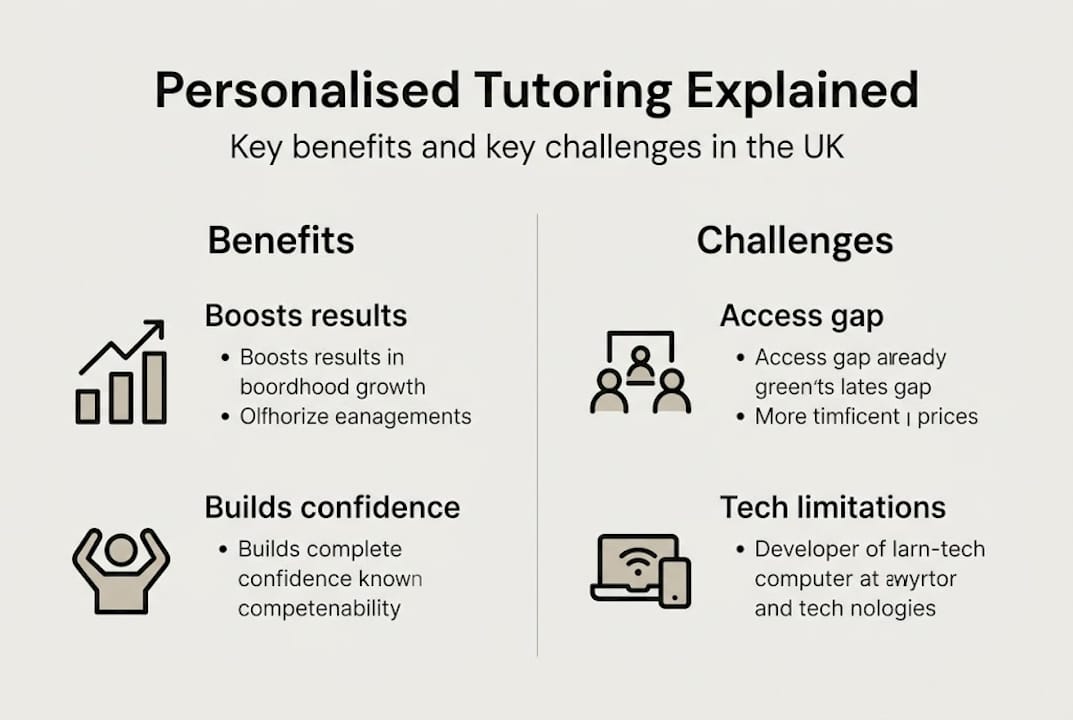
This is very different from a classroom where one teacher serves thirty students. In a personalised setting, your child gets direct, targeted feedback. They move faster through topics they grasp quickly, and spend more time on the areas that genuinely need work.
Key features of personalised tutoring include:
- Adaptive content: Lessons adjust based on what your child already knows.
- Real-time feedback: Mistakes are caught and corrected immediately, not weeks later.
- Knowledge tracing: Progress is tracked so gaps do not go unnoticed.
- Tailored pacing: Your child is never rushed or left bored.
- Exam technique coaching: Targeted practice for the specific qualifications your child is working towards.
Research from Brookings confirms that both human and AI tutoring use methods including adaptive content, real-time feedback, knowledge tracing, reinforcement learning for curriculum sequencing, and pedagogical fine-tuning. Human tutors also rely on diagnostic assessments and tailored exam technique coaching.
"Personalised tutoring is not about doing more work. It is about doing the right work, at the right time, in the right way for your child."
The psychological benefits are just as important as the academic ones. When a student is not afraid of getting things wrong, they ask more questions. They engage more deeply. Anxiety drops. Motivation rises. AI-driven personalisation can replicate many of these conditions at scale, making them accessible beyond the traditional private tutor market. And when paired with strong personalised learning strategies, the results can be transformative.
So the question is not whether personalised tutoring works. It is whether your child is getting access to it.
Who benefits and where are the gaps?
Understanding personalised tutoring leads us to an important question: who actually gets to benefit, and where do gaps remain?
The honest answer is that access is still heavily shaped by wealth and geography. Secondary students in London are significantly more likely to receive tutoring, as are students from Black and Asian backgrounds. Meanwhile, pupils from the lowest-income households are the least likely to access private tuition, despite being the group most likely to benefit from it.
Here is a snapshot of the current landscape:
| Group | Tutoring uptake |
|---|---|
| All secondary students (England & Wales) | 29% |
| Students in London | Above national average |
| Black and Asian students | Above national average |
| Worst-off households | Lowest nationally |
| School-provided tutoring (disadvantaged) | 22% |
| School-provided tutoring (best-off) | 19% |
There is something striking in those final two rows. School-based tutoring actually reaches more disadvantaged students (22%) than the best-off (19%). That tells us school-provided programmes are doing something right in terms of targeting. The problem is that private tutoring, which is far more intensive and frequent, remains out of reach for most families.
"The tutoring gap is not just an educational issue. It is an equity issue. Children from wealthier families are compounding their advantages year after year."
Research consistently shows that disadvantaged students gain the most from personalised support. The attainment gap between pupils from different income backgrounds is well-documented, and tutoring has been shown to narrow it. But if those students cannot access quality support, the gap widens instead.
This is precisely why closing the tutoring gap matters so much. The good news is that school-based programmes and affordable AI tools are beginning to shift the balance. As a parent, knowing these options exist is the first step.
Evidence: Does personalised tutoring really work?
Having explored who benefits, it is crucial to see what the research actually says about personalised tutoring's effectiveness.
The short answer is yes, it works. And the evidence is robust.
Human tutoring has long been recognised as one of the most effective educational interventions available. One-to-one support consistently outperforms whole-class instruction for improving attainment, engagement, and exam outcomes.

AI-powered tutoring is catching up fast. Intelligent Tutoring Systems (ITS) are a category of AI tools designed to replicate the adaptive, responsive qualities of a skilled human tutor. A major meta-review of ITS outcomes found they improve academic outcomes by approximately 0.66 standard deviations. In plain terms, that is a very meaningful improvement.
| Tutoring type | Evidence strength | Key benefit |
|---|---|---|
| One-to-one human tutor | Very strong | Highest personalisation, relationship-driven |
| Small group tutoring | Strong | Cost-effective, nearly as effective as 1:1 |
| Intelligent Tutoring Systems (AI) | Growing | Scalable, 24/7, adaptive feedback |
| Generic AI (essay writing tools) | Weak or negative | Bypasses learning, builds dependency |
The distinction in that final row matters enormously. Not all AI is equal. Tools that simply write essays for students are not tutoring. They are shortcuts that undermine genuine learning. Effective AI tutoring asks questions, challenges thinking, and guides students to their own conclusions, much like the Socratic method used by the world's best educators.
0.66 SD improvement in academic outcomes from Intelligent Tutoring Systems. That is equivalent to moving a student from average to well above average.
Timely feedback and self-pacing are particularly powerful. When your child gets an answer wrong and understands why immediately, retention improves dramatically. Waiting until the next lesson, or worse, until exam results arrive, is far less effective.
Pro Tip: Ask any tutor or AI platform how they handle mistakes. If the answer is simply "we mark it wrong," look elsewhere. The best tutors use errors as teaching moments.
The impact of AI tutors on engagement is also significant. Students who feel psychologically safe, who are not embarrassed to ask questions, learn more and retain more. That is a benefit that extends well beyond exam results.
Affordable options: Making personalisation accessible
With effectiveness established, parents next want to know: how can you access personalisation without breaking the bank?
The good news is that you have more options than you might think. School-provided tutoring currently reaches around 20% of students and is often free or subsidised, particularly for pupils eligible for pupil premium funding. Small group sessions, typically three to five students, are another strong option. They cost significantly less than one-to-one private tuition and research shows they deliver nearly comparable results.
AI tutoring tools represent the most scalable and affordable route. The best platforms offer genuine personalisation, not just content delivery, and are available around the clock. However, quality varies enormously, so it pays to be selective.
Here is a practical step-by-step approach for parents:
- Talk to your child's school. Ask whether tutoring programmes are available, especially if your child qualifies for pupil premium support. Many schools have expanded provision since the pandemic.
- Consider small group tutoring. Look for local or online providers offering groups of three to five students. The cost per session drops significantly while the quality of support remains high.
- Evaluate AI platforms carefully. Look for tools that use Socratic questioning and adaptive feedback rather than just providing answers. Check for safeguarding policies and accuracy standards.
- Set clear goals. Know what you want tutoring to achieve, whether that is improving a specific grade, building confidence in one subject, or preparing for key exams.
- Review progress regularly. Good tutoring should show measurable improvement within a few weeks. If it does not, adjust your approach.
Pro Tip: When choosing AI tutoring tools, ask whether the platform tracks your child's progress over time. A tool that remembers where your child struggled last week is far more valuable than one that starts fresh every session.
It is also worth knowing the risks. AI learning companion tools that lack proper safeguards can produce inaccurate information or encourage passive consumption rather than active learning. Always check reviews, look for evidence-based credentials, and involve your child in choosing the right tool. Their buy-in matters.
What most parents miss about personalised tutoring
Beyond practical steps, here is a perspective every parent should consider before choosing any tutoring approach.
Personalised tutoring is not a magic fix. It works best as part of a broader approach to supporting your child's education. The parents who see the biggest gains are not necessarily the ones who spend the most. They are the ones who stay curious about what their child actually needs, and who blend the right combination of tools, people, and relationships.
There is a tendency to over-rely on technology, especially as AI tools become more capable. But the most effective learning still happens when a student feels genuinely understood. That requires human connection too. The best approach combines the efficiency of AI-powered tutoring with the warmth and accountability of a real relationship, whether that is a parent, a teacher, or a mentor.
You do not need a large budget to advocate for your child's personalised learning. Ask questions at parents' evening. Request targeted feedback. Push for small group support if one-to-one is not affordable. Personalisation is a mindset, not a price tag.
Find the right personalised tutoring support
If you are ready to put these strategies into action, here is how you can explore personalised options at your fingertips.
Affordable, high-quality personalised tutoring is no longer out of reach. At IntuitionX, we have built a 24/7 AI tutor with Oxbridge-level intelligence, backed by Sir Anthony Seldon and designed to make elite education accessible to every student, regardless of background or budget.
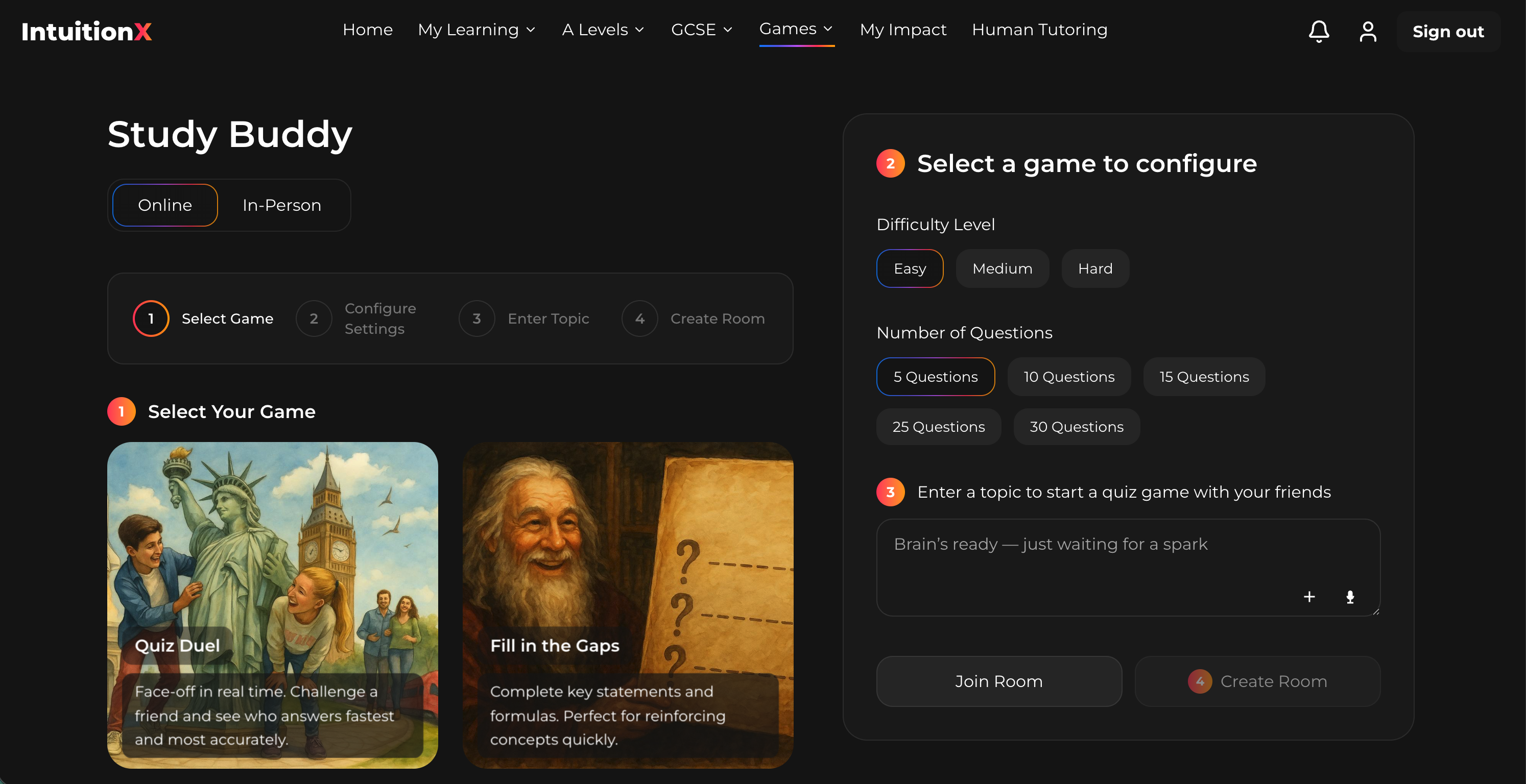
Our AI does not write essays for your child. It asks the right questions, challenges their thinking, and builds genuine understanding, just like the world's best tutors do. Explore personalised AI tutor solutions or start with IntuitionX today and see the difference personalised learning can make for your child.
Frequently asked questions
Does personalised tutoring really improve exam results?
Yes. Evidence shows personalised tutoring, including AI-based Intelligent Tutoring Systems, consistently boosts academic outcomes, with ITS improving results by approximately 0.66 standard deviations in peer-reviewed studies.
How can I find affordable personalised tutoring for my child?
Start with your child's school, as school and small group tutoring are proven affordable alternatives to private tuition, and explore quality AI platforms that offer adaptive, evidence-based support.
Are AI tutoring platforms safe and effective?
Well-designed AI platforms are both safe and effective, but parents should verify that accuracy safeguards are in place and avoid platforms that encourage passive learning or over-reliance on generated answers.
Can school-based tutoring compete with private tutors?
Absolutely. School and small group tutoring are often nearly as effective as private one-to-one tuition, particularly for disadvantaged students, and at a fraction of the cost.