

TL;DR:
- High-dosage tutoring, involving three or more sessions weekly, can produce academic gains equivalent to several months of extra learning. Effective tutoring complements classroom instruction by reinforcing current topics and employing research-supported techniques like Socratic questioning and immediate feedback. Combining human expertise with adaptive AI technology offers the most promising future for personalized, scalable education.
Most parents think tutoring means sitting next to a student and re-explaining what the teacher already covered. That's a fair assumption. But research tells a very different story. High-dosage tutoring of three or more sessions per week produces effect sizes equivalent to four to six months of additional learning. That's not a marginal gain. It's a genuine academic leap. This guide breaks down what effective tutoring actually looks like, why it works so powerfully, and how modern methods can give your teenager a real and lasting advantage.
Table of Contents
- Why tutoring matters more than ever
- How tutors drive results: the evidence
- What makes tutoring effective? Methods that work
- Challenges in scaling tutoring: what parents should watch for
- Human expertise meets innovation: the future of tutoring
- What most articles miss: tutors bridge, not replace, classroom learning
- Looking for innovative tutoring solutions?
- Frequently asked questions
Key Takeaways
| Point | Details |
|---|---|
| Tutoring drives progress | Regular, high-quality tutoring can move students ahead by several months of learning. |
| Personalisation matters most | The best outcomes come from tutoring targeted to your child’s schoolwork and needs. |
| Human and AI work together | Blending empathetic human tutors with digital tools delivers both depth and flexibility. |
| Watch for quality as scale grows | Larger programmes may offer less individual impact, so check for strong tutor support and oversight. |
| Parents play a role | Parents who engage with tutors and teachers can help ensure academic strategies are unified for their teen’s success. |
Why tutoring matters more than ever
We're living through a learning crisis. In the UK, 73% of students are not actively engaged in learning. In the US, 80% describe themselves as bored in class, and 91% say they feel too nervous to ask questions. These aren't abstract statistics. They're the reality inside classrooms your teenager sits in every day.
Against this backdrop, tutoring has become far more than a luxury for the wealthy. It has become a genuine equaliser. And the evidence for its impact is striking.
Across multiple randomised controlled trials, tutoring effect size averages 0.37 standard deviations. To put that plainly: a student sitting at the 50th percentile, perfectly average by any measure, can move to the 66th percentile through structured tutoring. That's the difference between a B and an A, or between a pass and a distinction.
Consider what that means in practical terms. A student who struggled in maths throughout Year 9 could, with consistent, well-structured tutoring, enter their GCSE year performing above the national average. That kind of shift changes university options, career trajectories, and self-belief.
Key outcomes from well-structured tutoring programmes:
- Measurable gains in maths achievement, particularly with high-dosage approaches
- Improved confidence and willingness to ask questions
- Stronger retention of core concepts through repeated, personalised practice
- Better alignment between school learning and independent study
For families exploring personalised tutoring for UK students, understanding this evidence is the first step toward making an informed choice.
"The evidence is clear: structured, frequent tutoring moves students from average to well above average performance in a remarkably short period of time."
How tutors drive results: the evidence
With the academic benefits of tutoring established, it's important to understand exactly how tutors create these results in different settings. Not all tutoring is equal. The format, frequency, and training of tutors all play a decisive role in outcomes.

Here's how the main tutoring models compare:
| Tutoring model | Typical group size | Effect on outcomes | Best suited for |
|---|---|---|---|
| 1:1 tutoring | 1 student | Highest individual impact | Students with specific gaps |
| Small group tutoring | 2 to 3 students | Strong outcomes, cost-effective | Peers with shared challenges |
| Cross-age peer tutoring | 1 to 3 students | 0.34 SD benefit for both parties | Building confidence in older pupils |
| Digital or AI-based tutoring | Unlimited | Scalable, personalised, 24/7 | Consistent daily practice |
| Hybrid model | Varies | Combines personal and digital strengths | Most students |
Research confirms that optimal tutoring conditions involve in-school delivery, small groups of one to three students, trained tutors, and high dosage exceeding 60 hours total. When these conditions are met, the results are consistently strong across both UK and US settings.
One of the most encouraging findings concerns cross-age peer tutoring, where an older student tutors a younger one. Cross-age tutoring shows an overall effect size of 0.34 SD, with tutees gaining 0.33 SD and the student acting as tutor gaining an even stronger 0.39 SD. Teaching something, it turns out, is one of the best ways to learn it deeply.
What makes the biggest difference in any tutoring setting:
- Tutor training and subject knowledge
- Frequency of sessions (three or more per week is ideal)
- Small group sizes that allow for real interaction
- Clear feedback loops that show students where they're improving
- A consistent, trusted relationship between tutor and student
Pro Tip: Mix human and AI support for the best of both worlds. Human tutors bring emotional warmth and adaptability. AI tutors deliver instant feedback, patience, and availability at 11pm the night before an exam. The combination is more powerful than either alone. Explore how digital tutors vs human tutors compare in different contexts to find the right balance for your child.
"The tutor-student relationship, built on trust and consistency, is the engine behind lasting academic progress."
If you're exploring what a more structured approach looks like in practice, this AI tutoring process for UK parents offers a helpful overview.
What makes tutoring effective? Methods that work
Understanding the forms of tutoring leads naturally to the question: what are the actual techniques that drive its effectiveness? Because not every session is created equal. A tutor who simply re-reads the textbook adds little value. The methods matter enormously.
The single most impactful variable is curriculum alignment. Classroom-aligned tutoring materials yield 1.3 additional months of learning compared to supplemental materials that don't connect to what the student is currently studying in school. This finding is significant because it challenges a common approach where tutors use their own preferred worksheets and resources without reference to what the student's teacher is actually covering.
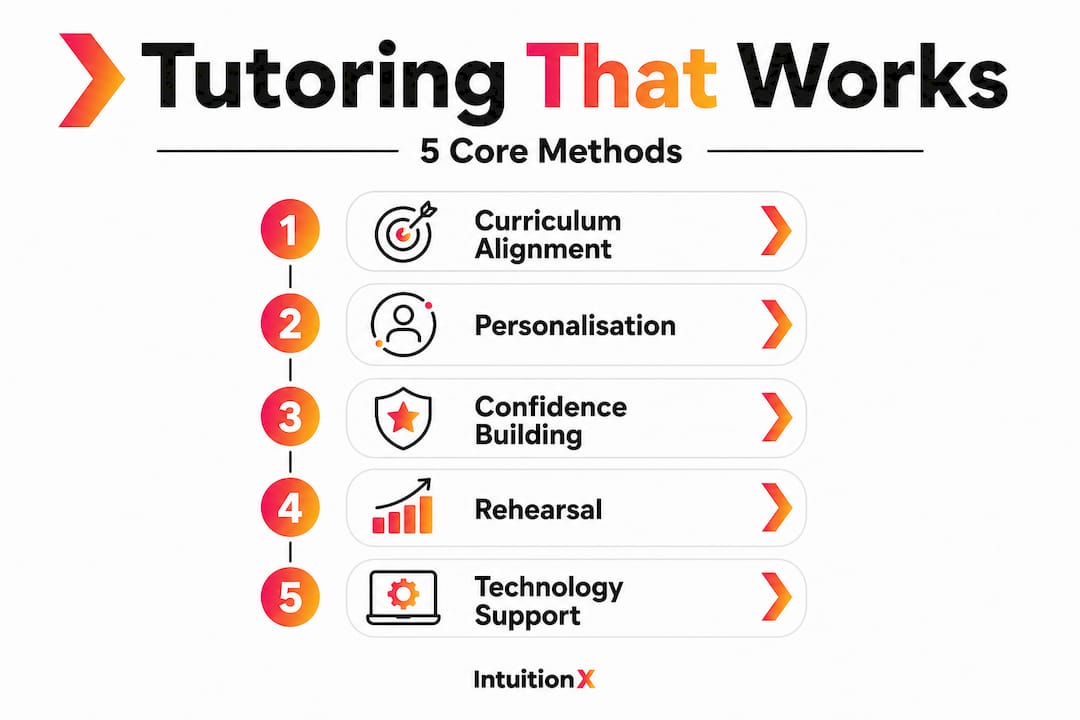
When your child's tutor knows they're studying simultaneous equations this week, or working through the causes of World War One, the tutoring session becomes a targeted reinforcement of live learning. That reinforcement accelerates understanding rather than creating a parallel but disconnected curriculum.
Techniques that research consistently supports:
- Socratic questioning: Rather than giving the answer, effective tutors ask questions that lead students to discover answers themselves. This builds genuine understanding, not just short-term recall.
- Immediate corrective feedback: Students learn faster when mistakes are identified and corrected in the moment, not days later when a marked paper is returned.
- Spaced repetition: Revisiting material at strategic intervals strengthens long-term memory. Good tutors build this into their sessions without the student even noticing.
- Metacognitive coaching: Teaching students how to think about their own learning. This includes strategies for checking understanding, planning revision, and managing exam nerves.
- Confidence-building through success: Structuring sessions so students experience small wins regularly. This is particularly powerful for students who have come to believe they simply "aren't maths people" or "can't write essays."
Pro Tip: When you're choosing a tutor or tutoring platform, ask directly how they coordinate with your child's school teachers. A good tutor will welcome that collaboration. A great one will proactively seek it out. Understanding pedagogy in online tutoring can help you ask sharper questions when evaluating your options.
Digital platforms are increasingly able to support many of these methods at scale. Adaptive algorithms can adjust difficulty in real time, deliver spaced repetition automatically, and track progress across subjects. Paired with human oversight, they represent how AI transforms education in a genuinely meaningful way.
Challenges in scaling tutoring: what parents should watch for
Even with all the benefits, not every tutoring programme delivers, especially as student numbers grow. This is important context for parents evaluating options, whether through schools, national programmes, or private providers.
Research shows a clear pattern: when tutoring programmes scale beyond roughly 1,000 students, the effect sizes reduce significantly. Large-scale tutoring programmes typically show effect sizes of just 0.16 to 0.21 SD, compared to the 0.37 SD or higher achieved in smaller, more controlled settings. That's still a positive result, but it's notably weaker.
Why does scale reduce impact? Several interconnected reasons:
- Tutor quality becomes harder to maintain as programmes recruit more widely and training becomes less rigorous
- Funding sustainability creates pressure to cut session frequency, which directly undermines the high-dosage effect
- Logistical barriers mean some students miss sessions, reducing the consistency that drives results
- Tutor retention suffers when pay or working conditions don't attract committed professionals
- One-size-fits-all content creeps in as personalisation becomes harder to deliver at volume
"Scale is the enemy of personalisation, and personalisation is the engine of effective tutoring."
What should you look for when evaluating a tutoring provider? Transparency is your best friend. Ask about tutor qualifications, session frequency, how progress is measured, and how the programme reports back to you as a parent. Any reputable provider should welcome these questions.
This is one area where best educational AI tools offer a genuine advantage. Well-designed AI tutoring platforms can maintain personalisation at scale because the technology adapts to each learner individually, without the logistical constraints of human-led programmes. The key is ensuring that human expertise still oversees the process.
Human expertise meets innovation: the future of tutoring
Looking ahead, tutoring continues to evolve, integrating technology while keeping personal connection at the heart of the experience. The most effective approaches in 2026 are not choosing between human and digital. They're combining both deliberately.
AI-powered tutoring tools have matured significantly. The best platforms can now track a student's progress across dozens of competencies simultaneously, identify knowledge gaps before they become serious problems, and adjust the difficulty and style of questions in real time. This kind of responsiveness was simply not possible with traditional tutoring.
What to look for in a forward-thinking tutoring solution:
- Adaptive learning pathways that respond to your child's specific strengths and weaknesses
- 24/7 availability so revision doesn't stop when the tutor leaves
- Progress dashboards that give you, the parent, visibility into how your teenager is performing
- A human expert layer that reviews AI interactions and ensures the pedagogy is sound
- Emotional intelligence in design so the platform encourages rather than discourages when students struggle
That last point matters more than it might seem. A student who gets a question wrong and receives a cold "incorrect, try again" response learns something very different from one who hears "good thinking, but let's look at this part together." The emotional tone of feedback shapes whether students persist or give up.
"The future of tutoring is not artificial intelligence replacing human wisdom. It is artificial intelligence amplifying it."
Understanding what this looks like in practice is worth exploring. The omniscient AI tutoring guide explains how layering the traits of the world's greatest educators into AI creates something genuinely different from a search engine with a chat interface. And for parents who want to understand why human oversight remains non-negotiable, the case for human insight for AI tutoring is well worth reading.
What most articles miss: tutors bridge, not replace, classroom learning
Stepping back, let's look at the deeper truth about how tutors fit into education today. There's a narrative in some quarters that technology, or indeed any sufficiently skilled tutor, could eventually replace teachers. We think this fundamentally misunderstands what makes tutoring work.
Tutors complement teachers by providing rehearsal, confidence-building, and personalisation without replacing curriculum delivery. The teacher sets the direction of travel. The tutor helps the student keep pace with the journey and feel confident along the way. These are different but complementary roles.
The best results we see come from situations where the tutor, the teacher, the technology, and the parent are all pulling in the same direction. A student whose tutor knows what was covered in Monday's lesson, whose parent knows what topic to ask about on Tuesday evening, and whose AI study companion revisits that same material on Wednesday night is receiving something genuinely powerful. It's not any single element that creates the magic. It's the coherence.
We'd go further and say that any tutoring service promising to replicate or replace classroom teaching is selling something that the evidence simply does not support. The gains from tutoring come precisely because tutors work with the existing educational structure, not against it. They reinforce, personalise, and rebuild confidence. They don't redesign the curriculum from scratch.
For parents, this means the most important question when choosing tutoring isn't "is this the cleverest platform?" It's "does this platform work alongside my child's school?" Explore how pedagogy shapes online tutoring for a deeper look at what genuinely rigorous tutoring methodology looks like in practice.
Looking for innovative tutoring solutions?
If this article has clarified what effective tutoring really looks like, you're probably wondering where to find it. IntuitionX was built precisely to solve the problems this research exposes. We bring together Oxbridge-level academic expertise, Socratic questioning methodology, and AI that adapts to your teenager's specific needs, available 24/7, at a fraction of the cost of a private tutor.
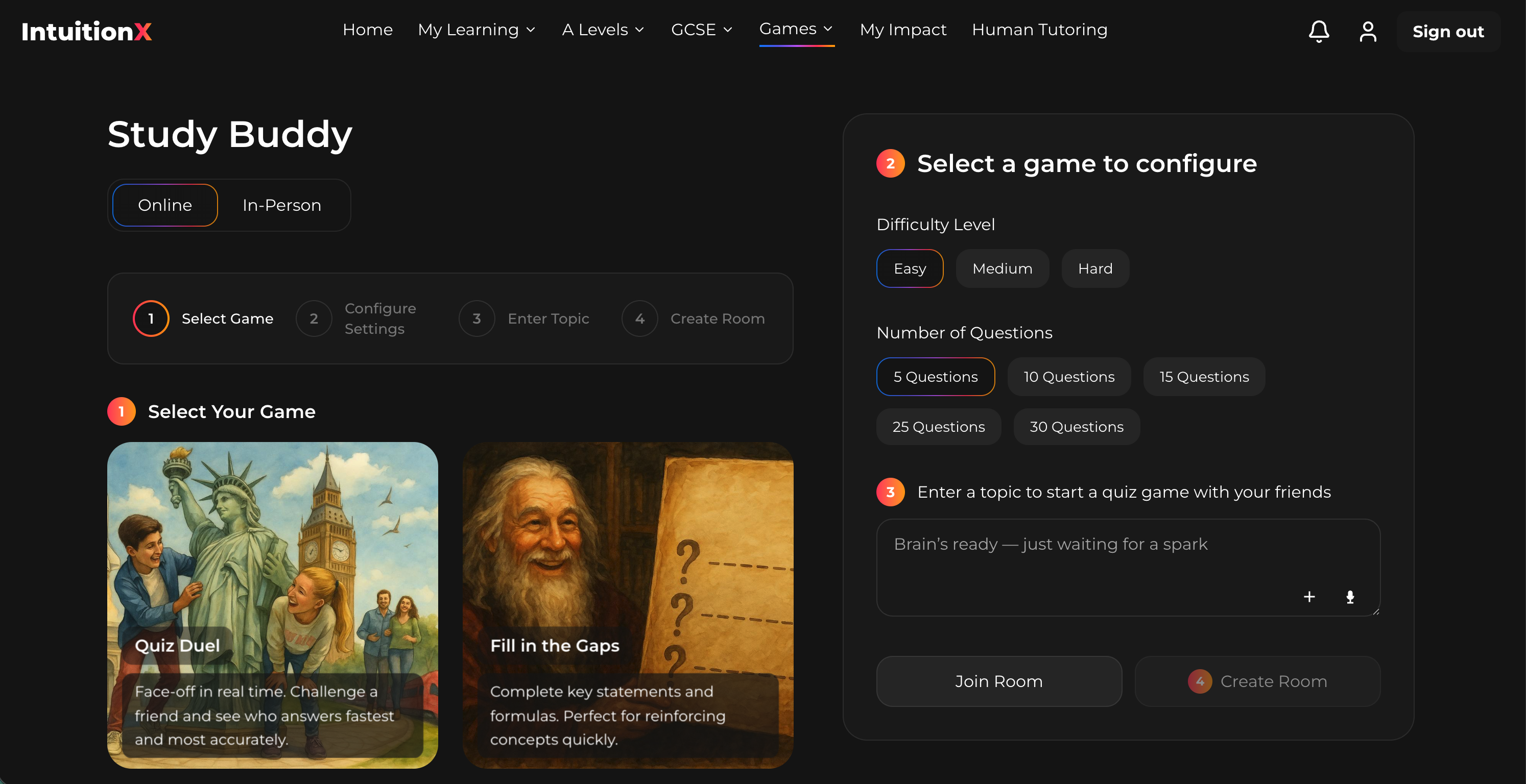
Our AI companion, Omniscience, doesn't just explain. It asks, guides, and builds genuine understanding, layering in the memory science and pedagogical methods of the world's greatest educators. Backed by Sir Anthony Seldon and partnered with the International Rescue Committee, we're committed to making elite education accessible to every student. Whether your teenager needs daily maths support or confidence before their GCSEs, IntuitionX is the thinking partner they deserve.
Frequently asked questions
What is high-dosage tutoring and does my child need it?
High-dosage tutoring means three or more structured sessions per week, and studies show it can give your child the equivalent of four to six months of additional learning, particularly in maths. If your teenager has noticeable gaps or upcoming high-stakes exams, it's well worth considering.
Do digital tutors work as well as human tutors?
Digital tutors can be highly effective, especially when combined with human oversight that ensures sound pedagogical judgement. The strongest outcomes consistently come from hybrid approaches that pair adaptive AI with qualified human expertise.
Is peer or cross-age tutoring beneficial for my teen?
Yes, and perhaps more than you'd expect. Cross-age tutoring boosts outcomes for both the student being tutored and the one doing the tutoring, making it a genuinely two-way benefit worth exploring through school programmes.
Should tutoring follow my child's school curriculum?
Absolutely. Classroom-aligned materials deliver 1.3 additional months of learning compared to generic supplemental content, so always choose a tutor who actively coordinates with what your child is covering in school.