

TL;DR:
- Effective AI tools should promote critical thinking and be tailored to humanities subjects.
- Khanmigo uses Socratic questioning; Socratic by Google provides visual explanations.
- AI supports early-stage understanding but may not fully replace human expertise in deep analysis.
Choosing the right AI learning tool feels overwhelming. There are dozens of options, bold promises, and very little clarity about which ones actually work for literature, history, or humanities. Meanwhile, 73% of UK students are not actively engaged in learning, and the gap between students with access to quality tutoring and those without keeps widening. The good news? The right AI tool can genuinely change that. This guide walks you through exactly what to look for, which tools lead the field, and how to make a confident, informed choice for your specific learning needs.
Table of Contents
- How to evaluate educational AI tools
- Khanmigo: Leading with the Socratic method
- Socratic by Google: Visual explanations for complex concepts
- Head-to-head: Comparing the top educational AI tools
- The hidden challenges and realities behind AI-led learning
- Level up with the right AI tutoring companion
- Frequently asked questions
Key Takeaways
| Point | Details |
|---|---|
| Focus on engagement | The most effective AI tools stimulate active thinking, not just answers. |
| Affordability matters | Affordable AI solutions like Khanmigo make smarter tutoring accessible to more students. |
| Humanities support differs | Not all AI tools handle literature and social studies equally—compare their strengths carefully. |
| Supplement with human insight | AI is powerful for revising basics, but real mastery in humanities still relies on critical thinking and teacher feedback. |
How to evaluate educational AI tools
Not all AI tools are built the same. Some are flashy but shallow. Others are genuinely designed to build understanding rather than just hand you answers. If you are a student or educator searching for something that actually works, especially in literature or the humanities, you need to know what separates a useful tool from a forgettable one.
Here are the key criteria worth assessing:
- Engagement quality: Does the tool ask questions that make you think, or does it just feed you information? Genuine engagement drives retention.
- Subject fit: Many AI tools are built around maths and science. If you need support with literary analysis, essay writing, or historical argument, check that the tool explicitly covers humanities.
- Pedagogical method: How the tool teaches matters more than how it looks. Socratic questioning, for instance, has strong evidence behind it for building critical thinking.
- Affordability: Private tutors can cost up to $150 per hour. AI tools should democratise that access, not replicate the price tag.
- Personalisation: A tool that adapts to your level and learning gaps will always outperform a one-size-fits-all approach. Explore the personalised education benefits of AI to understand why this matters.
- Ease of use: If it takes twenty minutes to figure out how to ask a question, students will abandon it quickly.
Affordability has become a genuine differentiator in 2026. Tools like Khanmigo have shown that Socratic engagement at low cost is achievable, proving that quality does not have to mean expensive.
Pro Tip: When shortlisting tools, focus on the teaching method first. A tool that uses guided questioning will serve you far better in humanities than one that simply summarises text. Flashy interfaces mean nothing if the pedagogy is weak.
Finally, think about your specific use case. Are you revising for A Level exams? Supporting a class of thirty students? Trying to understand a novel independently? The best tool for one situation may not suit another. Clarity about your goal makes the decision much simpler.
Khanmigo: Leading with the Socratic method
Khanmigo, developed by Khan Academy, is one of the most talked-about AI tutoring tools available right now. And for good reason. It is built around the Socratic method, which means instead of giving you the answer, it asks you questions that guide you towards working it out yourself. That distinction is enormous.
The results speak clearly. Khanmigo delivers a 23% improvement in maths retention, and its guided questioning approach has been applied across multiple disciplines. In maths, the evidence is strong. In humanities, it scores around 3 out of 5, which is respectable but worth understanding before you commit.
Here is what Khanmigo does well:
- Guided questioning: Pushes you to reason through problems rather than passively absorb information.
- Wide subject coverage: From algebra to essay structure, it covers a broad curriculum.
- Affordable access: At just $4 per month, it removes the financial barrier that keeps quality tutoring out of reach for many students.
- Safe, student-friendly design: Built with younger learners in mind, with guardrails that keep conversations focused and appropriate.
For humanities and literature specifically, Khanmigo can help you think through themes, character motivations, and argument structure. It will not write your essay for you, which is exactly the point. You can also find broader AI tutoring guidance to understand how tools like this fit into a wider revision strategy.
Where it falls short is in deep literary analysis. If you are studying complex texts at A Level or beyond, you may find that Khanmigo's questions are a good starting point but not sufficient for the nuance required. For that level of support, resources specifically designed for AI for A Level literature offer more targeted guidance.
Pro Tip: Use Khanmigo at the start of a revision session to activate your thinking. Let it question you on a text or topic before you read your notes. This primes your brain to engage more actively with the material that follows.
Socratic by Google: Visual explanations for complex concepts
Socratic by Google takes a different approach. Rather than a chat-based tutoring session, it lets you photograph a question or type it in, then provides visual explanations, relevant resources, and guided reasoning to help you understand the concept. For visual learners, this is genuinely powerful.

In humanities and literature, Socratic covers literature and social studies using guided reasoning to break down complex ideas. That means if you are struggling with a passage from a set text or trying to understand a historical event, Socratic can pull together explanations, definitions, and contextual information in a visually digestible format.
Here is what makes Socratic stand out:
- Photo input: Snap a question from a textbook and get an immediate, structured explanation.
- Visual learning support: Diagrams, step-by-step breakdowns, and colour-coded explanations suit students who struggle with dense text.
- Broad subject reach: Strong in science and maths, but genuinely useful for humanities and social studies too.
- Free to use: No subscription required, making it one of the most accessible options available.
"Socratic by Google is particularly effective for students who need to see a concept broken down visually before they can engage with it analytically." This is where it earns its reputation as a strong accessibility tool.
The limitation is depth. Socratic is excellent for initial understanding but less suited to the kind of iterative, questioning dialogue that builds real critical thinking. It answers your question well. It does not always push you to go further. Understanding the broader learning companion role of AI tools helps clarify when Socratic is the right fit and when something more dialogic is needed.
For students who need a quick, visual explanation of a concept before a lesson or exam, Socratic is hard to beat. For those who want to build deeper analytical skills over time, it works best as a complement to other tools.
Head-to-head: Comparing the top educational AI tools
With both tools covered, here is how they compare directly. This table draws on key data from research and humanities support analysis to give you a clear picture.
| Feature | Khanmigo | Socratic by Google |
|---|---|---|
| Teaching method | Socratic questioning | Visual and guided reasoning |
| Humanities support | 3/5 | Strong for literature and social studies |
| Maths/science strength | Very strong (23% retention gain) | Strong |
| Price | $4/month | Free |
| Best for | Deep engagement, revision dialogue | Visual learners, quick concept checks |
| Age suitability | All ages, especially secondary | Secondary and above |
| Personalisation | Moderate | Low |
Neither tool is universally superior. The right choice depends entirely on how you learn and what you need.
Here are four numbered steps to help you make the final decision:
- Define your subject priority. If humanities and literature are your focus, both tools offer support, but in different ways. Khanmigo questions you; Socratic explains to you.
- Consider your learning style. Visual learner? Socratic. Prefer dialogue and challenge? Khanmigo.
- Think about your budget. Socratic is free. Khanmigo costs $4 per month. Both are dramatically cheaper than private tutoring.
- Trial both before committing. Most students find that using two tools in combination, one for initial understanding and one for deeper engagement, produces the best results.
If neither feels quite right, it is worth exploring TuitionTeacher.ai alternatives to see what else is available in the market.
The hidden challenges and realities behind AI-led learning
Here is what most comparison articles will not tell you. AI tools, even the best ones, have real limits when it comes to advanced humanities. The Socratic method is genuinely effective for building engagement and retention, but as research shows, it is less effective for advanced literary analysis where nuance, interpretation, and cultural context matter enormously.
Reading a poem is not the same as solving an equation. A great literary analysis requires you to hold multiple interpretations simultaneously, to understand historical context, and to construct an original argument. Current AI tools can scaffold that process. They cannot replicate it.
This does not mean AI is not valuable. It means you should use it wisely. Treat AI as your thinking partner for the early stages of analysis, and bring human insight, whether from a teacher, a tutor, or a well-designed AI built specifically for this purpose, into the deeper work. Explore A Level literature strategies to see how AI fits most effectively into a serious revision plan.
The students who get the most from AI tools are those who use them to sharpen their thinking, not replace it.
Level up with the right AI tutoring companion
You now know what to look for, which tools lead the field, and where their limits lie. The next step is finding a tool that genuinely matches your ambition.
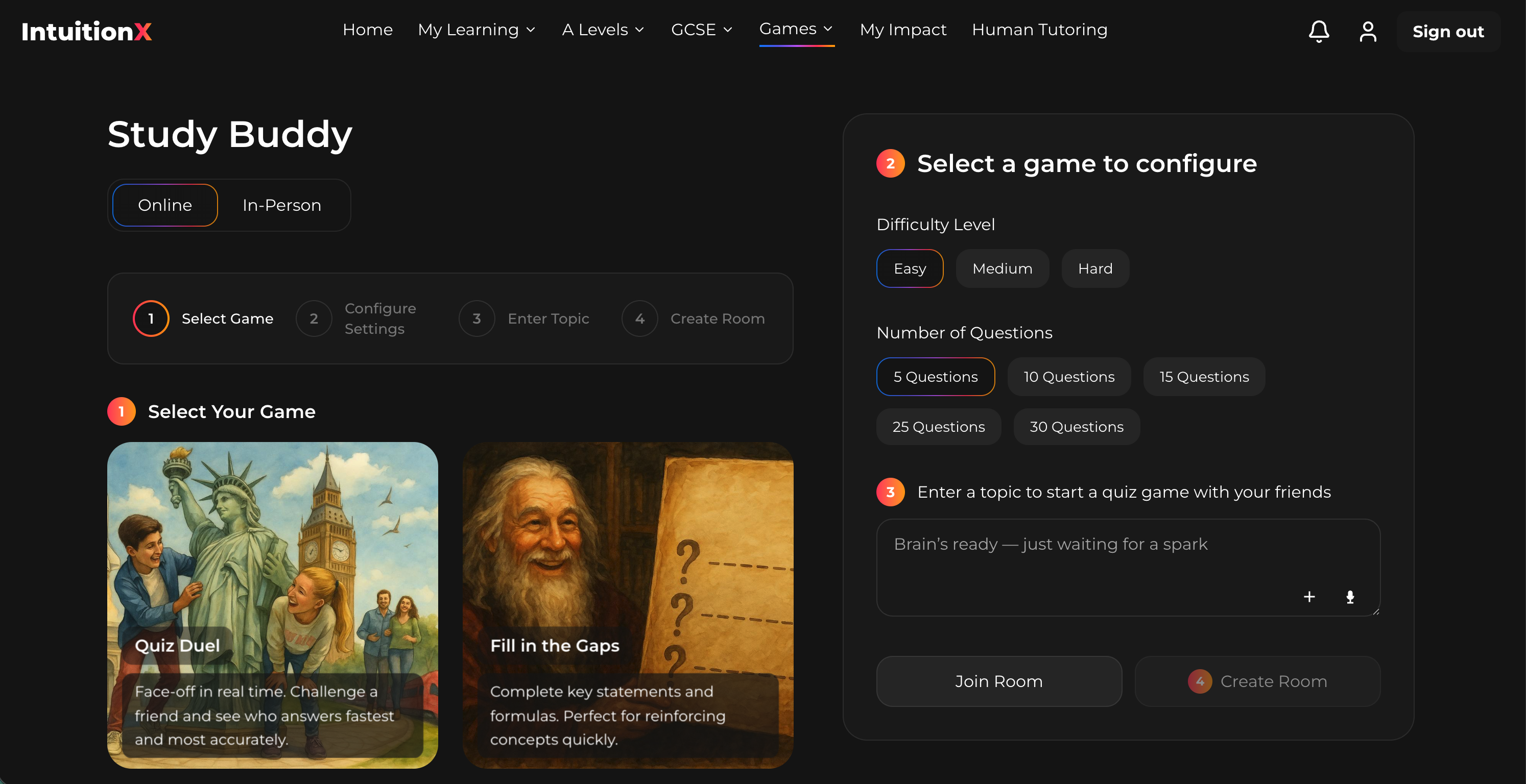
IntuitionX is built specifically for students who want more than a generic answer. Our Socratic AI tutor, Omniscience, is trained on the knowledge of Oxford and Cambridge graduates and designed to ask the questions that build real understanding. Whether you are tackling a Shakespeare text or preparing for an essay, it meets you where you are and pushes you further. Try the IntuitionX app today and experience what learning with genuine intellectual rigour feels like.
Frequently asked questions
Which is the best AI tool for A Level literature revision in 2026?
Both Khanmigo and Socratic offer support, but their strengths differ. Khanmigo is best for guided questioning that builds critical thinking, while Socratic excels in visual explanations and humanities concept breakdowns.
Are AI tutoring tools affordable for all students?
Yes, significantly so. Khanmigo costs just $4 per month, and Socratic by Google is entirely free, making both far more accessible than traditional private tutoring.
Can these AI tools help with deep analysis in literature?
AI tools are strong for building initial understanding and guiding your thinking, but advanced literary analysis still benefits greatly from human insight and subject-specific expertise.