

TL;DR:
- Effective online tutoring relies on pedagogy, such as questioning, scaffolding, and targeted feedback.
- Structured, reflective routines in tutoring promote long-term independence and deeper understanding.
- Parents should prioritize tutors who align sessions with the child's school curriculum and demonstrate strong pedagogical methods.
You've probably spent hours comparing platforms, reading reviews, and looking for the best online tutor for your teenager. But here's what most parents miss entirely: the technology is almost never the deciding factor. What actually determines whether your child makes real progress is pedagogy, the methods and principles a tutor uses to teach. Get that right, and results follow. Get it wrong, and even the most sophisticated platform in the world will leave your child exactly where they started.
Table of Contents
- What is pedagogy and why does it matter in online tutoring?
- Key pedagogical strategies that boost online learning
- How structured pedagogy prevents pitfalls in online tutoring and AI
- The importance of aligning tutoring with classroom learning
- Questions parents should ask when choosing an online tutor
- Why pedagogy is the secret differentiator in online tutoring
- How IntuitionX can help your child thrive with evidence-based tutoring
- Frequently asked questions
Key Takeaways
| Point | Details |
|---|---|
| Pedagogy drives results | Effective online tutoring depends on structured teaching strategies, not just advanced technology. |
| Feedback and scaffolding matter | Targeted feedback and fading support equip students with critical problem-solving skills and confidence. |
| Alignment boosts progress | Tutoring matched to classroom material yields significantly greater academic gains. |
| Parents should ask about methods | Ensure your child's tutor uses evidence-based pedagogy by asking about feedback, scaffolding, and curriculum links. |
What is pedagogy and why does it matter in online tutoring?
Let's clear something up first. Pedagogy is simply the science and art of teaching. It covers the specific moves a tutor makes during a session: how they ask questions, how they respond when a student gets something wrong, how much help they give and when they pull back. It sounds technical, but it has a very direct impact on your child's progress.
In traditional classrooms, good teachers use these moves instinctively. But in online tutoring, they can easily get lost. A tutor might default to explaining answers step by step, with the student passively listening. That feels productive. It rarely is.
The core pedagogical moves that actually work include:
- Eliciting student thinking: Asking open questions that require the student to reason aloud, not just recall a fact
- Scaffolding: Offering targeted, temporary help that guides students toward an answer without simply giving it to them
- Targeted feedback: Responding to the specific gap in a student's thinking, not just marking something right or wrong
- Retrieval practice: Encouraging students to actively recall information rather than re-read it
These are not nice extras. Pedagogical moves in online tutoring are consistently linked to measurable learning gains. The evidence is clear. Passive instruction, where a tutor talks and a student listens, is significantly less effective than guided, interactive teaching.
"Students learn best not when they receive information, but when they are actively supported to construct understanding themselves." This is the consensus from decades of cognitive science, and it applies just as powerfully in online settings as in any classroom.
Building active learning strategies into every session is what separates a genuinely effective online tutor from one who simply fills time.
Key pedagogical strategies that boost online learning
Now that you understand what pedagogy means, let's look at which specific strategies make the biggest difference. These are the methods you should be actively looking for when you choose a tutor for your teenager.
-
Scaffolding with fading support: Scaffolding means breaking a task into manageable steps and guiding the student through those steps. The crucial detail is that good scaffolding fades. As your child gains confidence and competence, the tutor gradually reduces the support. This is not just good practice. Scaffolding's positive impact on problem-solving skills is well established in meta-analytic research. A tutor who keeps giving the same level of help week after week is not building independence. They are creating dependency.
-
Feedback that is precise and well-timed: Not all feedback is equal. Immediate feedback, where the tutor corrects a mistake as soon as it happens, has its place. But research shows that delayed feedback, where students are prompted to reflect and self-correct before receiving guidance, can produce stronger learning outcomes. Online feedback's effect on learning is moderate and positive, with the most significant gains seen when feedback encourages genuine thinking rather than passive correction.
-
Interactive questioning and retrieval routines: The best tutors ask questions constantly. Not to catch students out, but to reveal what the student actually understands. This is retrieval practice: the act of pulling knowledge from memory, which strengthens memory itself. It also tells the tutor exactly where the gaps are. A session built around retrieval and questioning is far more valuable than one built around re-explaining content. Look at how the AI tutoring process incorporates these routines for a clearer picture of what this looks like in practice.
Pro Tip: When evaluating a tutor, ask to observe a session or request a trial. Watch whether the tutor asks your child to explain their reasoning, or whether they simply explain things themselves. The former is a sign of strong pedagogy.
How structured pedagogy prevents pitfalls in online tutoring and AI
Here is where things get important for parents considering AI-based tutoring options. Not all AI tutors are built with pedagogy in mind. In fact, many are not.
The most common failure mode is what researchers call "teaching-by-telling." This is where a tutor, human or AI, simply provides the answer. It feels helpful in the moment. Your child gets their homework done. But unguided AI tutoring can actually limit reflection and reduce the depth of learning when it is not structured around proven pedagogical routines.

Let's look at the difference clearly:
| Feature | Structured pedagogical tutoring | Unstructured or answer-first tutoring |
|---|---|---|
| How questions are used | To elicit student thinking and reveal gaps | To confirm answers already given |
| Feedback approach | Targeted, timely, and builds on errors | Generic praise or simple correction |
| Scaffolding | Temporary and fading as confidence grows | Absent or constant regardless of progress |
| Student independence | Grows over time | Stays the same or decreases |
| Risk | Low | Creates learned helplessness |
The risks of getting this wrong are not trivial. A student who spends months with a tutor who just provides answers can actually become less capable of independent thinking. That is the opposite of what you are paying for.
"Socratic questioning and scaffolded instructional sequences are not just nice pedagogical choices. They are the mechanisms by which genuine understanding is provoked and retained."
Look for red flags. If your child's AI tutor provides an immediate full answer every time they type a question, with no follow-up, no prompting to reason, and no check on understanding, that is a problem. Compare this with what omniscient AI for tutoring and leading educational AI tools are doing to build structured, reflective learning into every interaction.
The importance of aligning tutoring with classroom learning
Even the best-structured tutoring can underperform if it is operating in isolation from what your child is actually studying at school. This is one of the most overlooked factors in online tutoring effectiveness.
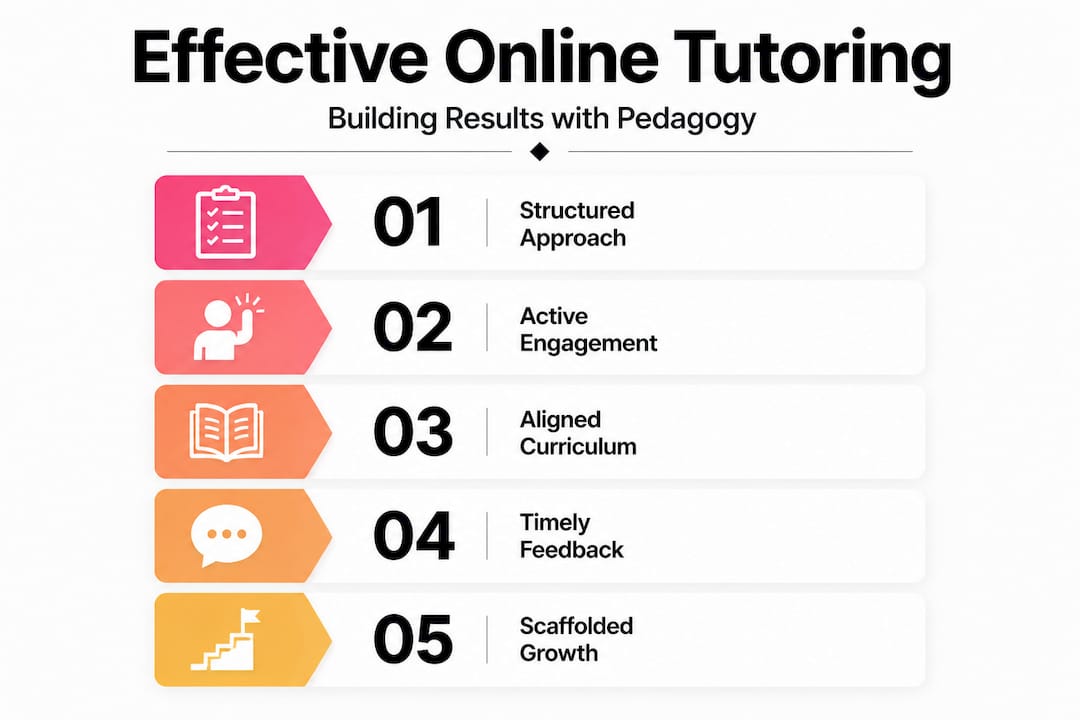
Tutoring aligned to classroom instruction produces stronger outcomes, with research showing students gaining the equivalent of an extra 1.3 months of progress when tutoring content follows classroom pacing and curriculum. That is a significant advantage. And it makes intuitive sense. When a student is being reinforced in tutoring on exactly what they encountered in class that week, the retrieval effect is amplified and the scaffolding feels immediately relevant.
Here is how you can make this happen for your child:
- Share the curriculum: Give the tutor access to your child's school syllabus or course outline so sessions can be planned around real classroom content
- Sync session timing: Wherever possible, book tutoring sessions shortly after classroom lessons on a topic, not weeks later when memory has faded
- Ask for a curriculum map: Request that the tutor show you how their programme connects to your child's school objectives
- Review together: After sessions, ask your child to explain what they covered and how it connects to their schoolwork. This adds another retrieval layer
- Feed back on tests: Share test results and teacher feedback with the tutor so they can adjust their approach in real time
| Tutoring condition | Average additional progress | Student engagement |
|---|---|---|
| Aligned with classroom curriculum | +1.3 months | Higher |
| Misaligned or generic content | Minimal or neutral | Lower |
| No tutoring | Baseline | Variable |
Pairing strong curriculum alignment with learning engagement strategies and targeted exam preparation support gives your teenager the best possible platform for sustained improvement.
Questions parents should ask when choosing an online tutor
You now have the knowledge. Here is how to put it to work. Whether you are assessing a human tutor, an AI platform, or a blended option, these questions will tell you quickly whether the approach is built on genuine pedagogy.
-
How do you use questioning during a session? The answer should describe open, probing questions that require the student to reason, not simple yes/no checks.
-
How is feedback delivered? Look for an answer that distinguishes between different types of errors and tailors feedback accordingly, not a blanket "I correct mistakes as they happen."
-
Is scaffolding built in, and does it reduce over time? A strong tutor should be able to explain exactly how they increase challenge and reduce support as a student gains confidence.
-
How do you track progress between sessions? Effective tutors keep detailed notes and use previous sessions to inform the next, rather than starting fresh each time.
-
Do you align your content with the school curriculum? As the research confirms, structured feedback loops and active retrieval are most effective when they operate within the context of what the student is already learning at school.
-
How do you develop metacognition? Metacognition means thinking about thinking. Strong tutors actively help students understand how they learn best, which creates lifelong academic skills, not just short-term fixes.
A tutor who can answer these questions clearly and confidently is one worth investing in. One who looks puzzled by them is one to reconsider. Explore what a well-designed learning companion AI looks like in practice to set a useful benchmark.
Pro Tip: Prioritise tutors that explicitly focus on building your child's independence and metacognitive awareness. The goal of great tutoring is to eventually make itself unnecessary.
Why pedagogy is the secret differentiator in online tutoring
Here is something we have observed consistently: parents invest heavily in finding tutors with impressive credentials and polished platforms. And those things matter. But time and again, the outcomes that genuinely transform a student's trajectory are not driven by credentials or interface design. They are driven by what happens in the fifteen seconds after a student gives a wrong answer.
Does the tutor ask, "Why did you think that?" or do they simply say, "No, the correct answer is..."? That moment is where pedagogy lives. And it is invisible to most parents choosing a tutor.
Consider two students, both in Year 11, both studying the same A-level subjects, both using online tutoring three times per week. One has a tutor who scaffolds carefully, fades support as confidence builds, and uses Socratic questioning to draw out understanding. The other has a tutor who is knowledgeable and warm but defaults to explanation and answer-giving. Six months later, the first student has developed genuine reasoning skills. The second has covered more content but struggles to apply it independently in exams.
The difference is not effort, intelligence, or even the quality of the content covered. It is pedagogy. Specifically, it is whether the tutoring routines are built around the science of how people actually learn.
Most platforms will not tell you this. They will talk about their curriculum coverage, their qualified tutors, their interactive dashboards. What you should be asking about is the structure of questioning, the sequencing of feedback, and whether support is designed to fade. Explore the full AI tutoring process for parents to understand what a genuinely pedagogically-grounded approach looks like in practice.
How IntuitionX can help your child thrive with evidence-based tutoring
If what you have read here resonates, you are already asking better questions than most parents. Finding a tutoring solution that actually embeds scaffolding, Socratic questioning, and curriculum alignment into every interaction is genuinely rare.

That is exactly what IntuitionX is built to do. Backed by academics who earned Firsts from Oxford and Cambridge, our AI tutor applies the same pedagogical principles outlined in this article: targeted feedback, structured questioning, and fading support that builds real independence. Endorsed by Sir Anthony Seldon as essential for staying ahead in the age of AI, IntuitionX offers every teenager access to the kind of evidence-based tutoring that was once reserved for those spending £150 an hour on private tutors. Try IntuitionX today and see the difference that genuine pedagogy makes.
Frequently asked questions
What is the most important pedagogical principle for online tutors?
Effective scaffolding stands out as essential. Scaffolding promotes problem-solving ability by offering temporary, targeted guidance that fades as a student builds confidence and competence.
How does feedback work differently online versus in-person?
Online feedback has a moderately positive effect on learning outcomes, with the strongest gains from delayed feedback that prompts reflection. Meta-analytic evidence shows that simply correcting errors immediately is less effective than prompting students to self-evaluate first.
Do AI tutors use effective pedagogy or just give answers?
The best AI tutors use Socratic questioning and structured instructional sequences, but many provide immediate answers without fostering genuine reflection. Unguided AI can limit student thinking if not built around proven pedagogical routines. Always check before committing.
How can I ensure my child's online tutoring matches schoolwork?
Ask tutors to align their material and session timing directly with your child's classroom curriculum. Tutoring aligned to school content delivers measurably stronger progress, including the equivalent of over a month of additional learning gains.