
TL;DR:
- AI tutors have been shown to double learning gains compared to classroom teaching.
- Digital tutors offer scalable, consistent, and affordable support, especially outside school hours.
- Human tutors remain essential for emotional support, complex needs, and motivation.
A Harvard randomised controlled trial recently found that AI tutors doubled learning gains compared to active classroom teaching, with effect sizes of 0.63 to 1.3 standard deviations. That is a striking result. It challenges the assumption that a skilled human tutor is always the gold standard, and it raises a genuinely important question for every parent and student weighing up their options: is the traditional one-to-one lesson still worth the cost?
Table of Contents
- What are digital tutors and human tutors?
- Comparing effectiveness: what does the research show?
- Where digital tutors excel—and their limits
- Why (and when) human tutors remain essential-human-tutors-remain-essential)
- Making the right choice: combining digital and human tutors
- Why the real question isn't "AI or human?" but "How do we blend for the best?"
- Take the next step with smarter tutoring solutions
- Frequently asked questions
Key Takeaways
| Point | Details |
|---|---|
| AI rivals human results | Modern AI tutors can match or exceed human tutors in specific academic outcomes for many students. |
| Blend is best | Combining digital and human tutors often produces the most reliable learning results. |
| Affordability and access | AI tutors deliver scalable support at a fraction of traditional costs, widening opportunity. |
| Critical limits remain | AI struggles with empathy and complex needs—human guidance is still essential. |
| Guardrails matter | Parental oversight and hybrid approaches help avoid the pitfalls of misuse or over-reliance on AI. |
What are digital tutors and human tutors?
Before we compare, let's be clear about what we're actually talking about.
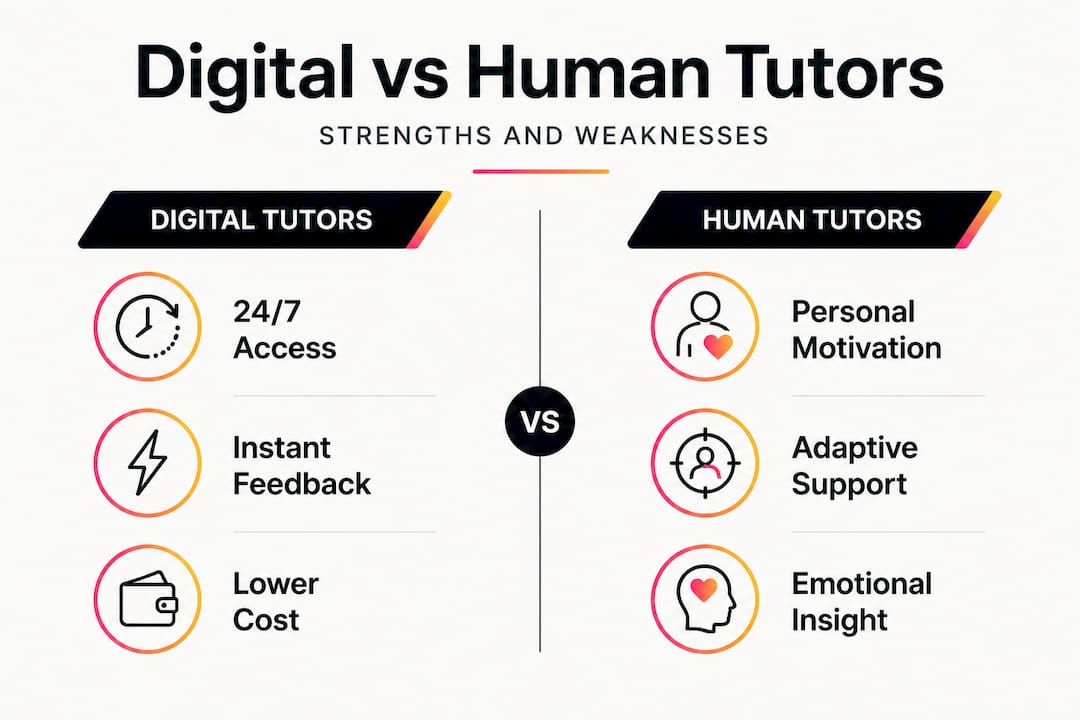
Digital tutors are AI-driven or app-based learning tools that guide students through material algorithmically. They operate 24 hours a day, seven days a week, respond instantly to answers, adapt questions to a student's level, and can serve thousands of learners simultaneously without any drop in consistency. Some use Socratic questioning to prompt deeper thinking. Others rely on adaptive testing to identify and fill gaps. As one Brookings Institution review notes, AI excels at scalability, 24/7 access, consistency, and immediate feedback in ways that no individual human can match.
Human tutors are individuals, whether teachers, graduates, or subject specialists, who work with students in person or online. Their strength lies in nuanced communication, emotional sensitivity, and the kind of flexible, relationship-driven support that adapts to a student's mood on any given day. A great human tutor notices when a student is anxious, not just when they've answered a question incorrectly.
There is also a third category worth knowing about: hybrid models, which pair an AI platform with human oversight or periodic check-ins. Research increasingly suggests this combination outperforms either approach used alone. Understanding how omniscient AI works in a tutoring context helps clarify why the hybrid model is gaining serious traction in schools and homes alike.
Who typically benefits from each approach?
- Digital tutors suit motivated learners who need flexibility, students in rural or underserved areas, families managing tight budgets, and anyone who wants to practise outside school hours
- Human tutors are often essential for students with learning disabilities, high anxiety, or complex emotional needs that require genuine empathy
- Hybrid models tend to work best for students who need structure and accountability but also value the consistency and availability of AI support
A practical guide to AI tutoring for UK parents can help you identify which category fits your child's situation most closely.
Comparing effectiveness: what does the research show?
With a clear sense of what each tutor type entails, we turn to the evidence. Which method genuinely produces better results?
The Harvard RCT mentioned above involved 194 physics students and found that AI tutors doubled learning gains relative to an active learning classroom, with students also reporting higher engagement. This was not a small, isolated result. It is one of the most rigorous comparisons ever conducted at university level, and the implications for secondary school students are significant.
A separate US randomised controlled trial involving more than 700 tutors and 1,000 students found that an AI co-pilot boosted mastery by 4 percentage points overall, and by 9 percentage points when paired with lower-rated human tutors. The cost? Just $20 per tutor per year. That figure is worth pausing on. Wealthy families in the UK and US routinely pay up to $150 per hour for private tutoring. The idea that comparable or superior outcomes could be achieved at a fraction of that cost is not a distant promise. It is already happening.
"AI tutors are not a replacement for great teaching. But for students who previously had no access to personalised support, they represent a genuinely transformative tool." This is the shift we are living through right now.
Here is how the two approaches compare across the dimensions that matter most:
| Factor | Digital tutor | Human tutor |
|---|---|---|
| Availability | 24/7, instant | Scheduled, limited |
| Cost | Very low (from £15/month) | High (£40–£150/hour) |
| Consistency | Always consistent | Varies by tutor quality |
| Personalisation | Algorithm-driven | Relationship-driven |
| Emotional support | Limited | Strong |
| Scalability | Unlimited | One student at a time |
| Complex needs | Poor | Strong |
| Engagement | High in structured tasks | High when rapport exists |
The data on AI tutor effectiveness is building rapidly. It no longer makes sense to dismiss digital tutoring as a lesser option. For many students, it is already the better one.
Where digital tutors excel—and their limits
Having established the strong evidence for AI's effectiveness, let's look at where digital tutors shine—and where they stumble.
Where digital tutors genuinely excel:
- Round-the-clock availability. A student revising at 11pm before a mock exam can get immediate, structured support. No human tutor can offer that reliably.
- Consistent, immediate feedback. Every answer is assessed instantly. There is no waiting for a marked essay to come back three days later with vague comments.
- Scale and access. A single AI platform can support a class of 30, a school of 1,000, or a country of millions simultaneously. This is why digital tutoring has the potential to close the education gap for the nearly 800 million children globally who currently have no access to education at all.
- Subject mastery through repetition. AI tutors can generate unlimited practice questions, vary difficulty dynamically, and identify exactly which concept a student is struggling with, something a human tutor doing a weekly hour session simply cannot track as precisely.
Where digital tutors fall short:
- Hallucinations. AI systems can occasionally produce incorrect information. Supervised platforms reduce this to around 0.1% of responses, but unguarded tools carry real risk.
- Empathy and motivation. AI cannot read the room. It cannot tell whether a student is disengaged because they are confused, anxious, or simply tired. Emotional responsiveness remains a distinctly human skill.
- Complex emotional needs and disabilities. Students with severe learning disabilities or significant anxiety often need nuanced human support that no algorithm can replicate.
Pro Tip: If you are choosing a digital tutor for your child, always look for platforms built on pedagogical frameworks, not just content libraries. The design of the questioning matters enormously for genuine learning outcomes. Explore AI tools for learning that are grounded in evidence.
| AI strength | Quality level | Human tutor equivalent |
|---|---|---|
| Feedback speed | Instant | Hours to days |
| Availability | 24/7 | 1–3 hours/week |
| Consistency | Always high | Variable |
| Empathy | Very low | High |
| Motivational coaching | Low | High |
| Tailored relationship | Low | High |
The picture is nuanced. Digital tutors are genuinely powerful. But power without the right guardrails can work against a student rather than for them.
Why (and when) human tutors remain essential
Of course, digital is not always best. So when do skilled human tutors still matter most?
The research is clear that AI lacks the empathy and motivational capacity needed for complex emotional or social situations, and that it is a poor fit for students with severe disabilities or high anxiety. In these cases, a human tutor is not just preferable. It is necessary.
Here are the situations where human tutors provide advantages that no AI can currently replicate:
- Special educational needs. Students with dyslexia, ADHD, autism, or processing difficulties often need adaptive communication styles that go far beyond algorithm design. A skilled specialist tutor reads body language, adjusts tone, and builds a safe relationship over time.
- Anxiety and low confidence. Ninety-one per cent of US students report feeling nervous about asking questions in class. A human tutor can address that fear directly, building trust over weeks and months in a way that feels personal and safe.
- Unpredictable or lateral questions. Brilliant students sometimes ask questions that sit outside a curriculum entirely. A great human tutor can explore those questions freely, fostering intellectual curiosity in ways that rigid AI systems may shut down.
- Motivational crises. When a student wants to give up, a skilled human tutor can identify the root cause, whether it is a family issue, fear of failure, or a mismatch of learning style, and respond with genuine care.
- Exam preparation with emotional stakes. For high-pressure examinations like A Levels or university entrance assessments, the emotional support offered by a trusted tutor can be the difference between freezing and performing. Read more on human guidance for exam prep to understand how this works in practice.
Pro Tip: If your child is working with a human tutor, ask the tutor to use an AI platform between sessions for daily practice. This dramatically increases the time-on-task without dramatically increasing cost. A good AI and human tutor guide can show you exactly how to structure this.
The honest truth is that the best human tutors are irreplaceable. But there are not enough of them, and most families cannot afford them. That is precisely why the hybrid model matters so much.

Making the right choice: combining digital and human tutors
Next, let's bring these insights together to help you find the right fit, which is often a strategic blend.
Research consistently shows that hybrids of AI and human support outperform either approach used alone. The question is not really "which one?" but "how do I combine them intelligently?"
Here is how to approach the decision:
- Assess your child's primary need. Is the main gap knowledge and practice time, or is it confidence and emotional support? The former is well-served by digital tools; the latter needs human input.
- Start with AI for daily practice. Use a well-designed digital platform for regular, low-stakes practice. This builds fluency and frees up any human tutor sessions for deeper, more meaningful work.
- Keep a human tutor for high-stakes moments. Rather than weekly hour-long sessions that cover the same ground as an AI could cover more efficiently, use a human tutor monthly for strategy, motivation, and checking understanding at a deeper level.
- Maintain adult oversight of AI use. One of the most important warnings from PNAS research is that unsupervised AI needs guardrails to avoid becoming a crutch, where students copy AI outputs rather than engaging their own thinking.
- Review progress regularly. A blended approach only works if someone is monitoring whether the student is actually learning, not just completing tasks.
Exploring an AI learning companion designed with pedagogical guardrails built in is a good place to start. And if you want to understand the role of dialogue in learning, reading about conversational AI support clarifies why the quality of the AI's questioning matters far more than the volume of content it can serve.
Why the real question isn't "AI or human?" but "How do we blend for the best?"
Here is something most of the debate around AI tutoring gets completely wrong. It treats the choice as binary. AI or human. Digital or traditional. But that framing is misleading, and it leads families to make suboptimal decisions.
The real question is: what does this specific student need, right now, at this stage of their learning journey? And how does that need shift over time?
A Year 7 student who is behind in maths and disengaged from school might benefit enormously from an AI tutor they can use at home, at their own pace, without the fear of embarrassment that 91% of their peers report feeling in class. Six months later, once their confidence grows, they might be ready for a human mentor who challenges them to think at a higher level.
The mistake we see again and again is parents investing heavily in weekly human tutoring sessions from the start, when the student is not yet ready to make the most of them. Or, at the other extreme, parents assuming that any AI tool will do the job, without considering whether it is actually designed for learning or simply designed to generate answers.
We believe strongly that the most effective approach is intentional and adaptive. Use digital tools to build volume, consistency, and accessibility. Use human expertise to build depth, confidence, and resilience. And review the balance as your child grows. A practical starting point is this bite-sized guide to blending AI and human tutors, which lays out how to make this work in a realistic family setting.
The families who get the best outcomes are not the ones who spend the most. They are the ones who think most carefully about what they actually need.
Take the next step with smarter tutoring solutions
If you have been looking for an AI tutor that is built for real learning rather than just answer generation, IntuitionX was designed specifically for this. Our AI, Omniscience, is built on the pedagogy and subject knowledge of Oxbridge graduates and backed by Sir Anthony Seldon, described by The Times as "visionary" in education. It uses Socratic questioning rather than spoon-feeding answers, so students build genuine understanding.
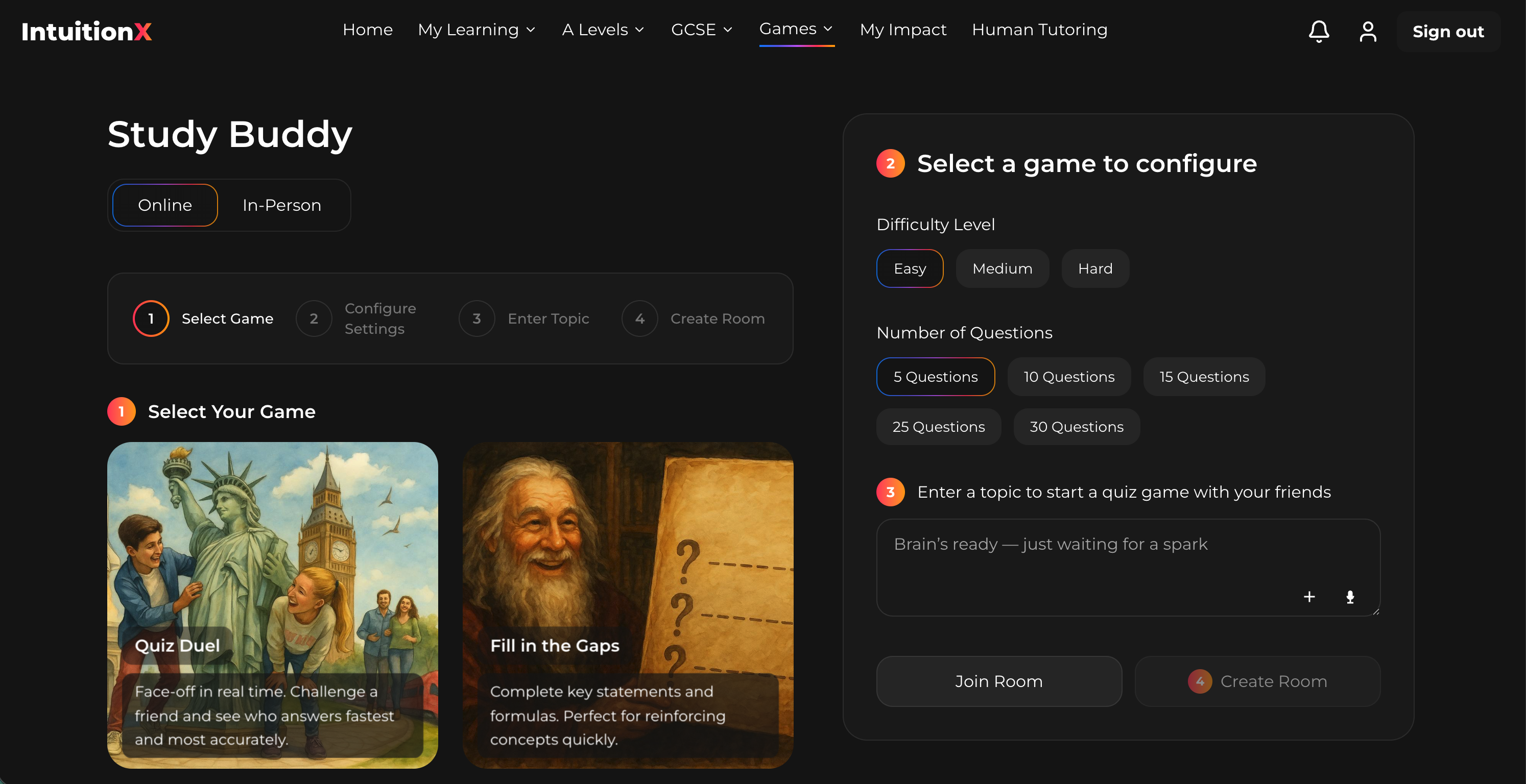
Visit IntuitionX to explore a tutoring experience that blends the best of AI efficiency with the kind of intellectual rigour that elite students benefit from every day. Whether you are a parent looking for affordable, high-quality support or a student who wants a thinking partner available at any hour, IntuitionX offers a research-backed, ethically grounded solution. And with 10% of revenue committed to the International Rescue Committee's educational programmes, every subscription also supports children in crisis and conflict regions worldwide.
Frequently asked questions
Are digital tutors suitable for all age groups?
Digital tutors work well for most primary and secondary pupils, but children with complex special needs may require human support, as AI lacks the empathy needed for emotionally sensitive or disability-related learning challenges.
How cost-effective are digital tutors?
Extremely cost-effective. One US randomised trial showed that AI co-pilots cost just $20 per tutor per year whilst boosting student mastery by up to 9 percentage points, compared to hundreds or thousands of pounds for equivalent private tuition.
Do AI tutors replace the need for human tutors?
No. AI dramatically expands access and can boost learning gains, but it cannot replicate the empathy or motivational coaching of a skilled human tutor, particularly for students with unique emotional or learning needs.
What is the biggest risk of using AI tutors?
Unsupervised AI can produce occasional errors ("hallucinations") and, more critically, can become a shortcut that bypasses genuine thinking. Research from PNAS shows that AI needs pedagogical guardrails to avoid undermining the very learning it is meant to support.