

AI can now adapt a lesson to your child's exact strengths and weaknesses in real time, something no single teacher managing thirty pupils could ever do alone. Yet most students are still stuck in a one-size-fits-all system that leaves too many behind. 73% of UK students are not actively engaged in learning, and in the US, 80% report feeling bored in class. This article explores how AI is changing that reality, from personalising learning pathways to closing educational gaps, boosting engagement, and giving every student a genuine shot at academic success.
Table of Contents
- What is AI in education?
- How AI enables personalised learning
- Bridging educational gaps with AI
- AI for engagement and motivation
- Limitations, challenges, and safeguarding with AI in education
- How to get started with AI-powered learning
- Explore IntuitionX: your educational AI companion
- Frequently asked questions
Key Takeaways
| Point | Details |
|---|---|
| Personalised learning | AI adapts content and pace to fit each student's needs and strengths. |
| Bridging gaps | AI identifies and supports students who need extra help, closing learning gaps. |
| Boosting engagement | AI makes sessions interactive and fun, increasing motivation and involvement. |
| Responsible use needed | Data privacy, oversight, and informed choices ensure AI is safe and effective. |
What is AI in education?
To start, it is important to define what AI in education really means for students and parents. Artificial intelligence, at its core, refers to software that can analyse data, recognise patterns, and make decisions without being explicitly programmed for every scenario. In education, that means tools that can adapt content to learner needs rather than delivering the same lesson to everyone.
AI is already being used across a wide range of educational settings. Here are the main areas where it operates:
- Tutoring and one-to-one support: AI tutors provide instant, personalised explanations and feedback outside classroom hours.
- Assessment and marking: Automated tools analyse student responses and flag areas of weakness quickly.
- Lesson planning: Teachers use AI to generate differentiated resources tailored to different ability levels.
- Classroom management: AI platforms track attendance, participation, and progress to support teacher decision-making.
One of the most persistent myths is that AI will replace teachers. It will not. AI-powered education platforms are designed to support educators, not substitute them. Think of AI as the world's most patient teaching assistant, one that never gets tired and never loses its temper.
How AI enables personalised learning
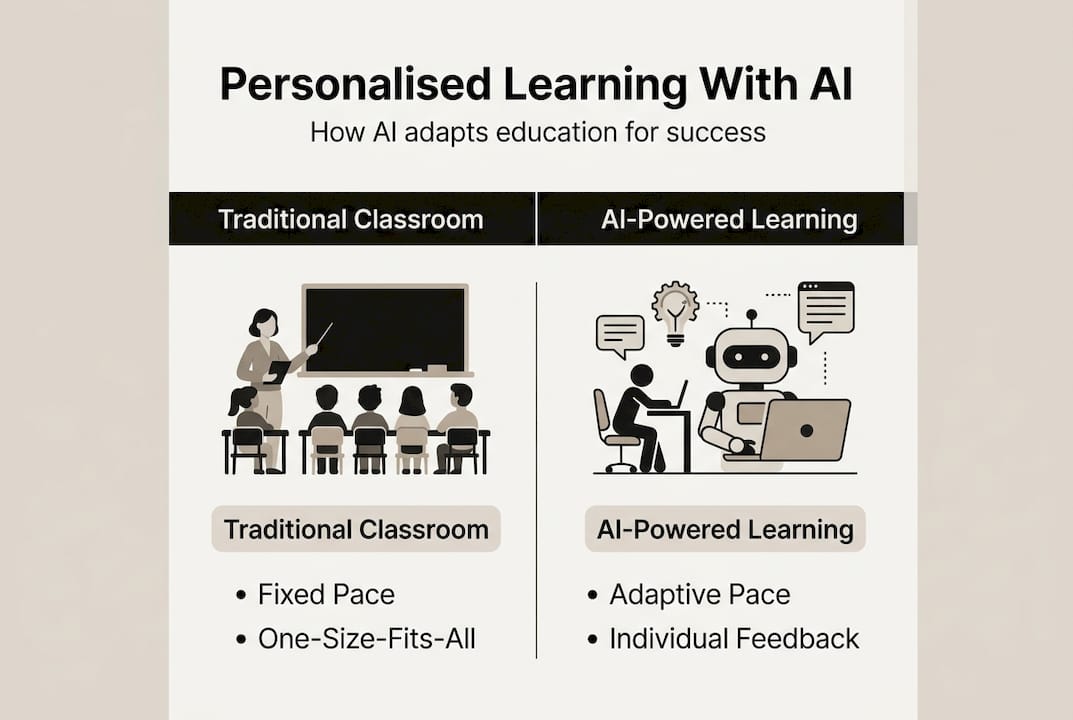
With that understanding, let us look at how AI delivers one of its biggest promises in education: personalisation. Traditional classrooms move at a fixed pace. A student who grasps algebra quickly is held back waiting for others to catch up, while a student who struggles is swept forward before they are ready. AI breaks that cycle entirely.
AI uses data to tailor lessons and recommendations for each student, tracking every interaction, every correct answer, and every mistake. The system builds a detailed picture of where a student excels and where they need more support, then adjusts the difficulty, format, and pace of content accordingly.

| Feature | Traditional classroom | AI-powered learning |
|---|---|---|
| Pace | Fixed for the whole class | Adapts to each student |
| Feedback | Delayed (marked homework) | Instant and specific |
| Gap identification | Teacher observation | Automated data analysis |
| Resources | Same for everyone | Tailored to individual needs |
| Availability | School hours only | 24/7 access |
The results of personalised AI tutoring speak for themselves. Students who receive adaptive instruction show stronger confidence, better retention, and higher test scores compared to those in purely traditional settings. Personalisation also reduces anxiety because students are not constantly comparing themselves to peers working on different material.
Pro Tip: If your child is using an AI learning tool, encourage them to review the feedback after every session, not just the score. The explanation of why an answer was wrong is where the real learning happens.
Bridging educational gaps with AI
Personalisation is just one advantage, but how does AI help those at risk of falling behind or with special educational needs? This is where AI moves from being a convenience to being genuinely transformative.
AI can identify at-risk learners and target interventions before a small gap becomes an insurmountable one. By analysing quiz results, assignment patterns, and time-on-task data, AI flags students who are struggling and recommends specific resources or extra practice. Teachers receive this information in digestible dashboards, allowing them to act quickly.
"Nearly 800 million children worldwide have no access to education at all. AI cannot solve every barrier, but for those with connectivity, it can deliver the kind of individualised support that was previously reserved for the privileged few."
Students with special educational needs (SEN) benefit enormously from AI accessibility features. These include:
- Text-to-speech: Supports students with dyslexia or visual impairments.
- Adjustable reading levels: Content is rewritten at a simpler or more complex level on demand.
- Language support: Multilingual interfaces help students whose first language is not English.
- Extended time settings: AI tools do not rush students, removing the pressure of a ticking clock.
- Visual and audio alternatives: Concepts are presented in multiple formats to suit different learning styles.
AI also reduces certain forms of human bias. When supporting diverse learners, data-driven recommendations are based on performance rather than a teacher's subjective impression, which can sometimes be influenced by unconscious assumptions about a student's background or ability.
AI for engagement and motivation
Alongside bridging gaps, AI is also changing how students feel about learning itself. Engagement is arguably the biggest crisis in modern education. When 91% of US students feel nervous about asking questions in class, something is fundamentally broken. AI offers a judgement-free environment where curiosity is always rewarded.
AI can gamify learning and encourage participation through features that make progress visible and rewarding. Here is how that works in practice:
- Badges and milestones: Students earn recognition for completing challenges, which builds a sense of achievement.
- Adaptive difficulty: Tasks get harder as a student improves, keeping them in the productive zone between boredom and frustration.
- Instant encouragement: AI chatbots provide positive, personalised feedback after every attempt, not just the correct ones.
- Interactive tutorials: Lessons respond to a student's attention level, switching format if engagement drops.
- Parental dashboards: Parents can see progress in real time, enabling supportive conversations at home rather than anxious ones.
The psychological impact of this should not be underestimated. When a student sees their own progress mapped visually, when they receive encouragement immediately after a difficult problem, their relationship with learning shifts. It stops feeling like something done to them and starts feeling like something they are doing for themselves.
Pro Tip: Use interactive AI learning tools alongside your child for the first few sessions. Showing genuine curiosity about what they are learning is one of the most powerful motivators a parent can offer.
Limitations, challenges, and safeguarding with AI in education
With the benefits clear, it is crucial to address the challenges and ensure responsible AI use. No technology is without risk, and AI in education is no exception.
AI in education raises questions around data privacy, bias, and overreliance that parents and schools must take seriously. Here is a balanced comparison of the risks and the mitigations available:
| Challenge | Why it matters | How to mitigate it |
|---|---|---|
| Data privacy | Student data can be misused or breached | Choose platforms with clear GDPR compliance and privacy policies |
| Algorithmic bias | AI trained on non-inclusive data can disadvantage certain groups | Use platforms that publish their training data standards |
| Overreliance | Students may stop thinking independently | Set boundaries on AI use; encourage offline problem-solving too |
| Lack of empathy | AI cannot replace human connection or pastoral care | Ensure teachers remain central to the learning relationship |
| Access inequality | Not all students have devices or reliable internet | Schools and governments must invest in infrastructure |
Key statistic: 73% of UK students are not actively engaged in learning. Generic AI tools that simply write essays for students make this worse, not better. The goal of responsible AI in education is to increase independent thinking, not bypass it.
Human oversight remains non-negotiable. Teachers bring empathy, ethical judgement, and an understanding of a child's whole life that no algorithm can replicate. AI should empower educators, not sideline them.
How to get started with AI-powered learning
Once informed, you might want to explore AI tools at home or school. Here is how to start without feeling overwhelmed.
Choosing reputable, transparent platforms is the most important first step. Not all AI education tools are equal, and some prioritise engagement metrics over genuine learning outcomes. Follow these steps to get started well:
- Define your goals first. Is your child struggling with a specific subject? Do they need enrichment beyond the classroom? Knowing the goal shapes the tool you choose.
- Research the platform's credentials. Look for evidence of educational expertise behind the product, not just slick design.
- Trial it together. Sit with your child for the first few sessions. Observe how the tool responds to mistakes and whether it explains concepts clearly.
- Track progress over time. Use the platform's reporting features to monitor improvement. If progress stalls, adjust the approach.
- Balance AI with offline learning. Reading physical books, writing by hand, and discussing ideas face-to-face all build skills that AI cannot replicate.
When choosing an AI tutor, ask whether the platform uses Socratic questioning rather than simply providing answers. The difference between a tool that hands a student the answer and one that guides them to discover it themselves is the difference between passive consumption and genuine learning.
Explore IntuitionX: your educational AI companion
If you are ready to put what you have learned into action, IntuitionX is built for exactly this moment. Unlike generic AI that scrapes the internet and writes essays for students, IntuitionX is a 24/7 Socratic AI tutor built on Oxbridge-level academic expertise, designed to make students think, not just copy.
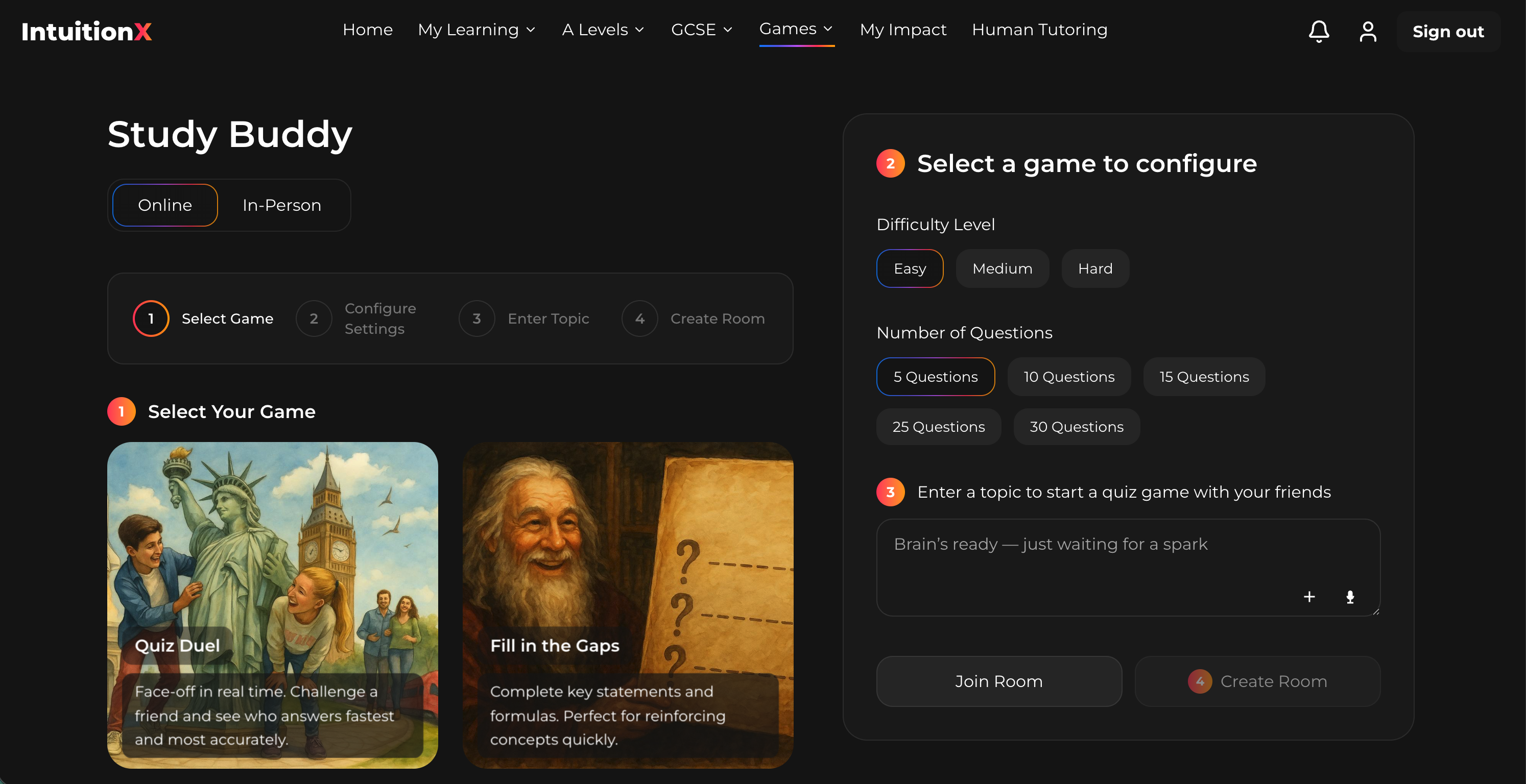
Backed by Sir Anthony Seldon, described by the BBC as one of Britain's leading educationalists, and with a first-of-its-kind agreement with the International Rescue Committee committing 10% of revenue to education in crisis regions, IntuitionX is education with a conscience. Every subscription helps fund learning for children who have none. Start your journey with the IntuitionX app today and discover what learning like the 1% actually feels like.
Frequently asked questions
How does AI personalise learning for each student?
AI continuously analyses how a student interacts with materials and adapts content accordingly, adjusting pace, difficulty, and format to match each learner's needs.
Is AI safe for student privacy?
Responsible platforms apply strict data security and privacy protections, but always check for GDPR compliance and a clear privacy policy before signing up.
Does AI replace teachers?
No. AI assists teachers by handling data analysis and personalised feedback, but human educators remain essential for empathy, pastoral care, and social development.
What should parents look for in an AI education tool?
Prioritise platforms with transparent, proven methods, strong privacy assurances, and evidence of genuine learning outcomes rather than just engagement metrics.