

TL;DR:
- AI tutors improve learning outcomes by personalizing instruction and providing 24/7 access.
- Combining AI with human oversight offers the most effective approach for student success.
- Starting with free platforms and monitoring engagement helps parents implement AI tutoring effectively.
Private tutoring in the UK can cost upwards of £80 per hour, and even then, there is no guarantee your child will stay engaged or make consistent progress. It is a frustrating reality many parents know well. The good news is that AI tutors outperform traditional methods, doubling learning gains in less time for secondary students. This guide walks you through the entire AI tutoring process, from choosing the right platform to tracking real results, so you can make a confident, informed decision for your child.
Table of Contents
- Why choose AI tutoring? Evidence, benefits and limits
- Getting started: what you need for effective AI tutoring
- Step-by-step: setting up your AI tutoring environment
- Monitoring progress: how to track outcomes and keep engagement high
- Our perspective: why the AI+human blend delivers the real results
- Ready to get started with AI tutoring?
- Frequently asked questions
Key Takeaways
| Point | Details |
|---|---|
| AI tutors deliver proven results | AI tutoring doubles learning gains in key subjects and makes one-to-one support affordable for UK families. |
| Setup is simple and flexible | Getting started with AI tutoring requires only basic tech, a reliable platform, and parental involvement. |
| Blending AI with human oversight is best | The best outcomes come from combining AI tools with regular check-ins and emotional support. |
| Monitoring progress is essential | Parental engagement and dashboard tracking ensure motivation stays high and outcomes remain strong. |
Why choose AI tutoring? Evidence, benefits and limits
AI tutoring is not just a trend. The research behind it is genuinely compelling. Studies show that AI tutors scaled one-to-one instruction, showing a +5.5 percentage point improvement in novel maths problems over human tutors. That is a meaningful, measurable result. And unlike a private tutor who is available for one hour a week, an AI tutor is available at midnight before an exam.
The strongest benefits are worth knowing clearly:
- Personalisation: AI adapts to your child's pace, not a classroom average.
- On-demand access: Available 24/7, including weekends and school holidays.
- Progress tracking: Built-in dashboards show exactly where your child is improving.
- Affordability: A fraction of the cost of traditional private tutoring.
- Consistency: No cancelled sessions, no variable quality between tutors.
AI tutoring particularly excels in education technology subjects like maths and sciences, where structured problem-solving lends itself well to algorithmic feedback. It is less suited to the nuanced, emotionally rich conversations that great English literature or pastoral care requires.
Honesty matters here. 84% of social and emotional learning elements remain largely untouched by AI. That is a real limitation. Your child still needs human connection, encouragement, and someone who notices when they are struggling emotionally, not just academically.
| Feature | AI tutoring | Traditional tutoring |
|---|---|---|
| Availability | 24/7 | Fixed hours |
| Cost | Low to moderate | High (£50 to £100+/hr) |
| Personalisation | Algorithm-driven | Tutor-dependent |
| Emotional support | Limited | Strong |
| Progress tracking | Automated | Manual |
| Subject strength | STEM-focused | Broad |
Think of AI tutoring as a powerful engine for routine practice and targeted skill-building. It frees up any human support you invest in to focus on the deeper stuff: critical thinking, motivation, and genuine understanding. That combination is where the real magic happens. As we explore AI learning companions more broadly, the evidence consistently points to blended approaches outperforming either method alone.
Getting started: what you need for effective AI tutoring
Before your child logs in for their first session, a few practical things need to be in place. Getting the basics right from the start saves a lot of frustration later.
Device and connectivity requirements:
- A laptop, tablet, or smartphone with an up-to-date browser
- A reliable broadband connection (most AI tutoring platforms are browser-based)
- Headphones, particularly useful for audio-based explanations
- A quiet, distraction-free space for sessions
Once you have the hardware sorted, the next step is choosing the right platform. UK parents can trial free options like Khan Academy or prompt general AI tools, and monitoring engagement is key to ongoing learning.
| Platform | Best for | Free option | UK curriculum aligned | Socratic method |
|---|---|---|---|---|
| Khan Academy + Khanmigo | Maths, science | Yes | Partial | No |
| IntuitionX | All subjects, A-level focus | Trial available | Yes | Yes |
| ChatGPT | General queries | Yes | No | No |
| Seneca Learning | GCSE revision | Yes | Yes | No |
Not all platforms are equal. Generic AI tools can write an essay for your child, but that is not learning. That is bypassing learning. What you want is a platform that asks questions back, challenges thinking, and guides your child to the answer rather than handing it over.
Pro Tip: Start with a free trial and monitor your child's motivation and engagement for a full week before committing to a paid subscription. If they are leaning in, asking follow-up questions, and finishing sessions without being chased, that is a very good sign.
Also consider whether the platform requires a parent account alongside the student account. Parental visibility into session history and progress is not optional. It is essential, especially in the early weeks.
Step-by-step: setting up your AI tutoring environment
With everything in place, here is how to get your child's AI tutoring environment properly configured. Take it one step at a time.
-
Register and create accounts. Set up both a parent account and a student account. Use your child's actual year group and age so the platform calibrates correctly from day one.
-
Select subjects and year group. Choose the subjects your child most needs support in. Start with one or two, not everything at once.
-
Personalise learning targets. Most platforms allow you to set specific goals, such as improving algebra scores or preparing for a GCSE mock exam. Be specific. Vague goals produce vague results.
-
Set daily and weekly session goals. Even 20 to 30 minutes per day is enough to see meaningful improvement over a term. Consistency beats intensity.
-
Enable notifications and progress dashboards. Turn on weekly summary emails or alerts so you are kept in the loop without hovering over your child's shoulder.
-
Run a trial session together. Sit with your child for their first session. Understand how the platform works, what kinds of questions it asks, and how it responds to mistakes.
"70% of students complete AI tutoring sessions in under 60 minutes, and engagement levels remain significantly higher than with traditional homework methods."
That efficiency matters. Your child is not wasting time. They are working in focused, productive bursts. Understanding smarter tutoring with AI means recognising that shorter, targeted sessions often outperform long, unfocused study blocks.

Pro Tip: Begin with a single subject for the first one to two weeks. Track engagement and outcomes before expanding to additional subjects. This keeps the experience manageable and lets you identify what is working early.
Monitoring progress: how to track outcomes and keep engagement high
Setting up the platform is the easy part. Keeping the momentum going is where most parents need a clear strategy. Fortunately, good AI tutoring platforms do a lot of the heavy lifting for you.
What to look for in progress reports:
- Weekly accuracy rates per topic
- Time spent per session (consistency matters more than duration)
- Areas flagged as weak by the platform's algorithm
- Improvement trends over four to six weeks
Most platforms generate these automatically. Review them every week or two, not daily. Daily checking creates pressure; fortnightly reviews create perspective.
| Approach | Strengths | Weaknesses |
|---|---|---|
| AI only | Scalable, consistent, affordable | No emotional support, limited creativity |
| AI + human oversight | Balanced, adaptive, motivating | Requires coordination and some cost |
| Human tutor only | Personal, emotionally rich | Expensive, inconsistent availability |
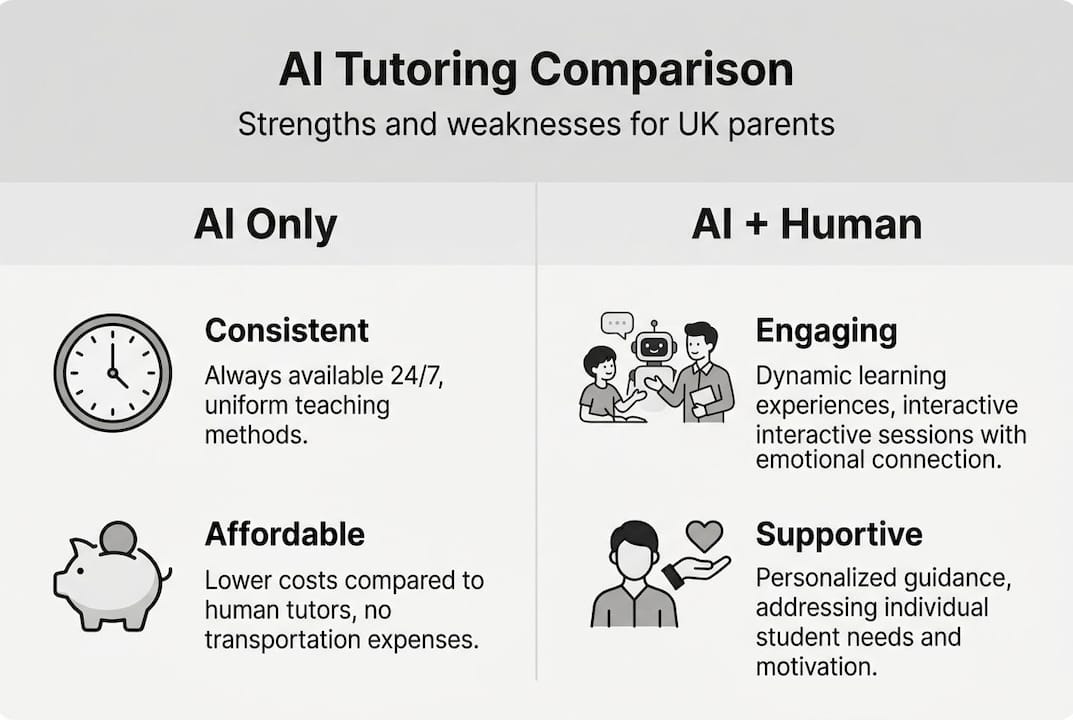
Best results come when AI tutors supplement, not fully replace, existing teaching or mentoring. That is not a caveat. It is the strategy.
Know the red flags. If you notice any of the following, it is time to step in:
- Plateaued results over three or more weeks with no improvement
- Your child skipping sessions or making excuses to avoid them
- Visible frustration or complaints that the platform is too hard or too easy
- A drop in overall school performance despite regular AI sessions
When these signals appear, a conversation matters more than a dashboard. Ask your child how they are feeling about their learning, not just how many sessions they have completed. Celebrate milestones too. Finishing a topic module, hitting a target score, or simply completing a full week of sessions all deserve recognition. Motivation is fuel, and it needs to be replenished. Explore resources on empowering student learning to find practical ways to keep your child inspired through the process.
Our perspective: why the AI+human blend delivers the real results
Here is something most guides will not say plainly: full automation in education is a myth, and chasing it will let your child down.
We have seen what happens when parents hand over the learning process entirely to technology. The platform becomes background noise. Sessions get completed without genuine thinking. Grades might tick up slightly, but the deeper confidence and curiosity that make a student truly succeed? Those stall.
Human oversight remains essential for the social and emotional aspects of learning, and for troubleshooting when engagement drops. This is not a weakness of AI. It is simply an honest recognition of what technology can and cannot do.
The parents who see the best outcomes are not the ones who set up a platform and step back. They are the ones who use AI to handle the repetitive, structured practice, and then show up themselves for the conversations that matter. They check in emotionally. They ask what clicked and what did not. They treat AI-driven personalisation as a tool in a wider strategy, not the strategy itself. That is the mindset that produces real, lasting results.
Ready to get started with AI tutoring?
If this guide has given you a clearer picture of how AI tutoring actually works, the next step is straightforward. Try it.
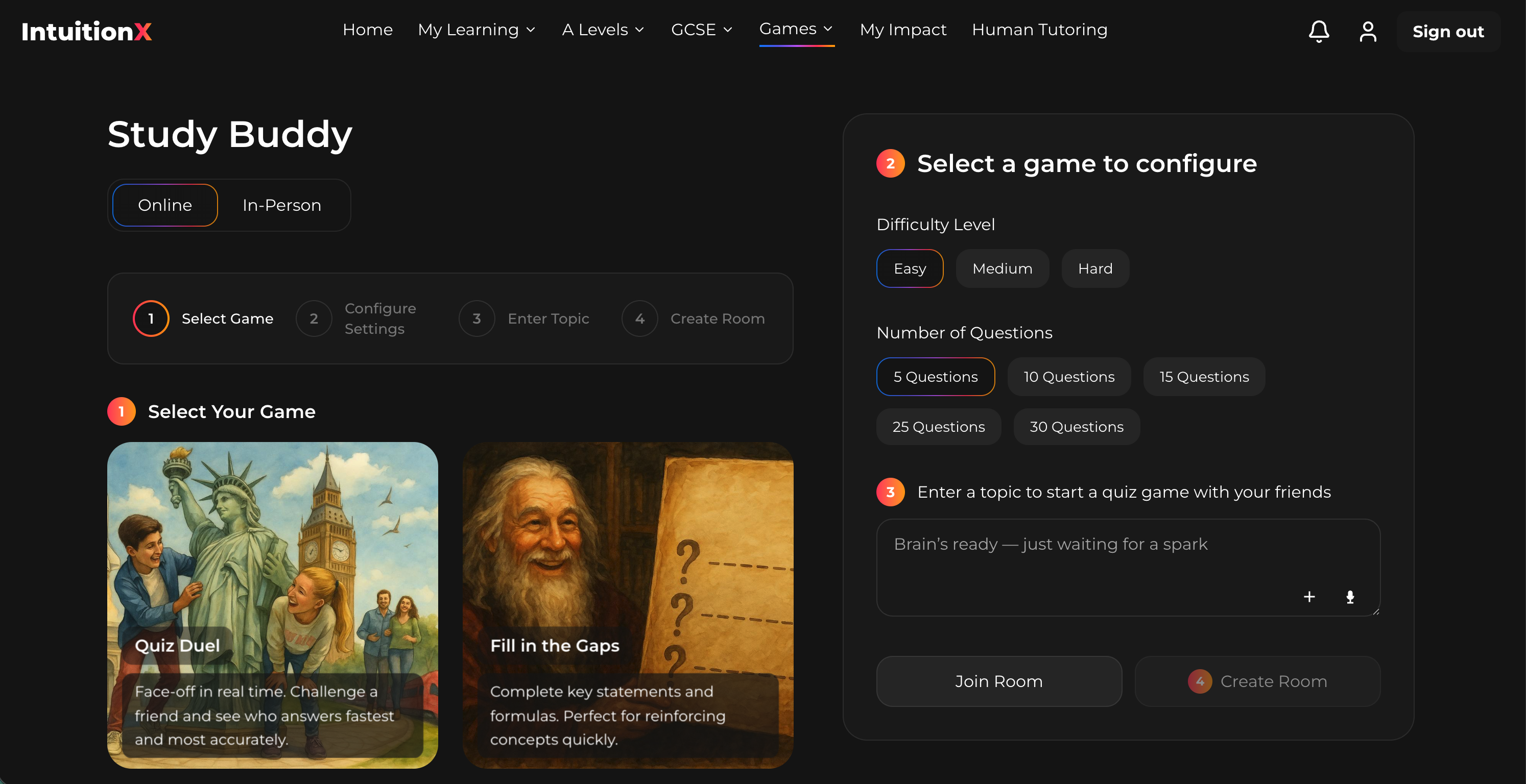
IntuitionX is a 24/7 Socratic AI tutor built on Oxbridge-level academic expertise, designed specifically to guide students to answers through questioning rather than just handing them over. It is backed by Sir Anthony Seldon, one of Britain's leading educationalists, and aligned with the UK curriculum. There is a trial available, so you can see how your child responds before committing. Start with one subject, monitor engagement for a week, and let the evidence guide your next decision. Your child deserves a tutor that genuinely makes them think.
Frequently asked questions
Does AI tutoring work for all subjects or just maths and science?
AI tutoring delivers strongest gains in maths and science, where structured problem-solving suits algorithmic feedback well. Humanities and emotional learning still benefit significantly from human guidance and discussion.
Is AI tutoring safe and appropriate for teenagers?
AI tutoring is safe when parents maintain oversight and review privacy settings on any platform used. Human oversight is essential for balanced development, particularly for younger teenagers navigating both academic and emotional pressures.
How can parents ensure AI tutoring stays effective over time?
Review progress reports fortnightly, watch for red flags like skipped sessions or plateaued results, and bring in human support when motivation or emotional needs arise. Supplementing AI with human intervention consistently produces the best sustained outcomes.
What is the best way to start AI tutoring for free in the UK?
Begin with platforms like Khan Academy using their Khanmigo AI assistant, or explore a general AI tool to gauge your child's response before upgrading. UK parents should start with free trials to assess engagement and fit before committing to paid options.