
TL;DR:
- Teaching is the observable practice, while pedagogy encompasses the deliberate design behind classroom decisions. Pedagogy aligns beliefs about learning with teaching methods, shaping student outcomes through intentional choices. Effective engagement in humanities requires deliberate pedagogical strategies, meaningful feedback, and adaptable practices grounded in a clear philosophical framework.
Most people think teaching is pedagogy. It is not. Teaching is what you can observe: a teacher at the board, students answering questions, a worksheet being handed out. The role of pedagogy in learning goes far deeper. It is the intentional design behind every classroom decision, the philosophy that connects what you believe about learners to how you actually teach them. For educators and parents navigating secondary humanities education, understanding this distinction is not academic; it is the difference between a lesson that lands and one that is simply delivered. This guide shows you what that looks like in practice.
Table of Contents
- Understanding pedagogy: beyond teaching to intentional design
- Pedagogical strategies that boost student engagement in humanities
- The critical role of effective feedback in shaping learning outcomes
- Implementing reader-response pedagogy with structured classroom practices
- Aligning pedagogy to diagnose and design for engagement
- A fresh perspective on pedagogy: moving from theory to dynamic classroom practice
- Explore tools to bring thoughtful pedagogy to life
- Frequently asked questions
Key Takeaways
| Point | Details |
|---|---|
| Pedagogy is intentional design | Pedagogy is the purposeful alignment of teaching methods with educational beliefs to shape learning outcomes effectively. |
| Engagement needs design | Active student engagement results from deliberate pedagogical choices like collaboration and ongoing feedback, not just teaching style. |
| Feedback drives learning | Timely, specific feedback aligned to learning goals is crucial for motivating students and improving performance. |
| Reader-response requires structure | Effective reader-response pedagogy uses consistent classroom routines to enrich understanding and personal connection. |
| Pedagogy in practice matters | Pedagogical theories have impact only when translated into responsive, moment-to-moment teaching decisions. |
Understanding pedagogy: beyond teaching to intentional design
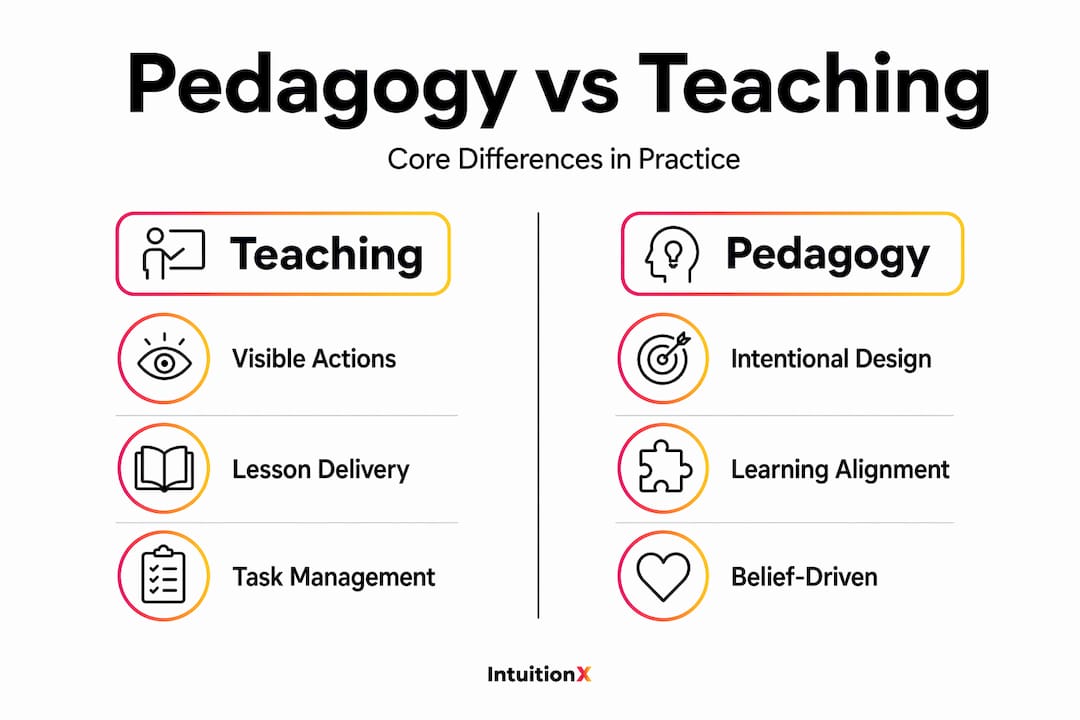
People often use "teaching" and "pedagogy" as if they mean the same thing. They do not. Teaching is the visible surface. Pedagogy is the thinking underneath it.
Pedagogy is intentional alignment between your beliefs about learning and the choices you make in the classroom. It is not just observable teaching. That distinction matters enormously, because it means two teachers can run what looks like the same lesson and produce completely different outcomes, depending on the pedagogical framework guiding their decisions.
When you approach teaching and learning concepts with pedagogical awareness, every choice becomes deliberate. Why are students in groups today? Why is this topic introduced through a primary source rather than a textbook summary? Why are you asking questions instead of explaining? These are pedagogical questions, and they shape outcomes far more than surface delivery style.
There are three broad traditions worth knowing:
- Traditional pedagogy: teacher-led instruction, structured content delivery, clear authority in the classroom. Effective for foundational knowledge transfer.
- Constructivist pedagogy: students build meaning through experience, dialogue, and inquiry. Strong for humanities subjects where interpretation matters.
- Critical and culturally responsive pedagogy: teaching that acknowledges students' identities, challenges power structures, and connects content to real-world contexts.
"Pedagogy is not a technique you apply. It is a set of principles you make real, moment by moment, through your instructional design choices."
None of these traditions is universally superior. The importance of pedagogy lies in choosing the right framework for your students, your subject, and your goals, and then staying consistent with it across your planning and delivery.
Pedagogical strategies that boost student engagement in humanities
Knowing what pedagogy is matters less than knowing what it produces. So let us look at what the evidence says actually increases student engagement in humanities classrooms.
Collaborative learning and formative feedback consistently improve engagement, particularly in design-thinking and discussion-heavy courses. Humanities subjects like history, English literature, and philosophy are ideal environments for both. The reason is straightforward: these subjects require students to construct arguments, weigh perspectives, and communicate ideas, precisely the conditions where social and cognitive engagement thrive.

Reader-response pedagogy is one of the most underused approaches in secondary humanities. Rather than asking students to retrieve a "correct" reading of a text, it positions them as active co-creators of meaning. This approach uses structured practices including literature discussions, free response writing, varied reading modalities, and teacher read-alouds to deepen empathy and support identity formation. The result is not just better engagement; it is more genuine literary understanding.
Here is a comparison of traditional and engagement-focused pedagogical strategies in humanities:
| Strategy | Traditional approach | Engagement-focused approach |
|---|---|---|
| Text analysis | Teacher explains meaning | Students discuss personal responses first |
| Writing tasks | Formal essay with set criteria | Free response followed by structured reflection |
| Discussion | Teacher-led Q&A | Student-led small group dialogue |
| Feedback | End-of-task grade | Ongoing formative check-ins |
| Reading | Silent individual reading | Read-alouds, annotation, and paired reading |
Four practices that reliably increase engagement in humanities:
- Structured literature discussions where students defend and revise positions
- Free response writing that allows personal voice before formal drafting
- Varied reading modalities, including paired, silent, and teacher-led reading
- Frequent low-stakes feedback that rewards thinking over getting it right
Explore more engagement strategies that translate directly into improved outcomes, and consider how engagement techniques from online settings can inform your in-person practice.
Pro Tip: Combine collaborative tasks with frequent, specific feedback. Students who discuss ideas and receive timely responses to their thinking show the highest engagement gains in humanities subjects. Do not choose between collaboration and feedback; use both deliberately.
The critical role of effective feedback in shaping learning outcomes
Feedback is one of the most powerful tools in any teacher's repertoire. It is also one of the most misused. The impact of teaching methods on learning outcomes often comes down not to what was taught, but to how feedback was given and received.
Effective feedback must be understandable, actionable, and aligned with learning intentions and success criteria. That sounds straightforward. In practice, most classroom feedback fails at least one of those three tests. Comments like "good effort" or "needs more analysis" communicate almost nothing useful to a secondary student trying to improve their history essay.
Here is what genuinely effective feedback looks like in secondary humanities:
- Task-level feedback: specific comments on what was done well or poorly in this particular piece of work
- Process-level feedback: guidance on the strategies and approaches that led to the outcome
- Self-regulation feedback: prompts that help students reflect on and monitor their own learning
- Alignment: every comment tied to the learning intention for that task, not just general improvement
Timing matters enormously. Feedback given a week after a formative writing task is far less useful than feedback given within the lesson or the following day, while the thinking is still fresh. This is where personalised learning strategies become so valuable; they allow feedback to be targeted and immediate rather than generic and delayed.
The gap between feedback being given and feedback being used is where most progress is lost. Students need to understand what the feedback means, believe it is relevant to them, and have a clear opportunity to act on it. That is a pedagogical responsibility, not just a marking one. You can find more on student engagement insights to understand why this action gap exists and how to close it.
Pro Tip: Build a classroom culture where mistakes are evidence of thinking, not signs of failure. When students feel safe to be wrong, they engage more honestly with feedback and apply it more readily.
Implementing reader-response pedagogy with structured classroom practices
Reader-response pedagogy sounds simple. Give students a text. Ask what they think. But without structure, it becomes aimless, and aimless discussion does not build literary understanding. Structured classroom routines are what prevent an "anything goes" culture and ensure that personal responses lead somewhere meaningful.
The four core routines of reader-response pedagogy are:
- Literature discussions: structured protocols where students share, challenge, and refine their interpretations of a text
- Creative and free response writing: low-stakes writing that captures personal reactions before formal analysis begins
- Reading modality practices: mixing silent reading, paired reading, and listening to vary how students encounter texts
- Teacher read-alouds: modelling fluency, tone, and interpretive thinking in real time
Beyond these routines, genre selection is a genuine pedagogical act. Choosing texts that connect with your students' cultural backgrounds, lived experiences, or current questions makes literary engagement feel relevant rather than compulsory.
The benefits are substantial:
- Deeper empathy through inhabiting characters and perspectives unlike their own
- Stronger personal connections to texts, which improves memory and motivation
- Identity formation as students see themselves reflected in, or challenged by, literature
- Richer written analysis once personal response has been grounded in structured discussion
Here is how traditional and reader-response practices compare in a humanities setting:
| Practice | Traditional | Reader-response |
|---|---|---|
| Entry point | Author's intent | Student's personal response |
| Discussion structure | Teacher poses, student responds | Student poses, peers respond |
| Writing format | Formal analytical essay | Free write then structured reflection |
| Assessment focus | Accuracy of interpretation | Depth of engagement and reasoning |
| Text selection | Canonical curriculum texts | Culturally diverse and contextually relevant |
Pairing this approach with strong learning strategies for humanities ensures that personal engagement translates into academic achievement, not just enjoyment.
Aligning pedagogy to diagnose and design for engagement
Here is a shift in thinking that many educators find genuinely transformative. Engagement is not a mood. It is not something that happens when a lesson goes well. Engagement can be actively diagnosed and designed through pedagogical structures like collaboration and formative feedback, rather than relying on presentation style or student personality.
Think of it this way. If your students are disengaged, the question is not "how do I make this more entertaining?" The question is "which dimension of engagement is low, and what pedagogical structure addresses it?"
Consider the three dimensions:
- Social engagement: are students connecting with peers and the learning community?
- Cognitive engagement: are they thinking deeply, making connections, forming arguments?
- Regulatory engagement: are they setting goals, monitoring progress, and responding to feedback?
Each dimension calls for a different pedagogical response. Low social engagement might call for structured collaborative tasks. Low cognitive engagement might require more open-ended questions and fewer closed tasks. Low regulatory engagement suggests students need more explicit feedback loops and self-assessment opportunities.
Feedback failure often stems from students not understanding or using the feedback they receive, which means the responsibility sits firmly with the teacher's pedagogical design, not the student's attitude. This is a perspective shift that changes how you plan lessons and how you evaluate what went wrong when a class falls flat.
How does pedagogy influence learning in this diagnostic sense? It gives you a language for identifying where the breakdown is happening and what to change. That is far more powerful than vague reflection. For more on this, boost learning with engagement frameworks, and explore a learner engagement workflow that applies these principles step by step.
Pro Tip: After each lesson, ask yourself which dimension of engagement was highest and which was lowest. That single reflection, done consistently, becomes an extraordinarily precise tool for improving your pedagogical design over time.
A fresh perspective on pedagogy: moving from theory to dynamic classroom practice
Here is something most guides on the importance of pedagogy will not tell you. Having a well-articulated pedagogical philosophy means very little if it only lives in your lesson plans.
The educators we have seen make the greatest difference are not the ones with the most sophisticated theoretical frameworks. They are the ones who audit their practice moment by moment. They notice when a task they planned is not producing the thinking they intended, and they adjust on the spot. They connect their daily classroom moves to their core beliefs about how learning happens, and when there is a gap, they close it.
We think of this as the 70/30 rule. Anchor 70% of your practice in one coherent pedagogical tradition. That gives you consistency, which students need more than variety. Then reserve 30% for responsive adaptation based on what your students actually need in the room, on that day, in that lesson. Rigidity in pedagogy is just as damaging as inconsistency.
For humanities teachers specifically, this matters because the subject itself is interpretive. You cannot teach English literature or history with a purely transmissive approach and expect students to develop genuine analytical voice. The pedagogy must model the intellectual behaviour you want students to develop. If you want critical thinkers, your classroom moves must demonstrate critical thinking.
There is also an emotional dimension here that rarely gets discussed. Effective pedagogy in humanities requires reading students' emotional and cognitive states and adjusting accordingly. A class that has just had a difficult week does not need a high-challenge, high-stakes task. It needs an entry point that rebuilds confidence before asking for performance. Knowing how to make that call is not instinct; it is pedagogical skill, developed through reflection and practice.
Explore what this looks like in pedagogy in online tutoring contexts, where responsive, moment-by-moment adaptation is built into the design of the learning itself.
Explore tools to bring thoughtful pedagogy to life
Translating pedagogical principles into daily classroom reality is genuinely hard work. Knowing that formative feedback matters is one thing. Finding the time to give it well, to every student, consistently, is another. That is where the right tools change everything.

At IntuitionX, we have built an AI tutor that does not just answer questions. It engages students through Socratic dialogue, drawing on the teaching methods of the world's greatest educators, layering in memory science and genuine pedagogical design to produce real learning outcomes. Our conversational AI, Omniscience, adapts to each student's cognitive and emotional state in real time, something no worksheet or one-size-fits-all platform can do. Backed by Sir Anthony Seldon and built on Oxbridge-level academic expertise, IntuitionX gives every student access to the kind of thinking partnership that wealthy families pay £120 an hour to replicate. Explore IntuitionX and see how intentional pedagogy, at scale, transforms what is possible for your students.
Frequently asked questions
What is the difference between pedagogy and teaching?
Teaching refers to the observable actions in the classroom, while pedagogy is the intentional alignment between your beliefs about learning and the methods you choose to enact them.
How does formative feedback improve student engagement?
Formative feedback provides timely, specific guidance that helps students understand where they are and what to do next, which directly increases motivation. Effective feedback must be understandable, actionable, and tied to clear learning intentions to produce this effect.
What classroom practices support reader-response pedagogy?
Literature discussions, creative writing responses, varied reading modality practices, and teacher read-alouds are the four core routines that make reader-response pedagogy structured and effective rather than open-ended and directionless.
Why should engagement be viewed as a design problem rather than a mood?
Because engagement can be actively diagnosed and shaped through intentional pedagogical structures like collaboration and feedback loops, giving teachers a far more precise and repeatable way to improve outcomes than relying on presentation style or student motivation alone.
How can educators ensure feedback is effective?
Feedback must be timely, specific, and directly linked to the learning intention for that task. Beyond clarity, effective feedback requires a classroom culture where students feel safe to engage with it and are given clear opportunities to act on what they have received.