

TL;DR:
- Genuine engagement involves behavioral, emotional, cognitive, and agentic dimensions beyond mere activity.
- High engagement significantly improves grades, reduces dropout rates, and enhances student motivation.
- Effective strategies include active learning, project-based tasks, and personalized approaches, avoiding misconceptions.
Educational engagement dramatically improves achievement, yet it is one of the most misunderstood concepts in modern education. Many parents and teachers assume that a busy classroom or a student who nods along is an engaged one. But true engagement goes far deeper than that. It is not about keeping students occupied. It is about sparking genuine curiosity, building emotional connection to learning, and encouraging students to think hard and take ownership. This article breaks down what educational engagement really means, why it matters so much, which strategies actually work, and which common myths are holding students back.
Table of Contents
- Understanding educational engagement: the core dimensions
- How educational engagement transforms outcomes
- What drives engagement? Approaches that work
- Myths and realities: what engagement is not
- Why a nuanced, flexible approach really beats a one-size-fits-all
- Take engagement further with innovative tools
- Frequently asked questions
Key Takeaways
| Point | Details |
|---|---|
| Four engagement dimensions | Behavioural, emotional, cognitive, and agentic engagement all play essential roles in student learning. |
| Evidence-based impact | Higher engagement leads to better grades, lower dropout rates, and improved well-being for students. |
| Practical strategies work | Active learning, PBL, and collaborative methods can be applied at little to no extra cost. |
| Myths can hinder success | Misconceptions about engagement prevent lasting improvement—nuance is critical. |
| Adaptability is key | Tailoring approaches to individual students and contexts outperforms any one-size-fits-all solution. |
Understanding educational engagement: the core dimensions
Ask ten teachers what engagement looks like and you will get ten different answers. That is part of the problem. Without a shared understanding, it is almost impossible to improve it consistently.
The most useful way to think about engagement is as a multidimensional construct with four distinct layers, each telling a different part of the story.
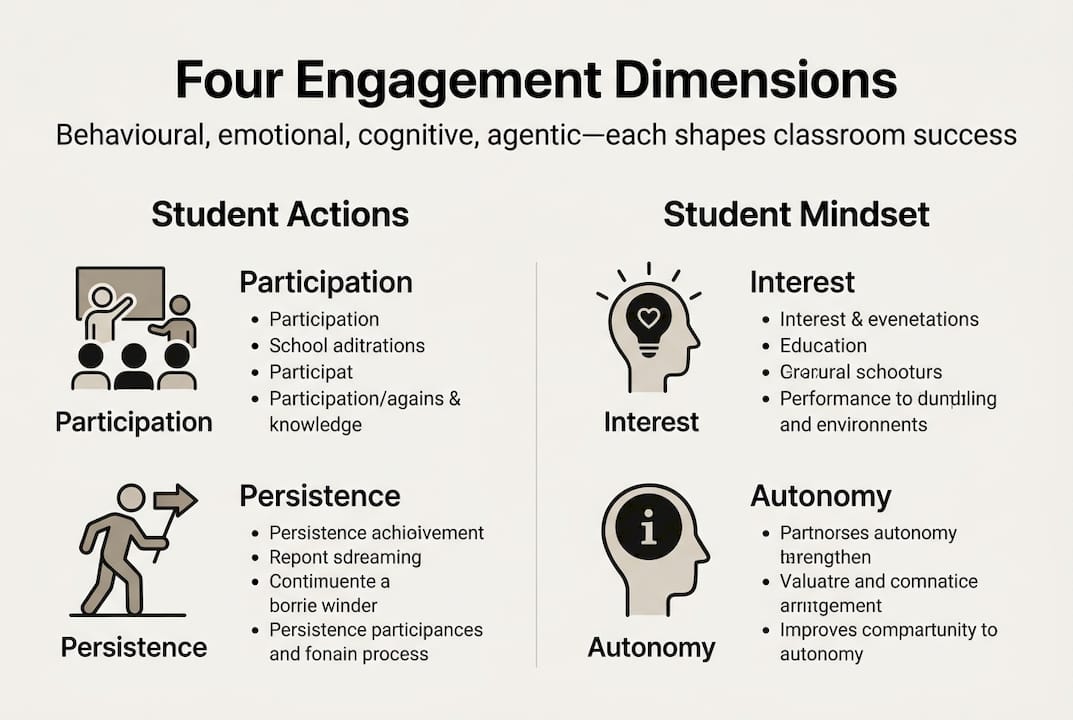
| Dimension | What it means | Signs in the classroom |
|---|---|---|
| Behavioural | Participation and effort | Attending, completing tasks, joining discussions |
| Emotional | Interest, belonging, and enjoyment | Enthusiasm, feeling safe to ask questions |
| Cognitive | Investment in thinking and understanding | Self-questioning, connecting ideas, seeking depth |
| Agentic | Student-initiated action | Asking extra questions, suggesting topics, owning goals |
Think of these dimensions as four dials. A student can have one turned up high while the others sit low. A child who always hands in homework on time (behavioural) but feels no connection to the subject (emotional) and never thinks beyond the surface (cognitive) is not truly engaged. They are compliant.
This distinction matters enormously. Compliance keeps the classroom orderly. Genuine engagement is what builds lasting knowledge and confidence.
"Engagement is not a single trait. It is a dynamic interaction between the learner, the content, and the environment." — expert definition of engagement
Here is what each dimension looks like when it is working well:
- Behavioural engagement: The student shows up, participates, and puts in consistent effort without being prompted.
- Emotional engagement: The student feels that learning is relevant and that they belong in the room. They are not afraid to get things wrong.
- Cognitive engagement: The student wrestles with ideas, makes connections, and asks "why" rather than just "what."
- Agentic engagement: The student takes initiative. They drive their own learning rather than waiting to be directed.
Understanding these layers also connects directly to questions of educational equity and engagement. Students from disadvantaged backgrounds often show surface-level behavioural engagement while struggling emotionally and cognitively, precisely because the system was not designed with their context in mind.
When you focus on all four dimensions together, you move from managing a classroom to genuinely transforming it.
How educational engagement transforms outcomes
Once the core dimensions are clear, it becomes essential to ask: why does engagement matter so much in practice? The answer, backed by solid research, is striking.
High engagement leads to 25% higher grades, 55% lower dropout rates, and 35% better test scores. Those are not marginal improvements. They are the kind of results that change a student's entire trajectory.

And the evidence does not stop there. Active learning reduces failure rates by 1.5 times and boosts exam scores by 6% compared to passive instruction. That means the way you structure learning time has a measurable, direct impact on results.
| Outcome | High engagement | Low engagement |
|---|---|---|
| Average grades | Significantly above expected | Below expected |
| Dropout risk | 55% lower | Much higher |
| Test performance | 35% better | Underperformance common |
| Attendance | Consistent | Declining over time |
| Sense of belonging | Strong | Weak or absent |
Engagement also acts as an early warning system. When a student starts to disengage emotionally or cognitively, it often shows up in attendance and participation before grades begin to slip. That gives teachers and parents a vital window to intervene.
Here is what the research tells us about learner engagement statistics and specific outcomes:
- Students who feel emotionally connected to school are far less likely to drop out.
- Cognitive engagement predicts deeper understanding and better retention of material.
- Agentic engagement correlates with higher motivation and self-directed study habits.
- Low engagement is one of the strongest predictors of absenteeism and long-term academic decline.
Engagement is not just a booster for already-thriving students. It is a preventive tool. Building it early and consistently is one of the most powerful things a school or family can do. For practical ideas on putting this into action, explore these strategies for academic success that connect directly to engagement principles.
What drives engagement? Approaches that work
With the importance established, the next step is to uncover which strategies make engagement possible and practical, especially for students aged 11 to 18.
The good news is that the most effective approaches are well-evidenced and, in many cases, affordable to implement. Active learning, project-based learning, gamification, and collaborative models are all backed by strong research as methods for growing engagement across all four dimensions.
A useful framework here is the ICAP model, which ranks learning activities by depth of engagement:
- Interactive learning (highest engagement): Students co-construct knowledge through dialogue, debate, or collaborative problem-solving. Think Socratic questioning or peer teaching.
- Constructive learning: Students create something new, such as an essay, a model, or a presentation, going beyond what they were directly taught.
- Active learning: Students physically manipulate materials or practise skills, such as experiments, role-play, or worked examples.
- Passive learning (lowest engagement): Students listen or read without producing anything. Useful for introducing ideas but insufficient on its own.
The goal is to move students up this hierarchy as often as possible. Even small shifts, like replacing a lecture with a structured discussion, can dramatically increase cognitive and agentic engagement. Explore specific active learning strategies for secondary-age students to see this in action.
Project-based learning is particularly powerful for emotional engagement. When students work on real-world problems that matter to them, the subject stops feeling abstract and starts feeling relevant. Gamification, used thoughtfully, taps into the same motivational circuits, rewarding effort and progress rather than just correct answers.
For parents, personalised learning explained is worth exploring too. Tailoring the approach to your child's strengths and interests is one of the most effective ways to build all four dimensions of engagement at home.
The engagement frameworks emerging from recent research also highlight the importance of educational technology trends in supporting these methods affordably and at scale.
Pro Tip: When choosing strategies, look for approaches that work for neurodiverse learners too. Methods that reduce anxiety, offer multiple ways to respond, and celebrate progress over perfection tend to lift engagement for all students, not just those who already thrive.
Myths and realities: what engagement is not
A nuanced view is essential for applying strategies that really work, so it is critical to address widespread misconceptions that trip up even experienced teachers and well-meaning parents.
Myth 1: If a student looks busy, they are engaged. Not necessarily. Copying notes, colouring diagrams, or completing repetitive worksheets can all look productive while requiring very little actual thinking. Hands-on does not always mean minds-on, and mistaking activity for engagement is one of the most common errors in education.
Myth 2: Engagement is the same as motivation. Motivation is what gets a student to the desk. Engagement is what happens once they are there. A student can be highly motivated to get good grades but still disengage cognitively if the task is too easy, too hard, or feels meaningless.
Myth 3: One strategy works for everyone. Engagement is deeply personal. What sparks curiosity in one student may bore another. Commercial models and engagement research shows that packaged, one-size-fits-all programmes often dilute engagement by ignoring individual context.
Myth 4: Entertainment equals engagement. A fun lesson is not automatically an engaging one. If students are laughing but not thinking, the emotional dimension may be active while the cognitive and agentic ones sit idle. Entertainment has its place, but it is not a substitute for intellectual challenge.
Here are some practical checks to help you spot genuine engagement:
- Can the student explain why they are doing a task, not just what they are doing?
- Are they asking questions that go beyond what was directly taught?
- Do they show curiosity outside of formal lessons?
- Are they comfortable making mistakes and learning from them?
For ideas on making learning inclusive for all types of learners, it is worth looking at how engagement strategies can be adapted for different needs and contexts.
Pro Tip: If a student seems engaged but cannot recall or apply what they learned a week later, that is a red flag. True cognitive engagement leaves traces. Test understanding, not just performance in the moment.
Why a nuanced, flexible approach really beats a one-size-fits-all
Here is something most guides on engagement miss: engagement is not a fixed state you switch on and leave running. Engagement fluctuates and varies by student, context, and approach. A strategy that works brilliantly on Monday may fall flat on Thursday. A student who is highly engaged in one subject may be completely switched off in another.
This is why checklists fail. You can tick every box, use every recommended strategy, and still find that a student is drifting. The difference between schools and families that get real results and those that do not often comes down to one thing: they keep asking questions and adjusting.
The most effective educators build regular feedback loops. They check in not just on grades but on how students feel about their learning. They notice shifts in energy and curiosity. They treat engagement as something to be cultivated continuously, not achieved once.
Student voice is central to this. When young people have a say in how and what they learn, agentic engagement rises sharply. That does not mean abandoning structure. It means creating space for empowering student learning within a clear framework. Flexibility and evidence-based practice are not opposites. Together, they are the most powerful combination available to any parent or teacher.
Take engagement further with innovative tools
Understanding engagement is the first step. Acting on it is where the real difference is made. For parents and educators ready to put these strategies into practice, innovative technology offers helpful, affordable resources that bring all four dimensions of engagement to life.

IntuitionX is built on Oxbridge-level pedagogy and Socratic questioning, designed to make every student feel genuinely supported and intellectually challenged. Rather than handing students answers, it asks the right questions to build real understanding. It adapts to each learner, supports active and personalised learning, and is available 24/7. Whether your student is preparing for GCSEs or navigating A Levels, explore the educational AI companion that puts genuine engagement at the heart of every session.
Frequently asked questions
What are the main types of educational engagement?
The four core aspects are behavioural, emotional, cognitive, and agentic, covering actions, feelings, thinking depth, and student-initiated learning respectively.
How can parents help boost engagement at home?
Active and personalised methods increase home engagement significantly; parents can support this by encouraging curiosity, showing genuine interest in topics, and adapting study approaches to their child's individual strengths.
Does engagement guarantee better grades?
Engagement boosts grades and reduces dropout risk substantially, but it works best as part of a broader support system that includes consistent encouragement from teachers and families.
Is all group work engaging?
Not all group activities increase engagement; hands-on does not always mean minds-on, and only collaborative tasks that foster genuine participation and deeper thinking reliably build cognitive and agentic engagement.
How can teachers spot disengagement early?
Disengagement predicts absenteeism and dropout before academic decline becomes visible, so watch for declining curiosity, reduced participation, and attendance issues as early warning signs.