
TL;DR:
- Adaptive learning personalizes education by adjusting content and pacing based on individual performance.
- Research shows it significantly improves student achievement, especially in subjects like math and science.
- Combining AI tools with human teaching offers the most effective and ethical approach to learning.
Sitting in a classroom where the teacher moves too fast for some and too slowly for others is a frustration shared by millions of students every single day. Traditional education was built for the average learner, which means it often serves nobody particularly well. Meta-analyses show medium positive effects on learning outcomes when adaptive systems replace one-size-fits-all instruction, with effect sizes reaching Hedges' g of 0.42 to 0.50. Adaptive learning is changing the rules. It tailors content to each individual's pace, strengths, and gaps, making education genuinely effective rather than merely available. This guide covers everything you need to know: what adaptive learning is, how it works, what the evidence says, and how you can put it to work today.

Table of Contents
- Defining adaptive learning: Core concepts and technology
- How adaptive learning adapts: Personalisation in action
- Evidence and outcomes: Does adaptive learning deliver?
- Strengths, limitations, and the future of adaptive learning
- Our verdict: What adaptive learning gets wrong (and right)
- Experience adaptive learning for yourself
- Frequently asked questions
Key Takeaways
| Point | Details |
|---|---|
| Adaptive learning defined | Adaptive learning leverages AI to personalise lessons and assessments for each student’s needs. |
| Evidence of impact | Research shows adaptive learning delivers measurable achievement gains, especially with consistent use. |
| Hybrid success | Combining adaptive technology with teacher support produces the strongest student outcomes. |
| Limitations and safeguards | Awareness of privacy, bias, and equity issues is crucial as adaptive solutions continue to evolve. |
Defining adaptive learning: Core concepts and technology
Now that we've set the stage for why personalisation matters, let's clarify exactly what adaptive learning involves, and how it stands out from other educational approaches.
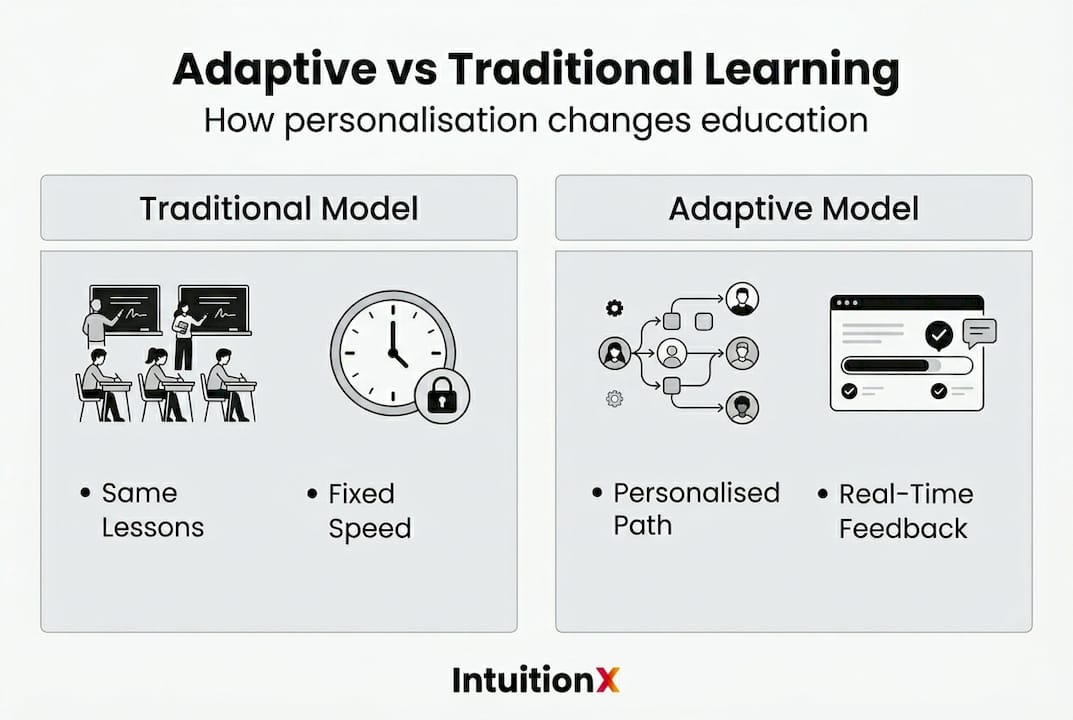
Adaptive learning is an approach to education that uses algorithms and real-time data to adjust what a student sees, practises, and reviews based on their individual performance. Instead of every learner following the same path through a textbook, an adaptive system watches how you respond to questions, identifies where you are confident and where you are struggling, and then reshapes the learning journey accordingly. Think of it as a GPS for your mind: it recalculates the route the moment you take a wrong turn, rather than leaving you lost.
There are three core forms of adaptation worth understanding:
- Adaptive content: The system selects different explanations, videos, or worked examples depending on what suits your learning style and knowledge level.
- Adaptive sequencing: Topics are reordered so that foundational gaps are addressed before more advanced concepts are introduced.
- Adaptive assessment: Questions change in difficulty and focus depending on how you are performing, giving a far more accurate picture of mastery than a fixed test ever could.
The technology powering these systems is genuinely sophisticated. Key methodologies include Item Response Theory (IRT), which estimates a learner's ability from their pattern of correct and incorrect answers; Bayesian Knowledge Tracing (BKT), which models the probability that a student has mastered a given skill; Deep Knowledge Tracing (DKT), which applies neural networks to predict future performance; and reinforcement learning, which trains systems to optimise for long-term learning gains. Knowledge graphs and constraint-based modelling are also used to map complex relationships between concepts, ensuring that prerequisites are always in place before harder material is introduced.
It sounds complex, and under the bonnet it is. But from a student's perspective, the experience feels natural: content that actually matches where you are right now.
Adaptive learning vs traditional learning at a glance:
| Feature | Traditional learning | Adaptive learning |
|---|---|---|
| Content delivery | Same for all students | Personalised to each learner |
| Pacing | Fixed by curriculum | Adjusted in real time |
| Assessment | Standardised tests | Dynamic, ongoing evaluation |
| Feedback | Delayed (end of class or exam) | Immediate and targeted |
| Teacher role | Central deliverer | Facilitator and coach |
| Engagement | Variable | Consistently higher |
Exploring educational technology trends will show you just how rapidly these tools are reshaping classrooms across the UK and beyond.
Pro Tip: When evaluating any adaptive learning tool, ask specifically whether it uses dynamic sequencing or simply randomises questions. True adaptive systems track knowledge over time; basic quiz apps do not.
How adaptive learning adapts: Personalisation in action
With the essentials covered, it's essential to see how adaptive learning operates in practice: what actually changes in the student experience?
A well-designed adaptive learning system works continuously in the background. From the moment a student begins a session, the system is gathering data. Every answer, every hesitation, every topic revisited tells the algorithm something useful about the learner's current state of knowledge. Here is what that looks like step by step:
- Initial diagnostic: The student completes a short assessment that maps their existing knowledge. This could be as brief as ten questions covering core concepts.
- Real-time adjustment: As the student works through material, the system compares each response to a model of ideal progression. If you answer three maths problems correctly in a row, the system raises the difficulty. If you struggle, it steps back and revisits the underlying concept.
- Targeted recommendations: The system surfaces specific resources, practice questions, or explanations that address your weakest areas. You are not wading through content you already know.
- Instant feedback: Rather than waiting until the end of a lesson or a marked homework, you receive feedback immediately after each response. This is crucial for correcting misconceptions before they solidify.
- Progress tracking: Both students and parents can see exactly which skills have been mastered and which still need work. Transparency replaces guesswork.
Crucially, true adaptation requires multi-modal data that goes far beyond simple click tracking, pedagogical integration, regular bias audits, and strong privacy safeguards. Research is also clear that hybrid approaches combining AI and teacher involvement consistently outperform purely automated systems, and that learning gains are proportional to usage, with meaningful improvements typically appearing at 30 or more minutes per week.
This matters for three very different types of learner. A student who is struggling gains a patient, tireless resource that keeps explaining concepts in new ways without ever making them feel embarrassed. A bored, high-achieving student is stretched with harder challenges rather than waiting for the class to catch up. An average student who simply learns at a different pace finally gets the time they need to genuinely understand, rather than being forced to move on before they are ready.
Developing strong personalised learning strategies alongside adaptive tools amplifies the results considerably. Pairing the technology with intentional study habits creates a feedback loop that accelerates progress far beyond what either approach achieves alone.
Pro Tip: Don't just use an adaptive platform passively. After each session, spend five minutes reviewing the topics the system flagged as weak. Active reflection on machine-identified gaps accelerates improvement dramatically.
Using a learning companion tool that integrates adaptive sequencing with conversational support means you are not just receiving content: you are engaging in the kind of dialogue that builds genuine understanding.
Evidence and outcomes: Does adaptive learning deliver?
So, does all this smart technology make a difference in the real world? Let's examine what the published research and real classroom data demonstrate.
The short answer is yes, and the evidence is robust. Meta-analyses confirm medium positive effects on learning outcomes, with effect sizes of Hedges' g between 0.42 and 0.50 for intelligent tutoring systems and adaptive platforms used in blended learning environments, and correlation coefficients of r = 0.45 to 0.53 for improvements in cognition and academic achievement. In practical terms, this means a typical student using adaptive tools consistently can expect to outperform peers using traditional methods by roughly half a standard deviation. That is not a marginal gain. That is the difference between a grade boundary.
Khan Academy provides perhaps the most scrutinised real-world example. Randomised controlled trials using the platform showed maths gains of 0.44 to 0.47 standard deviations, with significant MAP Growth score improvements across diverse student populations in both the US and India. Effect sizes of 0.3 to 0.6 standard deviations represent a medium impact considered educationally meaningful by most researchers.
Summary of key research findings:
| Study type | Platform or method | Effect size | Subject area |
|---|---|---|---|
| Meta-analysis (blended) | ITS/adaptive systems | g = 0.42 to 0.50 | Mixed |
| Cognition and achievement | Adaptive systems | r = 0.45 to 0.53 | Mixed |
| Randomised controlled trial | Khan Academy | 0.44 to 0.47 SD | Maths |
| Real-world scalability | Khan Academy | Significant MAP Growth gains | Maths |
"Effect sizes of 0.3 to 0.6 SD are typical for well-implemented adaptive platforms, placing them firmly in the range of educationally meaningful interventions, comparable to the impact of reducing class sizes."
It is worth noting that gains are not automatic. Equity varies across demographic groups, and students from under-resourced backgrounds sometimes see smaller initial gains, partly because of inconsistent access to devices and reliable internet. However, when access is equalised, the personalisation benefits often help disadvantaged learners the most, because adaptive systems do not carry the unconscious biases that can affect human instruction.
Understanding the AI tutoring process for UK families reveals how these evidence-backed systems can be integrated into your child's existing routine without disruption. The best educational AI tools share a common thread: they use data intelligently, provide transparent feedback, and complement rather than replace good teaching.
The evidence is clear. Used consistently and thoughtfully, adaptive learning technology genuinely raises achievement. The question is no longer whether it works. The question is how to use it well.
Strengths, limitations, and the future of adaptive learning
With solid evidence in hand, it's time to step back and consider the bigger picture: what adaptive learning gets right, where it still falls short, and what's next.
Where adaptive learning excels:
- Personalisation at scale: It can serve thousands of students simultaneously, each receiving a tailored experience that a single teacher simply could not provide.
- Efficiency for struggling learners: Students who are falling behind benefit enormously from patient, repeated explanation and targeted practice without any social embarrassment.
- Engagement: Dynamic difficulty keeps learners in the "flow zone," where tasks are neither too easy nor too overwhelming, which is where motivation and focus thrive.
- Strongest results in maths and science: Adaptive platforms show particularly clear gains in structured, sequential subjects where prerequisite knowledge is easy to map.
- Immediate feedback loops: Misconceptions are caught and corrected before they become ingrained habits, which is something traditional homework marking cannot achieve.
Where it falls short:
- Superficial adaptation: Some platforms merely randomise question order rather than genuinely modelling knowledge. This creates the appearance of personalisation without the substance.
- Motivation risks: Over-reliance on algorithmic pacing can reduce a student's sense of agency and intrinsic motivation if the human element is missing.
- Ethical concerns: Bias in training data, insufficient privacy protections, and opaque algorithmic decisions are genuine risks that responsible platforms must address.
- Equity gaps: Students without reliable devices or internet access cannot benefit equally, and the technology risks widening the very divide it could help close.
- Deep learning limitations: Critics rightly note that pure AI cannot replicate the Bloom's 2-sigma effect achieved by one-to-one human tutoring, and that risks to deep learning and long-term motivation remain if human oversight is removed.
"The most promising future for adaptive learning is not AI replacing teachers but AI empowering them: handling routine practice and feedback so that teachers can focus on creativity, critical thinking, and the irreplaceable human connection."
The future of adaptive learning is moving towards multi-modal data collection, meaning systems will soon incorporate voice, writing patterns, and even emotional cues to build richer models of learner understanding. Ethical safeguards and transparency will become non-negotiable expectations rather than optional features.
Bridging the gap between technology and equal access is explored in depth when you look at elite education access and the broader challenge of educational access equity. For families ready to act on the evidence, understanding how AI transforms education gives a clear picture of what is possible right now.
Pro Tip: Before committing to any adaptive platform, check its privacy policy for clear statements about data use, ask whether it carries out independent bias audits, and look for evidence of pedagogical expertise behind the technology. Good tools are transparent about all three.
Our verdict: What adaptive learning gets wrong (and right)
Here is our honest take. Adaptive learning is one of the most genuinely exciting developments in education in decades. It delivers real, measurable progress for most students, especially when used regularly and alongside skilled teaching. But the hype sometimes runs ahead of the reality.
The biggest mistake we see students and parents make is treating an adaptive platform as a magic fix. It is not. It is a powerful support tool, and like any tool, the results depend entirely on how consistently and thoughtfully it is used. Thirty minutes per week of engaged, reflective practice will outperform two hours of passive clicking every time.
Our view is that the hybrid model, where AI personalisation insights and human teaching work together, is not just the best current option. It is the only option worth taking seriously. Push for privacy, demand transparency, and choose platforms built on genuine pedagogical expertise rather than marketing claims. The technology is ready. The question is whether you are using it wisely.
Experience adaptive learning for yourself
If you're ready to try adaptive learning, here's how you can get started.
Knowing the research is one thing. Feeling the difference in your own learning is something else entirely. At IntuitionX, we have built an AI tutor powered by the knowledge and pedagogical methods of Oxford and Cambridge graduates, available 24/7 and designed to ask the right questions rather than just hand you the answers.
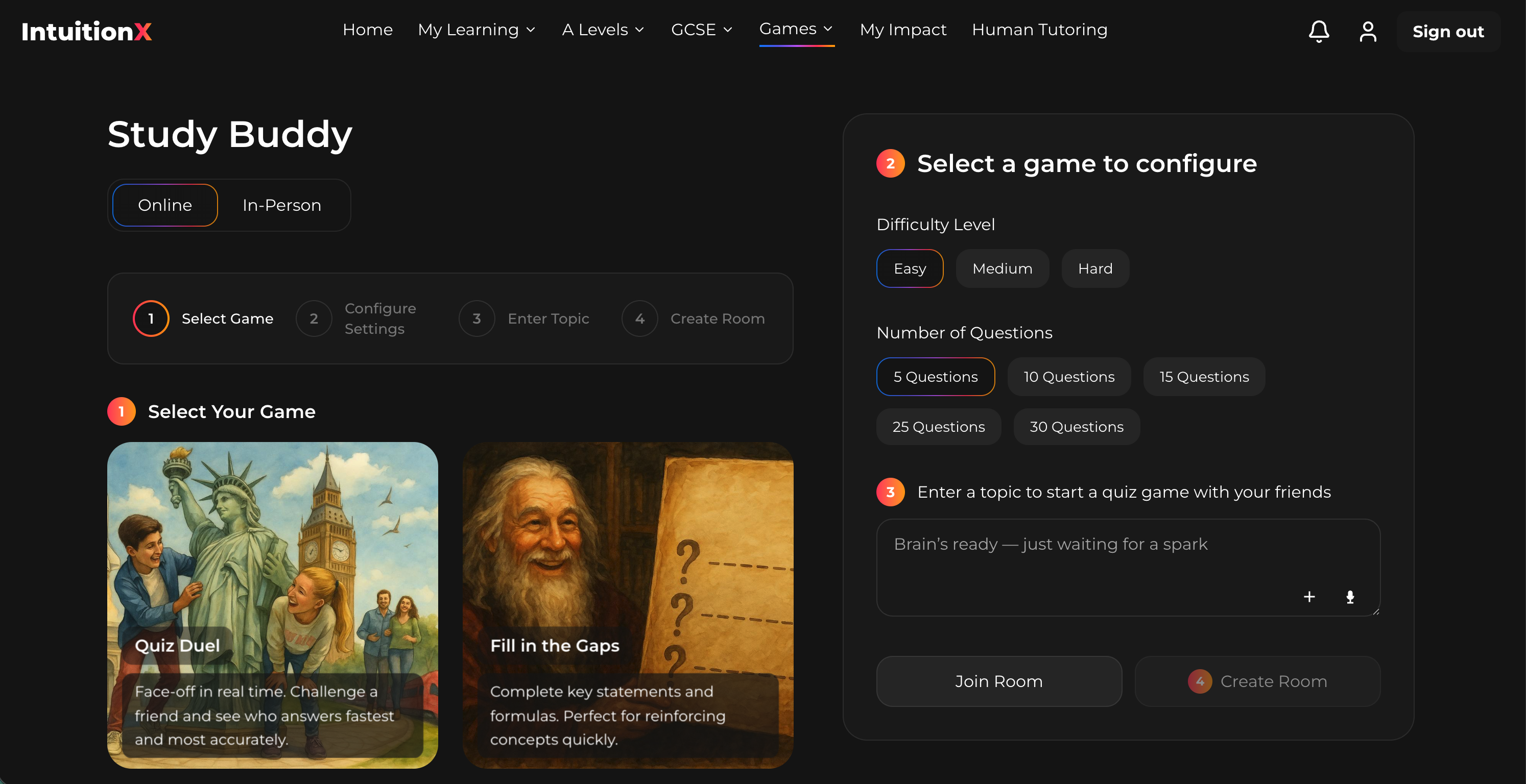
Our Socratic approach means you build genuine understanding, not just surface recall. Whether you are preparing for GCSEs, A Levels, or simply want to learn more effectively, IntuitionX adapts to your pace and pushes you to think more deeply. Sir Anthony Seldon calls it essential for staying ahead in the age of AI. We think you deserve to find out why. Start your personalised learning journey today.
Frequently asked questions
How is adaptive learning different from traditional e-learning?
Adaptive learning uses AI to adjust content and pacing based on the learner's strengths and progress, drawing on methods like IRT and BKT, unlike traditional e-learning where every student follows the same fixed path regardless of performance.
Is adaptive learning effective for all subjects?
It is proven most effective in structured, sequential subjects like maths and science, though well-designed adaptive systems can support personalisation across many other subjects too.
Are there privacy concerns with adaptive learning platforms?
Yes, and they are legitimate. Responsible platforms conduct bias audits and implement strict privacy safeguards to protect user data, so always review a platform's data policy before signing up.
How much time do students need to spend for results?
Research shows gains proportional to usage, with meaningful improvements typically seen at 30 or more minutes per week of consistent, engaged practice.
Does adaptive learning replace teachers?
No. Research consistently shows that hybrid AI and teacher approaches outperform pure AI, making human involvement not optional but essential for the best outcomes.