

Every student deserves a fair shot at a great education. Yet the gap between those who get one and those who don't has never felt wider. Wealthy families spend up to $150 an hour on private tutors, while millions of students rely on generic tools that do the thinking for them rather than building real understanding. If you're an educator or parent trying to change that, you need more than good intentions. You need a clear framework for choosing solutions that actually work, at scale, for every kind of learner.
Table of Contents
- Setting the criteria: What makes learning truly democratic?
- High-dosage tutoring: Personalised, impactful support
- AI-powered platforms: Affordable, scalable personalised learning
- Free college-credit programmes: Boosting outcomes with access
- Universal school choice: Customising education for every student
- Comparing the options: Which approach suits your context?
- Next steps: Tools to bring these solutions to your school
- Frequently asked questions
Key Takeaways
| Point | Details |
|---|---|
| High-dosage tutoring boosts scores | Regular, school-day tutoring sessions deliver months of additional learning, especially for students needing extra support. |
| AI platforms scale support affordably | Personalised AI learning solutions are low-cost, easy to deploy, and help overcome shortages and language barriers. |
| Programmes and school choice multiply opportunities | Free college-credit courses and universal school choice schemes create new pathways for disadvantaged students. |
| Blend approaches for best results | Combining tutoring, AI platforms, advanced courses, and flexible school options maximises impact for diverse learners. |
Setting the criteria: What makes learning truly democratic?
Before comparing solutions, it helps to agree on what we're measuring. Not every tool that claims to close the gap actually does. Universal school choice enables customisation for diverse needs, and that principle applies to any democratic learning solution worth considering.
Here are the five criteria that matter most:
- Affordability: Can schools or families access this without significant financial strain?
- Scalability: Does it work for ten students or ten thousand?
- Student-centred personalisation: Does it adapt to the individual learner's pace, gaps, and strengths?
- Ease of implementation: Can teachers and parents realistically adopt it without extensive training?
- Evidence of impact: Are there measurable outcomes, not just promising claims?
You can explore how these criteria map to real-world education equity benchmarks to see how different solutions perform in practice.
"The most effective educational interventions combine strong implementation mechanics with genuine family engagement. Without both, even the best-designed programme will underdeliver."
Keep these five criteria in mind as we work through each option. They'll help you cut through the noise and make decisions grounded in evidence rather than enthusiasm.
High-dosage tutoring: Personalised, impactful support
High-dosage tutoring is one of the most rigorously studied interventions in education. The mechanics are straightforward: students receive three or more sessions per week, each lasting at least 30 minutes, ideally during the school day. Consistency is everything here.
The evidence is compelling. High-dosage tutoring significantly boosts maths and reading scores, with effect sizes reaching up to 0.40 standard deviations. That's the equivalent of several additional months of learning in a single academic year. School-day sessions maximise attendance and reduce the dropout rate from programmes that rely on after-school participation.
This approach works best for students with lower prior achievement, particularly those from low-income backgrounds. It's not a one-size-fits-all fix, but for the students who need it most, the results are hard to argue with.
Pros and cons at a glance:
- Pro: Strong evidence base across multiple studies and contexts
- Pro: Paraprofessionals (trained teaching assistants) can deliver sessions, reducing cost significantly
- Pro: Builds genuine relationships between tutor and student
- Con: Scheduling during the school day can be logistically complex
- Con: Requires consistent family engagement to sustain attendance
- Con: Costs can still be prohibitive without paraprofessional models
| Factor | High-dosage tutoring |
|---|---|
| Cost per student | Moderate to high (lower with paraprofessionals) |
| Evidence strength | Very strong (0.40 SD effect size) |
| Scalability | Limited without significant staffing |
| Best suited for | Lower-achieving, low-income students |
"Tutoring works best when it's frequent, relational, and embedded into the school day rather than bolted on as an afterthought."
Pro Tip: If budget is a barrier, train paraprofessionals to deliver structured tutoring sessions. Research consistently shows this model maintains strong outcomes while cutting costs considerably. Pair this with active learning for A levels to reinforce what students cover in sessions.
AI-powered platforms: Affordable, scalable personalised learning
Technology opens doors that traditional models simply can't. AI-powered platforms address teacher shortages and language barriers affordably, making personalised learning accessible to students who would otherwise have nothing.

The best AI tools adapt to each student's skill level and pace in real time. They provide instant feedback, support multiple languages, and are accessible via a smartphone or tablet. That matters enormously in communities where laptops are scarce but mobile data is not.
Key features to look for in an AI learning platform:
- Real-time, personalised feedback on student responses
- Multi-language support for diverse classrooms
- Customisable difficulty levels that adapt as students progress
- Progress tracking for teachers and parents
- Availability outside school hours for independent study
However, not all AI tools are created equal. AI democratises expertise but risks introducing algorithmic bias and encouraging over-reliance if students use it to bypass thinking rather than develop it. That's a real concern, and it's one that separates genuinely educational AI from tools that simply produce answers.
"The risk isn't AI itself. The risk is AI that does the learning for the student instead of with them."
Pro Tip: Pair any AI platform with regular teacher check-ins. Even a brief weekly review of a student's AI interactions can catch over-reliance early and redirect learning productively. Explore how AI in education is reshaping outcomes, or see how AI for A Level literature works in practice. If you're comparing tools, a review of AI tutor alternatives is a useful starting point.
Free college-credit programmes: Boosting outcomes with access
For high-achieving students from disadvantaged backgrounds, free college-credit programmes represent one of the most powerful bridges available. These initiatives give secondary school students access to university-level content, often at no cost, creating a direct pathway to higher education.
The numbers speak for themselves. NEON serves over 50,000 Title I students, reports an 80% pass rate, and has doubled college attendance rates among participants. That's a transformational outcome for students who might otherwise never consider university a realistic option.
What these programmes typically offer:
- University-backed, structured courses aligned to degree-level content
- Built-in academic support and study skills coaching
- A recognised qualification that strengthens university applications
- Peer learning communities that build confidence and motivation
The practical requirements are worth noting. Participation usually depends on a school partnership with the programme provider, and students need a reasonable level of motivation and self-direction to succeed. These programmes are not yet universally available, which limits their reach. But where they do exist, the impact is remarkable.
"When disadvantaged students are given genuine access to rigorous academic content, they rise to meet it. The barrier was never ability. It was opportunity."
Building the habits that make these programmes successful starts early. Explore active learning strategies to help students develop the independent thinking skills they'll need.
Universal school choice: Customising education for every student
School choice schemes, including vouchers and Education Savings Accounts (ESAs), give families the ability to direct public education funding towards the learning environment that suits their child best. That might mean a private school, an online programme, a specialist tutor, or a combination of all three.
1.3 million students now participate in school choice programmes in the US, with Arkansas reporting a 90% retention rate. That level of sustained engagement suggests families find genuine value in having options.
| Factor | School choice | Traditional model |
|---|---|---|
| Flexibility | High | Low |
| Learning options | Wide range | Fixed curriculum |
| Student retention | High (90% in Arkansas) | Variable |
| Accessibility | Improving | Universal but uniform |
Opportunities unlocked by school choice:
- Access to private schools, specialist academies, and faith schools
- Online learning programmes tailored to individual needs
- Funded private tutoring as part of an education plan
- Hybrid models combining home education with school attendance
The federal choice programme continues to evolve, and its long-term impact on public school funding remains a genuine debate. Critics rightly point out that transport barriers and information gaps can limit access for the lowest-income families. Competition between schools, however, has shown positive effects on quality and retention across multiple studies.
"Choice without information is not really choice. Families need clear guidance to make school choice work for them."
Comparing the options: Which approach suits your context?
Each solution has genuine strengths. The right choice depends on your students' backgrounds, your school's resources, and the outcomes you're prioritising.
| Approach | Cost | Scalability | Evidence strength | Best for |
|---|---|---|---|---|
| High-dosage tutoring | Moderate | Limited | Very strong | Low-income, underperforming students |
| AI-powered platforms | Low | Very high | Growing | All students, especially remote learners |
| College-credit programmes | Free to student | Moderate | Strong | High-achieving disadvantaged students |
| School choice | Variable | High | Moderate | Families seeking tailored environments |
Here's a practical guide to choosing:
- If your students are significantly behind: Start with high-dosage tutoring. The evidence is strongest here for closing attainment gaps quickly.
- If budget is the primary constraint: AI-powered platforms offer the best value per student and can scale across an entire school with minimal additional cost.
- If you have motivated students from disadvantaged backgrounds: Explore college-credit programmes. The long-term impact on university attendance is exceptional.
- If families want more control over their child's education: School choice schemes provide the flexibility to build a genuinely personalised learning journey.
Pro Tip: The most effective approach is rarely a single solution. Blending high-dosage tutoring with an AI platform, for example, gives students both the relational support and the on-demand personalisation they need. Use benchmarking educational access data to track whether your chosen combination is actually moving the needle.
Next steps: Tools to bring these solutions to your school
Knowing which approaches work is one thing. Having the right tools to implement them is another. That's where IntuitionX comes in. Built on Oxbridge-level academic expertise and backed by Sir Anthony Seldon, IntuitionX is a 24/7 Socratic AI tutor that asks the right questions to build genuine understanding rather than just delivering answers. It's affordable, scalable, and designed specifically to give every student access to the kind of learning that was previously reserved for the privileged few.
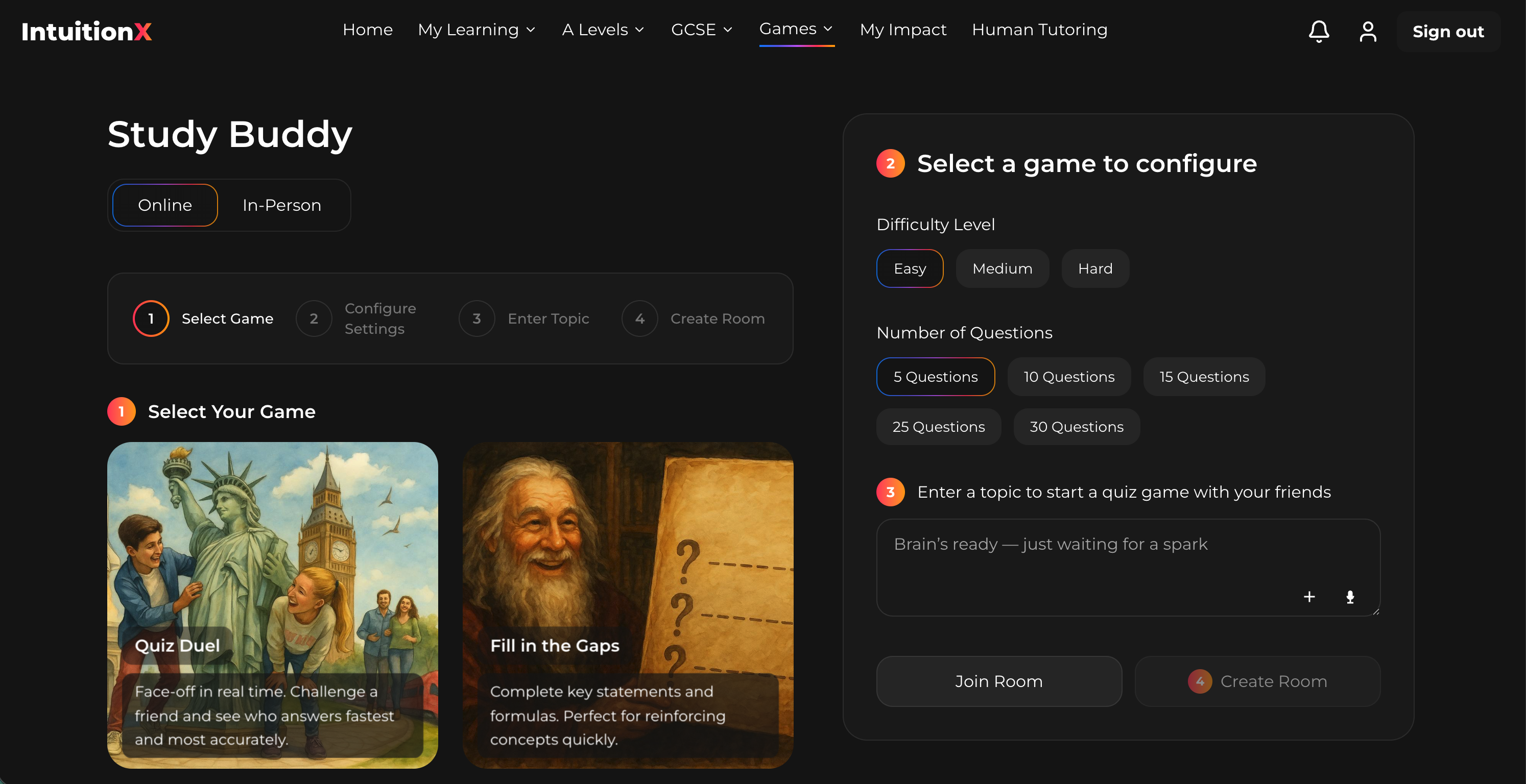
Whether you're an educator looking to supplement classroom teaching or a parent wanting to give your child a real academic edge, the IntuitionX platform is built for you. It adapts to each student's level, supports independent thinking, and is available any time of day or night. Ten per cent of every subscription goes directly to educational programmes for children in crisis and conflict zones, so every learner who uses IntuitionX helps another child access education too. Start today and see the difference genuine, personalised learning makes.
Frequently asked questions
What is the most cost-effective way to democratise learning for high school students?
AI-powered platforms offer low-cost, personalised support that scales across large groups and is accessible via most devices, making them the most practical starting point for schools with limited budgets.
Do high-dosage tutoring programmes work for all backgrounds?
High-dosage tutoring delivers the greatest gains for low-income and underperforming students, but consistent attendance and active family support are essential for the programme to work.
What are the risks of relying solely on AI-driven learning?
AI can introduce bias or encourage students to bypass genuine thinking, so it works best when paired with teacher oversight and regular quality monitoring rather than used in isolation.
How do school choice schemes affect public schools?
School choice increases competition and expands options for families, but critics note that funding shifts and transport barriers can limit access for the lowest-income pupils.
How can parents help bridge the educational gap at home?
Parents can use AI tutoring tools to support independent study, encourage active learning habits, and work with schools to secure access to tutoring or college-credit programmes.