
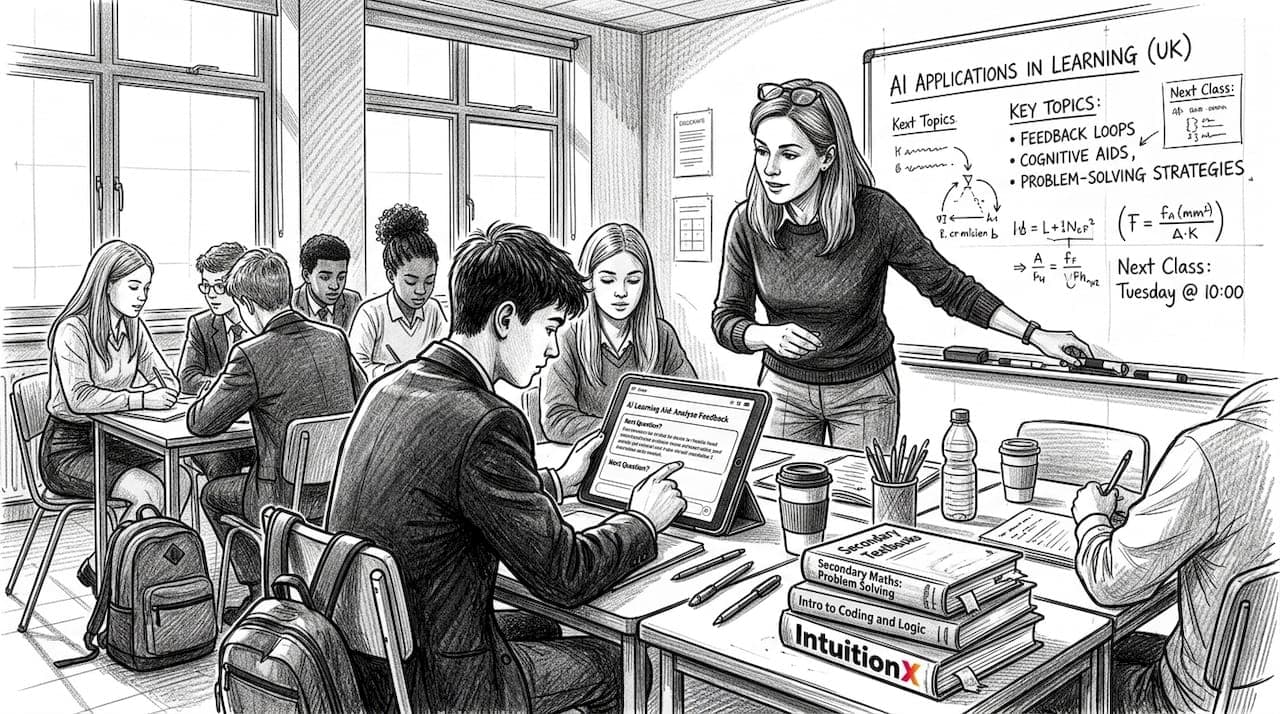
Edtech is no longer a classroom luxury. For most UK and US secondary schools, it is now mission-critical infrastructure, sitting alongside textbooks and timetables as a non-negotiable part of daily learning. What changed? A wave of policy shifts, tightened budgets, and rapidly maturing AI tools have forced schools to make hard decisions about which technologies genuinely improve outcomes and which simply look impressive in a prospectus. If you are a parent or educator trying to make sense of it all, this guide cuts through the noise and maps the five pivotal trends reshaping secondary education right now.
Table of Contents
- AI integration: From experiment to expectation
- Screen-time, engagement, and the quality debate
- Data, privacy, and digital trust in the new edtech ecosystem
- Evidence, equity, and the ROI of edtech
- What most get wrong about the future of edtech
- Discover the next step in educational technology
- Frequently asked questions
Key Takeaways
| Point | Details |
|---|---|
| AI is now standard | Secondary schools require AI-powered tools as a core part of teaching, not a trial. |
| Screen-time merits scrutiny | Effective learning comes from structured digital engagement, not just more screen hours. |
| Data safety matters | Everyone—IT staff, teachers, parents—must help keep student information secure on edtech platforms. |
| Evidence before novelty | Schools and families should prioritise technology with proven impact and equitable access. |
AI integration: From experiment to expectation
Not long ago, AI in the classroom was a pilot programme. A handful of forward-thinking schools trialling chatbots, a few teachers experimenting with automated feedback. That era is over. AI integration in edtech has become mandatory and embedded across tools, shifting from optional pilots to core purchasing criteria for secondary schools. Procurement teams now ask "does it include AI?" as a baseline question, not a bonus.
The evidence points clearly towards hybrid models working best. Hybrid AI-human systems such as supervised tutoring yield the strongest benchmarks, and the UK's £23 million EdTech Testbed is actively measuring real-world efficacy across schools. The message is consistent: AI alone is not enough. Teacher oversight transforms good technology into great outcomes.
So what does well-implemented AI actually deliver? Three benefits stand out:
- Personalisation: AI adapts content to each student's pace, gaps, and learning style, something a class of thirty makes impossible for any single teacher.
- Workload reduction: Automated marking, progress tracking, and resource generation free up teacher time for genuine human connection.
- Support equity: Students who would never raise their hand in class get patient, judgement-free guidance at any hour.
But there are real risks when AI is overused or poorly structured. Students can become passive, waiting for answers rather than building the reasoning muscles that exams and life demand. Skill atrophy is a genuine concern. Understanding how AI transforms education means recognising both its power and its limits.
| AI tool type | Strengths | Risks |
|---|---|---|
| Socratic AI tutor | Builds reasoning, promotes curiosity | Requires student engagement |
| Essay-writing assistant | Saves time on drafts | Bypasses critical thinking |
| Adaptive quiz platform | Personalised practice | Can feel mechanical without context |
| General-purpose chatbot | Broad knowledge access | No pedagogical structure |
Pro Tip: When evaluating AI learning companions for your school or child, prioritise tools that ask questions rather than just supply answers. Structured guidance and human oversight are the markers of genuinely effective AI.
Screen-time, engagement, and the quality debate
As AI becomes everyday, the question of how students spend their screen time has never mattered more. Not all digital time is equal. A student working through a challenging problem with an AI tutor is doing something fundamentally different from passively scrolling through a video summary. Schools and policymakers are finally catching up with this distinction.

Screen-time policies are now being rewritten to distinguish pedagogical use from passive consumption, with serious debates emerging about whether edtech is displacing core teaching rather than supporting it. That is a question worth sitting with.
Meanwhile, the scale of change inside classrooms is striking. 80% of teachers in UK secondary schools are redesigning assignments for AI, with 60% incorporating it constructively. Yet many of those same teachers report concerns about declining communication skills in students who rely too heavily on AI-generated responses.
"The goal is not to limit screens but to make every minute on screen count. Active thinking, not passive viewing, is the standard we should hold edtech to."
What makes digital time genuinely productive in the classroom? Here is a practical framework:
- Active problem-solving: The student is generating ideas, not just receiving them.
- Feedback loops: The tool responds to the student's specific input, not a generic prompt.
- Metacognitive prompts: The platform asks students to reflect on their reasoning.
- Teacher visibility: Educators can see what students are doing and intervene when needed.
- Purposeful design: The task has a clear learning objective, not just a digital format.
Parents can apply this framework at home too. Ask your child what the tool asked them, not just what it told them. Explore active learning strategies that keep students genuinely thinking, and look for platforms that are built to democratise learning rather than simply automate it.
Data, privacy, and digital trust in the new edtech ecosystem
With more student learning happening online, digital safety has moved well beyond the IT department. It is now a whole-school concern, and increasingly a whole-family one. Every app a student logs into, every piece of work submitted through a platform, every adaptive assessment completed generates data. Who holds it, how it is used, and who can access it are questions every parent and educator deserves clear answers to.
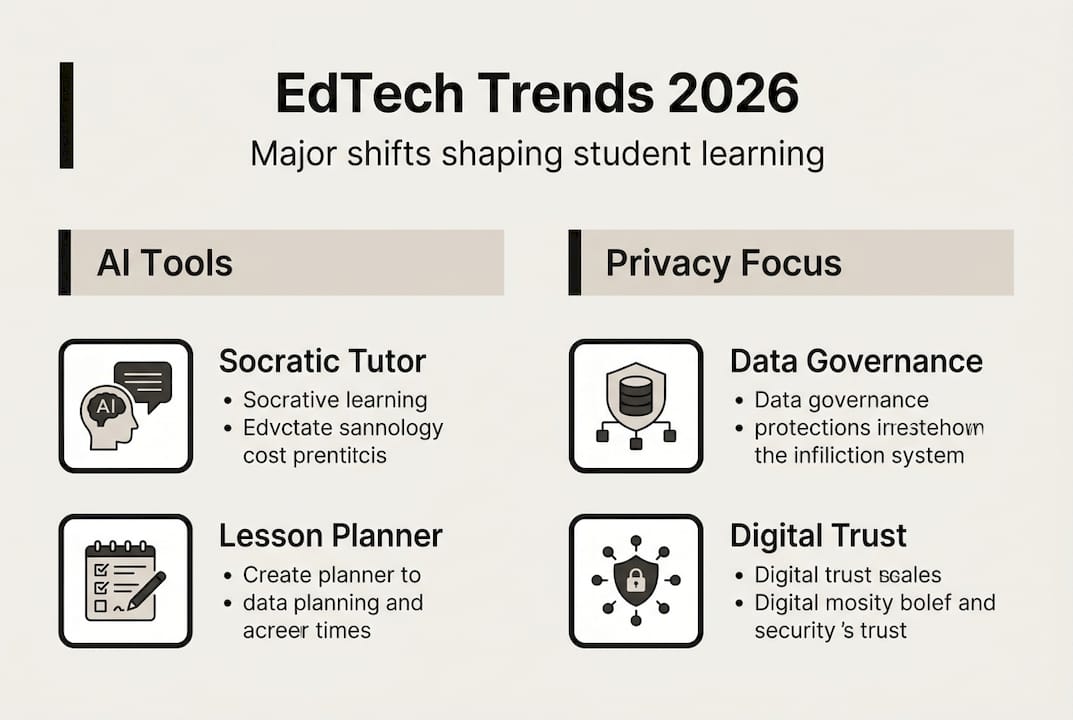
Data governance and cybersecurity have emerged as district-wide priorities, driven by AI's growing data needs and a rising tide of threats targeting educational institutions. Schools that treat this as an IT-only issue are leaving themselves exposed.
| Data privacy risk | Who is responsible |
|---|---|
| Unauthorised third-party data sharing | Platform provider and school IT |
| Weak student login security | School IT and teachers |
| Lack of parental consent processes | School leadership and admin |
| Unclear data retention policies | Platform provider |
| Insufficient staff training | School leadership |
Digital trust in 2026 means more than a privacy policy buried in small print. It means transparency about what data is collected, genuine consent processes for students and families, and clear reporting when something goes wrong. Platforms that cannot answer these questions simply should not be in classrooms.
Here are the top steps parents and teachers can take to protect student data:
- Ask any edtech provider for a plain-English summary of their data practices.
- Check whether the platform complies with UK GDPR or US FERPA, depending on your context.
- Ensure students use school-managed accounts, not personal ones.
- Review what third parties the platform shares data with.
- Look for tools that support educational access equity without compromising privacy.
Evidence, equity, and the ROI of edtech
Technological trust is vital, but cost and outcomes are now equally decisive for schools investing in edtech. The post-pandemic funding landscape in the US has seen ESSER funds expire, forcing districts to scrutinise every line of their technology budget. Budget constraints are pushing schools to prioritise tools with proven instructional impact over novelty. Shiny and new is no longer enough.
The research picture is genuinely exciting, but also carries a warning. GenAI boosts short-term performance significantly, with one experiment in Türkiye recording a 48% improvement, but risks metacognitive laziness without proper pedagogical guidance. In plain terms: AI can make students look better in the short run while quietly undermining their ability to think independently. Structure matters enormously.
Stat to know: A 48% performance boost was recorded in one GenAI experiment, yet the same research flagged metacognitive risks when AI lacked structured guidance.
What evidence should schools and parents demand before committing to any edtech tool?
- Proven impact: Randomised trials or independent evaluations showing measurable learning gains.
- Engagement data: Evidence that students are actively participating, not just logging in.
- Equity of access: Does the tool work for students with different devices, connectivity, and learning needs?
- Lesson planning efficiency: Does it genuinely save teacher time, or create new administrative burdens?
- Metacognitive support: Does it build independent thinking, or encourage over-reliance?
Equitable access remains one of the most pressing issues in edtech. Budget decisions made at district or school level determine which students benefit from the best tools and which are left behind. Explore personalised learning strategies that can work across different resource levels, not just in well-funded schools.
What most get wrong about the future of edtech
Here is an uncomfortable truth: the schools and families investing most heavily in edtech are not always getting the best outcomes. More technology is not the same as better learning. The temptation to adopt every new tool, to signal innovation through procurement, is understandable. But it often produces cluttered digital environments where students are overwhelmed and teachers are stretched.
The OECD's Digital Education Outlook 2026 is clear: prioritise AI tools with pedagogical scaffolding, such as Socratic tutoring, over general-purpose chatbots to avoid overreliance, and integrate human oversight for students who are disengaged or struggling. That is not a call for less technology. It is a call for better technology, used with intention.
The future belongs to educators and parents who ask harder questions. Not "is this AI-powered?" but "does this AI make my student think harder?" Not "is this the newest platform?" but "can I see exactly what my child is doing and learning?"
Pro Tip: Insist on visibility and customisation in any AI tool you adopt. If you cannot see how a student is progressing or adjust the level of challenge, the tool is working for the platform, not for the learner. Explore how AI for A Level literature can model what structured, subject-specific AI guidance looks like in practice.
Strong outcomes depend on teacher and parent involvement. Technology is the vehicle. Human judgement is still the driver.
Discover the next step in educational technology
The trends covered here point to one clear conclusion: the best edtech in 2026 combines rigorous pedagogy, genuine personalisation, and human oversight. That is precisely what IntuitionX was built to deliver. Backed by Sir Anthony Seldon and built on Oxbridge-level academic expertise, IntuitionX is a Socratic AI tutor that asks the questions that build real understanding, not a chatbot that hands over answers.

Whether you are a parent seeking a trusted learning companion or an educator looking for tools that genuinely move the needle, try the IntuitionX app and see what research-backed, structured AI tutoring looks like in practice. The divide between elite and everyday education does not have to be permanent.
Frequently asked questions
What should parents consider when selecting AI-powered educational tools?
Choose platforms with clear pedagogical guidance, robust privacy protections, and the ability for human oversight. Tools with pedagogical scaffolding, such as Socratic tutoring, consistently outperform general-purpose chatbots for genuine learning.
Does more screen time automatically improve student results?
No. Effective edtech use depends on structured, purposeful engagement rather than simply increasing the hours a student spends in front of a screen.
Are schools required to include AI in all subjects now?
Most secondary schools are making AI an embedded part of instruction, but specific requirements vary by country, local authority, and district policy.
How can teachers ensure AI supports and does not replace essential skills?
Incorporate AI with structured tasks, regular human feedback, and varied assignments. 80% of UK teachers are already redesigning work for AI, with the most effective approaches pairing automation with activities that build communication and critical thinking.