

Most parents assume that nothing beats a human tutor. It's a reasonable belief. But research is beginning to challenge it. AI sometimes outperforms human tutors in controlled studies, and the gap is closing fast. A new category of educational technology, the learning companion, is quietly reshaping how high school students engage with their studies. This article explains what learning companions are, how they work, and what the evidence says, so you can make a genuinely informed decision about your child's education.
Table of Contents
- Defining the learning companion
- How learning companions personalise education
- Comparing AI companions and human tutoring
- Benefits and risks: What parents should know
- How learning companions are used in high schools
- Discover IntuitionX: Next-generation learning companions
- Frequently asked questions
Key Takeaways
| Point | Details |
|---|---|
| AI learning companions defined | AI companions offer peer-like support, adapting to students' needs for personal learning. |
| Personalised education insights | These tools use advanced technology to tailor learning for each student, supporting engagement. |
| Benchmarked improvement | Systematic reviews and real trials reveal 4-9% mastery gains and up to 127% performance boosts. |
| Balanced risk awareness | Parents must weigh benefits against potential impacts on social, emotional, and academic honesty. |
| Practical school examples | UK and US schools have successfully implemented learning companions with positive academic outcomes. |
Defining the learning companion
The term gets used loosely, so let's be precise. A learning companion is not simply a chatbot that answers questions. According to research, an AI-empowered adaptive system that emulates a human-like peer or tutor, providing personalised support, companionship, and scaffolding in a social learning context, is the defining model. Scaffolding, in educational terms, means giving students just enough support to move forward without doing the thinking for them.
Learning companions typically operate within what researchers call Intelligent Tutoring Systems (ITS). These are structured platforms built around a three-agent model:
- The student: the learner whose progress is tracked and adapted to
- The tutor agent: the instructional component that delivers content and feedback
- The companion agent: the social and motivational layer that keeps the student engaged and supported
It is that third agent, the companion, that makes these systems genuinely different. Most generic AI tools skip it entirely. The companion layer is what transforms a tool into a thinking partner.
How learning companions personalise education
With a clear definition in place, let's explore how these systems actually adapt to each student's needs. The technology behind learning companions is more sophisticated than most parents realise.
Researchers confirm that personalisation methodologies align with project-based, competency-based, and constructivist learning approaches. They use natural language processing (NLP), machine learning (ML), knowledge graphs, and interest graphs to build a picture of each student. Here is what that looks like in practice:
- NLP analysis: The system reads how your child writes and speaks, identifying gaps in understanding and adjusting its responses accordingly.
- Knowledge graphs: These map what a student knows and what they need to learn next, creating a personalised learning path rather than a one-size-fits-all curriculum.
- Interest graphs: The companion identifies topics your child finds engaging and uses those as entry points into harder material.
- Socratic dialogue: Rather than giving answers, the companion asks questions that guide the student to reason through problems themselves.
That last point matters enormously. Socratic questioning, the method used by the world's greatest educators, builds genuine understanding rather than surface-level recall. It is the difference between a student who can reproduce an answer and one who can actually think.
"The best learning companions do not just deliver content. They inspire curiosity and build the confidence to ask better questions."
Pro Tip: When evaluating any AI learning tool for your child, ask whether it uses Socratic questioning or simply provides answers. Tools that prompt thinking rather than replace it produce far better long-term outcomes.
For a deeper look at how this works in practice, explore personalised success with AI and what it means for your child's academic journey.
Comparing AI companions and human tutoring
To help you make informed choices, let's look at what the evidence actually says when comparing learning companions with traditional human tutors.
| Factor | Human tutor | AI learning companion |
|---|---|---|
| Availability | Scheduled sessions only | 24/7, on demand |
| Cost | Up to £120 per hour | Fraction of the cost |
| Personalisation | Dependent on tutor skill | Algorithmically consistent |
| Emotional support | High | Moderate to high |
| Performance gains | Variable | Up to 127% with guardrails |
| Scalability | One student at a time | Unlimited |
Systematic reviews confirm positive effects on K-12 learning and performance compared to control groups, with randomised controlled trials (RCTs) showing mastery gains of 4 to 9%. Under the right conditions, with proper guardrails built in, performance boosts of up to 127% have been recorded. That is not a typo.
However, the research also shows that hybrid human-AI approaches produce the best outcomes overall. AI companions without safeguards can actually harm long-term retention. The guardrails matter. Think of them as the difference between a student who learns to ride a bike with stabilisers that gradually come off, versus one who is simply carried.
The verdict? AI companions are not a replacement for human connection in learning. They are a powerful supplement, especially when human tutoring is unavailable, unaffordable, or inconsistent.
Pro Tip: Look for platforms that combine AI-driven personalisation with human oversight or built-in pedagogical guardrails. These hybrid models consistently outperform either approach used alone.
If you are weighing up your options, this guide to AI tutor alternatives offers a useful comparison of what is currently available.
Benefits and risks: What parents should know
Having explored the effectiveness, let's consider the real benefits and risks involved. No technology is without trade-offs, and learning companions are no exception.
The benefits are real:
- Personalisation keeps students engaged by meeting them where they are, not where the curriculum assumes they should be
- 24/7 accessibility means your child can get support at 10pm before an exam, not just during a scheduled Tuesday session
- Scalability makes high-quality support available to students who cannot afford private tutors
- Consistent feedback removes the variability of human tutoring quality
The risks deserve honest attention:
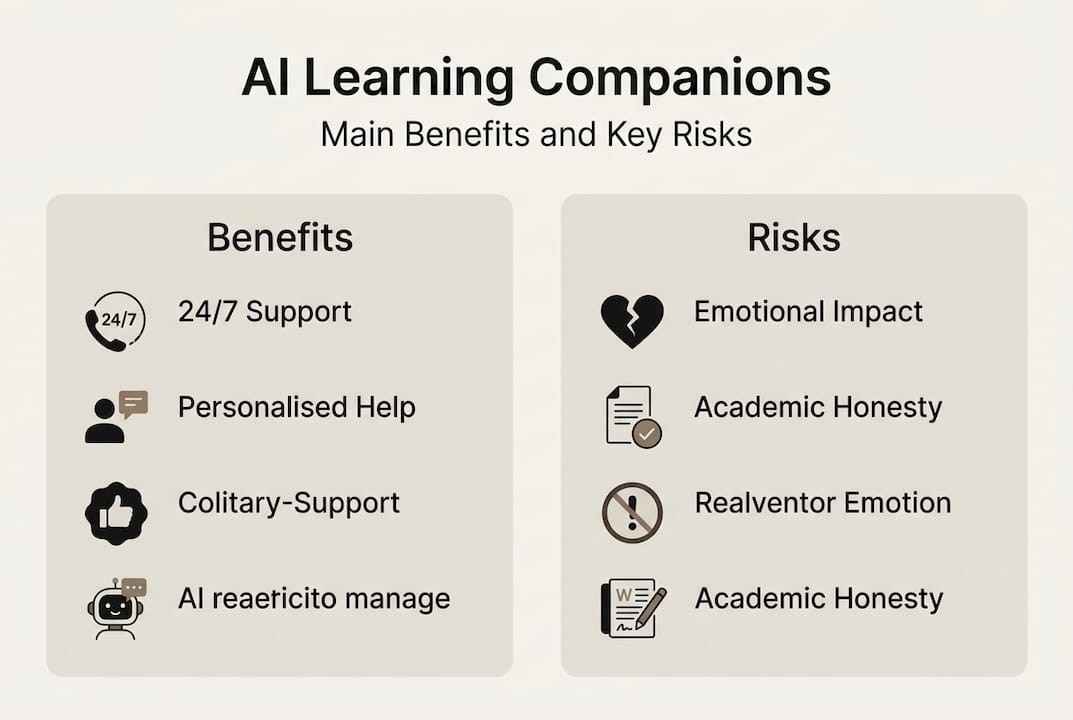
- Social and emotional development can suffer if AI interaction replaces peer learning and human connection
- Mental health concerns arise when students become overly reliant on AI for emotional support
- Cheating potential is real if the tool simply produces work rather than guiding the student to produce it themselves
Researchers note that proponents highlight personalisation and 24/7 access while critics flag risks to social and emotional development, mental health, and academic honesty. Both sides have valid points.
"The goal is not to replace your child's thinking. It is to strengthen it. The right learning companion should make your child more capable, not more dependent."
For parents supporting students through high-stakes qualifications, this guide to AI success for A Levels offers practical advice on using these tools responsibly.
How to set healthy boundaries:
- Use AI companions for practice and explanation, not for producing assessed work
- Keep human relationships, with teachers, tutors, and peers, central to your child's learning
- Review what your child is actually doing with the tool, not just how long they spend on it
How learning companions are used in high schools
To illustrate what this looks like in practice, here are examples from high schools using learning companions in both the UK and the US.
| Platform | Country | Focus area | Reported outcome |
|---|---|---|---|
| Walnut | UK | Secondary school subjects | Improved engagement and self-directed study |
| ClassBuddy | US | High school STEM | Increased participation and confidence |
| IntuitionX | UK/US | A Level and high school | Socratic AI with Oxbridge-level pedagogy |
Empirical reviews consistently show positive effects on K-12 performance, with the strongest results in maths and science when guardrails are in place. The data points to a clear pattern: structured AI support, used alongside active learning strategies, produces measurable gains.
What most parents overlook is the hidden potential of these tools outside formal study time. A student who spends 20 minutes working through a concept with an AI companion at 9pm is doing something a textbook simply cannot replicate. The companion responds, adapts, and challenges. The textbook does not.
- Encourage your child to use the companion for revision, not just homework
- Ask them to explain what the companion taught them, reinforcing their own understanding
- Use the companion's feedback to identify recurring weak spots before exams
For practical strategies that work alongside these tools, explore active learning strategies and how to master active learning for A Levels effectively.
Discover IntuitionX: Next-generation learning companions
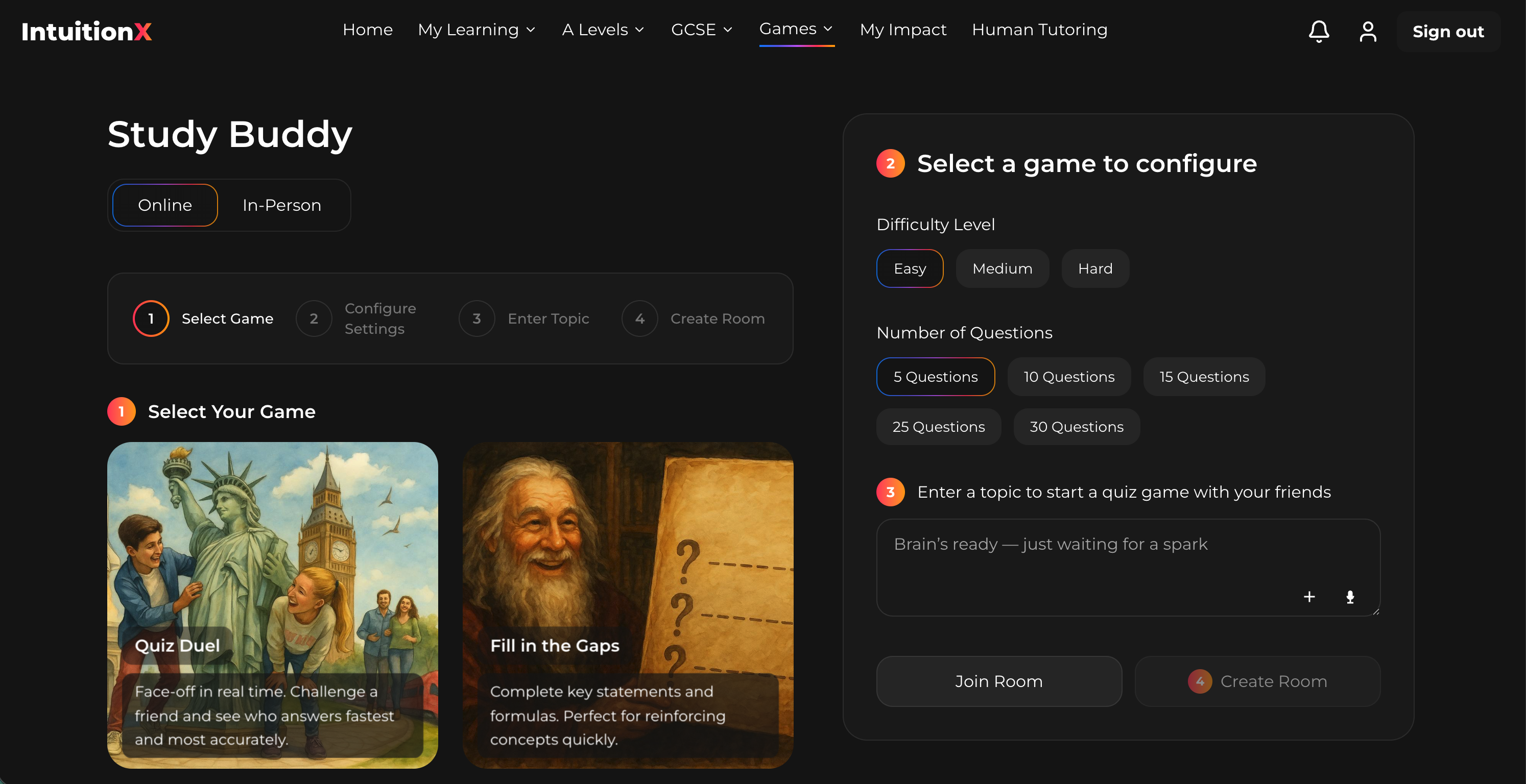
If you are ready to give your child the kind of support that was once reserved for the wealthiest families, IntuitionX was built for exactly this moment. Our AI, Omniscience, is not a generic chatbot. It is trained on the knowledge and pedagogical methods of academics who earned A*s at A Level and Firsts from Oxford and Cambridge. It uses Socratic questioning, memory science, and genuine personality to make learning stick.
Sir Anthony Seldon, described by the BBC as one of Britain's leading educationalists, put it simply: "If you are serious about staying ahead in the age of AI, try IntuitionX today." We are also proud to commit 10% of our revenue to the International Rescue Committee's educational programmes, because we believe every child deserves access to great teaching. Explore what IntuitionX can do for your child today.
Frequently asked questions
How does a learning companion differ from a regular AI tutor?
A learning companion provides peer-like social support and adapts to the student in real time, while a regular AI tutor mainly delivers instruction without the companionship or scaffolding layer.
Are learning companions effective for maths and science?
Yes. RCTs show students can achieve up to 127% performance boosts in maths and science using AI companions, particularly when guardrails are in place to support genuine learning rather than shortcutting it.
What risks should parents watch for when using learning companions?
Research flags risks to social and emotional development, mental health, and academic honesty; staying involved in how your child uses these tools is the most effective safeguard.
Is there evidence that learning companions boost student engagement?
Systematic reviews confirm positive impacts on high school engagement and academic performance compared to traditional methods, with the strongest gains seen in structured, guardrail-supported environments.