

TL;DR:
- Educational equity means providing each student with tailored resources and supports to succeed, rather than treating all students equally.
- Persistent gaps result from systemic inequalities such as funding disparities, socioeconomic barriers, and biased curricula, requiring targeted interventions.
Many people assume fairness in education means giving every student the same thing. Same textbook. Same lesson. Same time with the teacher. But educational equity means something different: it means giving each student what they need to succeed, not just what everyone else gets. That distinction matters enormously. When schools confuse equality with equity, the students who face the greatest barriers often fall furthest behind. This article breaks down what educational equity truly means, how it is measured, what drives persistent gaps, and what practical steps actually move things forward.
Table of Contents
- What is educational equity?
- How is educational equity measured?
- What causes persistent gaps in educational equity?
- Strategies for promoting educational equity
- Challenges and debates in achieving equity
- What most equity guides don't tell you
- Tools to support your equity journey
- Frequently asked questions
Key Takeaways
| Point | Details |
|---|---|
| Equity differs from equality | Educational equity means meeting individual students’ needs, not treating every student identically. |
| Measurement requires two types of data | True progress is tracked via both outcomes (test scores, attainment) and opportunities (resources, course access). |
| Opportunity gaps are persistent | Systemic factors, not just individual ability, drive achievement gaps — and solutions must address these causes. |
| Frameworks and strategies exist | Methodologies like UDL, targeted resources, and tailored instruction support equity in practical ways. |
| Equity efforts face challenges | Policy and implementation can be contentious, but evidence shows fairness and excellence can go hand in hand. |
What is educational equity?
Educational equity is one of those terms that gets used often but rarely defined clearly. So let us be precise. Educational equity generally means ensuring that every student receives the resources, supports, and fair opportunities needed to succeed, rather than treating all students identically regardless of their circumstances.
Think about a classroom with 30 students. Five of them are learning English as a second language. Four have identified learning differences. Several come from households without reliable internet or quiet spaces to study. Giving every child the same worksheet and expecting the same results is not fairness. It is indifference dressed up as neutrality.
Here is how the core principles of equity play out in practice:
- Individual supports: Some students need additional scaffolding, others need enrichment, and many need both at different times.
- Resource targeting: Schools and systems should direct greater resources toward students who face greater barriers, not distribute everything evenly regardless of need.
- Context awareness: A strategy that works brilliantly in one school community may be poorly suited to another with different demographics or challenges.
- Removing structural barriers: Equity asks us to look beyond individual student effort and examine what the system itself is doing to create or perpetuate disadvantage.
"Equity is not about making everyone the same. It is about making sure the playing field is fair enough that every child has a genuine shot at success."
A common misconception is that equity means lowering expectations. It does not. Equity means raising the floor of support so that every student can reach high expectations. Another misconception is that equity only benefits struggling students. In reality, when schools build more responsive, flexible systems, every learner tends to benefit.
Why does this matter beyond the classroom? Students who miss out on equitable support are more likely to face reduced lifetime earnings, poorer health outcomes, and limited civic participation. Equity in education is not just a moral argument. It is an economic and social one.
Pro Tip: When explaining equity to parents or colleagues who resist the concept, try the "glasses" analogy. We do not say it is unfair that only some students wear glasses in class. We give glasses to those who need them because it helps everyone learn better. Targeted support works the same way.
How is educational equity measured?
Knowing what equity means is one thing. Knowing how to track it is another. Researchers and policymakers often propose measuring equity via indicators that capture both educational outcomes and the opportunities schools provide. This two-track approach is important because a system can appear to have good outcomes on average while hiding serious disparities beneath the surface.
Educational inequities show up both as outcome gaps and as opportunity gaps. Outcome gaps refer to measurable differences in things like test scores, graduation rates, and progression into higher education. Opportunity gaps refer to differences in the quality and availability of inputs, such as experienced teachers, advanced courses, and well-funded facilities.

Consider a real-world example. In New York City, thousands of students miss out on Algebra 1 in eighth grade, a course widely recognised as a gateway to higher-level mathematics. The students who miss out are disproportionately from lower-income households and communities of colour. This is an opportunity gap that then becomes an outcome gap at secondary school level and beyond.
Here is a summary of the key indicators used to measure educational equity:
| Indicator type | What it measures | Why it matters |
|---|---|---|
| Standardised test scores | Academic achievement by subgroup | Reveals outcome gaps across demographics |
| Graduation and completion rates | Whether students finish their education | Shows systemic failure points |
| Access to advanced courses | Availability of higher-level learning | Tracks opportunity gaps at school level |
| Teacher quality and experience | Who is being taught by whom | Highlights resource distribution inequity |
| Disciplinary data | Suspension and exclusion rates by group | Uncovers systemic bias in school culture |
| Digital and material access | Devices, internet, learning materials | Essential for remote and hybrid learning |
Beyond individual schools, frameworks for measuring equity at a system level are used by government bodies and researchers to benchmark progress over time. These frameworks often disaggregate data by race, income, disability status, and language background, because averaging across groups hides exactly the disparities that need fixing.
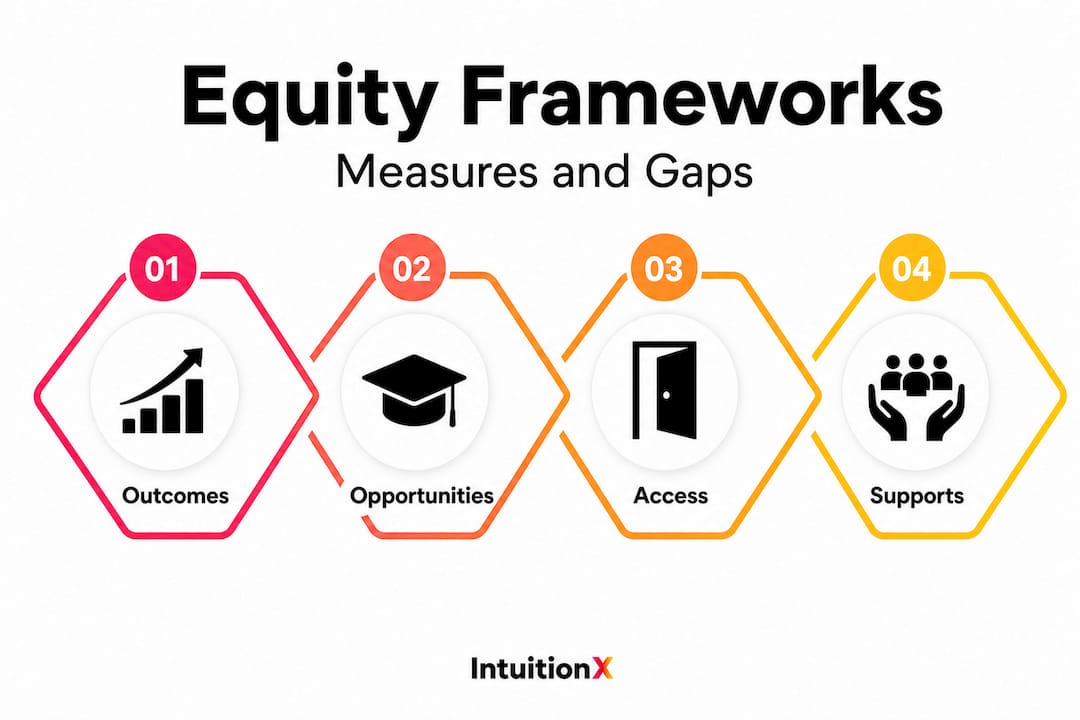
One critical insight: measuring outcomes alone is never enough. A school might show improved average test scores while the gap between its highest and lowest performers is actually growing. That is why dual measurement, tracking both outcomes and opportunities, is now considered best practice.
What causes persistent gaps in educational equity?
If we can measure gaps clearly, why do they persist? This is where the conversation gets both more complex and more important.
Empirical research tracking subgroup achievement disparities shows that gaps often begin before formal schooling starts and can widen over time without deliberate intervention. They are not primarily a matter of student ability or effort.
The main drivers behind persistent educational inequities include:
- Socioeconomic status: Children from lower-income households face challenges including food insecurity, housing instability, and reduced access to enrichment activities outside school, all of which affect readiness to learn.
- School funding disparities: In many countries, school funding is tied to local property taxes or equivalent mechanisms. This creates a cycle where lower-income areas have less-resourced schools serving the students who need the most support.
- Teacher distribution: Experienced, highly qualified teachers disproportionately work in more affluent schools. Students in under-resourced settings are more likely to be taught by newly qualified or rotating staff.
- Curriculum and tracking: When schools group students into rigid academic tracks at an early age, those tracks often reflect socioeconomic and racial background rather than genuine potential, limiting future options.
- Cultural and linguistic barriers: Curricula and assessments that do not reflect the backgrounds or languages of all students can systematically underestimate their abilities.
- Technology access: The shift toward digital learning has made online resources and access gaps increasingly significant. Students without reliable devices or internet are at a structural disadvantage.
"Achievement gaps are not random. They are the predictable result of predictable inequalities in resources, opportunities, and systems."
Understanding why education access matters is the foundation of designing interventions that work. The research is clear: when you address the structural causes of inequality rather than just treating symptoms, outcomes improve faster and more sustainably.
| Driver | Evidence of impact | Typical intervention |
|---|---|---|
| Socioeconomic barriers | Strong correlation with early gaps | Wraparound services, free meal programmes |
| Funding disparities | Lower outcomes in underfunded schools | Progressive funding models |
| Teacher experience gap | Achievement gaps widen with less experienced staff | Targeted retention and incentive schemes |
| Early tracking | Limits long-term academic mobility | Later and more flexible grouping |
| Technology access gap | Remote learning exposed digital divides sharply | Device and broadband provision schemes |
Strategies for promoting educational equity
So if gaps are persistent and structurally rooted, what can actually shift them? The good news is that there is solid evidence behind several approaches.
Universal Design for Learning, known as UDL, is one of the most well-evidenced frameworks. It operates on the principle that if we design learning environments to work for the widest possible range of learners from the start, we reduce the need for reactive accommodations later. UDL focuses on three core principles: providing multiple means of representation (how information is presented), multiple means of action and expression (how students demonstrate learning), and multiple means of engagement (what motivates and sustains effort). When implemented well, UDL benefits every learner in the classroom, not just those with identified needs.
Beyond UDL, here are proven strategies for promoting equity at classroom and school level:
- Targeted resource allocation: Directing additional tutoring, materials, and staff time toward students with the greatest demonstrated need rather than spreading resources equally.
- High-quality teacher training: Professional development focused on culturally responsive pedagogy, recognising implicit bias, and adapting instruction to diverse learners.
- Early intervention: Identifying and supporting students who are falling behind as early as possible, before gaps compound across year groups.
- Family and community engagement: Involving families as genuine partners in learning, particularly families from communities historically underserved by schools.
- Removing punitive barriers: Reviewing exclusion and discipline policies that disproportionately affect certain student groups and replacing them with restorative approaches.
Incorporating active learning strategies is also a proven lever. When students are actively engaging with material rather than passively receiving it, they build deeper understanding and are more likely to retain and transfer knowledge.
Pro Tip: Sustainability matters more than intensity. A modest equity intervention implemented consistently over three years will almost always outperform an intensive programme abandoned after one. When designing equity strategies, build in review cycles and stakeholder input from the start so you can adapt without losing momentum. Personalised learning strategies that flex to individual student needs are particularly effective when embedded as an ongoing practice rather than a one-off initiative.
Challenges and debates in achieving equity
Equity in education is genuinely contested territory. That is not a reason to avoid the conversation. It is a reason to engage with it honestly.
Some of the central challenges include:
- Maintaining high standards for all: Critics worry that focusing resources on struggling students means less attention for high achievers. But this is largely a false trade-off. Responsive, well-resourced schools tend to improve outcomes across the ability range.
- Political polarisation: Equity has become a politically charged term in several countries. This makes it harder to have clear, evidence-based conversations about what is actually working.
- Measurement difficulties: Disaggregating data meaningfully, especially in smaller schools, is technically challenging and can create privacy concerns.
- Implementation fatigue: Schools that have been through repeated reform cycles may resist new equity initiatives, even well-evidenced ones, simply because of exhaustion.
- Short-term thinking: Politicians and school leaders often face pressure to show results within electoral or inspection cycles. Genuine equity work often takes years to show its full impact.
"Equity efforts can require careful implementation and may be contentious; some critics argue for a clearer focus on fairness and outcomes."
When it comes to high achievers specifically, research consistently shows that achievement gaps and high achievers can coexist with strong equity policies. High-performing education systems internationally tend to combine high expectations for all students with robust support structures. They do not choose between excellence and equity. They pursue both.
How do you know when equity strategies are working? Look for narrowing outcome gaps over time, improved access metrics across all student groups, more consistent teacher quality across schools, and, crucially, qualitative feedback from students and families who have historically felt underserved. Numbers matter. So does trust. When strategies to democratise learning are working, you tend to see both.
What most equity guides don't tell you
Most writing on educational equity focuses on frameworks and policies. And frameworks matter. But here is an uncomfortable truth: the schools and systems that make the most real progress on equity are rarely the ones with the most sophisticated policies on paper. They are the ones with the most honest, localised conversations happening every week.
Top-down equity initiatives often fail not because the ideas are wrong, but because they are designed without genuine input from the communities they are meant to serve. A framework developed in a capital city office will need significant adaptation before it works in a coastal fishing town, an inner-city comprehensive, or a rural primary school. Genuine equity requires that schools treat their own data and their own community's experience as the primary guide, not just the national framework.
The second thing most guides miss is the importance of recalibration. Equity is not a destination you reach and then maintain on autopilot. It requires frequent, honest measurement and the willingness to change course when something is not working. The schools we admire are not the ones that got equity right first time. They are the ones that kept asking the right questions and adjusting.
Finally, buy-in is consistently underestimated. When teachers, parents, and school leaders do not share a genuine understanding of what equity means and why it matters, even the best-funded initiatives stall. Bridging educational gaps starts with building shared understanding, not just implementing programmes. That takes time, honest communication, and a willingness to sit with discomfort when data reveals difficult truths.
Tools to support your equity journey
Promoting equity is an ongoing process, and choosing the right support makes a real difference.
At IntuitionX, we built our platform specifically to address the deepest inequities in learning. Wealthy families spend up to $150 an hour on private tutors. Most students get nothing comparable. Our Socratic AI tutor, Omniscience, gives every learner access to Oxbridge-calibre teaching, adapting to individual needs, asking the right questions, and building genuine understanding rather than handing over answers. Backed by Sir Anthony Seldon and partnered with the International Rescue Committee, we direct 10% of revenue to educational programmes for children in crisis zones. If you are serious about equity in action, explore IntuitionX and see what genuinely personalised, accessible learning looks like.
Frequently asked questions
What is the main difference between educational equality and equity?
Equality gives all students the same resources; equity provides each student with what they specifically need to succeed, recognising that identical treatment does not produce equal outcomes.
How can you measure progress toward educational equity?
Progress is tracked by monitoring both outcomes and opportunities, such as test score gaps alongside access to quality teachers, advanced courses, and learning materials.
Do equity efforts lower academic standards for high achievers?
No. Research shows that high-performing systems can maintain smaller achievement gaps without sacrificing challenge or rigour for top students. Equity and excellence are not opposites.
What are practical strategies for promoting educational equity in classrooms?
Universal Design for Learning and targeted individual supports are among the most evidence-based approaches, addressing diverse learning needs without lowering expectations for any student.
Why do opportunity gaps persist between student groups?
Persistent gaps are driven by socioeconomic status and school environment, alongside the limited reach of some accountability policies, rather than differences in individual student ability or effort.