

TL;DR:
- Humour in classrooms should serve pedagogical purposes, with course-related wit enhancing motivation and understanding.
- Misused humour, especially sarcasm or unrelated jokes, can damage trust, classroom climate, and student engagement.
Not all humour helps students learn. Some types actively harm the classroom climate, damage trust, and leave students less motivated than before. The role of wit in teaching is widely misunderstood: many educators assume that being funny is straightforwardly good, but the evidence tells a more nuanced story. Get it right, and wit becomes one of the most powerful tools in your pedagogical toolkit. Get it wrong, and you risk undermining the very relationships that make effective teaching possible. Here is what UK A-Level educators and parents actually need to know.
Table of Contents
- How different types of humour impact teaching and learning
- Best practices and guidelines for using wit effectively in the classroom
- How wit enhances student engagement and motivation
- Practical strategies for educators and parents to integrate wit in learning
- Rethinking the role of humour in teaching: beyond popularity to pedagogical power
- Enhance your teaching with innovative support tools
- Frequently asked questions
Key Takeaways
| Point | Details |
|---|---|
| Humour type matters | Only course-related and respectful humour positively impacts learning and student engagement. |
| Wit boosts motivation | Appropriately used wit reduces anxiety and boredom, increasing intrinsic motivation in students. |
| Use wit sparingly | Limit humour to a few times per lesson to avoid distraction and loss of teaching quality. |
| Avoid sarcasm | Sarcasm can harm self-esteem and classroom climate and should be avoided in teaching. |
| Humour is a tool | Effective humour amplifies teaching quality and relationships; it is a deliberate pedagogical choice. |
How different types of humour impact teaching and learning
Not all teacher humour is created equal. Research identifies four main categories, and their effects on learning outcomes could not be more different.
Course-related humour connects directly to lesson content. Think a witty analogy explaining entropy in Physics, or a clever wordplay moment that makes a Macbeth theme click. This type of humour improves teaching quality, boosts intrinsic motivation, and meaningfully reduces boredom. Students do not just laugh; they remember.
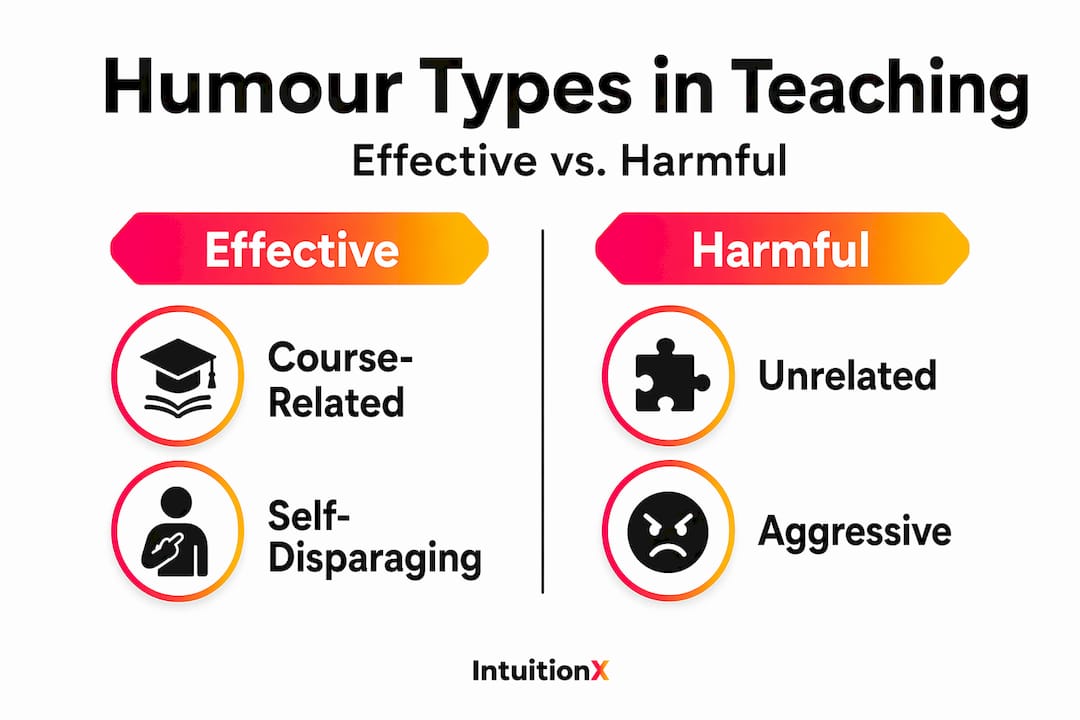
Course-unrelated humour is the random anecdote about your weekend or a joke that has nothing to do with the lesson. It might get a laugh, but it can distract students and actually harm the teacher-student relationship over time.
Self-disparaging humour involves the teacher poking fun at themselves. Used sparingly, it can feel endearing. Used too often, it quietly erodes credibility. A-Level students, in particular, are acutely aware of whether their teacher really knows their subject.
Aggressive or other-disparaging humour is the most damaging type. Sarcasm aimed at students, jokes at a classmate's expense, and dismissive wit all fall here. This approach damages classroom atmosphere and should be avoided entirely.
Interestingly, a 2025 study found that mathematics-related humour positively affects teacher-student relationships, while mathematics-unrelated humour harms them. That is a striking finding for anyone teaching a high-stakes STEM subject at A-Level.
Humour types at a glance
| Humour type | Effect on motivation | Effect on relationships | Risk level |
|---|---|---|---|
| Course-related | Positive | Positive | Low |
| Course-unrelated | Neutral to negative | Negative | Medium |
| Self-disparaging | Neutral | Neutral | Medium if overused |
| Aggressive/sarcastic | Negative | Strongly negative | High |
Here is what matters most for student engagement: the humour must serve the content. If it does not illuminate something, it is just a distraction wearing a punchline.
- Course-related humour increases enjoyment without sacrificing lesson focus
- Other-disparaging humour is the single fastest way to lose student trust
- Self-deprecation works best when the teacher is clearly still the expert in the room
- Unrelated humour has diminishing returns the more academically pressured the context
Now that we understand different types of humour, let us explore the nuances and best practices for their use in classrooms.
Best practices and guidelines for using wit effectively in the classroom
Knowing that wit can help is one thing. Knowing how to use it well is where most educators struggle. The good news is that the guidance is practical and specific.
Research recommends that effective teacher humour should be sparing, course-related, culturally sensitive, and free from sarcasm to maintain classroom safety and respect. Three to four well-placed moments per lesson appears to be the sweet spot. Beyond that, the positive effects begin to fade.
Here is a step-by-step approach to integrating wit into A-Level teaching without undermining your authority or your students' focus.
- Plan your humour in advance. Spontaneous jokes are a gamble. A pre-planned witty analogy linking, say, the Russian Revolution to modern workplace politics is both funny and pedagogically useful. Active learning strategies work best when humour is woven into the learning, not bolted on afterwards.
- Keep it content-connected. Before any joke lands, ask yourself: does this illuminate the topic? If the answer is no, leave it out.
- Test humour in smaller settings first. Before using a joke with a full class, try it in a tutorial or small group. Cultural sensitivity matters enormously, especially in diverse A-Level cohorts.
- Model the behaviour you want. If you use humour respectfully, students learn that wit and kindness go together. This sets the tone for peer interactions too.
- Avoid sarcasm entirely. It is worth stating plainly: sarcasm in classrooms risks normalising mockery, damaging classroom climate, and harming your professional reputation. Even when a student "takes it well," others in the room are watching.
Pro Tip: If you are unsure whether a joke lands appropriately, read the room after you deliver it. Forced laughter, silence, or confused faces are signals worth paying attention to. Adjust your approach and move on quickly. Never explain the joke.
One area that deserves special attention is cultural sensitivity. A-Level classrooms in the UK are often genuinely diverse. A joke that reads as neutral to one student may feel pointed or exclusionary to another. Rotating your humour styles and checking in informally with students about classroom tone is a simple, effective habit. You can also explore making learning fun through activities that naturally incorporate levity without relying solely on teacher-led jokes.
The goal of effective questioning techniques and wit are actually the same: you are trying to spark curiosity, lower anxiety, and keep students engaged. Think of humour as another form of question. It invites the student to see something familiar in an unexpected way.
Having outlined best practices, let us now examine the measurable benefits wit brings to student engagement and motivation.
How wit enhances student engagement and motivation
Here is the part parents often find most compelling. The benefits of wit in classrooms are not just anecdotal; they show up clearly in the data.

A 2026 University of Georgia study found that students with funny instructors report more positive emotions and greater motivation, particularly in smaller class settings. That has direct implications for A-Level tutorials, revision sessions, and one-to-one tutoring, where the emotional dynamics between educator and student are especially pronounced.
The role of wit in tutoring is particularly interesting here. In a one-to-one setting, a well-timed witty remark from a tutor can do something a textbook never can: it tells the student that this topic is worth being curious about. That shift in attitude is often what separates a student who grinds through A-Level Maths and one who genuinely engages with it.
How wit enhances learning goes beyond just mood. Consider the chain of effects:
- Positive humour reduces anxiety, making students more willing to attempt difficult problems
- Reduced anxiety lowers the cognitive load associated with performance pressure
- Lower pressure means students can focus on active learning rather than self-protection
- Emotional connection through shared laughter builds a sense of belonging in the classroom
- That sense of belonging correlates directly with willingness to ask questions and take academic risks
For parents supporting A-Level students at home, this last point is particularly worth noting. 73% of UK students are not actively engaged in their learning. Wit, used well, is one of the most underutilised tools for changing that.
Statistic to consider: Research confirms that mathematics-related humour reduces anxiety and strengthens teacher-student relationships, making it especially valuable for a subject where anxiety is rife and student confidence is often the biggest barrier.
With engagement benefits clear, we move next to how to apply wit in daily teaching and parental support.
Practical strategies for educators and parents to integrate wit in learning
The importance of humour in teaching is clear. But what does it actually look like in practice, for both a classroom teacher and a parent sitting at the kitchen table helping with revision?
Thoughtful humour integration increases perceived teaching quality and student motivation while maintaining lesson flow. Here is how to make that happen:
- Build a small repertoire of content-linked jokes and analogies. For a Geography teacher, it might be a running gag about plate tectonics whenever a student makes an "earth-shattering" discovery. These recurring references create an in-joke culture that students feel part of, which builds loyalty and engagement.
- Use playful exaggeration to make abstract concepts land. "If this cell were the size of a football pitch..." is not just funny; it is genuinely illuminating. Exaggeration and analogy are cognitive tools, not just comedic ones.
- Parents: model humour around learning challenges. When your son or daughter is stressed about an upcoming Chemistry exam, a well-timed observation like "Even Boyle had to start somewhere" does two things: it normalises struggle and reframes the subject as human rather than hostile.
- Avoid improvising jokes mid-lesson. The best habits around learning come from consistency. Spontaneous, unrelated jokes break concentration and can make a teacher appear less prepared, especially with high-achieving A-Level cohorts who notice everything.
- Regularly gauge student reaction. Adjust your humour frequency and style based on genuine feedback. A brief anonymous survey at the end of term is surprisingly revealing.
Pro Tip: For parents, the most effective home strategy is not cracking jokes, but not catastrophising. Laughing at your own confusion about a topic you are trying to help with ("I have no idea what integration means either, let's figure it out together") builds resilience and models a growth mindset more powerfully than any motivational speech.
Explore effective learning strategies to see how wit fits into broader approaches, and consider how transforming academic engagement through small daily shifts in tone can produce real results over a term.
Rethinking the role of humour in teaching: beyond popularity to pedagogical power
Here is the uncomfortable truth most teacher training courses do not say clearly enough: being funny does not make you a better teacher. It can make you a better teacher, if the humour is doing pedagogical work. But popularity earned through jokes is not the same as teaching quality.
Funny teachers are popular but not always more effective. Students may rate them highly on end-of-term surveys while actually retaining less, because the wit became entertainment rather than a learning tool.
The key insight is this: humour mediates its impact through teaching quality. A teacher who is clear, rigorous, and relationship-focused can use wit to amplify all three of those things. A teacher who is unclear and disorganised cannot use humour to compensate. The laughter becomes a distraction, not a bridge.
This matters enormously in the A-Level context. Students preparing for high-stakes examinations need both warmth and rigour. The wit has to serve the rigour, not replace it.
We also know that humour reception is deeply subjective. What one student finds hilarious, another finds grating. This is especially true across cultural backgrounds, neurodivergent learners, and students carrying significant stress. The most effective use of wit is intentional, not spontaneous, and it is always adaptable. A good educator treats wit the way a good surgeon treats their instruments: with precision, not bravado.
The best model for this kind of wit, incidentally, is the Socratic tradition. Not telling students what to think, but using wit, curiosity, and sharp questioning to open up their thinking. That is what great pedagogy in tutoring has always looked like, and it is what we have tried to build into the very core of IntuitionX.
Enhance your teaching with innovative support tools
Teaching with wit and genuine pedagogical intelligence is a skill, and like any skill, it develops faster with the right support. At IntuitionX, we have built an AI tutor that puts exactly this kind of wit to work: Oxbridge-calibre intelligence, Socratic questioning, and the kind of warm, engaging tone that makes difficult A-Level content feel approachable rather than intimidating.

Whether you are an educator looking to understand how engagement analytics can inform your teaching, or a parent seeking a smarter way to support your child's revision, the IntuitionX platform is designed specifically for UK A-Level contexts. We do not just deliver content. We build the confidence, curiosity, and motivation that make real learning possible. Backed by Sir Anthony Seldon and built on Oxbridge expertise, IntuitionX is the thinking partner your student deserves.
Frequently asked questions
What types of humour are best for engaging A-Level students?
Course-related humour that connects directly to lesson content is most effective for engaging A-Level students, improving motivation and reducing boredom without sacrificing academic focus.
Can humour ever harm student learning?
Yes. Aggressive humour, sarcasm, and excessive course-unrelated humour can damage classroom atmosphere and weaken teacher-student relationships, directly undermining motivation and trust.
How often should teachers use humour in lessons?
Using humour sparingly, no more than three to four times per lesson, tends to maximise its positive effects without causing distraction or reducing lesson pace.
Is sarcasm recommended in classroom humour?
Sarcasm is strongly discouraged because it risks damaging wellbeing and undermining the respectful classroom climate that effective learning depends on.
How can parents support the use of humour in learning at home?
Parents can model positive, learning-related humour to build resilience and make revision sessions more enjoyable, helping normalise struggle and supporting motivation through engaging activities that connect wit with curiosity.