
TL;DR:
- Research shows that well-structured tutoring significantly improves student learning, especially at A-Level. However, access disparities favor wealthier families, making affordable, effective alternatives essential for equity. Parents should prioritize curriculum alignment, diagnostic assessment, and evidence-based methods when choosing tutoring options.
Despite mounting evidence that tutoring can accelerate learning, many families still feel unsure which approach truly makes a difference. Peer tutoring alone can add the equivalent of six months of additional progress within a single academic year. Yet not all tutoring is created equal, and as school budgets tighten and access gaps widen, parents of A-Level students face more confusing choices than ever. This guide cuts through the noise, using the strongest available research to show you exactly what works, for whom, and how to find it without spending a fortune.
Table of Contents
- What the research says about tutoring and student success
- Key types of tutoring: one-to-one, small group, and peer support
- What makes tutoring effective? Structure, alignment, and curriculum connection
- Access, affordability, and equity: navigating tutoring for your child
- Practical steps for parents: choosing the right tutor or alternative
- Our perspective: moving beyond the 'private vs school' tutoring debate
- Explore affordable, effective tutoring solutions
- Frequently asked questions
Key Takeaways
| Point | Details |
|---|---|
| Tutoring boosts progress | Research shows tutoring can accelerate A-Level learning, sometimes by over six months. |
| Alignment is crucial | Tutoring linked with classroom curriculum delivers stronger results than generic help. |
| Access remains unequal | Not all students have the same opportunity—families should seek out local and affordable alternatives to bridge the gap. |
| Effective tutoring is structured | High-impact tutors diagnose gaps, follow the curriculum, and use scheduled interventions. |
What the research says about tutoring and student success
The evidence is clear: when tutoring is well designed and properly implemented, it works. Students make meaningful academic gains, particularly at secondary and sixth-form level where exam pressure is highest and content becomes increasingly demanding. Understanding how tutors boost student learning helps you make smarter decisions for your child.
But access is becoming a serious issue. 58% of schools reduced their tutoring offer in 2025 compared with the year before. At the same time, a notable gap exists between income groups: 23% of pupils in the least well-off households had access to private tutoring, versus 30% in the most well-off households. That gap compounds over time, especially at A Level, when subject complexity and grade stakes are at their peak.
| Tutoring type | Typical progress gain | Cost range (per hour) | Best suited to |
|---|---|---|---|
| One-to-one private | Up to 5+ months | £40–£150 | Any student; especially those with specific gaps |
| Small group (2-4) | 4–5 months | £15–£40 | Students needing engagement and accountability |
| Peer tutoring | Up to 6 months | Free or low cost | Motivated students; benefits both parties |
| AI-assisted tutoring | Variable; improving rapidly | Low or subscription | Independent learners; flexible schedules |
"Peer tutoring can have an average positive impact equivalent to approximately six additional months' progress within one academic year." — Education Endowment Foundation
The students who benefit most from tutoring tend to share certain characteristics. Keep an eye on whether your child falls into one of these groups:
- Students with lower prior attainment who need targeted help bridging gaps before key exams
- Pupils with SEND who require adjusted pacing or alternative explanations
- Students from disadvantaged backgrounds who lack access to books, revision materials, or subject expertise at home
- Young people with high anxiety around exams who need a safe space to ask questions without judgement
- A-Level pupils in highly technical subjects such as Further Maths, Chemistry, or Economics, where school time alone rarely suffices
With these foundational insights in mind, we need to examine what makes certain tutoring approaches stand out.
Key types of tutoring: one-to-one, small group, and peer support
There are three main tutoring models, and each serves a different purpose. Knowing which one fits your child can save you both time and money.
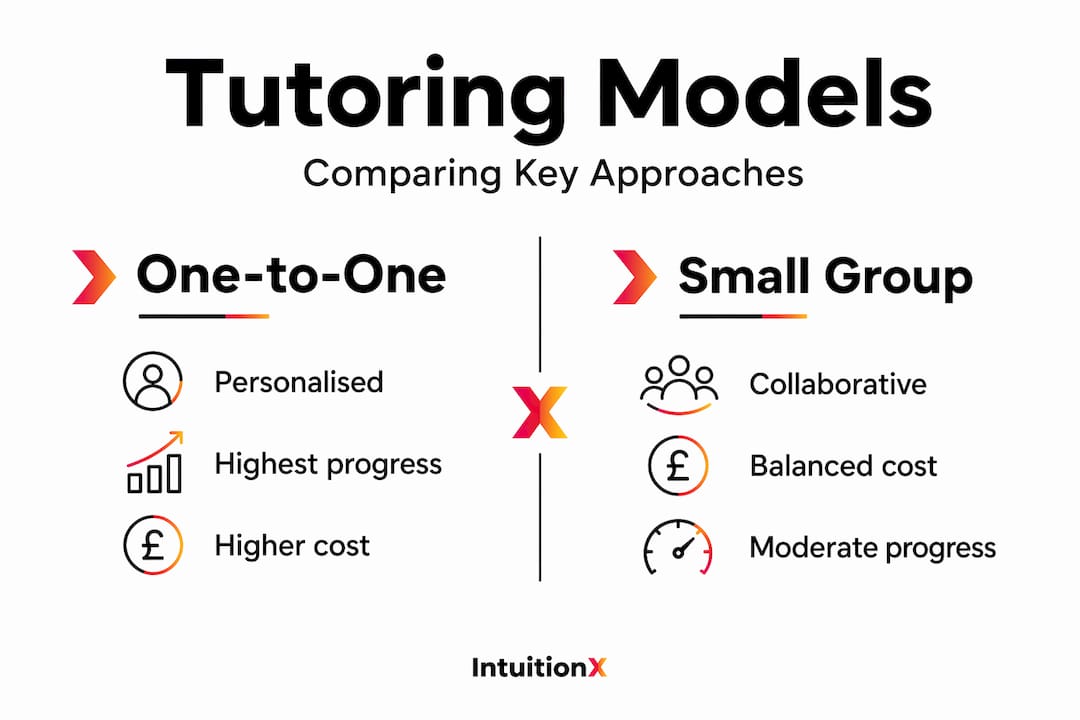
One-to-one tutoring is the gold standard in many parents' minds, and for good reason. It offers complete personalisation, immediate feedback, and the ability to work at exactly your child's pace. It is particularly powerful for students who need to rebuild confidence or address specific misconceptions in a subject. The drawback? Cost. Quality one-to-one tutors can be expensive, and not every family can sustain that for two or more A-Level subjects across two years.
Small group tutoring (typically two to four students) is a strong middle ground. It reduces cost while preserving most of the benefits of targeted instruction. EEF guidance confirms that both small group and one-to-one interventions can be powerful, provided they are carefully scheduled and aligned with what students are studying in school. The social dynamic of a small group can also reduce anxiety for students who feel self-conscious asking questions in front of a full class.

Peer tutoring is the most underused model, and the research behind it is genuinely compelling. A 2025 meta-analysis on cross-age tutoring confirms a small-to-moderate positive effect on academic outcomes, and the benefits flow in both directions. The student doing the teaching deepens their own understanding. This is sometimes called the "protégé effect," and it is particularly useful at A Level, where re-explaining a concept forces genuine mastery.
| Model | Effectiveness | Average cost | Key pros | Key cons |
|---|---|---|---|---|
| One-to-one | Very high | £40–£150/hr | Fully personalised | Expensive; hard to sustain |
| Small group | High | £15–£40/hr | Social; affordable | Less tailored to individual |
| Peer tutoring | High (both parties) | Free | Builds confidence; free | Needs structure to work well |
| AI tutoring | Growing | Low/subscription | 24/7; no pressure | Less human connection |
Explore personalised learning strategies to understand how to match the right model with your child's specific learning style.
How to decide which model suits your child best:
- Identify the core problem: Is it gaps in understanding, confidence, revision habits, or exam technique?
- Assess your budget honestly and determine how many hours per week are sustainable long term.
- Consider your child's personality. Do they find one-to-one sessions intense or comforting?
- Check what is available locally through school, community groups, or digital platforms.
- Trial one model for four to six weeks and review progress before committing further.
Pro Tip: Cross-age and peer tutoring are often overlooked entirely by parents, yet they offer real engagement and identity benefits alongside the academic gains. A sixth-form student tutoring a younger peer in Biology, for example, will dramatically strengthen their own understanding of core concepts ahead of their A-Level exams.
Choosing the right tutoring model is only part of the answer. How sessions are structured and delivered is just as critical.
What makes tutoring effective? Structure, alignment, and curriculum connection
You can have the most qualified tutor in the country and still see disappointing results. Why? Because structure and curriculum alignment are the real engines of progress.
Effective tutoring depends heavily on implementation quality. That means structured, scheduled sessions aligned with what your child is actually studying in school, not ad hoc help with whatever homework landed that evening. Without this connection, tutoring can feel like a separate activity rather than a genuine support for classroom learning.
The numbers back this up. Tutoring aligned with classroom instruction produced an additional 1.3 months of learning progress, even when controlling for other factors. Pair that with well-structured sessions using diagnostic assessment and deliberate practice, and gains can reach six months or beyond within a single year.
So what should you look for? Here is a practical checklist of questions to ask any tutor before you commit:
- Does the tutor know the specific exam board your child's school uses (AQA, Edexcel, OCR, etc.)?
- Will sessions be planned in advance rather than reactive to whatever homework appears?
- How does the tutor diagnose gaps before starting, rather than assuming where the problems are?
- Are there regular review points to measure progress and adjust the approach?
- Does the tutor use active retrieval practice, spacing, and other evidence-based techniques, or is it just re-reading notes?
- Can the tutor adapt their explanation style if the first approach does not land?
Good pedagogy for effective tutoring is not complicated, but it does require intention. A tutor who simply goes through past papers without diagnosing the root cause of errors is likely to produce limited gains. Understanding the AI tutoring process can also help you identify what structured support looks like, whether it comes from a human or a digital learning tool.
Pro Tip: Avoid tutors offering generic "homework help" not connected to your child's curriculum. The research is unambiguous: alignment to classroom content is what turns tutoring hours into real academic progress. Ask specifically how each session connects to what is happening in school that week. If the tutor cannot answer that question, keep looking.
Strong engagement strategies within sessions also matter enormously. A tutor who lectures for an hour is far less effective than one who asks questions, invites the student to explain their thinking, and creates genuine dialogue.
While alignment and structure are essential, not all students have equal access to effective tutoring, and cost and equity issues are growing.
Access, affordability, and equity: navigating tutoring for your child
The numbers are striking. In 2025, only 23% of pupils in the worst-off households had access to private tutoring, compared with 30% in the most affluent homes. Meanwhile, 58% of schools reduced their tutoring provision that same year. The result is a growing gap at exactly the moment when A-Level students need the most support.
This is not just a fairness issue. It is a practical problem with long-term consequences. Disadvantaged pupils are far less likely to benefit from private tutoring, yet the evidence for one-to-one and small-group tuition raising attainment is the strongest we have. That means the families who need it most are least likely to get it. Exploring the tutoring access gap in the UK reveals just how entrenched this inequality has become.
The good news is that there are real alternatives, and many of them are free or very low cost.
Strategies for finding affordable, quality tutoring:
- Check your local authority. Some councils offer subsidised tutoring programmes, particularly for students in receipt of pupil premium or free school meals.
- Ask your child's school directly. Many schools still run intervention groups or can connect you with a teacher willing to offer extra time before exams.
- Explore charity-funded programmes. Several national charities run structured tutoring initiatives specifically designed for families who cannot afford private fees.
- Consider peer learning circles. Organising a small group of motivated students to study together, with rotating "teaching" roles, is free and research-backed.
- Use structured digital and AI platforms. Quality AI-assisted learning tools are now genuinely effective and available at a fraction of the cost of human tutors, particularly for independent learners.
- Look for university widening access schemes. Many Russell Group universities offer free subject support sessions to state school students in Years 12 and 13.
Do not assume that expensive automatically means better. Online resources for access now exist that were unimaginable a decade ago, and the quality gap between premium private tutors and structured digital alternatives is narrowing fast. What matters most, as the research shows consistently, is structure and alignment, not price.
With the challenges clear, let us turn to expert recommendations parents can use right now.
Practical steps for parents: choosing the right tutor or alternative
You do not need to spend hours researching every option. Here is a clear, evidence-based process for making a confident decision.
Your step-by-step checklist for selecting a tutor:
- Define the goal clearly: Is your child aiming for a specific grade, addressing one weak topic, or building general exam confidence?
- Ask about curriculum alignment before anything else. Any tutor worth considering should know your child's exam board inside out.
- Request a diagnostic session first. Good tutors identify gaps before they teach, not after.
- Look for tutors who diagnose misconceptions early, then deliver targeted, structured practice explicitly connected to the school curriculum.
- Agree on clear milestones: What will improved performance look like after four sessions? After eight?
- Review progress formally every half-term. Do not assume it is working. Check mock scores, class feedback, and your child's own sense of confidence.
- If private tutoring is not financially viable, explore peer tutoring, structured online groups, or AI tutoring for UK parents as genuinely effective alternatives.
Monitoring progress matters just as much as finding the right tutor in the first place. Keep a simple log of your child's test scores and teacher feedback. If three months pass without measurable improvement, it is time to reassess the approach, not just persist and hope.
Pro Tip: Prioritise tutors who diagnose learning gaps first, not tutors who simply reteach content or churn through past papers. The most effective tutors work like a detective, finding out exactly where understanding breaks down and addressing that root cause directly.
Finally, what does all of this mean in practice for the future of tutoring and student success?
Our perspective: moving beyond the 'private vs school' tutoring debate
Here is an uncomfortable truth that most tutoring conversations ignore: the binary of "expensive private tutor versus whatever school provides" is increasingly unhelpful, and in some cases, it actively holds families back.
Parents are told, implicitly or explicitly, that if you can pay for a tutor, your child will be fine. If you cannot, they will fall behind. That framing misses the point entirely. The research tells us something far more nuanced: the how of tutoring matters considerably more than the who pays for it. A poorly structured hour with a highly qualified tutor produces less progress than a well-designed peer tutoring session. A generic AI tool that writes essays for students does nothing. A Socratic AI that asks questions, challenges thinking, and adapts to the learner's exact needs can be genuinely transformative.
What we find most encouraging about where the field is heading is this: the ingredients of great tutoring are becoming more democratic. Diagnostic thinking, curriculum alignment, Socratic questioning, retrieval practice — these are pedagogical tools, not exclusive privileges. The challenge is ensuring that families at every income level know how to access them and recognise them when they see them.
We also believe, deeply, that equity is not just a policy issue. It is something individual families can act on today. Learning about tutors and engagement, exploring peer models, and choosing structured digital support over passive content consumption: these are all choices available to most families right now, regardless of budget.
The question is no longer just "Can we afford a tutor?" It is "Do we understand what effective support actually looks like?" That is a more hopeful question, and this guide is designed to help you answer it with confidence.
Explore affordable, effective tutoring solutions
Your child deserves the very best support, whatever your budget. At IntuitionX, we have built a 24/7 AI tutor trained on Oxbridge-level academic expertise, combining Socratic questioning, memory science, and genuine pedagogical craft to give every student access to elite-level learning. It is not about replacing human connection. It is about making world-class support available any time your child needs it.
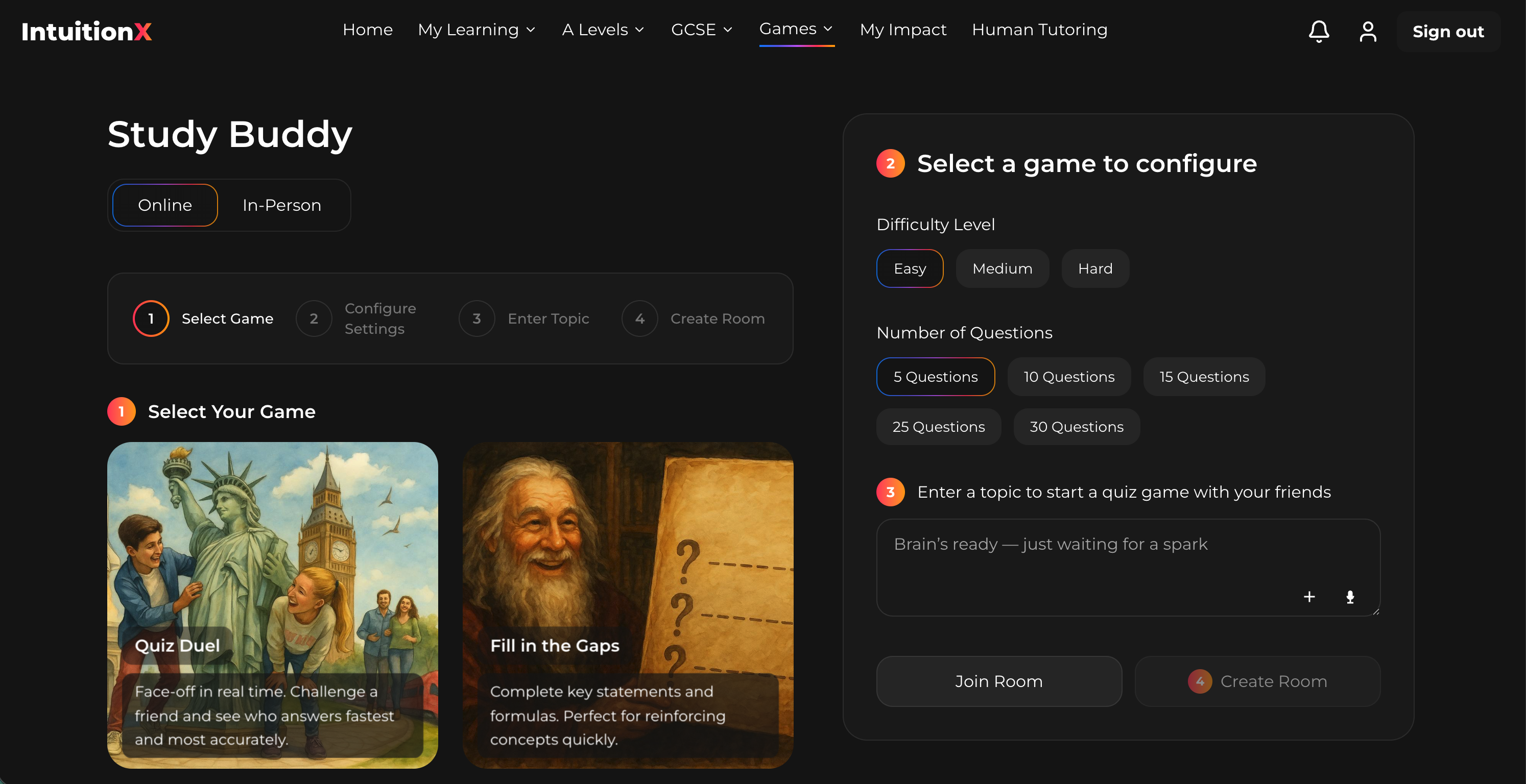
Whether your child is wrestling with A-Level Chemistry at midnight or needs a confidence boost before a mock exam, our affordable tutoring platform is ready to help. Explore our UK parents' AI tutoring guide to understand exactly how it works and why leading educationalists like Sir Anthony Seldon are backing this approach. The future of tutoring is structured, personalised, and accessible. We are here to help your child be part of it.
Frequently asked questions
Does peer tutoring actually work for A-Level students?
Yes. Peer tutoring can improve progress by up to six months within a single academic year, and some studies show even greater gains for secondary students when sessions are well structured and consistent.
How does one-to-one tutoring compare to small group models?
Both can be highly effective when carefully scheduled and aligned with the school curriculum. Some students find the social dynamic of a small group reduces anxiety and keeps motivation higher over a long period.
What should I ask before choosing a tutor?
Ask whether the tutor diagnoses learning gaps before teaching, aligns every session to the A-Level curriculum your child studies, and sets measurable progress points so you can track impact over time.
Are there affordable tutoring options for families with lower incomes?
Yes. Disadvantaged pupils are less likely to access private tutoring, but local authority schemes, charity programmes, peer learning circles, and structured AI tools all offer genuine, research-backed support at low or no cost.