

TL;DR:
- A clear, structured learning workflow enhances teen engagement and measurable progress.
- Optimizing environment and tools is crucial for effective online learning success.
- Implementing step-by-step routines increases consistency, independence, and motivation in teen learners.
Is your teen sitting through online lessons but not really learning? You're not alone. Many parents notice their child going through the motions, completing tasks without genuine understanding, and losing motivation fast. The problem often isn't the content or even the platform. It's the absence of a clear, structured process. A teen learning workflow is the series of steps your teen follows to engage with material, retain it, and apply it confidently. Get that right, and everything else improves. This guide walks you through exactly how to build one, from setup to troubleshooting, so your teen can move from passive scrolling to active, measurable progress.
Table of Contents
- Understanding teen learning workflows: what and why
- Preparing for success: tools, resources, and your teen's environment
- Step-by-step guide: setting up an effective teen learning workflow
- Troubleshooting and empowering independent learning
- Our perspective: why workflow is the missing link for teen success
- Next steps: supporting your teen with the right tools
- Frequently asked questions
Key Takeaways
| Point | Details |
|---|---|
| Workflow outperforms tradition | Structured online learning increases achievement more than project-based or traditional methods. |
| Preparation is critical | Set up the right tools and environment to boost your teen’s engagement and results. |
| Workflow drives independence | A clear process empowers teens to self-manage their learning and motivation. |
| Troubleshooting ensures progress | Address challenges early so workflow changes can support consistent improvement. |
| Platforms ease the journey | Digital solutions like AI learning companions make customising and sticking to workflows far simpler. |
Understanding teen learning workflows: what and why
A teen learning workflow isn't just a timetable. It's the full structured sequence your teen follows when they sit down to learn: how they prepare, how they engage with material, how they review it, and how they check their own progress. Think of it as the operating system behind every study session.
Why does this matter so much? Because without a clear process, teens default to passive habits. They re-read notes, highlight text, or watch videos on repeat without actually processing anything. That's not learning. That's going through the motions.
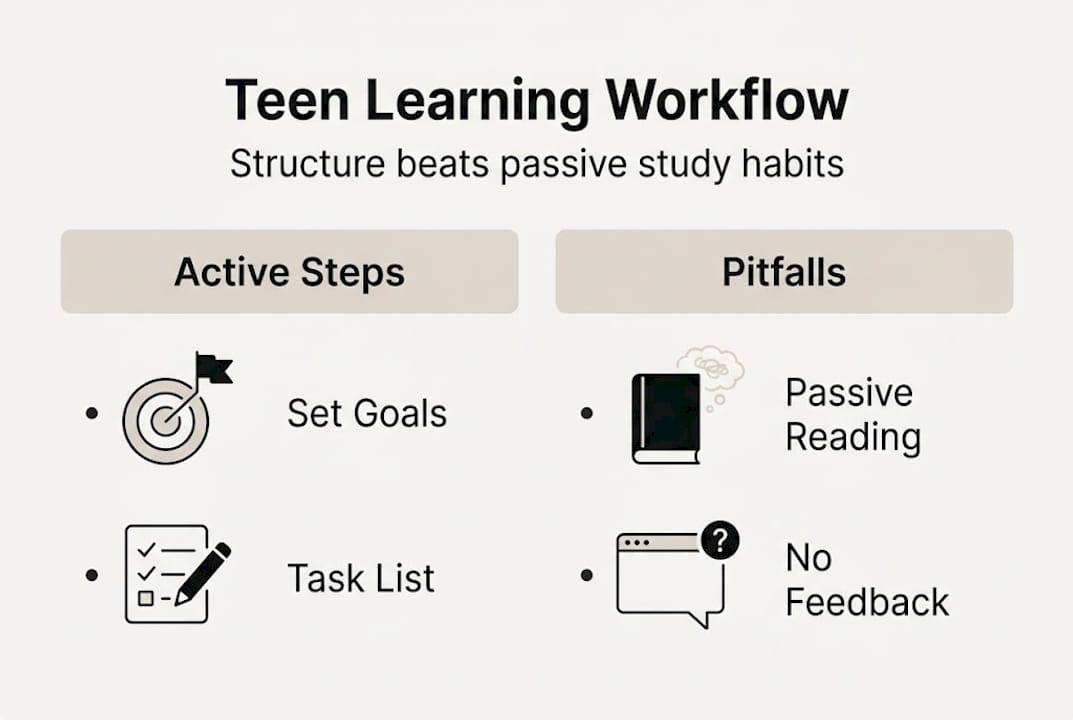
A well-designed workflow changes this. It creates consistency, reduces the overwhelm of not knowing where to start, and gives teens a sense of control over their own progress. For parents, it means fewer arguments about screen time and more visible results.
The evidence backs this up. Research shows that online lessons outperform both project-based learning (PBL) and conventional teaching methods for teen academic achievement. The numbers are striking:
"Online structured learning achieves a 72% success rate, compared to 64% for project-based learning and just 53% for conventional classroom teaching."
Those aren't marginal gains. That's a significant difference, and it comes down to how learning is structured and delivered.
Here's what a strong teen learning workflow delivers:
- Improved consistency across subjects and study sessions
- Reduced overwhelm by breaking big goals into manageable steps
- Measurable progress your teen can actually see and feel proud of
- More independent learning over time, reducing reliance on constant parental input
- Active engagement rather than passive consumption of material
Exploring personalised learning strategies can help you tailor this further, and pairing the workflow with engaging learning methods ensures the process stays motivating rather than mechanical.
Preparing for success: tools, resources, and your teen's environment
Before your teen starts any workflow, the environment and tools need to be right. A cluttered desk, a slow laptop, and a phone buzzing every two minutes will undo even the best-planned routine.

Start with this checklist:
| Tool | Purpose | Free option available? |
|---|---|---|
| Reliable device (laptop or tablet) | Core learning platform access | School-issued devices often available |
| Stable internet connection | Uninterrupted sessions | Check provider bundles |
| Online learning platform | Structured lessons and feedback | Many offer free trials |
| Note-taking app (e.g. Notion, OneNote) | Organising and reviewing material | Yes, both free tiers available |
| Digital calendar or planner | Scheduling sessions and deadlines | Google Calendar is free |
| Quiet, dedicated workspace | Minimising distraction | Rearrange existing space |
| Motivation or progress tracker | Maintaining momentum | Habit apps like Habitica are free |
The physical environment matters more than most parents realise. Good lighting reduces eye strain and keeps your teen alert. An ergonomic chair and screen at eye level prevent fatigue during longer sessions. And yes, the phone should be in another room. Research consistently shows that even the presence of a smartphone reduces cognitive capacity, even when it's face down and silent.
For tech tools, UK and US teens are currently finding success with:
- Notion for organising notes and revision schedules
- Anki for spaced repetition flashcard revision
- Forest for focus and distraction blocking
- Google Classroom for school-assigned work
- Khan Academy for free supplementary lessons
Pro Tip: Before spending money on premium tools, check whether your teen's school provides free access. Many platforms offer educational licences, and there are strong affordable education resources available that won't stretch your budget.
Studies confirm that online learning environments support higher academic achievement than conventional setups, but only when the environment supports focused engagement. You can also explore educational technology trends shaping how teens learn in 2026 for further inspiration. For broader planning frameworks, lesson planning workflow insights offer useful structural ideas you can adapt at home.
Step-by-step guide: setting up an effective teen learning workflow
With resources in place, here's a practical blueprint you and your teen can follow together.
- Define clear learning goals. Start each week by identifying two or three specific outcomes. Not "study maths" but "understand quadratic equations well enough to solve five practice problems independently."
- Choose the right digital tools and platforms. Match tools to the subject and your teen's learning style. Visual learners may prefer video-led platforms; analytical learners may prefer structured text and quizzes.
- Map out a weekly and daily schedule. Block specific times for each subject. Consistency matters more than duration. Four focused 45-minute sessions beat one exhausting three-hour marathon.
- Integrate active learning tasks. Replace passive re-reading with retrieval practice, self-quizzing, or explaining concepts aloud. These methods dramatically improve retention.
- Monitor progress regularly. Use weekly check-ins to review what's been covered, what's clicked, and what needs revisiting. Progress tracking keeps motivation high.
- Adjust as needed. No workflow is perfect from day one. Treat it as a living system that evolves with your teen's needs.
Pro Tip: Build short breaks into the schedule using the Pomodoro method: 25 minutes of focused work followed by a 5-minute break. Add a longer review session at the end of each week to consolidate memory.
| Approach | Clarity | Engagement | Adaptability | Outcomes | |---|---|---|---| | Online structured workflow | High | High | High | 72% achievement | | Project-based learning | Medium | Medium | Medium | 64% achievement | | Conventional classroom | Low | Low | Low | 53% achievement |
Research confirms that step-by-step digital workflows drive measurably better learning results than unstructured approaches. For deeper support, explore effective learning strategies and active learning strategies that complement this framework beautifully.
Troubleshooting and empowering independent learning
Even with a solid workflow in place, things go wrong. That's normal. The goal isn't a perfect system. It's a resilient one.
Here are the most common problems parents and teens encounter:
- Tech issues disrupting sessions and breaking concentration
- Motivation dips after initial enthusiasm fades
- Workflow overwhelm when the schedule feels too rigid or demanding
- Unclear goals leaving teens unsure what success looks like
- Lack of feedback making it hard to know whether learning is actually happening
Practical fixes for each:
For tech issues, have a backup plan. A mobile hotspot, a downloaded lesson, or a simple notebook can keep momentum going. For motivation dips, revisit the goals and remind your teen why they set them. Connecting effort to a meaningful outcome reignites drive. For overwhelm, simplify. Cut the schedule back to essentials and rebuild gradually.
For unclear goals, get specific together. For feedback gaps, use platforms that provide instant responses, or consider an AI tutor that asks questions rather than just giving answers.
Pro Tip: Schedule a ten-minute check-in with your teen at the end of each week. Ask them what worked, what didn't, and what they'd change. This builds self-reflection habits that are genuinely valuable for life beyond school.
Research shows that self-paced online learning enables better independent progress over time. Building this independence is the real long-term win. Explore how AI for personalised success can support your teen's autonomy, and see how democratising learning is making these tools accessible to every family. For further troubleshooting ideas, lesson planning troubleshooting offers practical approaches you can adapt.
Our perspective: why workflow is the missing link for teen success
Most advice for parents chases the latest app or the trendiest curriculum. New platform this month, new methodology next term. It's exhausting, and it rarely moves the needle.
Here's what we've seen consistently: the teens who thrive aren't using the fanciest tools. They're using any tools within a clear, repeatable process. Workflow is what makes content stick. Without it, even the best lesson is forgotten within 48 hours.
Passive learning is the silent enemy of academic progress. Teens who scroll through content without active engagement aren't building knowledge. They're building the illusion of knowledge, which is arguably worse because it creates false confidence before exams.
A structured workflow gives your teen agency. It shifts them from passenger to driver. And when teens feel in control of their learning, motivation follows naturally. You don't have to chase it.
This is why we believe workflow is the missing link, not a nice extra. Explore how online resources and education access are levelling the playing field, and consider what a difference the right structure could make for your teen today.
Next steps: supporting your teen with the right tools
Building a learning workflow from scratch can feel like a lot. But you don't have to do it alone, and neither does your teen.

Platforms like IntuitionX are designed to make this process effortless. IntuitionX is a 24/7 Socratic AI tutor built on Oxbridge-level intelligence that adapts to your teen's individual learning needs, asks the right questions to deepen understanding, and keeps the workflow engaging rather than mechanical. It's backed by Sir Anthony Seldon, described by The Times as "visionary," and endorsed by some of Britain's leading educators. Ready to see consistent progress? Start with IntuitionX today and give your teen the structured, personalised support that genuinely makes a difference.
Frequently asked questions
What is the most effective learning workflow for teens?
A structured online learning workflow with clear goals, active tasks, and regular feedback consistently delivers the best outcomes. Online lessons achieve higher success rates than both project-based and conventional methods.
How can parents help teens stick to an online workflow?
Set a regular study schedule, reduce distractions in the learning environment, and choose engaging online tools that encourage active participation rather than passive consumption.
What if my teen struggles with motivation using online workflows?
Involve your teen in setting their own goals and selecting their tools. Reviewing progress together each week builds accountability and keeps motivation grounded in real achievement.
Are online workflows better than traditional study routines?
Studies show online structured workflows achieve 72% success rates compared to just 53% for conventional methods, making them significantly more effective when thoughtfully implemented.
Recommended
- Unlock affordable education resources: your expert guide
- Personalised learning explained: strategies for high school success
- Effective learning strategies for academic success in 2026
- Top ways to democratise learning in high schools for all
- Teaching Aids in ESL: 35% Boost in Engagement for 2026 | TEFL Institute