

TL;DR:
- AI-powered platforms significantly improve exam grades through personalized, adaptive learning and instant feedback.
- Evidence shows many students benefit from AI tools, but risks include accuracy issues, over-reliance, and cheating.
- Choosing the right AI tool involves checking exam board alignment, transparency, privacy, and suitability for individual learning needs.
Exam revision has long felt like a lonely slog through textbooks, past papers, and highlighter pens. But something significant is shifting. Grade improvements are emerging from AI-powered platforms, with tools like Medly reporting that 74% of students improved by at least one grade, and 40% by two. These are not small gains. They represent real students, real exams, and real futures. This guide breaks down exactly how AI is changing A Level preparation, what the evidence actually says, where the risks lie, and how to choose a tool that genuinely supports your learning rather than doing it for you.
Table of Contents
- What does AI do differently in exam prep?
- Does the data prove AI prep works? Evidence and results
- Downsides, risks and ethical concerns of AI exam prep
- How to pick the right AI tool for your exam prep
- Our perspective: What students, parents and teachers often overlook
- Get started with AI-powered exam prep today
- Frequently asked questions
Key Takeaways
| Point | Details |
|---|---|
| Personalised learning support | AI offers tailored revision paths and instant feedback, boosting exam confidence and outcomes. |
| Significant grade improvements | Empirical data show students can gain 1–3 A Level grades using effective AI-backed tools. |
| Ethical use and oversight | Responsible use of AI with human guidance helps avoid cheating and over-dependence. |
| Select tools wisely | Opt for AI tools verified for UK exam alignment, free trials, and clear privacy protections. |
What does AI do differently in exam prep?
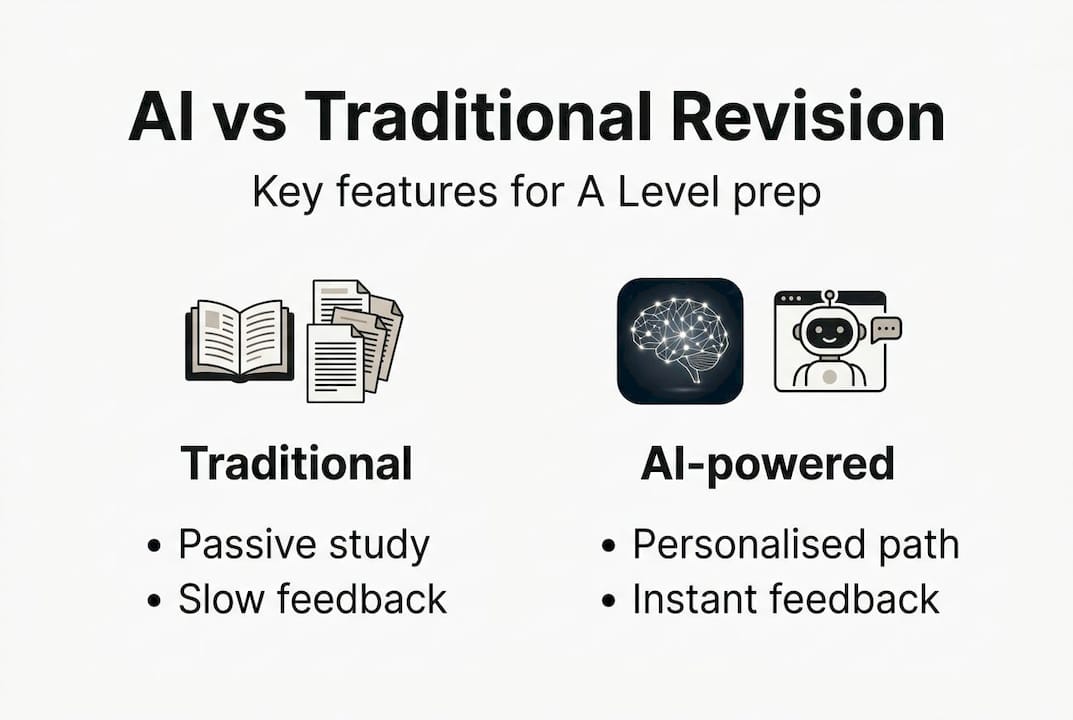
Traditional revision is largely passive. You read, you highlight, you hope it sticks. AI platforms work differently because they respond to you specifically, adjusting in real time based on how you are performing.
At the core of most AI exam tools are several key technologies. Adaptive learning algorithms track which topics you struggle with and serve more practice in those areas. Natural language processing (NLP) allows the tool to read your written answers and give meaningful feedback, not just tick-or-cross marking. Machine learning predicts where you are likely to drop marks before you even sit the exam. Knowledge graphs map how concepts connect, so the AI can spot gaps in your understanding that you might not even notice yourself. Generative AI creates fresh practice questions and model explanations on demand.
Here is what that looks like in practice for a student revising Biology at home:
- A diagnostic assessment identifies weak areas (say, protein synthesis)
- A personalised revision plan is generated automatically
- The AI provides instant explanations when you get something wrong
- New practice questions are generated until the concept clicks
- Progress is tracked and the plan adjusts as you improve
One particularly impressive development: fine-tuned language models now achieve a 0.847 correlation with expert human grading. That is remarkably close to what a teacher would give.
| Feature | Traditional revision | AI-powered revision |
|---|---|---|
| Personalisation | Low | High |
| Feedback speed | Days or weeks | Instant |
| Availability | Limited | 24/7 |
| Question variety | Fixed | Unlimited |
| Progress tracking | Manual | Automated |
Pro Tip: Use AI learning companions as a starting point to understand which type of AI tool suits your learning style before committing to one platform.
The best conversational AI tools do not just quiz you. They ask why you think an answer is correct, pushing you to reason rather than recall. That distinction matters enormously for A Level success.
Does the data prove AI prep works? Evidence and results
Let's look at what the evidence actually shows, because the results are genuinely striking.

AITutorPro claims an average improvement of three A Level grades per student. Medly reports that 74% of students improved by at least one grade, with 40% improving by two. AI assessments in these platforms have also been shown to be comparable to human marking through item response theory (IRT) analysis, a rigorous statistical method used to evaluate test reliability.
Closer to home, the Wensleydale School trial in the UK used AI marking tools for English and History mock papers. Teachers reviewed the AI feedback before passing it to students. The result? Students received far more detailed commentary than a single teacher could realistically produce across a full class set of essays.
"The AI gave students paragraph-level feedback that would have taken me hours to write manually. It freed me up to have real conversations with students about their thinking." — Teacher participant, Wensleydale School trial
For context, traditional revision methods rely heavily on teacher availability, which is finite. AI removes that bottleneck entirely.
| Platform | Reported grade improvement | Subject focus | Evidence type |
|---|---|---|---|
| AITutorPro | Avg. 3 grades | Mixed | Platform claim |
| Medly | 74% up 1 grade, 40% up 2 | Mixed | Platform data |
| Wensleydale trial | Qualitative improvement | English, History | School pilot |
It is worth being honest about the limits here. Most robust studies focus on STEM subjects and higher education settings. Evidence for humanities at A Level is thinner. AI for A Level literature revision is promising but less proven than, say, Maths or Chemistry.
Parents researching options will find useful context in parent perspectives on AI tutoring, which covers how families are integrating these tools alongside school support. BBC Bitesize also provides a helpful student-facing overview of AI study tools currently available in the UK.
Key stat: AI assessments now show IRT-validated reliability comparable to trained human markers, a significant benchmark for academic credibility.
Downsides, risks and ethical concerns of AI exam prep
AI exam prep is not without its problems. Being clear-eyed about the risks helps you use these tools wisely.
First, accuracy. AI grading is within 10% of human teachers roughly 70% of the time. That sounds reassuring, but it also means 30% of the time there is a meaningful discrepancy. AI tends to score essays slightly higher and with less variation than human markers. For subjects requiring nuanced argument, like History or English Literature, this inconsistency matters.
Second, over-reliance. When AI does the thinking for you, a process researchers call cognitive offloading, you may feel like you are learning without actually building the deep understanding A Levels demand. Passive use of AI is just as ineffective as passive reading.
Third, and most seriously, cheating. Ofqual has flagged concerns about AI being used in A Level English and History coursework, calling it a cause for genuine anxiety. The exam system itself may need an overhaul to keep pace with generative AI capabilities.
Key risks to keep in mind:
- Accuracy gaps in essay and extended writing feedback
- Over-dependence replacing genuine understanding with surface recall
- Cheating risks in coursework and non-exam assessments
- Equity concerns as premium AI tools are not equally accessible
- Privacy issues if platforms handle student data carelessly
"There is cause for anxiety about the use of AI by students in ways that undermine the integrity of qualifications." — Ofqual representative
Pro Tip: Use AI to check your thinking, not to replace it. Write your answer first, then ask the AI to critique it. This approach, supported by AI for personalised learning, builds genuine understanding rather than bypassing it.
For teachers, the message is clear: AI tools should supplement your marking and feedback, not replace your professional judgement.
How to pick the right AI tool for your exam prep
Not all AI exam tools are equal. Here is how to choose wisely.
- Check exam board alignment. Does the tool explicitly cover AQA, Edexcel, OCR, or whichever board your school uses? Generic AI often misses specification-specific content.
- Look for a free trial. Reputable tools let you test before you commit financially. Exam-board aligned tools with free trials are the safest starting point.
- Assess adaptability. Does the platform adjust to your performance, or does it serve the same content to everyone?
- Review transparency. Can you see why an answer was marked correct or incorrect? Explanation matters more than the score.
- Check privacy and safeguarding. Especially important for under-18 users. Look for GDPR compliance and clear data policies.
| Platform | Free trial | Exam board aligned | Parent/teacher dashboard | Price range |
|---|---|---|---|---|
| IntuitionX | Yes | Yes | Yes | Affordable |
| AITutorPro | Limited | Partial | No | Mid-range |
| Medly | Yes | Partial | Limited | Mid-range |
| Generic AI (e.g. ChatGPT) | Yes | No | No | Free/low cost |
For a deeper comparison, AITutorPro alternatives breaks down the leading platforms side by side, covering features, pricing, and suitability for different subjects. You can also explore the broader AI revision data to understand which platforms have the strongest evidence base.
Pro Tip: Always check whether a platform offers a parent or teacher dashboard. This transparency helps adults support students responsibly and ensures AI is being used for learning, not shortcuts.
Our perspective: What students, parents and teachers often overlook
Here is something most articles on AI exam prep will not tell you. The students who benefit most from AI tools are not the ones who use them the most. They are the ones who use them most intentionally.
AI is brilliant at identifying gaps, generating practice, and giving instant feedback. But it cannot replicate the moment a great teacher challenges your thinking in a way that genuinely changes how you see a problem. That is irreplaceable.
AI enhances A Level preparation through personalisation, but it needs human oversight to mitigate inconsistencies, cheating risks, and over-reliance. The students who treat AI as a thinking partner rather than an answer machine are the ones who actually improve.
Parents and teachers play a crucial role here. Aligning the AI tool with the specific syllabus, reviewing the feedback it gives, and having conversations about what the student is actually learning all make an enormous difference. Without that layer of human guidance, AI prep can become just another passive revision habit.
Pro Tip: Build a revision routine that pairs AI practice sessions with handwritten notes and a weekly conversation with your teacher about what the AI flagged. This combination, covered in more depth at making the most of AI in revision, is where real progress happens.
Get started with AI-powered exam prep today
You now know what works, what to watch for, and how to choose a tool that genuinely supports learning. The next step is finding an AI companion that is built for exactly this purpose.
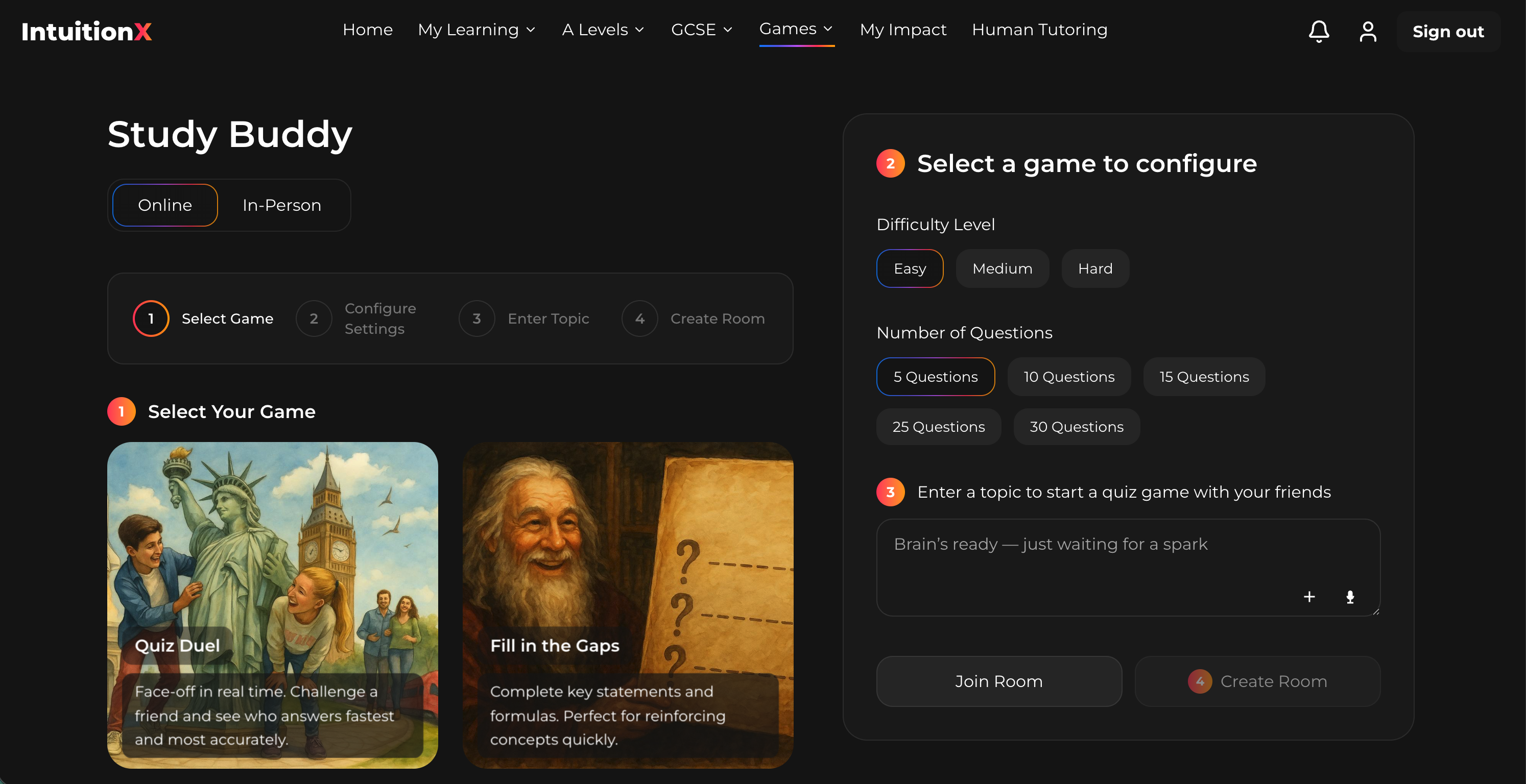
IntuitionX is a 24/7 Socratic AI tutor built on Oxbridge-level academic expertise, designed to ask the right questions rather than just hand you answers. It is aligned with UK exam boards, offers a free trial, and includes dashboards for parents and teachers. Backed by Sir Anthony Seldon, one of Britain's leading educationalists, IntuitionX is built to help every student learn like the top 1%, regardless of background or budget. Start your free trial today and turn revision stress into genuine confidence.
Frequently asked questions
How accurate is AI grading compared to human teachers?
AI grading falls within 10% of human teachers 70% of the time, but tends to score essays slightly higher and with less variation, so teacher review remains essential for extended writing.
Can AI really help students improve their A Level grades?
UK trials and platforms like AITutorPro and Medly report students improving by one to three grades on average with structured, consistent AI support.
Are there risks of relying too much on AI for revision?
Yes. Over-reliance can reduce independent thinking through cognitive offloading, and Ofqual has flagged cheating risks in coursework if AI is not used responsibly.
What should I look for in a trustworthy AI exam prep tool?
Prioritise tools that are aligned with UK exam boards, offer free trials, demonstrate strong data privacy, and include dashboards for parents and teachers to monitor progress.