
TL;DR:
- Education democratisation goes beyond increasing school enrollment; it focuses on removing barriers to ensure all learners benefit equally.
- Achieving true equity involves improving access, support, and learning quality to foster social mobility and societal fairness.
Most people assume that education democratisation simply means getting more students into school. Fill the classrooms, boost enrolment figures, and job done. But that assumption misses the point entirely. True democratisation is about removing the barriers that prevent learners from benefiting equally from quality education, not just occupying a seat. It is a far more demanding, more nuanced goal than the headline numbers suggest. Whether you are an educator, a parent, or a student, understanding this distinction is the first step towards making real, lasting change.
Table of Contents
- What is education democratisation?
- Why does education democratisation matter?
- How is education democratisation achieved?
- Challenges and misconceptions in democratising education
- A realistic roadmap: what most guides miss about education democratisation
- Explore more and put education democratisation in action
- Frequently asked questions
Key Takeaways
| Point | Details |
|---|---|
| True democratisation pillars | Access, inclusive mechanisms, and quality must all be prioritised for genuine education democratisation. |
| Beyond enrolment numbers | Genuine progress depends on learning outcomes and real equity, not just increased attendance. |
| Role of technology | Digital tools can drive equity but only with inclusive implementation and ongoing support. |
| Quality matters most | Expanding education must not come at the cost of disengagement or diluted learning. |
| Sustainable change | Community-led solutions and regular feedback ensure democratization delivers lasting impact. |
What is education democratisation?
At its core, education democratisation means creating systems where every learner, regardless of background, postcode, or circumstance, can access education and genuinely gain from it. The 2026 Global Education Monitoring (GEM) report defines it clearly: "Education democratization generally means reducing or removing barriers that prevent learners from accessing education and benefiting equally from its quality."
That definition rests on three essential pillars:
- Access for all: Every learner should have a realistic pathway into education, regardless of gender, geography, wealth, or disability.
- Inclusive equity mechanisms: Systems must be designed to close gaps, not just open doors. This means targeted support for those who face the greatest barriers.
- Learning quality and relevance: Education must be meaningful. It must produce knowledge and skills that genuinely improve lives.
The third pillar is where many well-intentioned policies fall short. Historically, education expansion focused on enrolment targets. Get the numbers up, celebrate progress. But the 2026 Global Education Monitoring Report is emphatic: designing education systems so that access expands without lowering quality, and so disparities by sex, location, wealth, and disability reduce over time, is the standard we must hold ourselves to.
"The shift in focus must be from participation rates to meaningful learning outcomes. Attendance without learning is not education, it is an illusion of progress." — UNESCO Global Education Monitoring Framework
Understanding educational access explained in this deeper sense changes how we approach every policy decision, classroom innovation, and resource allocation. It is not enough to count heads. We must count what those heads are learning.
Why does education democratisation matter?
Here is a sobering reality. Global primary school enrolment has risen dramatically over the past two decades. And yet, hundreds of millions of children still cannot read a basic sentence by the age of ten. Enrolment climbed. Learning did not always follow.
Education democratisation matters because it is the engine of social mobility. When learners from disadvantaged backgrounds gain genuine access to quality education, they gain the tools to change their circumstances. Communities grow stronger. Economies become more productive. Societies become fairer.
Consider the range of inequalities that democratic education must tackle:
- Gender gaps: In many regions, girls are still routinely excluded from secondary and higher education.
- Geographic divides: Rural learners often receive under-resourced schooling compared to their urban peers.
- Wealth disparities: Wealthy families in the UK spend up to £150 an hour on private tutors, while underprivileged students make do with generic tools that bypass actual learning.
- Disability exclusion: Learners with physical or cognitive differences are frequently left behind by systems not designed with them in mind.
There is also a civic dimension to this. Research published in the journal Democratization draws an important distinction: the conceptual link between education and democracy is real, but democratisation of education is best kept focused on equity of educational opportunity rather than equating it with political outcomes. Education builds civic capacities. It fosters critical thinking, informed participation, and empathy. These are not soft extras; they are foundational to a functioning society.
Pro Tip: When pushing for change in your school or community, focus on "opportunity quality" not just "attendance rates." Ask: what are students actually learning, and is that learning equally distributed?
The personal stakes are just as high. A student who attends school but leaves without foundational skills is not better off than one who never enrolled. Genuine democratisation means asking what every individual learner walks away with, not what percentage of children walked through the door.
How is education democratisation achieved?
So how do we actually do this? There is no single lever to pull. Democratising education requires coordinated effort across multiple levels, from government policy to individual classroom practice.
Here are the key strategies that drive real progress:
- Policy reform: Governments must eliminate structural barriers, including fees, discriminatory admissions practices, and underfunded schools in low-income areas. Legislation alone is insufficient, but it sets the conditions for change.
- Teacher training and professional development: Teachers are the most powerful variable in any classroom. Equipping them with inclusive pedagogical methods ensures that diverse learners are genuinely supported, not just present.
- Technology and digital learning: Used well, technology can bring Oxbridge-level educational quality to a student in a rural village. Used poorly, it can simply replicate existing inequalities on a screen.
- Community-led innovation: Local solutions, designed by and for communities, often outperform top-down programmes. Parents, community organisations, and local educators understand the specific barriers their learners face.
- Ongoing assessment and feedback: Progress must be measured rigorously and honestly. Data should drive decisions, not political optics.
Ways to democratise learning in practice often involves combining several of these approaches simultaneously. The most successful programmes tend to bridge educational gaps by tackling access and quality at the same time.
| Approach | Widens access | Enhances equity | Improves quality |
|---|---|---|---|
| Removing school fees | ✓ | Partially | ✗ |
| Building more schools | ✓ | Partially | ✗ |
| Teacher training | ✗ | ✓ | ✓ |
| Adaptive digital tools | ✓ | ✓ (if designed well) | ✓ |
| Community-led programmes | ✓ | ✓ | ✓ |
| Socratic AI tutoring | ✓ | ✓ | ✓ |
Digital learning deserves special attention here. UNESCO highlights that digital learning can promote equity in low-resource contexts when pursued with deliberate policy support. But without that support, technology risks becoming yet another privilege of the wealthy. A student without reliable internet, a working device, or the literacy to navigate digital platforms cannot benefit from digital tools, no matter how sophisticated those tools are.

The EdTech trends shaping learning in 2026 are exciting. But excitement must be paired with equity-focused implementation.
Pro Tip: Before scaling any digital learning solution, ask who is being left out. Equity audits at the design stage prevent exclusion at the delivery stage.
Challenges and misconceptions in democratising education
Even well-meaning efforts can go wrong. Let us be honest about the traps.
The biggest misconception is that enrolment equals democratisation. It does not. The 2026 GEM Report is direct: reforms that expand enrolment without ensuring quality and relevance can lead to disengagement or unequal learning gains. Numbers on a register do not tell you whether a child is learning, whether a teenager feels safe asking a question, or whether a student from a disadvantaged background receives the same quality of instruction as a wealthy peer.
Here are the most common misconceptions that derail democratisation efforts:
- "Technology always closes the gap." Not true. Without equitable access to devices, connectivity, and digital literacy, technology widens the gap.
- "Free education means democratic education." Cost is one barrier. But social exclusion, language barriers, disability, and poor quality teaching are equally significant obstacles.
- "High enrolment proves the system is working." Enrolment is a starting point, not an endpoint. Learning outcomes are the real measure.
- "Top-down policy is enough." Policy creates the framework, but real change happens in classrooms, families, and communities.
The data tells a difficult story in some regions:
| Region | Enrolment increase (2010–2024) | Reading proficiency at age 10 |
|---|---|---|
| Sub-Saharan Africa | +35% | Less than 30% of students |
| South Asia | +28% | Approximately 40% of students |
| Latin America | +18% | Around 50% of students |
| High-income OECD | +5% | Approximately 78% of students |
The gap between enrolment and learning outcomes is stark. More students in school does not automatically mean more students learning. Understanding elite education access online as a genuine vehicle for quality is part of the answer, but only when implemented with genuine care for equity.
"Quality and relevance are not supplementary features of democratic education. They are its foundation. Without them, what we call 'education' risks becoming a system that processes children without empowering them." — UNESCO, 2026 GEM Framework
For educators and parents navigating this landscape, EdTech for parents and educators offers a grounded starting point for evaluating which tools genuinely support learning versus those that simply look impressive.
A realistic roadmap: what most guides miss about education democratisation
Here is what we genuinely believe, based on working at the intersection of educational innovation and equity. Most guides on this topic stay at the level of policy and principle. They talk about systemic reform, national frameworks, and international targets. That is all important. But it misses where the real work happens.
Democratisation is not delivered from the top. It is built from the bottom.
The teachers who redesign their questioning techniques to include quieter students. The parents who advocate for better resources in under-funded schools. The students who refuse to accept that their postcode determines their potential. These are the change agents that theory often ignores.
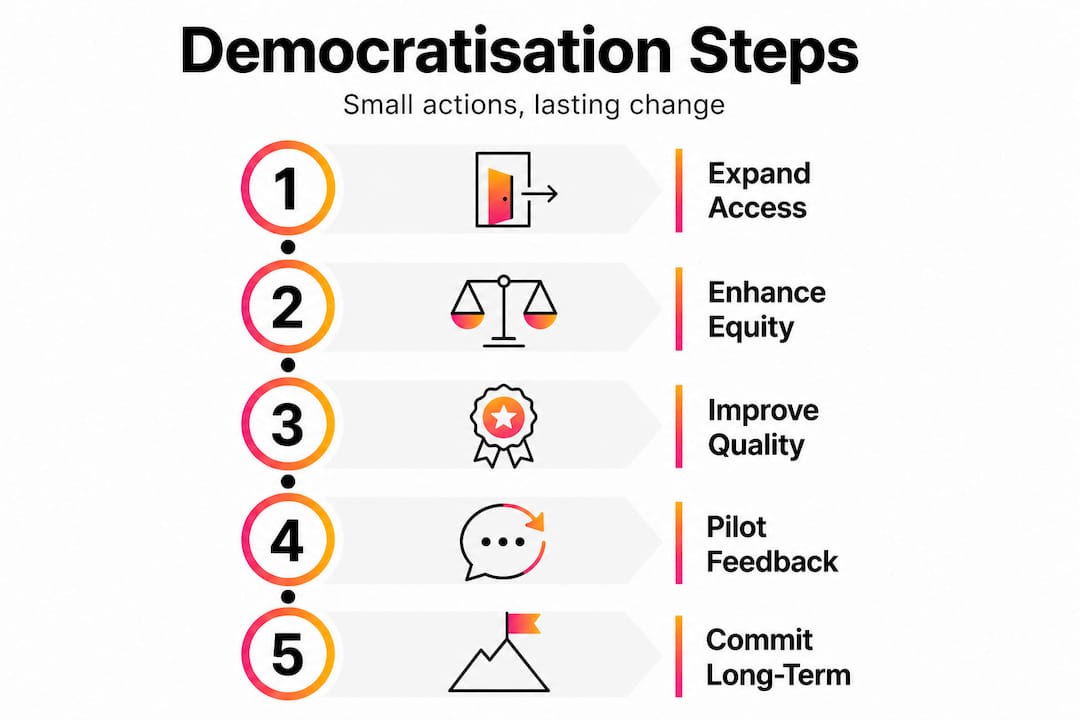
What does a realistic roadmap actually look like? It starts small and stays specific. Pilot programmes in a handful of classrooms reveal equity gaps that national surveys miss entirely. A feedback loop between students, teachers, and curriculum designers catches problems before they become systemic failures. Regular, honest assessment of learning outcomes, not just participation metrics, keeps everyone accountable.
We also think most approaches underestimate the role of personalised learning. A student who feels seen, heard, and challenged at the right level is a student who stays engaged. Generic content delivered at an average pace leaves the fastest and slowest learners equally frustrated. Real democratisation requires education that adapts to the individual, not the average.
Explore affordable education resources that prioritise this kind of personalised, quality-focused approach. Because sustainable democratisation is not about hitting a target once. It is about building systems that keep improving, keep including, and keep raising the standard for every single learner.
Pro Tip: Run small feedback pilots in your school or learning environment. Ask students directly: do you feel supported? Are you actually learning? Their answers will surface the equity gaps that data alone cannot capture.
The most important insight? Democratisation is not a destination. It is a commitment. A commitment to keep asking whether every learner, regardless of who they are or where they come from, is genuinely gaining from their education.
Explore more and put education democratisation in action
Understanding the principles of education democratisation is a powerful start. But insight without action changes nothing.
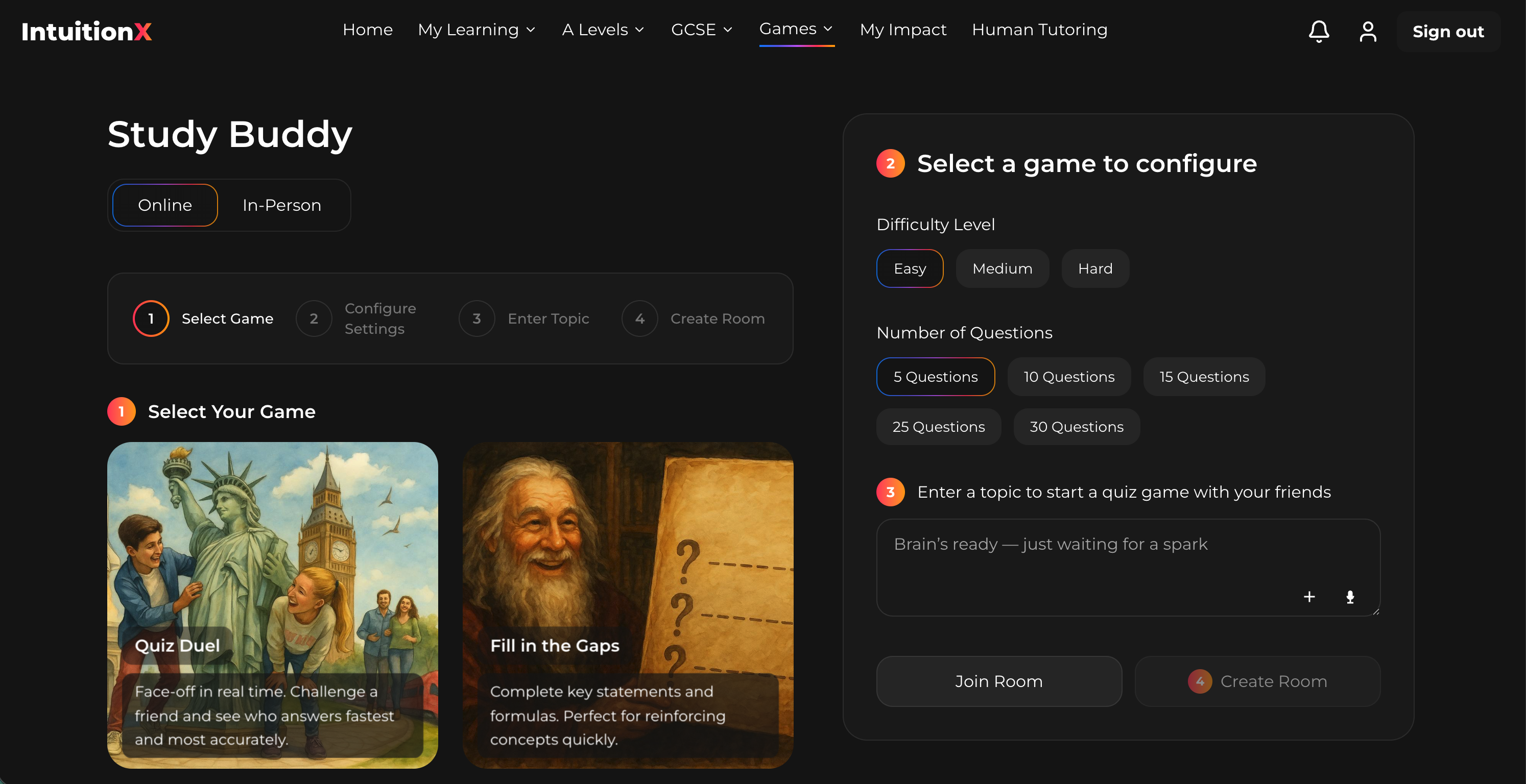
At IntuitionX, we exist to make the kind of education that wealthy families have always accessed available to everyone. Our AI tutor, Omniscience, is built on the knowledge and pedagogical methods of Oxford and Cambridge graduates, and it is available 24/7 to any learner with a device. We have committed 10% of our revenue to the International Rescue Committee's educational programmes, supporting children in crisis and conflict zones. Backed by Sir Anthony Seldon, described by the BBC as one of Britain's leading educationalists, we are building the infrastructure for genuinely democratic education. If you are ready to see what equitable, quality learning actually looks like, explore IntuitionX today and take the next step.
Frequently asked questions
Does education democratisation guarantee equal outcomes for all students?
No, democratisation aims for equitable opportunities and access, but individual outcomes depend on personal, contextual, and pedagogical factors. As research confirms, democratisation focuses on equity of opportunity rather than ensuring identical results for every learner.
How can technology support education democratisation?
Technology can broaden access and deliver adaptive, locally relevant learning when paired with inclusive policy support. UNESCO notes that digital learning promotes equity most effectively in low-resource contexts when implementation is deliberate and equity-focused.
What risks should educators consider in democratisation efforts?
Expanding access without maintaining quality and relevance can lead to learner disengagement and unequal gains. The 2026 GEM Report is clear: quality is foundational, not an optional extra.
Is democratisation of education the same as making education free?
Not at all. Removing tuition fees is just one component. Democratisation covers overcoming social, geographic, linguistic, and quality barriers, all of which can exclude learners just as powerfully as cost.