

TL;DR:
- True conversational AI understands context, adapts responses, and supports personalized learning.
- AI tutors enhance learning through real-time feedback, motivation, and accessibility, democratizing education.
- Parental oversight is essential as many AI tools lack emotional nuance and may not be genuinely adaptive.
Not all AI is created equal. Many students and parents assume that any chatbot offering a quick answer counts as genuine conversational AI, but that's a significant misunderstanding. True conversational AI is a far more sophisticated beast, capable of understanding context, adapting in real time, and genuinely supporting learning rather than just delivering pre-written responses. With 73% of UK students not actively engaged in learning, finding the right technology matters enormously. This guide will help you understand what conversational AI really is, how it works, what it can and cannot do, and how to choose wisely for your family.
Table of Contents
- Defining conversational AI: More than just chatbots
- How conversational AI is revolutionising student learning
- Strengths and limits: What conversational AI can and cannot do
- How to evaluate and choose conversational AI for learning
- Why the real power of conversational AI lies in human partnership, not hype
- Discover your trusted AI study partner
- Frequently asked questions
Key Takeaways
| Point | Details |
|---|---|
| Conversational AI is advanced | It goes beyond simple chatbots by truly understanding and adapting to users' needs. |
| Impact on learning | AI tutors have shown to double learning gains and improve problem-solving for students. |
| Be aware of limitations | Conversational AI is not flawless and still needs human oversight for complex or sensitive queries. |
| Choose quality AI | Select AI tools with proven research results, strong adaptability, and clear support channels. |
Defining conversational AI: More than just chatbots
Let's clear something up straight away. A basic chatbot follows a script. You type a question, it matches keywords, and it returns a pre-set answer. It doesn't truly understand you. Conversational AI is fundamentally different.
True conversational AI combines several sophisticated processes working together. According to DigitalOcean, the core mechanics involve input processing (text or voice), natural language understanding (NLU) for intent and context detection, dialogue management, natural language generation (NLG) for crafting responses, and machine learning for continuous improvement over time. Every interaction makes the system smarter.
Here's a simple comparison to make this concrete:
| Feature | Basic chatbot | Conversational AI |
|---|---|---|
| Understands context | No | Yes |
| Adapts to the user | No | Yes |
| Learns over time | No | Yes |
| Handles follow-up questions | Rarely | Consistently |
| Personalises responses | No | Yes |
For students, this distinction is everything. A basic chatbot might answer "What is photosynthesis?" correctly. But a genuine conversational AI tutor can ask you what you already know, identify your misconceptions, and guide you towards understanding through questions rather than just handing you an answer.
The key components that make this possible include:
- Natural language understanding (NLU): Interprets what you actually mean, not just the words you typed
- Dialogue management: Tracks the conversation across multiple turns, maintaining context
- Machine learning: Continuously refines responses based on interactions
- Natural language generation (NLG): Crafts replies that feel natural and relevant
Think of AI learning companions as the difference between a vending machine and a knowledgeable friend. One dispenses fixed outputs; the other genuinely engages with your specific situation. That distinction shapes everything about how effective an AI tutor can be.

How conversational AI is revolutionising student learning
Understanding what sets conversational AI apart, we can now see how it's reshaping the landscape of student learning.
The most exciting application is the intelligent tutoring system (ITS). These systems use conversational AI to adapt to each student's pace, knowledge gaps, and learning style in real time. The results are genuinely impressive. Field trials published in Nature found that AI tutoring doubled learning gains compared to active learning in physics undergraduates, and produced a 5.5 percentage point improvement in novel problem-solving for UK secondary maths students. That's not a marginal gain. That's transformational.
Why does it work so well? Here are the key reasons:
- Personalised pacing: The AI adjusts difficulty based on your responses, so you're never bored or overwhelmed
- Immediate feedback: Mistakes are addressed instantly, preventing misconceptions from taking root
- Safe environment: Students who feel nervous asking questions in class can ask freely without judgement
- Consistent availability: Learning support at 11pm before an exam is suddenly possible
- Motivational design: Good AI tutors use encouragement and curiosity-building to keep students engaged
For parents, this matters practically. Wealthy families spend up to £120 an hour on private tutors. Conversational AI can provide comparable personalised support at a fraction of the cost, meaning quality learning is no longer reserved for those who can afford it. This is what democratising learning actually looks like in practice.
The data on engagement is equally striking. In the US, 80% of students report feeling bored in class and 91% feel nervous asking questions. AI tutors create a low-pressure space where curiosity is rewarded, not judged. That shift alone can transform a student's relationship with learning.
Pro Tip: When testing an AI tutor with your child, watch for whether it asks follow-up questions. A system that simply confirms correct answers without probing deeper is likely a basic chatbot, not a true AI that transforms education.
Strengths and limits: What conversational AI can and cannot do
While the benefits are impressive, it's equally important to look at what conversational AI can't currently achieve.
Let's start with the genuine strengths:
- Scalability: One AI system can support thousands of students simultaneously
- 24/7 accessibility: Learning support doesn't clock off at 5pm
- Personalisation: Adapts to individual needs in ways a classroom teacher simply cannot manage for 30 students at once
- Cost efficiency: Dramatically more affordable than private tutoring
- Reduced anxiety: Students feel safer asking questions without fear of embarrassment
But here's where honesty matters. Research highlights that conversational AI still struggles with slang, jargon, ambiguity, regional accents, novel queries, and emotional nuance. It can misread tone, miss cultural context, and occasionally generate confident-sounding but incorrect responses.
There's also a more fundamental issue. Brookings Institution research notes that many tools marketed as AI agents are, in reality, glorified chatbots that fail at genuine planning or adaptive reasoning. The evidence base for K-12 settings specifically is still developing, and longer-term studies across diverse student populations are needed.
"Not every AI labelled as intelligent actually is. Parents and students deserve transparency about what a system can genuinely do before they invest time and trust in it."
This is why parental oversight remains essential. AI tutors work best as a complement to human support, not a replacement. If your child is struggling emotionally, confused about a complex concept, or needs motivational guidance, a human teacher or parent is still irreplaceable.
When evaluating tools, watch for these red flags. Does the platform make vague claims without citing research? Does it simply generate essays rather than guide thinking? Explore AI model alternatives to understand the spectrum of what's genuinely available.
Pro Tip: Ask any AI tutor a deliberately ambiguous question and observe how it responds. A quality system will seek clarification. A basic chatbot will guess and move on.
How to evaluate and choose conversational AI for learning
With strengths and limits in mind, let's discover how you can confidently select the right conversational AI tools for your family's needs.
Start with a structured checklist. Not all platforms are equal, and marketing language can be misleading.
Step-by-step evaluation process:
- Check for genuine adaptability: Does the system change its approach based on your child's responses, or does it deliver the same content to everyone?
- Look for research backing: Does the platform cite peer-reviewed results? Studies across 28 trials involving 4,597 students confirm that intelligent tutoring systems produce positive effects on K-12 learning, with generative AI tutors matching or exceeding human tutors in mastery rates, particularly for low-income students.
- Assess safety controls: Are there content filters, privacy protections, and parental oversight features?
- Test engagement: Sit with your child for one session. Are they more curious afterwards, or just passive?
- Evaluate support channels: Can you contact a human if something goes wrong?
Key questions to ask any provider:
- Is the AI genuinely adaptive, or does it follow a fixed curriculum path?
- What subject areas has it been tested in?
- How does it handle incorrect answers: does it explain the error or simply correct it?
- Is student data protected and never used for advertising?
For students preparing for high-stakes exams, the bar is even higher. Look for platforms with subject-specific depth. A system built for A Level success needs genuine subject expertise, not just general knowledge scraped from the internet.
Staying informed about education technology trends also helps you spot genuine innovation versus marketing noise. The field is moving fast, and the best tools in 2026 are substantially more capable than what existed even two years ago.
Why the real power of conversational AI lies in human partnership, not hype
Here's something the technology industry rarely admits: the most impressive AI in the world underperforms when it's treated as a standalone solution. We've seen this pattern repeatedly. Families invest in a promising AI tutor, expect it to solve everything, and then feel disappointed when results are mixed.
The uncomfortable truth is that conversational AI amplifies good learning habits; it doesn't create them from scratch. When a student is genuinely curious, engaged, and supported by attentive parents or teachers, AI becomes extraordinarily powerful. When it's used as a passive substitute for real engagement, results suffer.
Most families focus heavily on features and pricing, which is understandable. But the deeper question is whether the AI encourages genuine thinking or just delivers answers. True learning democratisation happens when technology raises the quality of thinking, not just the speed of answer retrieval.
The best outcomes we've observed come from students who use AI tutors as a thinking partner, someone to challenge their reasoning, probe their understanding, and celebrate genuine progress. That's a fundamentally different relationship than using AI to generate an essay at midnight.
Oversight from parents and teachers isn't a limitation of the technology. It's the ingredient that makes it transformational.
Discover your trusted AI study partner
Ready to put this knowledge into practice and see what conversational AI can do for your learning journey?
IntuitionX is built on exactly the principles this guide describes: genuine adaptability, Socratic questioning, and subject expertise drawn from Oxbridge-level academics. It's available 24/7, designed to inspire curiosity rather than just deliver answers, and backed by Sir Anthony Seldon, one of Britain's most respected educationalists.
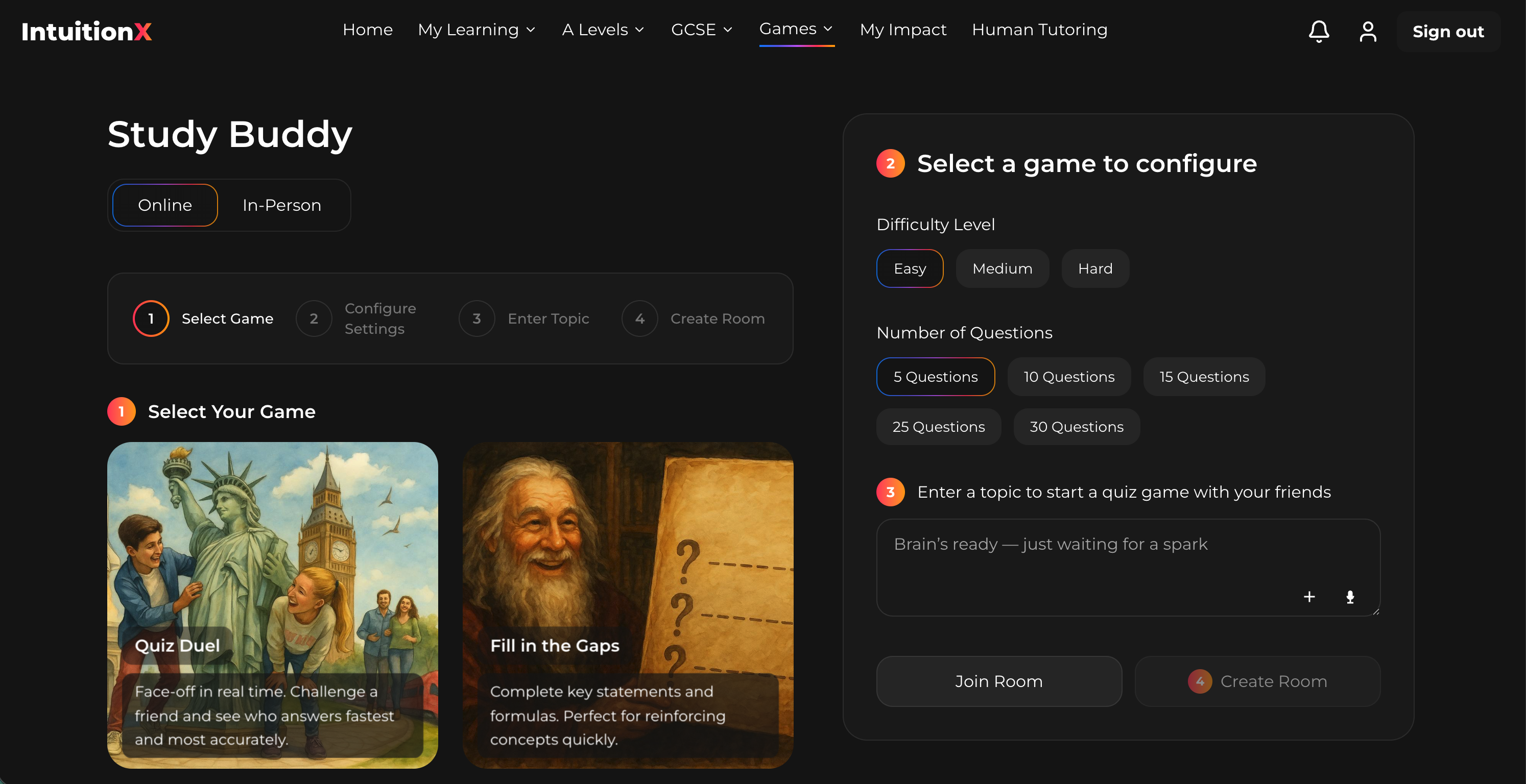
Whether you're a student preparing for A Levels or a parent searching for meaningful support, IntuitionX offers a free trial so you can experience the difference for yourself. This isn't generic AI that writes essays for you. It's a thinking partner built to help you genuinely learn, grow, and succeed. Start your free trial today and discover what learning like the top 1% actually feels like.
Frequently asked questions
What makes conversational AI different from a standard chatbot?
Conversational AI uses advanced NLU and machine learning to understand context and adapt responses dynamically, whereas basic chatbots follow fixed scripts and cannot handle follow-up questions or changing context.
Can conversational AI really help my child perform better in school?
Yes. AI tutoring doubled learning gains compared to active learning in controlled trials and produced a 5.5 percentage point improvement in novel problem-solving for UK secondary maths students, making it one of the most evidence-backed tools available.
Is conversational AI safe and reliable for all subjects?
Conversational AI performs well across most academic subjects, but it can struggle with slang, emotional nuance, and highly complex or ambiguous queries, so parental oversight and human escalation remain important safeguards.
How can I tell if an AI tutor is genuinely helpful for my child?
Look for improved motivation, better comprehension, and the ability to answer personalised follow-up questions. Studies across 4,597 students confirm that effective intelligent tutoring systems produce measurable learning gains, particularly for students from lower-income backgrounds.
Recommended
- How AI transforms education: personalised success for every student
- What is a learning companion? AI tools transforming education
- Active learning strategies list for high school engagement
- Harness AI for A Level literature success: your guide
- AI roleplay chat: build confident on-camera delivery | Pavone Academy