

TL;DR:
- Active engagement involves actively processing and applying information rather than passively receiving it.
- Effective learning combines structured guidance with independent exploration, especially for beginners.
- Technology tools like AI tutors and flashcards can enhance active learning habits.
Sitting in a classroom doesn't mean you're learning. Staring at a textbook doesn't mean the information is going in. Many students and parents assume that presence equals progress, but real learning demands something more. It requires you to think, question, and connect ideas actively. Research consistently shows that students who engage actively with material retain far more and perform significantly better than those who simply absorb content passively. This article unpacks what active engagement truly means, how it differs from other learning approaches, and what practical steps you can take to make every study session genuinely count.
Table of Contents
- Defining active engagement in learning
- Key components and examples of active engagement
- Active engagement vs. passive and discovery learning
- Tools and strategies to boost active engagement
- Why most people misunderstand active learning—and how to get it right
- Discover smarter ways to achieve active learning
- Frequently asked questions
Key Takeaways
| Point | Details |
|---|---|
| Active engagement defined | It means students participating and processing, not just listening, for deeper understanding. |
| Components for success | Discussion, practice, and guided questioning are all key to active learning. |
| Guidance is vital | For new topics, guided active learning is more effective than discovery learning alone. |
| Digital tools help | Modern AI and educational platforms can make active engagement easier and more personalised. |
Defining active engagement in learning
To truly appreciate how active engagement affects learning, it's crucial to understand what the term actually means. Active engagement is not just about paying attention. It's about doing something with the information you receive.
At its core, active engagement means actively processing information rather than simply receiving it. That means asking questions, discussing ideas, applying concepts to new situations, and reflecting on what you've understood. It's the difference between watching someone cook a meal and actually standing at the stove yourself.
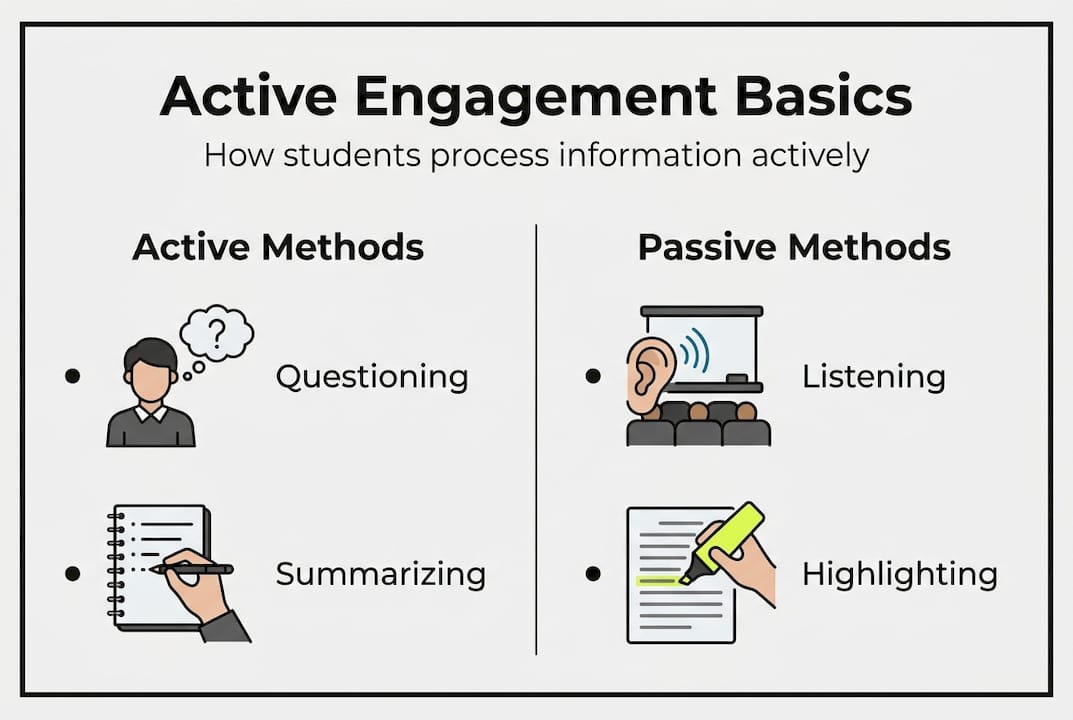
Passive learning, by contrast, involves listening to a lecture, reading a chapter, or watching a video without any deliberate mental effort to connect or apply the content. It feels productive. It often isn't.
Here's a quick comparison to make the distinction clear:
| Passive learning | Active engagement |
|---|---|
| Listening to a lecture | Asking questions during a lecture |
| Re-reading notes | Summarising notes in your own words |
| Watching a video | Pausing to predict what comes next |
| Highlighting text | Explaining the concept to someone else |
| Copying definitions | Creating examples from memory |
The evidence behind active engagement is compelling. Studies in cognitive science consistently show that students who process material actively build stronger, longer-lasting memory traces. Passive methods may feel easier, but they rarely lead to deep understanding.
One common misconception is that engagement simply means enthusiasm or participation in the social sense. A student who cheerfully raises their hand but never genuinely wrestles with the material isn't truly engaged. Another misconception is that engagement is the teacher's job alone. In reality, it's a shared responsibility.
"The goal of education is not to fill a bucket, but to light a fire." Genuine active engagement is what lights that fire.
For students and parents looking to build stronger habits, exploring educational engagement strategies can provide a useful starting point for understanding how to shift from passive attendance to genuine learning.
Active engagement also matters because it builds metacognition, which is your ability to think about your own thinking. When you actively process information, you start to notice what you don't understand. That awareness is incredibly powerful. It tells you where to focus your effort.
Key components and examples of active engagement
With a clear definition in hand, let's look at what active engagement looks like in practice.
Active engagement isn't a single behaviour. It's a collection of habits and approaches that work together. Here are the core components:
- Purposeful listening: Attending to what's being said with the intent to understand, not just hear
- Strategic note-taking: Writing in your own words, not transcribing verbatim
- Questioning: Asking why, how, and what if, rather than accepting information at face value
- Discussion: Talking through ideas with peers or a tutor to test your understanding
- Practice and application: Using knowledge to solve problems or create something new
- Reflection: Pausing to consider what you've learnt and what still confuses you
Imagine a student studying the causes of the First World War. A passively engaged student reads the chapter and highlights key dates. An actively engaged student reads the same chapter, then tries to explain the causes aloud without looking at their notes, questions whether one cause was more significant than another, and discusses their reasoning with a classmate or tutor. The second student is doing far more cognitive work, and they'll remember far more as a result.

Group projects are another excellent example. When students collaborate to solve a problem, they're forced to articulate their thinking, challenge each other's assumptions, and integrate different perspectives. That's active engagement in action.
It's worth noting that guidance matters enormously, especially for students who are new to a subject. Discovery learning is less effective for novices than guided active learning. Without structure, students can easily practise misconceptions or become overwhelmed. The best active learning experiences combine student effort with expert guidance.
For students wanting to build these habits, active learning strategies offer a practical framework, and those preparing for exams will find active learning for A levels particularly relevant.
Pro Tip: After every study session, spend five minutes asking yourself three questions: What did I learn? What confused me? How does this connect to something I already know? This simple reflective habit dramatically strengthens retention and helps you identify gaps before they become problems.
Active engagement vs. passive and discovery learning
Understanding the elements of active engagement naturally leads to questioning how it differs from other learning modes.
There are three broad approaches to learning that students and parents encounter most often:
- Passive learning: Information is delivered to the student with minimal effort required. Think lectures, videos, and reading without annotation.
- Active learning: The student processes, applies, and reflects on information with guidance and structure.
- Discovery learning: The student explores and constructs knowledge largely independently, without direct instruction.
Each approach has its place, but they are not equally effective in all situations. Here's how they compare:
| Method | Best for | Least effective for |
|---|---|---|
| Passive learning | Initial exposure to new topics | Deep understanding or retention |
| Active learning | Building understanding and skills | Students with no prior knowledge |
| Discovery learning | Advanced learners exploring independently | Beginners who need structure |
The research here is clear. Minimal guidance may hinder novices, while a brief passive introduction before active methods can actually support understanding. In other words, passive learning isn't always wrong. It can be a useful first step before you shift into active mode.
Knowing when to use each method is a genuine skill. Here's a practical guide:
- Start with passive exposure to get a broad overview of a new topic
- Move into guided active learning to build understanding with support
- Use discussion and practice to consolidate and apply what you've learnt
- Introduce discovery elements once you have enough prior knowledge to explore independently
- Reflect and review regularly to strengthen long-term memory
For students working across humanities subjects, effective learning strategies can help you apply this framework to essay-based subjects where active engagement looks slightly different.
Pro Tip: Don't abandon passive methods entirely. Use them strategically. Watch a short video or read an overview first, then switch to active methods like practice questions or discussion to deepen your understanding. Blending approaches intelligently produces better results than committing rigidly to one style.
Tools and strategies to boost active engagement
Recognising the differences between learning methods highlights why the right tools and strategies are vital.
The good news is that technology has made active engagement far more accessible. You no longer need an expensive private tutor to experience guided, interactive learning. Here are some of the most effective tools and strategies available today:
- AI-powered tutors: Platforms that ask questions, prompt reflection, and guide students through problems rather than simply providing answers
- Flashcard apps: Tools like spaced repetition systems that force active recall, one of the most evidence-backed memory techniques
- Discussion forums and study groups: Online communities where students explain and debate ideas
- Practice question banks: Subject-specific question sets that require application, not just recall
- Mind-mapping tools: Visual tools that help students connect ideas and build conceptual frameworks
Educational technologies enable guided and active learning approaches that were previously only available to students with access to elite tutors. That's a significant shift. It means a student in a state school can now access the same quality of guided, Socratic questioning that a student at a top independent school might receive from a private tutor.
For a broader view of what's available, exploring the best educational AI tools can help you identify platforms that genuinely support active learning rather than passive consumption. It's also worth staying informed about educational technology trends shaping how students learn in 2026 and beyond.
One of the most exciting developments is conversational AI in learning, which allows students to engage in real dialogue with an AI that challenges their thinking, asks follow-up questions, and adapts to their level of understanding.
Pro Tip: Build a tech-enabled study routine by pairing passive input with active output. Read or watch for 20 minutes, then spend 10 minutes answering questions, summarising, or explaining the content aloud to your AI tutor. Consistency matters more than duration.
Why most people misunderstand active learning—and how to get it right
Having explored tools and approaches, it's worth reflecting on what really makes engagement effective, because there's a widespread misunderstanding that needs addressing.
Many students and parents equate activity with engagement. They assume that because a student is doing something, they must be learning. But busyness is not the same as understanding. Completing ten worksheets without genuine thought produces far less learning than working through three problems with real curiosity and reflection.
The other common mistake is overemphasising independence too early. Encouraging students to figure things out on their own sounds empowering, but without sufficient prior knowledge and scaffolding, it often leads to frustration and the reinforcement of errors. True active engagement blends student-led effort with expert guidance.
What should parents and students prioritise? Structure first, then autonomy. Start with guided approaches that build confidence and accurate understanding. Then gradually introduce more independent exploration as knowledge grows. Exploring personalised learning strategies can help you find the right balance for your specific situation and learning style.
The students who thrive are not the ones who work hardest in isolation. They're the ones who engage thoughtfully, ask good questions, and seek the right guidance at the right time.
Discover smarter ways to achieve active learning
If you're ready to put these insights into practice, there are innovative solutions you can try today.
At IntuitionX, we've built a 24/7 Socratic AI tutor that does exactly what the research recommends: it guides, questions, and challenges students rather than simply giving them answers. It's like having an Oxbridge-trained tutor available whenever you need one, without the £100-per-hour price tag.
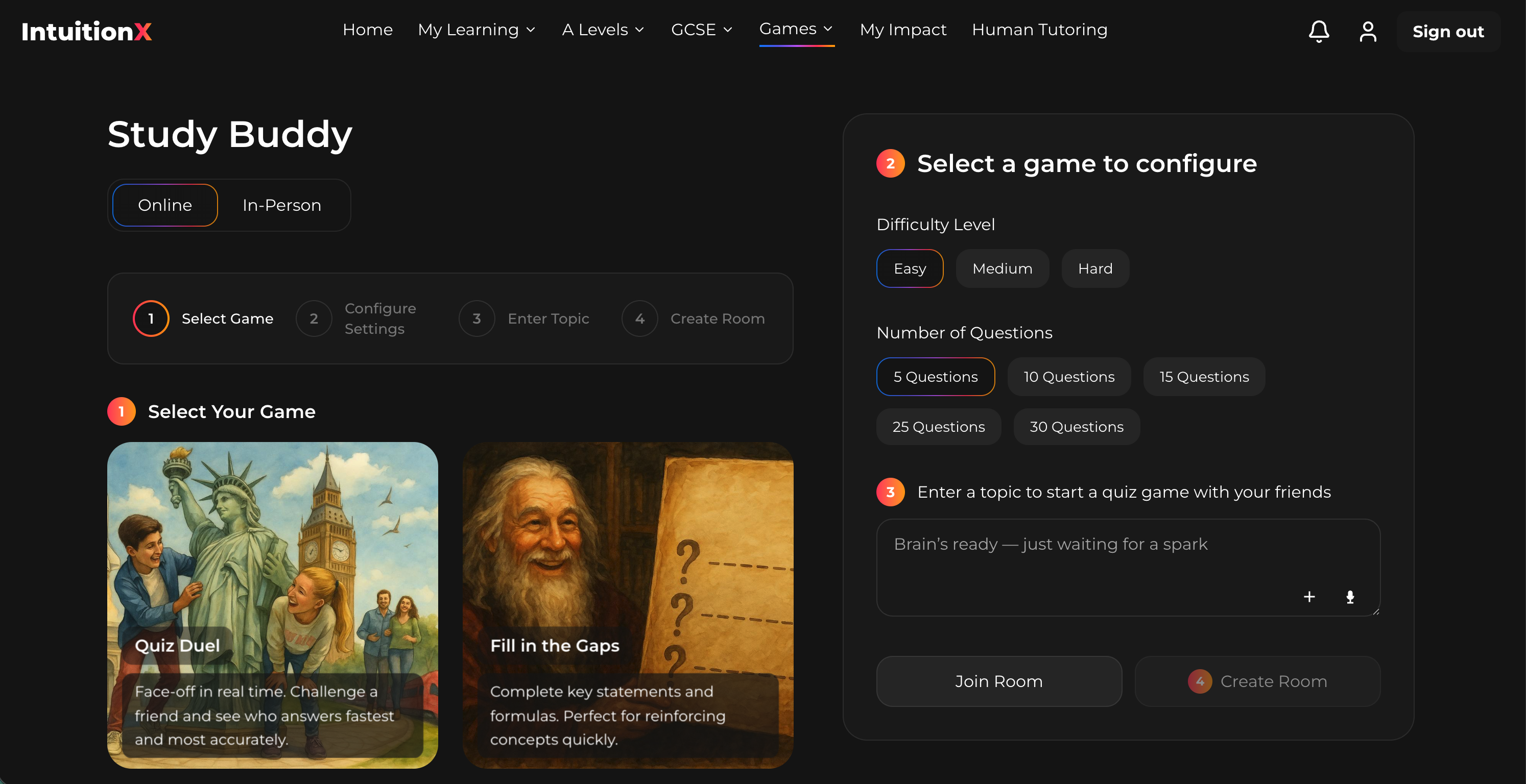
Whether you're a student who wants to stop passively re-reading notes and start genuinely understanding your subjects, or a parent looking for a smarter alternative to traditional tutoring, the IntuitionX platform gives you the tools to build real active engagement habits. Backed by Sir Anthony Seldon and built on Oxbridge-level expertise, it's designed to make elite-quality learning accessible to everyone.
Frequently asked questions
What is the main difference between active and passive learning?
Active learning requires students to participate and process information, while passive learning means simply receiving information without deliberate mental effort to connect or apply it.
Is discovery learning always better than guided instruction?
Discovery learning is less effective for beginners; guided active approaches are usually better when starting out, as structure helps novices build accurate understanding before exploring independently.
What digital tools help with active engagement?
Educational technologies enable guided and active learning, and AI-powered platforms, interactive apps, and spaced repetition tools can all boost engagement by prompting students to think rather than simply absorb.
How can parents encourage active engagement at home?
Parents can ask open-ended questions about what their child is studying, set small challenges that require explanation or application, and provide access to tools that promote discussion and critical thinking during study time.