

TL;DR:
- Clear, action-oriented learning outcomes are essential for measuring progress and guiding instruction.
- Humanities outcomes focus on critical thinking and cultural analysis, requiring nuanced design and assessment.
- AI tutoring enhances learning through personalization and scaffolding but must complement human facilitation for best results.
Learning outcomes. Two words that appear on every syllabus, every assessment rubric, and every school report, yet somehow manage to confuse almost everyone who encounters them. Students aren't sure what they really mean. Parents struggle to understand whether their child is genuinely progressing. Educators debate how to write them well. And underneath all this confusion sits a real cost: lost motivation, misdirected effort, and assessments that don't reflect actual ability. This guide cuts through that fog. We'll define what learning outcomes really are, explain how they're measured, explore what makes humanities outcomes unique, and show you how AI tutoring is changing the picture in ways backed by hard evidence.
Table of Contents
- What are learning outcomes and why do they matter?
- Mechanics of learning outcomes: alignment, assessment and measurement
- Unique characteristics of learning outcomes in the humanities
- AI tutors and technology: boosting learning outcomes with innovation
- A fresh perspective: the real challenge with measuring learning outcomes
- Ready to improve your learning outcomes with AI?
- Frequently asked questions
Key Takeaways
| Point | Details |
|---|---|
| Clear learning outcomes | Concise, measurable statements using strong verbs help students know exactly what they should achieve. |
| Constructive alignment | Teaching methods, activities, and assessments should all point directly to the stated learning outcomes. |
| Humanities focus | In humanities, outcomes emphasise analysis, perspective, and diversity—not just facts or recall. |
| AI tutor benefits | AI-powered tools with human guidance drive measurable learning gains and motivation, especially with strong scaffolding. |
| Nuance matters | Avoid vague outcomes, balance measurable metrics with real human learning, and value context as much as technology. |
What are learning outcomes and why do they matter?
Let's start with the basics. A learning outcome is not the same as a learning objective, a syllabus point, or a vague aspiration like "students will understand the causes of World War One." That kind of language sounds reasonable, but it's essentially unmeasurable. How do you assess whether someone truly understands something? You can't, at least not without a clearer definition of what that looks like in practice.
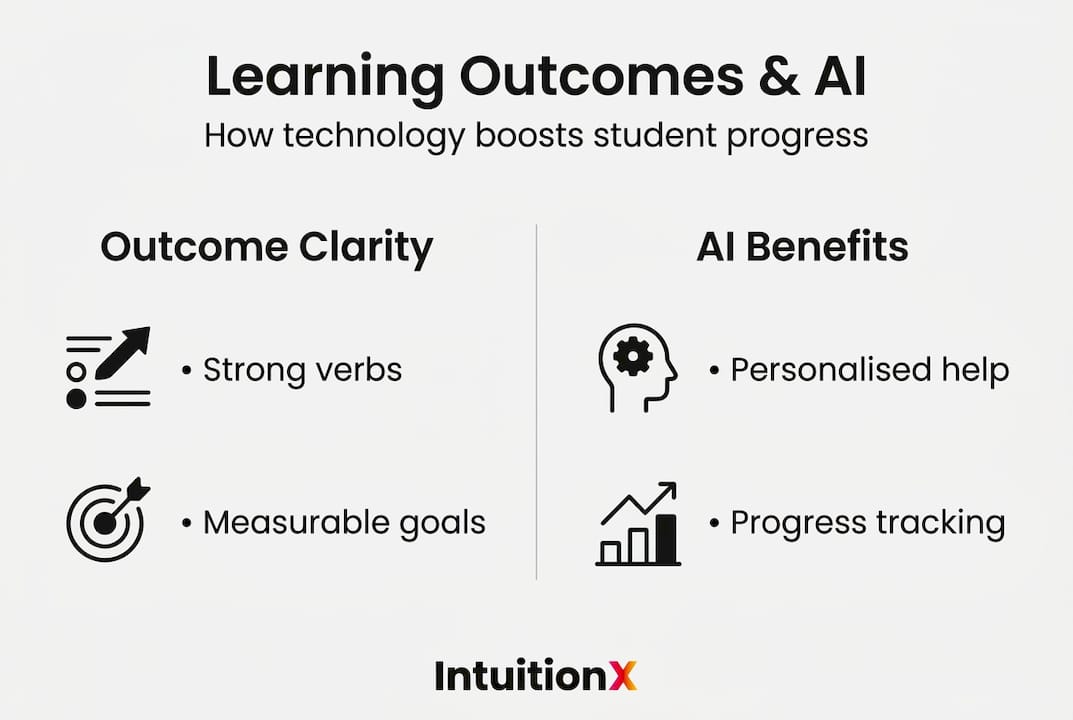
Learning outcomes explained are concise statements describing what students should be able to do after instruction, using action verbs from Bloom's Taxonomy to ensure measurability. Bloom's Taxonomy organises thinking skills into six levels: Remember, Understand, Apply, Analyse, Evaluate, and Create. The higher you go, the more sophisticated the thinking required.
So instead of "understand the causes of World War One," a well-written outcome might read: "Analyse the political and economic factors that contributed to the outbreak of World War One, drawing on primary and secondary sources." Notice the difference. The verb analyse tells you exactly what cognitive work is expected. That specificity matters enormously.
Why does it matter so much? Because clear outcomes do several things at once:
- They set shared expectations for students, teachers, and parents
- They direct where revision time and classroom effort should go
- They make assessment fairer, because everyone knows what's being measured
- They allow genuine progress tracking over time
- They reduce anxiety by removing ambiguity
In the humanities especially, this matters. History, English Literature, Philosophy, and similar subjects are often dismissed as "soft" partly because their outcomes can feel woolly. But a well-designed humanities outcome focuses on critical thinking, perspective-taking, and contextual analysis rather than factual recall. These are rigorous intellectual skills. They just need to be stated clearly.
"The problem isn't that humanities outcomes are hard to define. The problem is that we've been writing them badly for decades."
Understanding AI's role in personalised outcomes is also increasingly relevant here, as technology is beginning to help educators craft and deliver outcomes that are genuinely tailored to individual learners.
Mechanics of learning outcomes: alignment, assessment and measurement
Now that we understand why outcomes matter, it's crucial to break down how they're formulated and measured in practice.
The gold standard in educational design is something called constructive alignment. Constructive alignment and assessment means that outcomes define the objectives, assessments measure them, and learning activities support achievement of both. When these three elements are out of sync, students end up studying the wrong things, or being assessed on skills they were never actually taught.
There are two key types of assessment you'll encounter:
- Formative assessment sits within the learning process. Think quizzes, draft essays, class discussions, or AI-driven practice questions. Its job is to give feedback while there's still time to act on it.
- Summative assessment arrives at the end. Exams, final essays, coursework portfolios. It makes a judgement about what has been achieved.
Both serve different but equally important purposes. Formative assessment helps students course-correct. Summative assessment confirms whether outcomes were met.
So how do we actually measure whether outcomes are being achieved? Three metrics dominate the field:
| Metric | What it measures | What good looks like |
|---|---|---|
| Proficiency rate | % of students meeting the outcome threshold | Depends on context, but upward trends matter |
| Effect size | Statistical measure of impact | 0.4 or above is considered meaningful |
| Growth measure | Individual progress over time | Consistent improvement across cohorts |
Metrics including proficiency rates and effect sizes above 0.4, alongside growth measures, give educators a well-rounded picture of actual impact, though challenges around vague definitions and equity across student subgroups remain significant.

Pro Tip: When reviewing your child's or your own learning outcomes, look for action verbs. If the outcome says "know" or "understand," ask what evidence would actually prove that. Push for specificity.
Exploring active learning strategies alongside clear outcomes is one of the most effective combinations any student or educator can adopt.
Unique characteristics of learning outcomes in the humanities
While core mechanics are the same, humanities learning outcomes require special attention to nuance and diversity.
The humanities are not about memorising facts. They are about learning to think differently. A strong humanities outcome asks students to read critically, engage with cultural diversity, situate texts within their historical moment, and consider voices that have historically been marginalised.
Sample humanities learning outcomes emphasise critical analysis of texts, engagement with cultural diversity, historical context, and underrepresented experiences. In practice, this might look like:
- Evaluating the reliability of a 19th-century colonial source
- Comparing how gender is constructed across two literary traditions
- Analysing how economic context shaped a philosopher's argument
- Engaging with the work of writers from minority or non-Western backgrounds
These outcomes demand something far richer than recall. They require students to hold multiple perspectives simultaneously, which is a genuinely difficult cognitive skill.
A snapshot of humanities benchmarks:
| Benchmark | Humanities | Overall average |
|---|---|---|
| BA completion rate | 72.8% | 70.2% |
| Major retention rate | 54% | Varies by subject |
| Technology impact | Positive for lower-skill students | Mixed across disciplines |
Humanities students have a 72.8% BA completion rate compared to a 70.2% overall average, which challenges the narrative that humanities programmes are high-dropout territory. Technology mediates outcomes positively, particularly for students who start with lower prior attainment.
For students revising English Literature at A Level, for example, understanding how AI for English Literature can support contextual analysis is increasingly valuable.
The key point here is that humanities outcomes are not lesser than STEM outcomes. They are differently complex. Respecting that complexity is essential to designing assessments that genuinely capture what students have learnt.
AI tutors and technology: boosting learning outcomes with innovation
Emerging technology now lets us elevate outcomes in new ways, especially through AI tutoring.
The evidence base is growing fast. AI tutoring evidence from randomised controlled trials shows that AI outperforms traditional active learning, with a median learning gain of 4.5 compared to 3.5 in standard classrooms, and an effect size of 0.71 for technology-assisted collaboration. An effect size of 0.71 is, by educational standards, genuinely impressive.
Why do AI tutors perform so well? Several reasons:
- Personalisation: AI adapts to each learner's pace, gaps, and preferred approach
- Availability: 24/7 access means learning isn't confined to school hours
- Scaffolding: Well-designed AI breaks complex tasks into manageable steps, reducing cognitive overload
- Engagement: Interactive, conversational formats reduce the anxiety many students feel about asking questions
But the picture isn't uniformly rosy. AI risks including cognitive offload and the tendency for some tools to produce hallucinated facts mean that measurement rigour matters enormously. Generic AI tools that simply write essays for students are particularly problematic. They generate nominal metrics without producing real learning.
Pro Tip: Use AI tutoring as a thinking partner, not an answer machine. The goal is to have your reasoning challenged and refined, not replaced.
Understanding AI tutoring explained helps parents make informed decisions, and reviewing best AI tools for learning gives a clearer picture of what quality actually looks like across different platforms.
A fresh perspective: the real challenge with measuring learning outcomes
Before wrapping up, it's worth challenging the consensus on what actually makes for true learning progress.
Here's an uncomfortable truth: we've got very good at measuring outcomes, and not always better at producing them. Measuring more but learning less is a genuine risk when vague verbs like 'understand' or 'know' persist in outcome design, when humanities AI lacks depth without proper scaffolding, and when the pressure to show data leads to nominal metrics rather than real intellectual growth.
Humanities learning is process-rich. The moment a student genuinely shifts their perspective after engaging with a text from a radically different cultural tradition, that's real learning. It's hard to capture in a proficiency rate. That doesn't mean we shouldn't measure, but it does mean we should measure carefully.
Expert nuances around scaffolding confirm that AI tutoring is positive but can be mitigated compared to human tutors when human-centred frameworks are absent. Equity and context must remain at the centre of how we design outcomes, especially for students from disadvantaged backgrounds.
The most effective approach is a hybrid one: rigorous, verb-specific outcome design, intelligent AI scaffolding, and the kind of skilled human facilitation that encourages genuine curiosity. Technology is a powerful lever. It is not, on its own, the answer. Understanding the difference is what separates superficial gains from Omniscient AI for smarter learning that actually sticks.
Ready to improve your learning outcomes with AI?
If you're inspired to see the difference clear outcomes and supportive technology can make, here's how to get started with a proven AI tutor.
At IntuitionX, we've built something different from the generic tools that flood the market. Our AI is trained on the thinking of academics who earned Firsts at Oxford and Cambridge, and it tutors the way the world's greatest educators teach: through questions, challenge, and genuine intellectual engagement.
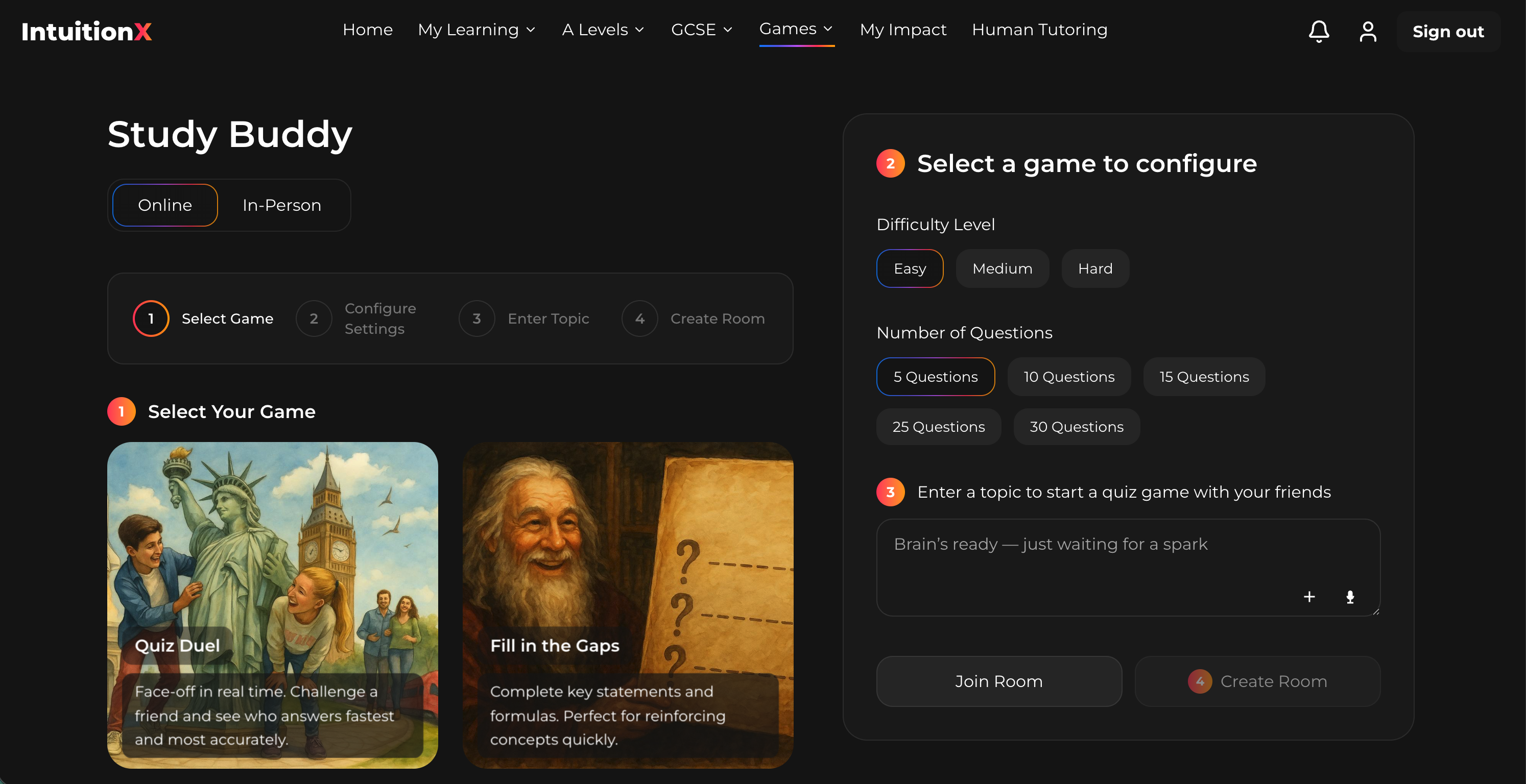
Whether you're a student wrestling with A Level essays, a parent seeking measurable progress, or an educator looking for a tool that genuinely raises outcomes, IntuitionX AI tutor is designed for exactly that. Backed by Sir Anthony Seldon and committed to funding education in crisis regions, we're here to make elite learning accessible to everyone. Start today and turn learning outcomes from abstract statements into real, measurable results.
Frequently asked questions
What makes a good learning outcome statement?
A good learning outcome is concise, uses clear action verbs from Bloom's Taxonomy, and is measurable within the specific context of the subject being studied.
How does assessment align with learning outcomes?
Assessments should directly measure stated outcomes, ensuring that learning activities support both formative feedback and summative judgement. Constructive alignment is the key principle: outcomes, activities, and assessments must all fit together coherently.
Are AI tutors suitable for humanities subjects?
With the right scaffolding and human-centred design, AI tutors can genuinely enhance humanities learning, particularly in areas requiring critical thinking, contextual analysis, and engagement with diverse perspectives.
What is the most common mistake in designing outcomes?
Using vague verbs like 'understand' or 'know', which cannot be reliably measured or assessed, is the single most common and most damaging pitfall in outcome design.
How are learning outcomes measured in practice?
Outcomes are measured through performance data including proficiency rates and growth statistics, with effect size serving as the most reliable indicator of real, meaningful impact.