

Artificial intelligence is reshaping how students approach A Level literature, with AI powered essay grading now matching senior markers at 100% accuracy whilst marking 30 essays in just 2 minutes. Yet confusion persists about whether AI truly aids or hinders exam success. Many students worry that relying on AI tools might weaken their critical thinking skills, whilst others wonder if they're missing out on competitive advantages. This guide cuts through the uncertainty, showing you exactly how to optimise AI for your exam preparation whilst preserving the literary analysis skills that examiners reward. You'll discover which tools deliver real results, where AI falls short, and how to strike the perfect balance for exam success.
Table of Contents
- Key Takeaways
- How AI supports personalised study and assessment in A Level literature
- Understanding the limitations and risks of relying on AI for literary analysis
- Balancing AI use and traditional study methods for effective exam preparation
- Future outlook: the evolving role of AI in A Level literature success
- How IntuitionX can enhance your A Level literature journey
- Frequently asked questions
Key Takeaways
| Point | Details |
|---|---|
| Personalised AI tutoring | AI tools offer immediate customised guidance that speeds up revision and strengthens essay planning. |
| Rapid AI feedback | AI driven feedback cycles allow multiple drafts with quick improvements. |
| Overreliance risks dulling analysis | Students may lose their critical voice and interpretive depth if they rely too much on AI insights. |
| Balanced use enhances efficiency | A measured approach preserves core literary skills while speeding preparation. |
How AI supports personalised study and assessment in A Level literature
AI tools have transformed how you can approach literature revision, offering capabilities that were previously available only through expensive private tutoring. Several platforms now cater specifically to A Level students, each bringing distinct features that address different aspects of your study needs.

A Level Tutor Online provides subject specific guidance across set texts, whilst Grammarly offers real time writing feedback that helps polish your essay structure and argumentation. Socratic uses visual recognition to explain complex passages when you photograph a text, and Olex.ai delivers comprehensive essay marking with detailed improvement suggestions. These tools share a common strength: they provide immediate, personalised responses that adapt to your individual learning patterns.
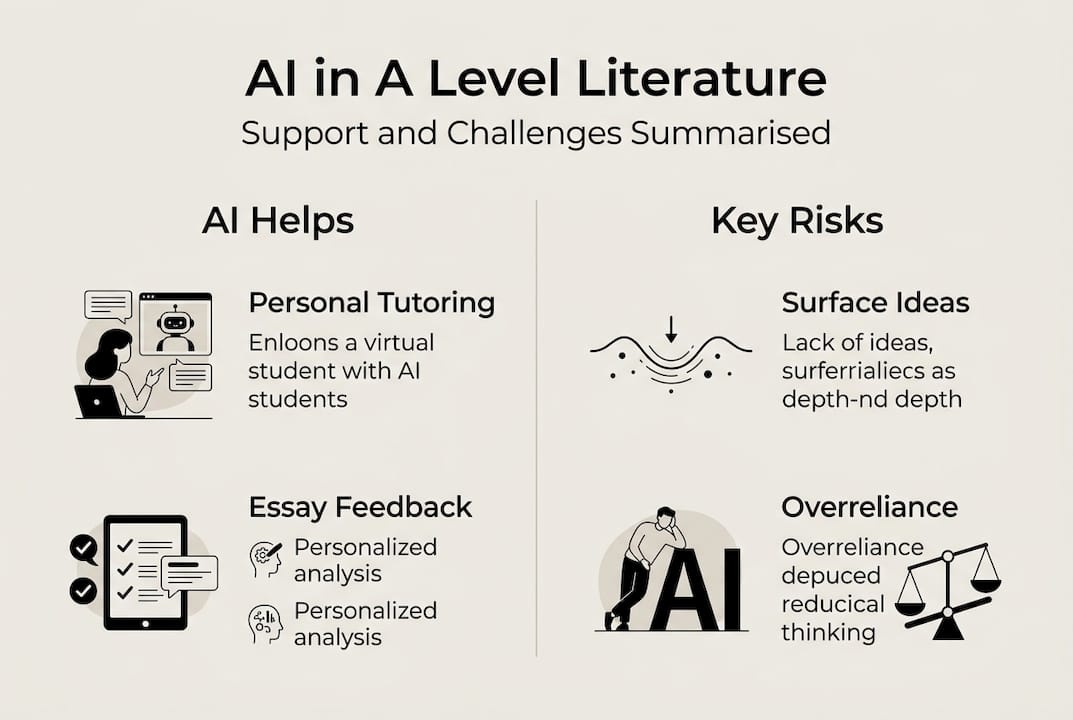
The measurable impact is striking. Olex.ai achieved a 13% uplift in GCSE Grade 5 English Literature results through increased essay practice and rapid feedback cycles. This improvement stems from students being able to submit multiple drafts and receive instant, actionable guidance rather than waiting days for teacher comments. The feedback loop accelerates dramatically, letting you identify weak areas in your analysis and address them immediately.
Pro Tip: Create a feedback cycle by submitting your essay to an AI tool, noting its suggestions, then rewriting independently before checking again. This approach harnesses AI's analytical speed whilst forcing you to engage critically with your own work rather than passively accepting suggestions.
Here's how leading AI tools compare in features and documented outcomes:
| Tool | Key Feature | Language Support | Result Impact |
|---|---|---|---|
| Olex.ai | Essay marking with detailed feedback | Multiple languages | 13% GCSE Grade 5 uplift |
| A Level Tutor Online | Personalised tutoring across set texts | English | Not publicly documented |
| Grammarly | Real time writing and structure feedback | English primary, 10+ supported | Improved essay clarity reported |
| Socratic | Visual text recognition and explanation | 15+ languages | Enhanced comprehension reported |
The educational AI companion approach takes this further by combining personalised tutoring with memory science principles, ensuring that feedback doesn't just correct errors but embeds deeper understanding. When you receive guidance that adapts to your specific knowledge gaps, you spend less time reviewing material you've already mastered and more time strengthening genuine weak spots. This targeted approach explains why students using AI tools report feeling more confident about their exam readiness, even when their actual grades show only modest improvements.
The accessibility dimension matters too. Tools offering multi language support help EAL students grasp complex literary concepts in their first language before translating understanding into English essay responses. This scaffolding reduces the cognitive load of simultaneously wrestling with language barriers and sophisticated textual analysis.
Understanding the limitations and risks of relying on AI for literary analysis
Whilst AI tools offer impressive capabilities, they carry significant limitations that can undermine your literary skills if you're not careful. The core problem is that AI excels at pattern recognition but struggles with the subjective, emotionally nuanced interpretation that defines strong literature analysis. When you lean too heavily on AI generated insights, you risk producing formulaic responses that lack the personal voice and interpretive depth examiners reward.
The risks manifest in several ways:
- Diminished critical thinking as you accept AI interpretations without questioning or developing your own analytical frameworks
- Surface level reading habits where you skim texts for quotations rather than engaging deeply with language, structure, and thematic complexity
- Loss of interpretive confidence as you doubt your own readings and defer to AI suggestions even when your instincts are valid
- Weakened close reading skills because AI provides pre digested analysis rather than forcing you to wrestle with ambiguous passages
Research confirms these concerns. Overreliance on AI leads to weakened critical thinking, close reading, and thematic interpretation skills, particularly when students use AI to generate rather than refine their analysis. Professors across humanities departments report that whilst student essays may appear more polished, they often lack the intellectual struggle and original insight that characterise genuine literary engagement.
"The danger isn't that AI produces wrong answers, it's that it produces adequate answers that bypass the cognitive work necessary for developing genuine analytical skills. Students who rely on AI scaffolding never build the intellectual muscles they need for independent literary interpretation."
The evidence is subtle but concerning. Post ChatGPT student writing shows more formal tone and positive sentiment but stable grades alongside weaker thematic development. Your essays might read more professionally, but the depth of literary insight remains unchanged or even declines. This creates a false confidence where you believe you're improving because your writing looks better, whilst your actual analytical capabilities stagnate.
The problem intensifies with subjective interpretation. AI trained on thousands of essays will gravitate towards consensus readings of texts, missing the unexpected insights and personal responses that distinguish exceptional work. When you analyse a poem's ambiguous imagery or a novel's unreliable narrator, the most valuable interpretations often come from your unique perspective, not from aggregated patterns in training data.
Pro Tip: After using AI for feedback, spend 20 minutes writing a fresh paragraph on the same topic without looking at AI suggestions. Compare the two versions to identify where you're genuinely improving versus where you're just echoing AI phrasing. This practice helps you distinguish between absorbed understanding and superficial mimicry.
The educational AI tutor approach recognises these limitations by focusing on Socratic questioning rather than answer provision. Instead of telling you what a passage means, it asks questions that guide you towards your own interpretation, preserving the cognitive work essential for skill development.
Balancing AI use and traditional study methods for effective exam preparation
The key to maximising AI's benefits whilst avoiding its pitfalls lies in strategic integration with proven traditional methods. You need a framework that harnesses AI's efficiency without letting it replace the deep engagement that builds genuine literary competence.
Follow these steps to create an effective balanced approach:
- Read your set texts completely without AI assistance first, making your own annotations and initial interpretations
- Use AI tools to check your understanding of historical context, difficult vocabulary, or complex plot points after your independent reading
- Write essay plans manually, developing your own arguments before seeking AI feedback on structure or evidence gaps
- Submit drafts to AI for technical feedback on clarity, coherence, and quotation integration, but maintain your interpretive stance
- Practise timed essays without any AI support regularly to build exam stamina and independent analytical confidence
- Review AI feedback critically, accepting suggestions that genuinely improve your work whilst rejecting formulaic or generic advice
This sequence ensures AI enhances rather than replaces your cognitive work. The evidence supports this approach: balanced AI use can reduce workload by 60 to 90 minutes per week whilst preserving critical skills, provided you maintain regular independent practice alongside AI assisted tasks.
Here's how different tasks benefit from AI support versus traditional methods:
| Task | AI Supported Approach | Traditional Approach | Recommended Balance |
|---|---|---|---|
| Initial text reading | Use for vocabulary/context only | Close reading with annotations | 90% traditional, 10% AI |
| Essay planning | Check argument logic and structure | Develop thesis and evidence independently | 70% traditional, 30% AI |
| Draft revision | Technical feedback on clarity | Peer discussion and teacher review | 50% AI, 50% traditional |
| Exam practice | Timed essays without AI | Timed essays with post review feedback | 80% traditional, 20% AI |
| Quotation selection | Verify relevance and integration | Identify through close reading | 60% traditional, 40% AI |
The flipped classroom model offers another effective framework. Engage with AI tools for foundational knowledge acquisition, freeing up your study time for higher order tasks like comparative analysis, creative interpretation, and argumentative synthesis. This approach recognises that AI excels at pattern recognition but struggles with subjective literature interpretation, so you delegate mechanical tasks whilst reserving creative analytical work for yourself.
Pro Tip: Watch for AI "trap words" like "multifaceted," "juxtaposition," or "exemplifies" that rarely appear in authentic student writing. If your essay contains vocabulary you wouldn't naturally use in discussion, you've likely over relied on AI phrasing. Replace these with your genuine voice to maintain originality and avoid detection.
Regular self assessment proves crucial. Every fortnight, complete a full essay under exam conditions without any AI support, then compare it to your AI assisted work. If your independent essays show significantly weaker analysis or structure, you've become too dependent and need to recalibrate your balance. The AI companion for A Level maths principles apply equally to literature: technology should amplify your capabilities, not substitute for them.
Future outlook: the evolving role of AI in A Level literature success
The landscape of AI in literature education is shifting rapidly, with implications for how you'll prepare for exams in coming years. Understanding these trends helps you anticipate changes and adapt your study strategies accordingly.
Key developments shaping AI's future role include:
- Wider adoption of AI marking systems in schools, with more teachers using automated first pass feedback before providing personalised guidance
- Enhanced multilingual support enabling EAL students to analyse texts in their first language before crafting English responses
- Sophisticated plagiarism detection that distinguishes between AI assisted and AI generated work, raising stakes for authentic engagement
- Integration of AI tutors into official curriculum delivery, normalising technology use whilst establishing clear boundaries
- Development of AI tools specifically trained on A Level mark schemes and examiner reports for more targeted feedback
The adoption statistics are remarkable. 92% of UK undergraduates use generative AI for assessments, primarily for explaining concepts and summarising content. Whilst this figure covers university students, A Level adoption is following a similar trajectory. You're part of the first generation navigating AI as a standard educational tool rather than an experimental novelty.
This widespread use has sparked intense debate about AI's appropriate role across disciplines. Debate exists between pro AI advocates who champion personalised learning and critics who argue humanities subjects require emotional depth and subjective interpretation that AI cannot replicate. The STEM versus humanities divide is particularly pronounced, with mathematics and sciences seeing more enthusiastic AI integration whilst literature and philosophy departments express greater caution.
The accessibility benefits cannot be ignored. AI tools offering real time translation and simplified explanations help SEND students and those with EAL backgrounds access complex literary texts that might otherwise prove overwhelming. This democratising effect aligns with broader educational equity goals, though concerns remain about whether AI support truly builds capability or merely provides temporary scaffolding.
For A Level literature specifically, expect exam boards to clarify AI use policies more explicitly in coming years. Current guidance remains vague, but pressure is mounting for clear boundaries around what constitutes acceptable AI assistance versus academic misconduct. You'll likely see more explicit instruction about citing AI use in coursework and potentially restrictions on AI access during controlled assessment conditions.
The pedagogical implications are profound. Teachers are experimenting with AI aware assignment design that makes AI use either irrelevant or obviously detectable. Expect more emphasis on personal response, creative interpretation, and in class writing that demonstrates your authentic analytical voice. The skills that AI cannot easily replicate, such as original comparative insights, unexpected textual connections, and sophisticated evaluation of critical perspectives, will likely receive increased weighting in mark schemes.
The AI educational technology trends suggest a future where AI becomes an accepted study companion, much like calculators in mathematics. The challenge for your generation is establishing healthy usage patterns now that will serve you through university and beyond, where AI capabilities will only expand.
How IntuitionX can enhance your A Level literature journey
Navigating the balance between AI assistance and independent literary analysis requires the right tools. IntuitionX offers a comprehensive AI study partner specifically designed to support A Level students without replacing the critical thinking that examiners reward. Unlike generic AI that simply provides answers, IntuitionX uses Socratic questioning to guide you towards your own interpretations, ensuring you develop genuine analytical skills.
The platform delivers personalised learning plans that adapt to your specific strengths and knowledge gaps across your set texts. Fast essay analysis provides detailed feedback on structure, evidence integration, and argumentative coherence whilst preserving your unique interpretive voice. Multi language support helps EAL students grasp complex literary concepts, and the intuitive interface integrates seamlessly with traditional study methods rather than replacing them.
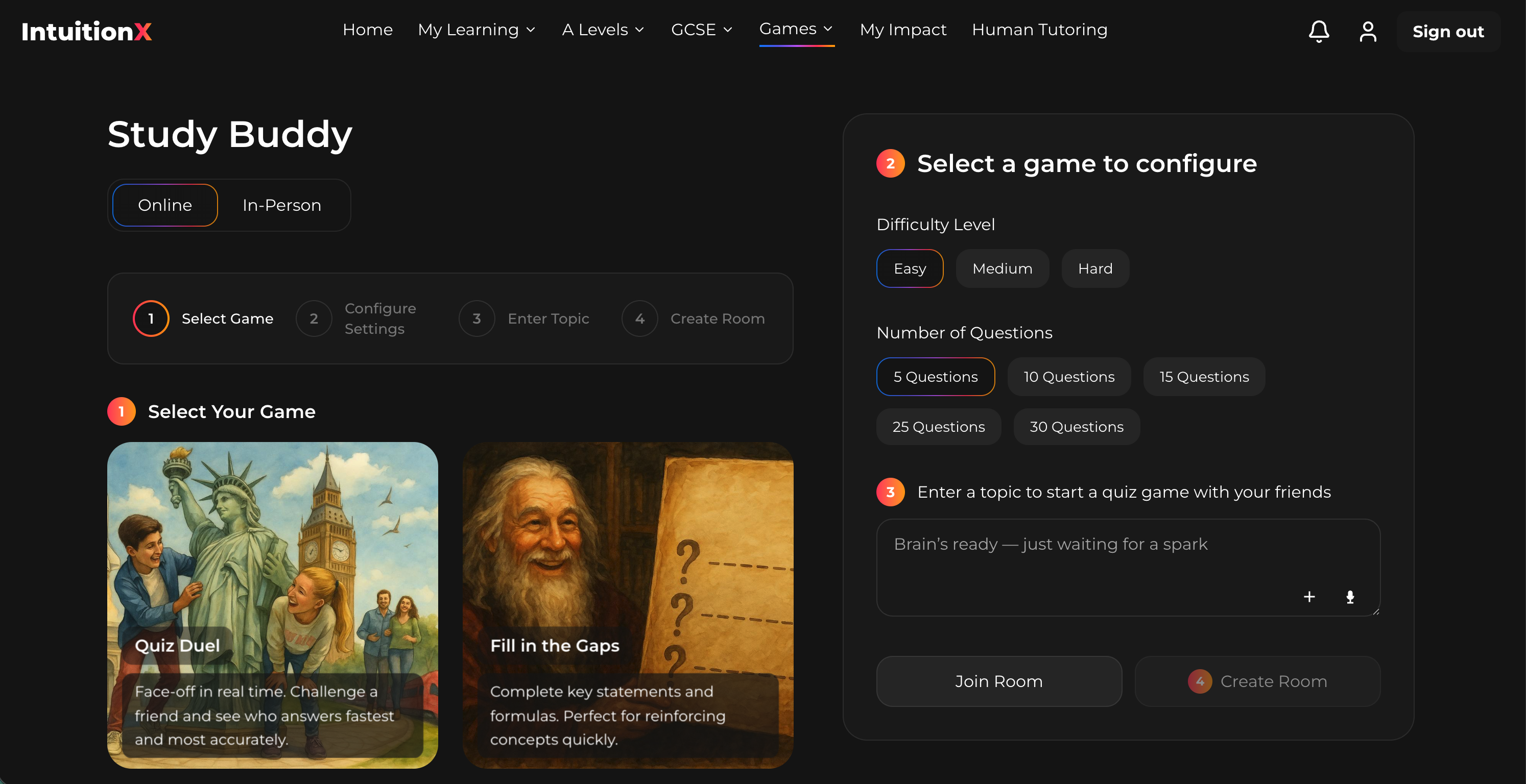
Built on Oxbridge level academic rigour, IntuitionX combines the expertise of tutors who achieved A*s at A Level and Firsts from Oxford and Cambridge with memory science principles that ensure lasting understanding. The tutoring features focus on building your capability, not just improving individual essays. Explore IntuitionX today to boost your exam readiness whilst developing the literary analysis skills that will serve you beyond A Levels.
Frequently asked questions
What are the best AI tools for A Level literature study?
Olex.ai leads for comprehensive essay marking and feedback, achieving documented grade improvements through rapid practice cycles. Grammarly excels at real time writing refinement, whilst Socratic helps with difficult passage comprehension through visual recognition. A Level Tutor Online provides subject specific guidance across set texts. Choose tools offering personalised feedback rather than generic essay generation to maintain skill development.
How can I avoid overreliance on AI in my literature studies?
Use AI for guidance and technical feedback, never for producing complete analysis or interpretations. Combine every AI interaction with independent critical reading where you develop your own arguments first. Step away from AI tools regularly to practise manual essay writing under timed conditions, ensuring you can perform independently in exam settings where AI access is unavailable.
Will using AI improve my A Level literature grades?
AI can accelerate learning through personalised feedback loops, with proxy data showing 13% GCSE grade improvements where rapid practice is emphasised. However, AI is not a substitute for deep literary comprehension and your authentic analytical voice. Balanced use shows positive impact, but no direct A Level benchmarks exist yet. Your improvement depends on using AI to enhance rather than replace genuine engagement with texts.
Can AI understand subjective literary interpretation?
AI excels at identifying patterns, structural issues, and technical writing problems but struggles with the nuanced, emotionally informed interpretation that defines strong literature analysis. It gravitates towards consensus readings rather than original insights. Use AI for mechanical feedback whilst preserving subjective interpretation and personal response as your unique contribution that AI cannot replicate.
How much time should I spend using AI versus traditional study?
Aim for 70% traditional methods including close reading, manual essay planning, and independent writing, with 30% AI use for feedback and efficiency gains. Increase traditional practice as exams approach to build independent capability. Regular timed essays without AI support ensure you maintain exam readiness whilst benefiting from AI enhanced learning during revision periods.