

TL;DR:
- AI provides instant, high-quality feedback but may lead to less active revision if used alone.
- Combining AI with traditional note-taking and teacher input results in better retention and understanding.
- Active engagement, such as rewriting and annotating, is essential for deep learning and effective revision.
AI promises to make revision easier. But here's the surprising part: some students actually revise less when they use AI feedback, even though the quality of that feedback is often higher than what a teacher alone can provide. That contradiction matters. It tells us that using AI doesn't automatically mean better results. What you do with it, and how you combine it with other strategies, is what genuinely moves the needle. This guide walks you through the real evidence on AI in English Literature revision, what works, what doesn't, and how to build a revision approach that actually sticks.
Table of Contents
- What is AI's role in English Literature revision?
- Comparing AI-powered and traditional revision techniques
- How to optimise your revision with AI: Practical techniques and strategies
- Common pitfalls and misconceptions about AI in revision
- Our perspective: Why balancing AI and traditional revision matters most
- Connect your revision journey with IntuitionX's AI tools
- Frequently asked questions
Key Takeaways
| Point | Details |
|---|---|
| Instant AI feedback | AI delivers prompt essay analysis, helping you revise more frequently and efficiently. |
| Hybrid revision works best | Combining AI feedback and active note-taking produces superior essay quality and retention. |
| Beware of AI-only revision | Relying solely on AI can diminish memory and depth; always supplement with traditional methods. |
| Practical strategies matter | Follow stepwise revision: AI review, notes, then teacher input for balanced improvement. |
| Access AI tools easily | Platforms like IntuitionX make AI-powered revision accessible for A Level English Literature students. |
What is AI's role in English Literature revision?
AI has moved well beyond simple spell-checkers. For A Level English Literature students, it now offers something far more useful: instant, detailed feedback on essay structure, argumentation, and even the quality of your textual analysis. That's a big deal when you're trying to improve quickly.
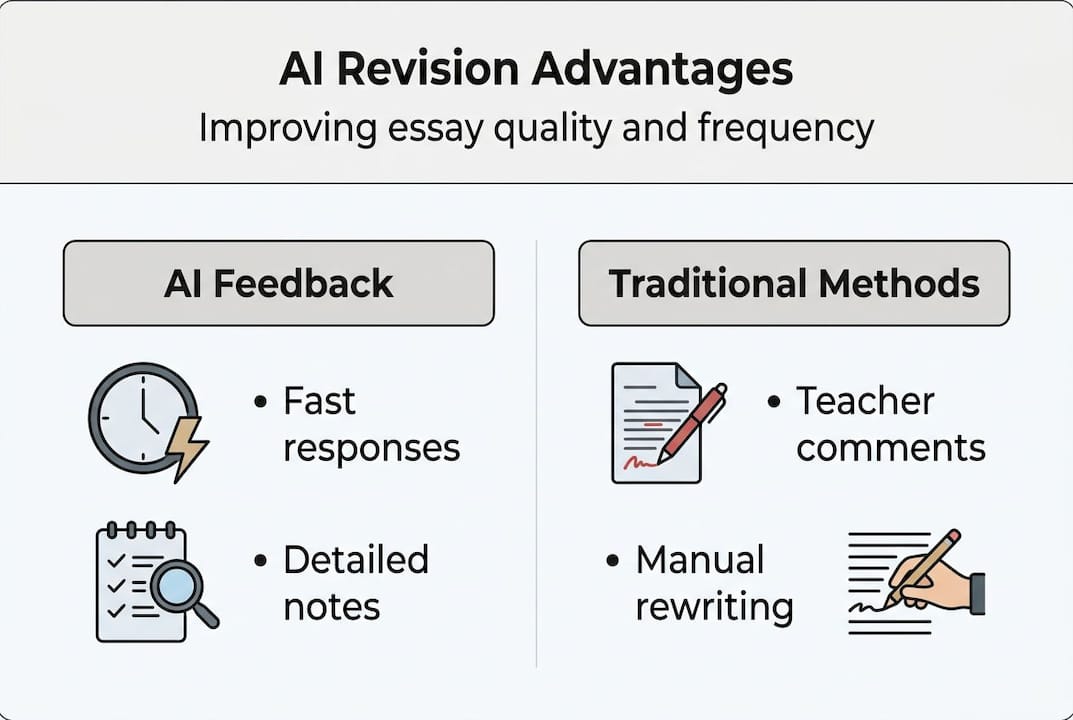
One of the most significant findings in recent research is that AI feedback increases revision frequency in writing tasks compared to teacher feedback alone, and that combining AI with teacher input produces the highest revision rates of all. Think about what that means practically. You can submit a draft essay at 11pm, receive structured feedback within seconds, and revise before your next lesson. That kind of rapid iteration simply wasn't possible before.
AI also plays a growing role in assessment itself. AI-enhanced comparative judgement shows high reliability and superior efficiency over traditional human marking in English Literature contexts. Comparative judgement works by asking the system to compare two pieces of writing and decide which is stronger, rather than assigning a numerical mark. It's a more nuanced method, and AI handles it with impressive consistency.
Here's a quick summary of what AI currently does well in English Literature revision:
- Instant essay feedback on structure, argument flow, and use of evidence
- Identifying revision gaps by highlighting weak sections you might overlook
- Comparative assessment that benchmarks your work against a standard
- Consistent availability, so you're never waiting for feedback at a critical moment
If you want to understand how AI for A Level literature fits into a broader revision plan, or how AI learning companions actually support deep learning rather than replacing it, those are worth exploring alongside this guide.
"The future of revision isn't AI or teachers. It's AI and teachers, working together to give students more feedback, more often, and more meaningfully."
Comparing AI-powered and traditional revision techniques
Having examined AI's basic functions, it's vital to compare them against familiar revision approaches. The evidence here is genuinely surprising, and it should change how you think about your revision toolkit.
Research on LLM use for revision found that using AI language models alone actually worsens retention and comprehension compared to traditional note-taking. However, combining AI with notes produces the best outcomes of all. Students in the study preferred AI for its accessibility and speed, but valued handwritten notes for depth and retention. Both perceptions turned out to be accurate.
Separate research also found that AI feedback produces higher quality feedback than teachers on argumentative essays, yet students paradoxically revise less when using AI alone. The feedback is better, but the engagement is lower. That's a critical insight.

Here's how the two approaches compare directly:
| Factor | AI-powered revision | Traditional revision |
|---|---|---|
| Speed of feedback | Immediate | Hours or days |
| Feedback quality | High (especially for structure) | Variable, teacher-dependent |
| Memory retention | Lower when used alone | Higher with active note-taking |
| Depth of engagement | Can be passive | Encourages active processing |
| Availability | 24/7 | Limited to school hours |
| Best use case | Structural and grammatical review | Deep comprehension and analysis |
The pattern is clear. Neither approach wins outright. AI is faster and often more consistent. Traditional methods build deeper understanding. Pairing active learning strategies with AI feedback is where the real gains are made.
The key benefits of combining both approaches include:
- Faster identification of structural weaknesses via AI
- Deeper retention through handwritten annotation and summarising
- More frequent revision cycles enabled by instant AI feedback
- Greater confidence from teacher validation alongside AI suggestions
Pro Tip: Use AI to flag structural issues in your essay first, then follow up by rewriting the weak sections in your own handwritten notes. That two-step process forces active engagement and locks in the learning.
How to optimise your revision with AI: Practical techniques and strategies
With the pros and cons clear, here's how you can harness AI alongside proven strategies to revise more effectively for A Level English Literature.
Research shows that chain-of-thought prompting significantly enhances the quality of AI feedback for literature analysis. In plain terms, this means asking AI to explain its reasoning, not just give you a verdict. Instead of asking "Is my essay good?", ask "Explain step by step what's strong and weak about my argument in this paragraph." The difference in output quality is substantial.
Here's a practical step-by-step process you can follow:
- Draft your essay without AI assistance. This preserves your independent thinking and gives AI something genuine to work with.
- Submit to AI for structural feedback. Ask specifically about argument clarity, use of textual evidence, and analytical depth.
- Annotate the feedback by hand. Don't just read it. Write down what you'll change and why. This is where retention happens.
- Revise the essay using your notes as a guide, not the AI output directly.
- Share with your teacher for a final layer of expert, contextualised feedback.
- Repeat the cycle on your next draft, tracking improvement over time.
Here's a simple framework to guide how you use AI at each stage:
| Revision stage | AI role | Your role |
|---|---|---|
| First draft | None | Write independently |
| Structural review | Identify weaknesses | Annotate and reflect |
| Redraft | Suggest improvements | Rewrite actively |
| Final check | Consistency and grammar | Confirm with teacher |
You can also explore conversational AI revision tools that guide you through Socratic questioning, pushing you to justify your interpretations rather than just accepting corrections. That's a fundamentally different and more powerful kind of feedback.
Pro Tip: When prompting AI for essay feedback, ask it to compare your argument to a strong A Level response and explain the specific gaps. Comparative feedback is far more useful than generic praise or surface-level edits.
Common pitfalls and misconceptions about AI in revision
Having seen practical strategies, it's essential to address some major risks and common misconceptions about using AI in your revision.
The biggest trap is passive consumption. AI gives you feedback. You read it. You feel like you've revised. But if you haven't actively engaged with that feedback, rewriting, annotating, questioning, then very little has actually been learned. Research confirms that AI alone hinders memory compared to active methods like note-taking. Feeling productive and being productive are not the same thing.
Here are the most common pitfalls to watch out for:
- Skipping the rewrite. Reading AI feedback without redrafting means you miss the actual learning moment.
- Over-prompting for answers. Asking AI to write improved paragraphs for you bypasses the thinking you need to do yourself.
- Ignoring teacher input. AI doesn't know your specific exam board's mark scheme the way your teacher does.
- Mistaking speed for depth. Fast feedback doesn't mean thorough revision. Slow, deliberate engagement with that feedback is what counts.
- Assuming AI is always right. AI can misread nuance in literary analysis. Always cross-check with your own judgement.
Research also shows that students perceive AI as more helpful than the evidence actually supports when used in isolation. That gap between perception and reality is dangerous. You might feel confident after an AI revision session when your actual retention is lower than it would have been after a focused note-taking session.
"The risk isn't that AI gives bad feedback. The risk is that good feedback, passively received, teaches you nothing at all."
Hybrid approaches consistently outperform pure reliance on either AI or traditional methods. Exploring effective learning strategies that blend both gives you the best of both worlds, without the blind spots of either.
Our perspective: Why balancing AI and traditional revision matters most
Here's our candid take. The students who will genuinely benefit from AI in revision are not the ones who use it most. They're the ones who use it most strategically.
Over-reliance on AI leads to shallow revision. It's comfortable, it's quick, and it feels like progress. But comfort is not the same as learning. The research is clear: memory and deep comprehension still depend on active, effortful engagement. No AI shortcut changes that.
What AI genuinely offers is more feedback, more often, at a higher standard than most students could access before. That's a real advantage. But the advantage only materialises if you treat AI feedback as a starting point, not a finishing line.
Manual note-taking, teacher dialogue, and genuine rewriting are not outdated. They are the mechanisms through which understanding becomes permanent. The best revision strategy combines the precision of AI with the depth of human engagement. Students who use AI to personalise their learning while maintaining active revision habits consistently outperform those who depend solely on technology. That's not a guess. That's what the evidence shows.
Connect your revision journey with IntuitionX's AI tools
If you're ready to experience these benefits first-hand, here's where to start.

IntuitionX is built specifically for students who want to learn at the highest level, not just get answers. Our AI tutor, Omniscience, is trained on the knowledge of academics who earned A*s at A Level and Firsts from Oxford and Cambridge. It uses Socratic questioning to push your thinking, not replace it. For A Level English Literature, that means instant, intelligent essay feedback combined with the kind of probing questions that build genuine analytical depth. Try the IntuitionX AI tutor today, or log straight into the IntuitionX platform to start a revision session that actually works.
Frequently asked questions
Can AI fully replace teacher feedback in English Literature revision?
No. Research shows that combined AI and teacher feedback produces the highest revision rates and essay improvement. AI enhances teacher input; it doesn't substitute for it.
Does AI marking make assessments more reliable?
Yes. AI-based comparative judgement is highly reliable and more efficient than traditional human marking, particularly in English Literature contexts where consistency can vary between markers.
Should I use AI or take notes for best revision results?
Both. Combining AI with note-taking delivers the highest retention and essay quality. Using AI alone is measurably less effective for memory and comprehension.
What's the risk of relying only on AI for revision?
Exclusive AI use can lower memory retention and reduce the depth of your revision. Hybrid approaches that mix AI feedback with active methods like note-taking and teacher input are consistently more effective.