

TL;DR:
- Effective teen engagement is rooted in creating safe environments, satisfying psychological needs, and providing genuine feedback. Incentives and thoughtful environment design can motivate participation despite teens' busy schedules, while digital tools should be used to complement human connection and personalize content. Planning with teens and consistently closing the feedback loop build trust and sustain long-term involvement.
Improving teen engagement methods is the process of applying targeted strategies and environments that motivate and sustain teenagers' active participation in educational settings. In the UK, 73% of students are not actively engaged in learning. In the US, 80% report feeling bored and 91% feel nervous asking questions in class. Those numbers are not a motivation problem. They are a design problem. This guide gives educators, parents, and youth programme coordinators the evidence-backed frameworks and practical tools to fix it.
What principles underpin improving teen engagement methods?
The most effective teen engagement strategies are built on three psychological needs: autonomy, competence, and relatedness. These come from Self-Determination Theory, and research confirms that student-centred approaches, real-world problems, and cooperative group tasks directly satisfy all three. When teens feel in control, capable, and connected, motivation follows naturally.
UNICEF's Lundy model adds another layer. It defines genuine youth engagement as creating safe, respectful, and accessible spaces where young people are treated as experts in their own experience. UNICEF Australia stresses that avoiding tokenism requires showing teens exactly how their input shaped decisions. This is called "closing the loop," and it is one of the most overlooked steps in youth programme design.
Here is what the foundational principles look like in practice:
- Autonomy: Give teens genuine choices about topics, formats, or session structures. Avoid prescribing every detail.
- Competence: Set tasks that stretch but do not overwhelm. Celebrate visible progress.
- Relatedness: Build peer connections through group work and shared goals.
- Safe environments: Establish clear ground rules. Make voluntary sharing the norm, not the exception.
- Closing the loop: After every consultation or session, report back. Tell teens what changed because of what they said.
Pro Tip: Send a short written summary to participants after each session explaining one specific decision that their feedback influenced. This single habit builds more trust than any incentive programme.
How can incentives and environment design boost teen participation?
Voluntary participation is the hardest problem in teen engagement. Teenagers face competing priorities: part-time jobs, social lives, revision, and family responsibilities. Any programme that ignores this reality will struggle with attendance regardless of content quality.

Child Trends research found that making participation feel worthwhile through fun environment design and tangible incentives helps programmes manage these competing demands. The key word is worthwhile. Teens are not passive recipients. They weigh the value of showing up against everything else they could be doing.
The most effective incentive types, ranked by practical impact, are:
- Incremental gift cards: Small rewards tied to attendance milestones keep motivation consistent without creating a transactional feel.
- Food provision: Providing a meal or snacks removes a practical barrier and creates a social atmosphere that encourages return visits.
- Community service hours: For teens building CVs or university applications, certified hours carry real-world value.
- Public recognition: Acknowledging contributions in newsletters or social media (with consent) satisfies the need for relatedness and visibility.
- Skill certificates: Formal recognition of participation in workshops or leadership roles adds lasting value beyond the session itself.
Environment design matters just as much as the incentive. Music playing on arrival, flexible seating arrangements, and a facilitator who models warmth and curiosity all signal that this is a different kind of space. Programme staff should attend closely to tone, inclusivity, and comfort from the very first session.
Pro Tip: Ask teens directly what would make them more likely to attend. Run a two-question anonymous poll before your first session. The answers will surprise you, and acting on them immediately signals that you mean business.
What role do digital tools and AI play in teen engagement?
Digital tools are not a shortcut to engagement. Used well, they are a multiplier. Used poorly, they add noise.
A 2026 meta-analysis of gamified AI learning environments found significant positive effects on motivation and learning outcomes in secondary education. The caveat is important: behavioural engagement results were mixed. That means AI and gamification improve how teens feel about learning without always changing how much they do. Sustained improvement requires alignment with curriculum goals and ongoing evaluation.
The LIFE4YOUth study adds a critical nuance around timing. Digital prompt timing significantly influenced whether teens engaged with an mHealth behaviour change programme. Students who received messages at the wrong moment, or whose targeted behaviours did not feel personally relevant, disengaged quickly. The lesson for educators is clear: tailor both the content and the delivery schedule to the individual, not the cohort average.
| Approach | Strength | Limitation |
|---|---|---|
| Gamified AI platforms | Improves motivation and self-regulation | Behavioural engagement results are variable |
| SMS or push notification prompts | Low-cost, scalable, timely | Timing and relevance must be personalised |
| Adaptive learning systems | Matches content to ability level | Requires curriculum alignment to sustain gains |
| Video-based content | High accessibility, familiar format | Passive consumption without interaction adds little |
For a deeper look at how these tools work in practice, the Intuitionx blog covers AI in education with specific examples from secondary settings.
How to plan and implement teen engagement activities effectively
Good intentions without good logistics produce poor turnout. GOV.UK's 2026 guidance on youth voice in policymaking sets a clear standard: plan with senior approval, recruit diverse participants, and make sure feedback can lead to real action. These principles apply equally to after-school programmes, classroom projects, and community initiatives.
Here is a practical planning checklist:
- Consult teens on timing: Ask about preferred days and times before scheduling. Avoid clashing with popular extracurricular activities.
- Offer multiple formats: Provide both in-person and online options. Not every teen can travel, and some engage better digitally.
- Address accessibility needs: Ask about physical, sensory, or language requirements at the point of recruitment, not on the day.
- Send reminders: A text or email 48 hours before and again on the morning of the session reduces no-shows significantly.
- Set clear expectations: Tell participants in advance how long the session will last, what they will be asked to do, and how their input will be used.
- Budget for fair compensation: Whether that is gift cards, travel reimbursement, or refreshments, compensation signals that you value their time.
The table below maps planning stages to the key actions required at each step.
| Planning Stage | Key Action |
|---|---|
| Pre-recruitment | Consult teens on preferred timing and format |
| Recruitment | Actively seek diverse participants, including those less likely to volunteer |
| Session design | Build in voluntary sharing, flexible seating, and clear ground rules |
| Post-session | Send a written summary showing how input will be used |
| Review | Evaluate attendance, diversity, and feedback quality to improve next time |
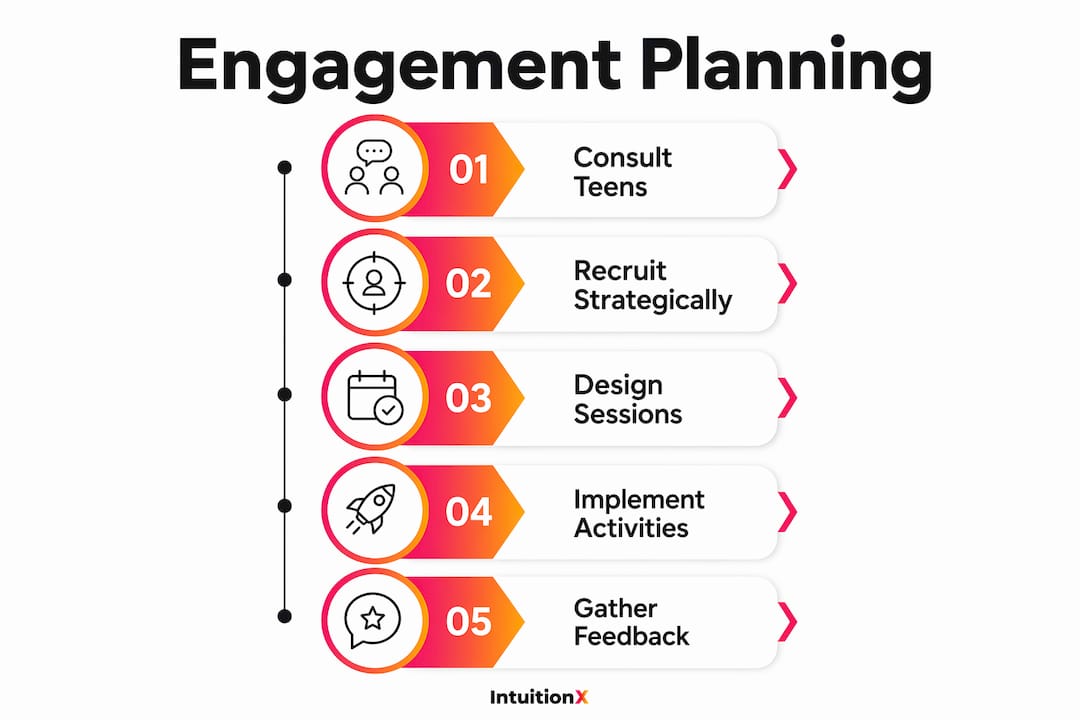
Designing programmes around teens' schedules and offering multiple session times leads to higher and more diverse participation. Diversity matters here. A room full of the same type of teenager produces narrow feedback and misses the young people who need support most.
What common pitfalls hinder teen engagement and how to avoid them?
The most common reason teen engagement programmes fail is not lack of effort. It is lack of follow-through. UNICEF's research shows that without visible evidence of how their input was used, teens quickly perceive engagement as irrelevant. Trust, once lost, is very hard to rebuild.
Other frequent pitfalls include:
- Tokenism: Inviting teens to participate but ignoring their contributions. Fix this by assigning a named person responsible for acting on feedback.
- Scheduling conflicts: Running sessions at times that clash with school, work, or family commitments. Fix this by consulting teens before booking anything.
- Misaligned incentives: Offering rewards that do not match what teens actually value. Fix this by asking, not assuming.
- Poor motivational fit: The LIFE4YOUth study found that teens with multiple risk behaviours disengaged when the programme did not feel personally relevant. Fix this by segmenting your audience and tailoring content accordingly.
- One-size-fits-all digital tools: Deploying an app or platform without testing it with your specific group first. Fix this by piloting with a small cohort and iterating before full rollout.
Pro Tip: After every programme cycle, ask three teens who did not return why they stopped coming. Their answers will tell you more than any attendance spreadsheet.
For a broader look at proven engagement strategies tailored for K-12 educators, the Empowered PL 2026 guide is worth bookmarking.
Key takeaways
Effective teen engagement requires safe environments, genuine feedback loops, and tailored incentives working together, not in isolation.
| Point | Details |
|---|---|
| Close the feedback loop | Always show teens how their input shaped decisions to build trust and sustain participation. |
| Use Self-Determination Theory | Design activities that satisfy autonomy, competence, and relatedness to drive genuine motivation. |
| Match incentives to your audience | Gift cards, food, and community service hours work, but only when teens find them personally relevant. |
| Tailor digital tools carefully | AI and gamification improve motivation, but timing and curriculum alignment determine whether gains last. |
| Plan logistics with teens, not for them | Consulting teens on timing, format, and accessibility before scheduling significantly increases diverse turnout. |
What i have learned about teen engagement after years in education
The research is clear, but the practice is messier. What strikes me most, having worked across educational settings and spoken with youth coordinators at length, is how often adults design engagement programmes with the best intentions and then forget to report back. That single omission, not closing the loop, destroys more goodwill than any scheduling mistake or poorly chosen incentive ever could.
I have also noticed a tendency to reach for technology first. A new app, a gamified platform, an AI tutor. These tools genuinely help, and the 2026 meta-analysis data on gamified learning environments backs that up. But technology without human connection is just content delivery. The teens who stay engaged are the ones who feel that someone in the room actually cares whether they show up.
My honest view is that the most underrated method for increasing teen involvement is simply asking teens what they want and then doing it. Not consulting them and then doing what you planned anyway. Actually changing something based on what they said. That act of responsiveness is worth more than any incentive budget.
Treat engagement as a living process. Test, adapt, and keep asking. The programmes that sustain participation over time are the ones that evolve with their participants, not the ones that launch with a polished plan and never revisit it.
— Angus
How Intuitionx supports teen engagement in the classroom
If you are looking for a digital tool that actually adapts to each teenager rather than delivering the same content to everyone, Intuitionx is worth exploring. Built on Oxbridge-level pedagogy and backed by Sir Anthony Seldon, Intuitionx uses Socratic questioning and memory science to keep teens curious, confident, and genuinely involved in their own learning.
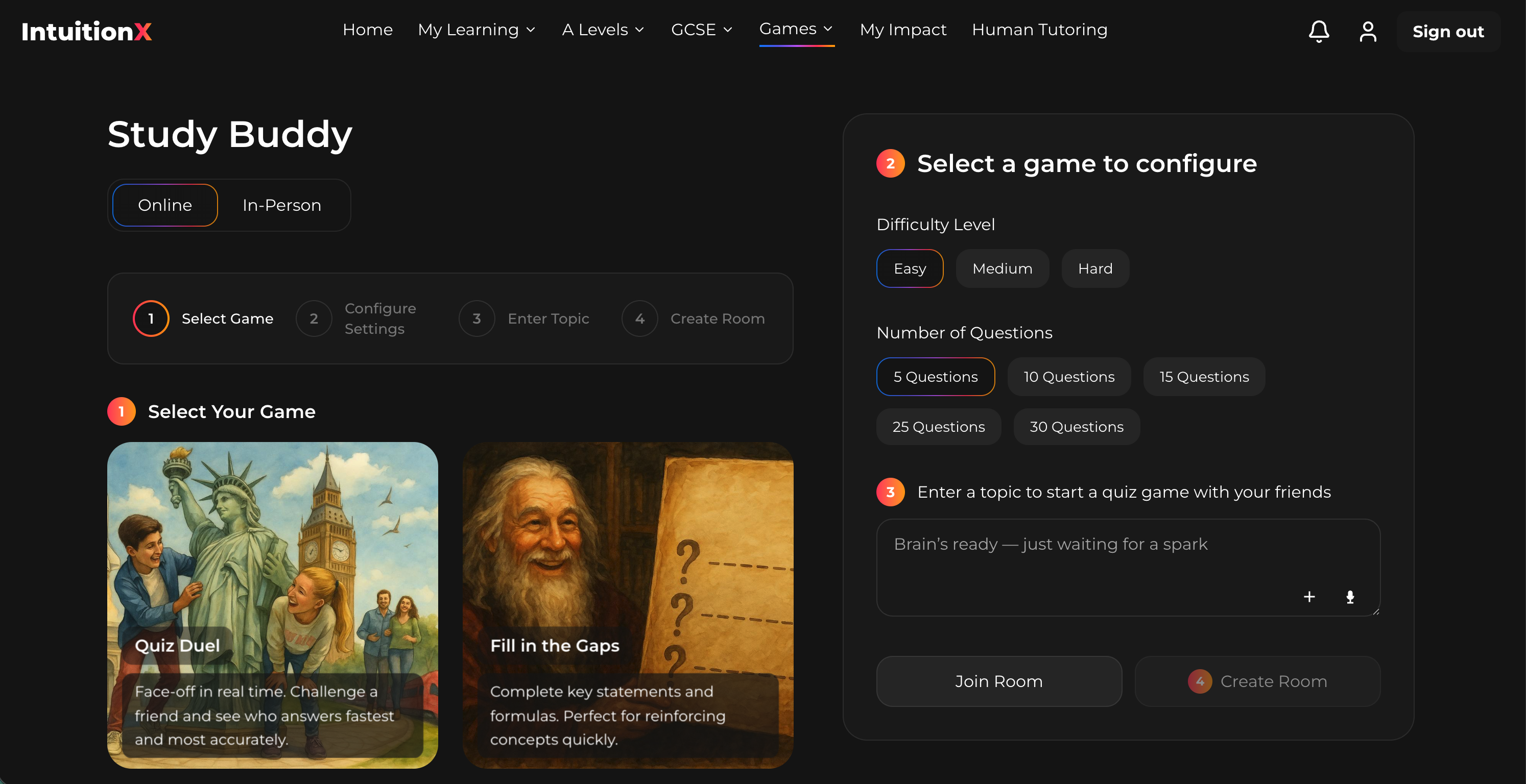
Unlike generic AI tools that write answers for students, Intuitionx's AI companion "Omniscience" asks the questions that make teens think. It is available 24/7, adapts to individual ability levels, and is designed to reduce the anxiety that stops 91% of students from asking questions in class. For educators and youth coordinators ready to put evidence-based engagement into practice, Intuitionx offers a practical starting point.
FAQ
What are the most effective teen engagement strategies?
The most effective strategies combine Self-Determination Theory principles (autonomy, competence, and relatedness) with safe environments and visible feedback loops. Incentives such as gift cards and community service hours also increase voluntary participation in after-school programmes.
How do incentives improve teen participation?
Incentives work by making participation feel worthwhile against competing priorities like work and revision. Child Trends research shows that incremental gift cards, food provision, and certified community service hours are among the most effective options for voluntary programmes.
Does AI genuinely help with methods for engaging teenagers?
A 2026 meta-analysis found that gamified AI learning environments produce significant positive effects on motivation in secondary education. Behavioural engagement results are mixed, so AI tools work best when aligned with curriculum goals and evaluated regularly.
How do you avoid tokenism in youth engagement?
Tokenism is avoided by closing the feedback loop: showing teens specifically how their input influenced decisions. UNICEF recommends follow-up meetings, written summaries, and named changes communicated directly to participants after every engagement activity.
What is the biggest logistical barrier to teen engagement?
Scheduling is the most common barrier. GOV.UK guidance recommends consulting teens about preferred times and locations before booking sessions, offering both in-person and online options, and sending reminders 48 hours before each session.