

TL;DR:
- Student engagement is a complex psychological state encompassing students' thoughts, feelings, and actions during learning activities. It involves four dimensions—behavioral, cognitive, emotional, and agentic—that collectively influence learning outcomes and motivation. Effective measurement requires combining self-reports, observations, and validated scales to capture all aspects beyond mere compliance or attendance.
Student engagement is one of the most talked-about ideas in education, yet it is also one of the most misunderstood. Ask ten teachers what it means and most will describe a student sitting quietly, paying attention, or raising their hand. That picture is incomplete. What is student engagement, really? It is a multidimensional psychological state that includes how students think, feel, and behave during learning. Miss any one of those layers and you are only seeing part of the story. This guide unpacks all of them.
Table of Contents
- Key takeaways
- Defining student engagement: the multidimensional model
- Signs of engagement in real learning environments
- Factors that influence engagement and pitfalls to avoid
- Practical strategies to support and boost engagement
- Measuring student engagement accurately
- My honest take on what engagement really demands
- How Intuitionx helps you put this into practice
- FAQ
Key takeaways
| Point | Details |
|---|---|
| Engagement has four dimensions | Behavioural, cognitive, emotional, and agentic engagement each play a distinct role in learning outcomes. |
| Compliance is not engagement | A student can appear on-task while remaining cognitively or emotionally absent from the learning experience. |
| Relationships drive engagement | Positive teacher-student rapport is one of the strongest predictors of genuine student engagement. |
| Measurement must go beyond observation | Validated scales that capture all four dimensions give a far more accurate picture than observation alone. |
| Strategies work best in combination | Active learning, student voice, and belonging-focused approaches together address all dimensions of engagement. |
Defining student engagement: the multidimensional model
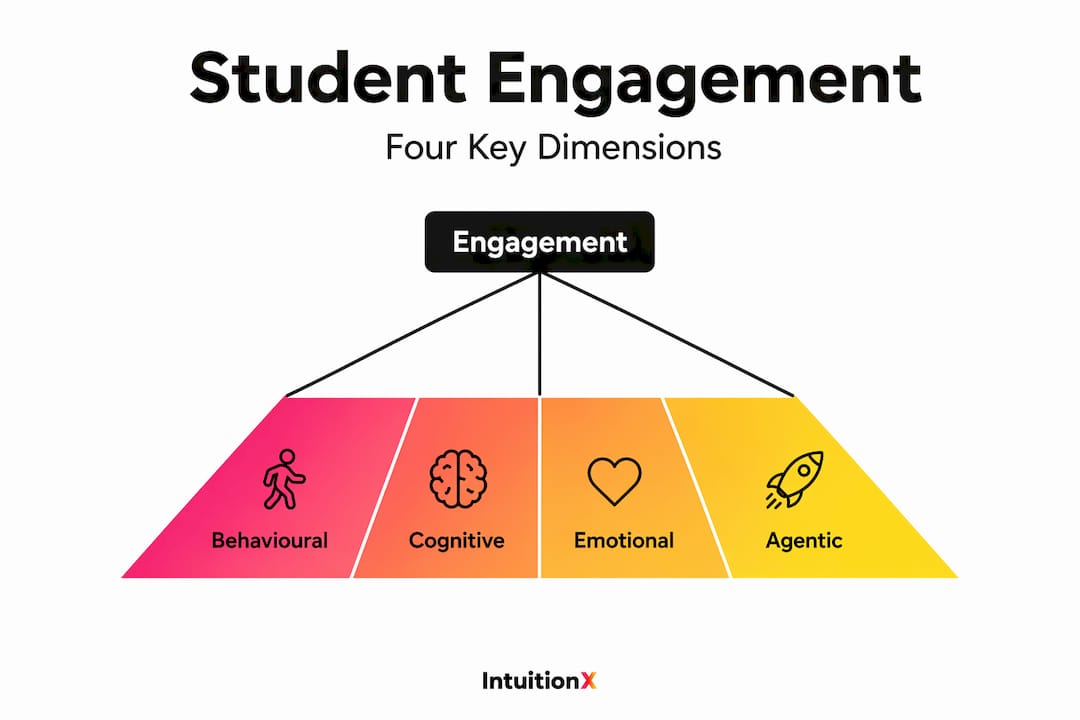
Most educators encounter the three-dimension framework developed by Fredricks and colleagues, which describes behavioural, cognitive, and emotional engagement as the core components. More recently, a fourth dimension has entered the conversation. A 2026 PLOS ONE study introduced agentic engagement as a fourth dimension, particularly relevant in higher education contexts. Understanding what each dimension actually means is the foundation for everything else.
Here is what each dimension looks like in practice:
- Behavioural engagement covers attendance, effort, participation in class activities, and following classroom rules. It is the most visible dimension and the one most commonly mistaken for engagement as a whole.
- Cognitive engagement is about mental investment. Does the student use self-regulation strategies? Do they push themselves beyond surface-level memorisation? Do they connect new ideas to things they already know?
- Emotional engagement captures how students feel about learning. Curiosity, enthusiasm, a sense of belonging, and anxiety all fall here. Positive emotional states trigger dopamine release, which aids motivation and memory. Stress and boredom do the opposite, activating the amygdala and shutting down higher-order thinking.
- Agentic engagement describes students actively contributing to and influencing their own learning. Offering input on how lessons are structured, expressing preferences, asking questions that redirect instruction. It is the most proactive dimension and the one most overlooked in assessment.
It is also worth noting that engagement extends beyond the classroom. Students engage with ideas during informal conversations, personal reading, and even unconscious processing. Defining student engagement too narrowly, as something that only happens in a lesson, misses a great deal of genuine learning.
Pro Tip: When discussing engagement with colleagues or parents, specify which dimension you mean. Saying "Maya is disengaged" tells you almost nothing. Saying "Maya completes work but rarely connects ideas or asks questions" points directly to cognitive engagement and opens a productive conversation.
Signs of engagement in real learning environments
Knowing the theory is one thing. Spotting engagement in the room is another. Each dimension leaves different clues, and recognising them helps you respond effectively.
Behavioural signs are the easiest to spot:
- Consistent attendance and punctuality
- Active participation in group tasks
- Completing assignments on time and with evident effort
- Staying focused during independent work
Emotional signs require a little more attention:
- Students who look forward to certain subjects or lessons
- Willingness to take risks and answer questions even when unsure
- Visible curiosity when a new topic is introduced
- Distress or withdrawal when topics feel irrelevant or too difficult
Cognitive signs show up in the quality of thinking:
- Students who ask "why" and "what if" rather than just "what"
- Work that shows genuine synthesis rather than copied facts
- Self-correction and revision without being prompted
- Use of multiple strategies when problem-solving
Agentic signs reveal student ownership of learning. The student who says "Could we look at this from a different angle?" or who negotiates the format of an assessment is demonstrating agentic engagement. This dimension uniquely contributes to gains in motivation and achievement, which is precisely why encouraging it matters so much.
For a deeper look at how these ideas connect to academic outcomes, the piece on why engagement matters offers useful context.
Factors that influence engagement and pitfalls to avoid
Understanding what drives engagement is just as important as knowing what it looks like. Several factors consistently appear in the research, and some common mistakes can actively undermine your efforts.
The key influencing factors, in rough order of impact:
- Teacher-student relationships. Positive rapport between teacher and student is foundational. Students who feel known and valued by their teacher are significantly more willing to risk participation and invest effort. The 2×10 strategy, where a teacher spends two minutes a day for ten consecutive days in genuine conversation with a struggling student, is a simple and well-evidenced approach to building this.
- Psychological safety. Students who fear humiliation when they get something wrong disengage quickly. A classroom culture where mistakes are treated as information rather than failure creates the conditions emotional engagement needs to thrive.
- Relevance and autonomy. When students see the purpose of what they are learning and have some say in how they learn it, cognitive and agentic engagement both increase. Lessons that feel arbitrary produce exactly the boredom that 80% of students in the US report feeling at school.
- Student mindset. Self-belief, growth orientation, and a sense of belonging are all internal factors that teachers and parents can actively support through language, feedback, and environment.
- Measurement and feedback practices. How you assess engagement shapes how students experience it. Over-reliance on grades and compliance metrics can actually reduce intrinsic motivation over time.
Pro Tip: Do not assume that a quiet, compliant class is a highly engaged one. Observable on-task behaviour is an incomplete proxy for engagement. A student copying notes in silence may be cognitively absent. Ask yourself what thinking is actually happening, not just what behaviour you can see.
The biggest pitfall? Conflating participation with engagement. Participation is one signal. Genuine engagement means the whole person, thinking, feeling, and contributing, is present in the learning process.

Practical strategies to support and boost engagement
Here is where understanding becomes action. These strategies map directly onto the four dimensions and are drawn from evidence-based practice.
- Think-Pair-Share. Students think individually, discuss with a partner, then share with the class. Active learning methods like this stimulate both cognitive and social engagement. They also reduce the anxiety that 91% of students in the US report about asking questions in class.
- Project-Based Learning. Students work on real-world problems over an extended period. This approach demands cognitive engagement, generates emotional investment, and creates natural opportunities for agentic engagement through student-led decision-making.
- The 2×10 relationship strategy. As mentioned above, consistent one-to-one connection with disengaged students transforms their emotional engagement over time.
- Student voice and choice. Give students genuine options in what they study or how they demonstrate understanding. Even small choices, choosing between two essay prompts or selecting the order of tasks, increase agentic engagement meaningfully.
- Universal Design for Learning (UDL). This framework designs lessons with multiple means of representation, engagement, and expression from the outset, reducing barriers for all learners rather than adapting after the fact.
Here is a quick comparison of approaches across engagement dimensions:
| Strategy | Behavioural | Cognitive | Emotional | Agentic |
|---|---|---|---|---|
| Think-Pair-Share | High | High | Medium | Low |
| Project-Based Learning | High | High | High | High |
| 2×10 relationship strategy | Medium | Low | High | Medium |
| Student voice and choice | Medium | Medium | High | High |
| Universal Design for Learning | High | High | Medium | Medium |
For educators wanting to go further, the resource on learning engagement strategies explores how these approaches transform academic results in practice.
Measuring student engagement accurately
Measuring engagement properly is harder than it sounds, and many schools get it wrong. The most common mistake is conflating engagement in learning with engagement in the academic community. The first is a psychological state tied to specific learning tasks. The second is about belonging to a school community. They are related but distinct constructs, with different predictors and different outcomes. Mixing them up produces data that is difficult to act on.
Traditional engagement measures, things like attendance rates, homework completion, and teacher ratings, capture behavioural engagement reasonably well. They miss almost everything else. A key finding from recent scale development research is that omitting agentic engagement from evaluation fails to capture the student participation aspects that most directly drive learning outcomes in higher education.
Here is a simple overview of what different measures actually capture:
| Measure | Dimension covered | What it misses |
|---|---|---|
| Attendance and participation data | Behavioural | Cognitive, emotional, agentic |
| Teacher observation ratings | Behavioural, some emotional | Cognitive depth, agentic input |
| Student self-report surveys | All four dimensions | None, if well designed |
| Validated multidimensional scales | All four dimensions | Context-specific nuances |
The practical takeaway is straightforward. Use student self-report tools alongside observation, ask students directly about their experience of learning, and treat their answers as data. A student who tells you they feel invisible in class is giving you more useful information than an attendance register ever could.
My honest take on what engagement really demands
I have spent a long time thinking about why engagement is so difficult to get right, and the honest answer is that it asks something genuinely uncomfortable of educators and institutions. It asks you to care about what a student is thinking and feeling, not just what they are doing.
The "on-task means engaged" assumption is deeply embedded in how schools are built. Lesson observations often reward visible compliance. Inspections count hands raised. Performance metrics track grades and completion. None of those things are wrong in isolation. The problem is when they become the whole story.
What I find genuinely exciting about the agentic engagement dimension is what it reveals about students. When you give a 15-year-old a real choice about how to demonstrate their understanding, and they take that seriously, you are seeing something that no amount of behavioural compliance can fake. It is authentic investment. And in my experience, it is far more predictive of long-term learning than any test score.
The challenge with technology and remote learning deserves an honest word, too. Digital tools can support engagement brilliantly when they invite thinking and dialogue. They can also create the illusion of engagement, clicks logged, videos watched, boxes ticked, without any genuine cognitive or emotional investment happening at all. The medium is not the engagement. The thinking is.
If you are a parent reading this, the most powerful thing you can do is talk about learning at home. Ask not "what did you do today?" but "what surprised you today?" That question targets emotional and cognitive engagement in a single breath.
— Angus
How Intuitionx helps you put this into practice
Understanding engagement theory is the starting point. The harder part is building the kind of learning experience that actually activates it. That is exactly what Intuitionx was designed for.
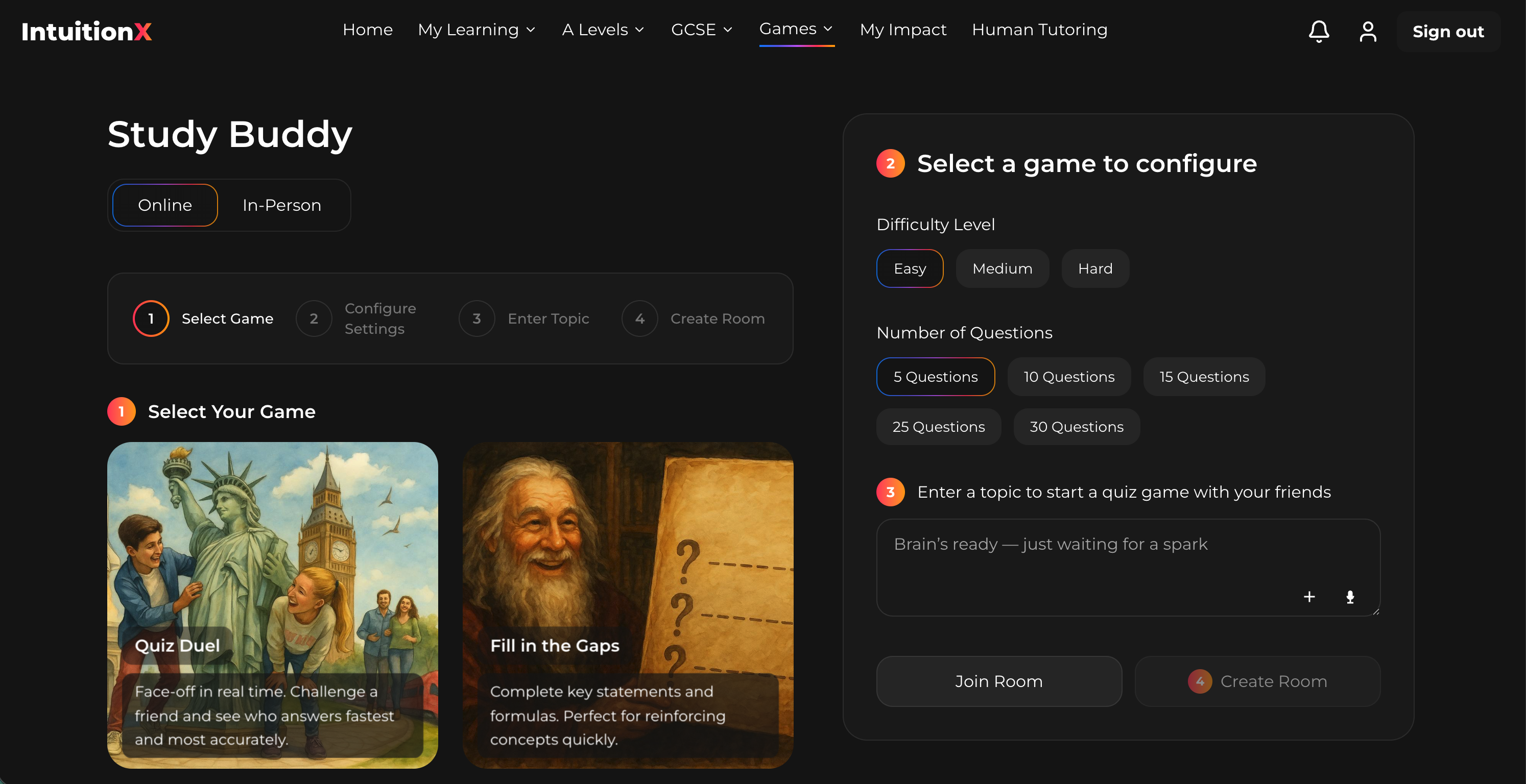
Intuitionx is a 24/7 AI tutor built on Oxbridge-level pedagogy, designed to make every student feel seen, challenged, and genuinely curious. Rather than simply providing answers, it uses Socratic questioning to draw out thinking, which directly targets cognitive and agentic engagement in every single session. It adapts to how a student feels and what they need, creating the psychological safety that emotional engagement depends on. If you are ready to see what genuine engagement looks like in action, start learning with Intuitionx today.
FAQ
What is student engagement in simple terms?
Student engagement describes how students think, feel, and behave during learning. It includes behavioural participation, emotional investment, cognitive effort, and the ability to actively influence their own learning experience.
How do you measure student engagement effectively?
The most accurate approach combines student self-report surveys with teacher observation and validated multidimensional scales. Measuring all four dimensions separately, including agentic engagement, gives a far more complete and usable picture.
What promotes student engagement most strongly?
Positive teacher-student relationships, psychological safety, relevant and purposeful tasks, and giving students genuine choice all consistently promote engagement across multiple dimensions.
Can a student appear engaged but actually not be?
Yes. Students can appear behaviourally engaged while lacking cognitive or emotional engagement. Compliance and on-task behaviour are useful signals but they do not confirm genuine learning is taking place.
What is agentic engagement and why does it matter?
Agentic engagement refers to students actively contributing to and shaping their learning, for example by offering input on instruction or expressing their needs. Research shows it uniquely predicts motivation and achievement gains beyond the other three dimensions.