
TL;DR:
- Almost 400 million children in crisis zones are currently out of school, despite education being a life-saving intervention.
- Supporting education during emergencies protects children from harm, promotes social cohesion, and prevents long-term conflict.
Almost 400 million children are out of school in crisis-affected areas right now. Yet when disasters strike, when conflict erupts, or when communities are displaced, education is almost always the last priority and the first thing cut. That is a catastrophic mistake. Understanding why support education in crisis matters is not an abstract policy debate. It is a question about children's safety, futures, and dignity. This guide is written for educators, parents, and advocates who want to understand the real stakes, and who are ready to do something about them.
Table of Contents
- Key takeaways
- Why support education in crisis: the protective role
- Education's role in equity and peacebuilding
- The underfunding crisis in humanitarian aid
- Why educators are the real frontline
- How to help education in crisis: practical steps
- My perspective: education is not a luxury, it is a lifeline
- How Intuitionx supports education for all
- FAQ
Key takeaways
| Point | Details |
|---|---|
| Education protects children | Schools act as safe spaces that shield children from exploitation, violence, and psychological harm during crises. |
| Funding is critically low | Only 3% of global humanitarian funding goes to education, leaving millions of children without support. |
| Teachers are frontline responders | Educators are central to learning continuity during crises and need their own psychosocial support. |
| Education builds long-term peace | Inclusive learning environments reduce radicalisation and foster social cohesion in post-conflict communities. |
| Advocacy saves lives | Early, coordinated advocacy for education in emergencies directly prevents harm and restores stability. |
Why support education in crisis: the protective role
When we think about emergencies, we instinctively reach for food, water, and shelter. Education rarely enters that first conversation. But education is a life-saving intervention that is every bit as urgent as medical care or nutrition. This is not a metaphor. It is a documented reality.
Schools, when they remain functioning during a crisis, do something extraordinary. They provide a physical location that is predictable and supervised. That predictability alone reduces the risk of children being recruited into armed groups, trafficked, or exploited. Routine matters enormously to a child whose world has collapsed. A school day, even a basic one held under a tarpaulin, offers structure that supports emotional recovery.
Here is what children lose when schools close during a crisis:
- Physical safety: Without the supervision that schools provide, children are far more vulnerable to gender-based violence and forced labour.
- Psychosocial support: Teachers and classmates become anchors during trauma. Removing that relationship compounds psychological damage.
- Nutrition and health access: School closures threaten child well-being beyond just learning. Many children rely on school meals as their primary daily nutrition.
- Mental health continuity: Structured learning gives children a sense of agency and normalcy, which is one of the most powerful tools against trauma-driven despair.
- Cognitive protection: Education in emergencies provides physical, psychosocial, and cognitive protection that sustains and saves lives, according to UNESCO.
Pro Tip: If you are an educator working in or near a crisis-affected area, identify which of these five protective functions your school currently provides, and advocate loudly for the ones that are missing. Framing education as a multi-function protective service, not just a classroom subject, makes it far harder for funders to deprioritise it.
Education's role in equity and peacebuilding
It is easy to see education as a personal benefit. A child learns, a child earns more later in life. But the role of education in conflict is far wider than individual gain. It is one of the few tools that can actually interrupt cycles of violence across generations.
Inclusive learning environments contribute to social cohesion and sustainable peace. When children from different ethnic, religious, or linguistic backgrounds learn together, empathy develops. Stereotypes erode. The conditions that allow hate to flourish become harder to maintain. This is not soft idealism. It is backed by decades of post-conflict reconstruction evidence.
There is a specific sequence that matters here:
- Inclusive access: Education programmes in crisis zones must actively reach girls, children with disabilities, and ethnic or religious minorities. These groups are consistently the most marginalised, and their exclusion deepens social fractures.
- Countering radicalisation: Young people without schooling, purpose, or community are significantly more vulnerable to recruitment by extremist groups. Education promotes peacebuilding by reducing this vulnerability.
- Long-term stability: Communities that maintain functioning schools during and after conflict recover faster economically and socially than those that do not.
- Empowering marginalised voices: Inclusive education in emergencies not only protects children but empowers marginalised groups, advancing equity and social cohesion.
"Education is not just a human right. In a post-conflict setting, it is the architecture of peace. Without it, we are building on sand." — UN Peace and Security Division
Understanding educational access and equity as a structural issue, rather than a charity concern, changes how we advocate for it. It shifts the question from "can we afford to support education in crisis?" to "can we afford not to?"
The underfunding crisis in humanitarian aid
Here is a number that should stop you in your tracks. Only about 3% of global humanitarian funding is allocated to education. Three per cent. For a sector that UNESCO classifies as a life-saving intervention. That gap is not accidental. It reflects a persistent, systemic undervaluation of learning as a humanitarian need.
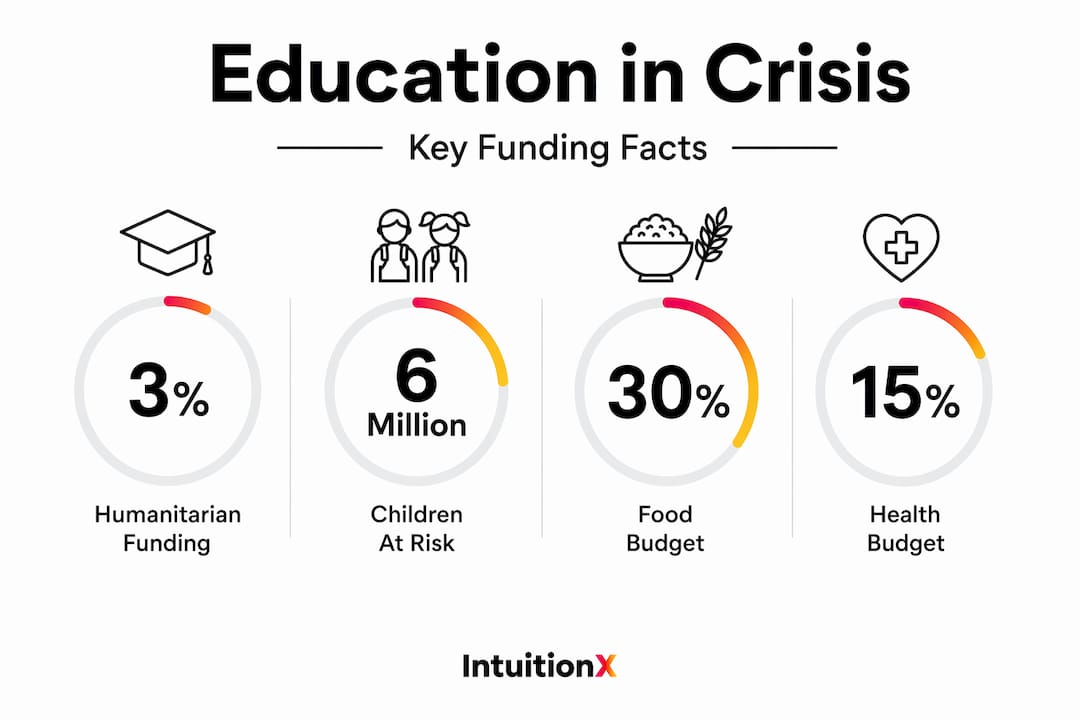
The consequences are measurable and worsening. Projected drops in current funding could push an additional 6 million children out of school by the end of 2026. These are not statistics in the abstract. Each one is a child losing months or years of learning that will be extraordinarily difficult to recover.
| Funding category | Share of humanitarian budget |
|---|---|
| Food and nutrition | ~30% |
| Health services | ~15% |
| Shelter and non-food items | ~13% |
| Education | ~3% |
| Water, sanitation, and hygiene | ~8% |
The mismatch is stark. And the structural reasons for it are worth understanding. Humanitarian funding mechanisms tend to reward speed and visibility. Food drops and medical triage are photogenic and immediate. A teacher sitting with traumatised children in a temporary learning space is not. Yet the impact of that teacher is profound and lasting.
A second problem is rigidity. Flexible, dedicated funding tailored for rapid education response is necessary to adapt to unpredictable learning needs in crises. But most humanitarian budgets are not designed that way. Funds are siloed, slow to release, and often tied to conditions that do not match the realities on the ground.
Pro Tip: When advocating for education funding, use the 3% figure explicitly. It is one of the most persuasive single data points available. Pair it with the UNESCO framing of education as a life-saving intervention, and you shift the entire argument from "extras" to "essentials."
Why educators are the real frontline
When we talk about supporting education in emergencies, we spend a lot of time discussing children. Rightly so. But we systematically overlook the people who make education happen: teachers.
Educators are central actors in maintaining education quality and continuity during crises, yet they are among the least supported group in any emergency response. Teachers in conflict zones face the same trauma as their students. They face physical danger, displacement, and the loss of colleagues, family members, and their own homes. Asking them to deliver quality education without addressing their own wellbeing is both unfair and counterproductive.
What does genuine educator support look like in a crisis context?
- Psychosocial care: Teachers need structured access to mental health support. They cannot pour from an empty cup, and a traumatised teacher cannot deliver stabilising education.
- Safe working conditions: Physical safety for educators is a prerequisite. Where teachers face threats, schools cannot function.
- Participation in policy: Climate-resilient education systems fail without recognising that educators are both frontline responders and key to policy dialogue. Teachers who are involved in planning respond more effectively when crises hit.
- Professional continuity: Salary payment during displacement is a persistent problem. When teachers are not paid, they leave. When they leave, schools collapse entirely.
- Capacity building: Helping teachers adapt their pedagogical approaches to disrupted settings, including larger class sizes, multi-grade teaching, and trauma-informed practice, is not optional. It is the difference between a functional school and a room where nothing is learned.
Supporting educators' well-being and capacity is the foundation of any resilient education system. Everything else sits on top of that foundation.
How to help education in crisis: practical steps
Knowing the problem is one thing. Knowing how to help is another. If you are an educator, parent, or advocate asking "what can I actually do?", here is where to start.
-
Advocate early and loudly. Rapid education response within the first 90 days of a crisis saves lives. That means advocacy cannot wait. Push for education to be included in the initial humanitarian response plans, not added as an afterthought six months later.
-
Support organisations with dedicated education mandates. Not all humanitarian organisations prioritise education equally. Research which ones do, and direct your fundraising, volunteering, and public advocacy towards them specifically.
-
Raise awareness in your own community. Most people have no idea that only 3% of humanitarian funding reaches education. Share that figure. Write to your MP. Talk to school governors. Frame educational support for displaced students as a community responsibility, not a distant charity concern.
-
Push for inclusive programming. Not all crisis education reaches the children who need it most. Advocate specifically for programmes that reach girls, children with disabilities, and displaced or stateless children.
-
Build partnerships for sustainability. Integrating education into multi-sectoral rapid response mechanisms is the structural solution. Work across sectors: health, food, and protection organisations all have reasons to care about schools staying open.
My perspective: education is not a luxury, it is a lifeline
I've spent years watching the same conversation happen. A crisis erupts. Resources flood in for food, water, and medicine. And somewhere near the bottom of the priority list, often as an afterthought, someone mentions the schools.
What I've learned, and what I find myself returning to again and again, is that this is not just a funding problem. It is a perception problem. We have collectively internalised the idea that education is what happens after the emergency is over. Something to return to once life is stable again. But that framing is exactly backwards.
The children I've seen benefit most from crisis interventions were not simply fed and sheltered. They were also learning. Not always in formal classrooms. Sometimes in temporary spaces with volunteer teachers and hand-drawn materials. But the act of learning, of showing up somewhere with a purpose, of being treated as a student rather than a victim, was transformative.
My honest take? We will not solve the education access gap in crisis zones until we stop treating education as a secondary concern. It needs to be on the same emergency footing as food and health. Not eventually. From day one.
— Angus
How Intuitionx supports education for all

At Intuitionx, we believe that quality education should reach every child, regardless of where they were born or what crisis surrounds them. That is why we have committed 10% of our revenue to the International Rescue Committee's educational programmes, specifically designed to support children in conflict and crisis countries. When you learn with Intuitionx, you are not just gaining access to Oxbridge-calibre AI tutoring built on genuine academic depth. You are also helping fund education for children who have almost nothing. Explore how Intuitionx works and be part of closing the gap between the children who have every educational advantage and the children who have none.
FAQ
Why is education considered life-saving during a crisis?
Education provides physical, psychosocial, and cognitive protection during emergencies, shielding children from exploitation, trauma, and violence. UNESCO classifies it as a life-saving intervention comparable to food and health services.
How much humanitarian funding currently goes to education?
Only about 3% of global humanitarian funding is allocated to education, making it one of the most underfunded sectors in crisis response.
How does education help prevent conflict and radicalisation?
Inclusive education builds empathy between communities, reduces vulnerability to extremist recruitment, and contributes to long-term social cohesion. Education promotes peacebuilding by countering hate and reducing youth radicalisation in post-conflict settings.
What is the impact of war on education for displaced students?
Displaced children lose access not only to learning but to school meals, health checks, psychosocial support, and physical safety. Without targeted educational support for displaced students, the effects compound over years and are extremely difficult to reverse.
When should education response begin in a humanitarian emergency?
Education response should begin within the first 90 days of a crisis. Rapid education response in the early phase of an emergency significantly reduces child exploitation risk and supports faster recovery.