

TL;DR:
- Investing in global education provides high returns, career benefits, and strengthens international diplomacy. Proper planning and outcome data are crucial for maximizing benefits and minimizing risks. Students and policymakers increasingly prioritize practical outcomes and long-term networks over traditional prestige.
Investing in global education is the single most evidence-backed strategy for building employable graduates, stronger economies, and more cooperative societies. The Forum on Education Abroad, Lightcast, and researchers at the University of Florida have all produced data confirming that international academic experience delivers returns well beyond the classroom. Whether you are a parent weighing the cost of a degree abroad, a policymaker designing cross-border programmes, or an educator shaping curricula, the case for why invest in global education is no longer a matter of opinion. It is a matter of evidence.
Why invest in global education: the economic and career case
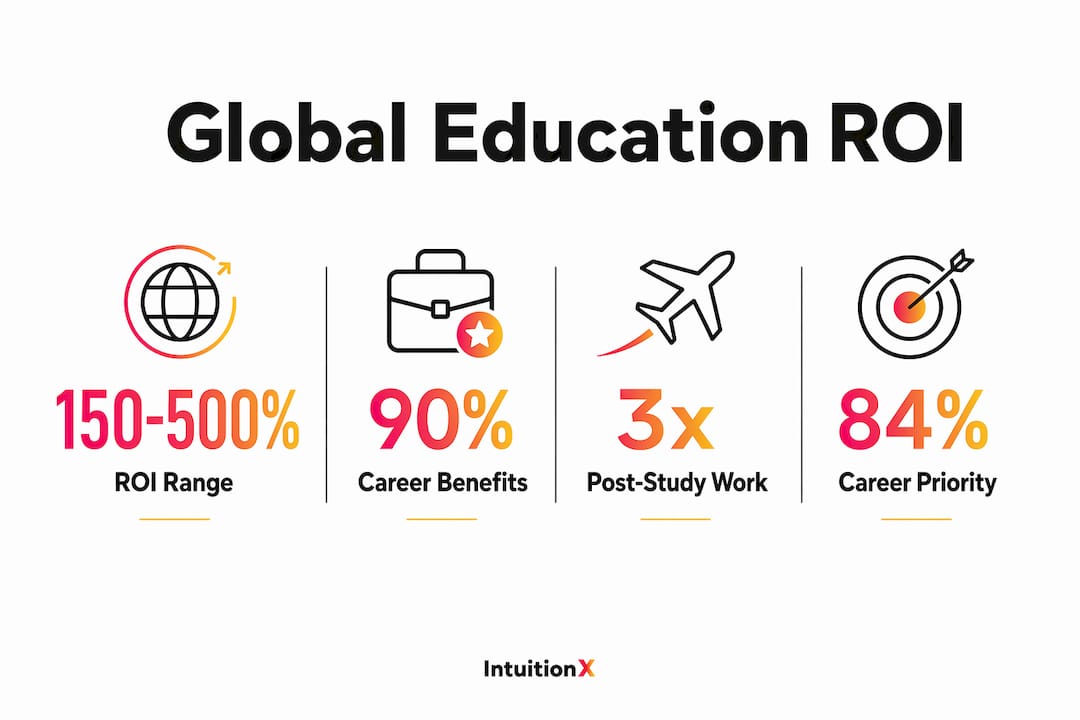
The financial argument for international study is concrete. International degrees generate ROI ranging from 150–500% over ten years, with break-even timelines of 18 months to five years depending on field and destination. STEM graduates from US institutions, for example, command starting salaries of $85,000–$120,000, making payback timelines significantly shorter than in humanities disciplines.
The career benefits extend beyond salary. Over 90% of education abroad alumni report that their international experience helped them build job skills, and approximately 50% credit it with helping them secure their first role. That is not a marginal advantage. It is a structural one.
The labour market data from 2024 reinforces this. Lightcast and the Forum on Education Abroad found that study abroad alumni contributed $1.8 billion in additional income to the US labour market in a single year. Alumni also reach management roles at higher rates than domestic-only graduates. The advantages of education investment compound over a career, not just in the first job.

Post-study work visa duration is a factor that many families overlook entirely. UK post-study work visas allow graduates to build £60,000–£80,000 in savings while establishing permanent residency credentials. That earning window transforms the financial calculus of an overseas degree from a cost into a compounding asset.
Pro Tip: When evaluating an international degree financially, compare the projected starting salary in your field against the total annual loan repayment. If the salary is not at least 1.5 times the annual repayment obligation, the investment carries significant risk and deserves closer scrutiny before committing.
How does global education advance diplomacy and society?
The benefits of global education are not confined to individual bank accounts. International study functions as a form of soft diplomacy, building the cross-cultural trust that underpins trade agreements, research partnerships, and long-term geopolitical cooperation. Graduates who have studied abroad become what researchers describe as "lifelong connectors," people who maintain relationships across borders and activate them in professional and civic life.
"International education is a quiet force shaping economies, communities, and ideas. Graduates become lifelong connectors supporting trade and research partnerships that would otherwise never form." — Dirk Mulder, as cited in The Koala News
The impact of global learning on social cohesion is measurable. Students who study internationally consistently demonstrate stronger cross-cultural communication skills, greater tolerance for ambiguity, and more sophisticated problem-solving in diverse teams. These are not soft skills in the dismissive sense. They are the competencies that multinational employers, international NGOs, and government departments actively recruit for.
Student entrepreneurship adds another layer. International students frequently launch ventures that draw on networks and knowledge from multiple countries, creating jobs and cultural exchange in their host communities. The importance of global education to local economies is therefore bidirectional: the host country benefits from talent and spending, while the sending country gains a graduate with an expanded professional network.
What practical factors determine a successful education investment?
Knowing the broad returns is useful. Understanding the variables that determine whether your specific investment succeeds is more useful still. Several factors have an outsized effect on outcomes, and most families do not account for them at the planning stage.
Students and parents consistently underestimate the impact of lender choice, city cost-of-living, and post-graduation networking on break-even timelines. These variables can shift the payback period by two to four years. A graduate who chooses a high-cost city without a strong local job market in their field may find that a theoretically sound investment performs poorly in practice.
Here are the key variables to assess before committing to an international programme:
- Field of study: STEM and business disciplines consistently produce faster payback and higher salary premiums than arts or social sciences in most destination countries.
- Destination city cost-of-living: Living costs in London, New York, or Sydney differ dramatically from those in Edinburgh, Toronto, or Melbourne. The difference compounds over a three or four year degree.
- Lender and interest rate: Loan structure affects monthly obligations for years post-graduation. A lower interest rate can reduce break-even time by 12–18 months.
- Post-study work visa length: Longer visa windows allow more time to build savings, establish professional networks, and qualify for residency pathways.
- Networking intensity in the first 24 months: Post-graduation networking efforts in the first two years after completing a degree can accelerate ROI more than the academic credential itself.
- Currency risk: Families saving in local currencies for hard-currency tuition face real depreciation risk. Building savings portfolios denominated in the destination currency reduces this exposure significantly.
Integrating professional internships with academic study also matters. Research by Dr. Pingchien Neo at the University of Florida confirms that combining internships with global study is particularly effective for STEM students, producing graduates who are career-ready rather than merely academically qualified.
Pro Tip: If you are advising a student on programme selection, ask the institution for median starting salary data by field and destination, not just graduate employment rates. Employment rates include part-time and unrelated roles. Salary data tells the real story.
How are students now deciding whether to study internationally?
Student decision-making around international study has shifted considerably. The prestige-led model, where a famous university name was sufficient justification for the investment, is giving way to an ROI-led model grounded in outcome data. This shift has direct implications for how educators and policymakers should communicate the value of global programmes.
The data is clear. 84% of students now prioritise career advancement as their primary motivation for international study. University brand still matters, but it is no longer the deciding factor. Students and families want to know what graduates earn, how long the post-study visa lasts, and what the employment rate is in their specific field.
This shift creates both a challenge and an opportunity for institutions. The challenge is that programmes with strong reputations but weak outcome data will lose students to less prestigious institutions with transparent, compelling career metrics. The opportunity is that institutions willing to publish honest, field-specific outcome data will attract the most motivated and ROI-conscious students.
Here is how the decision-making process now typically unfolds for internationally mobile students:
- Identify target career outcome: Students begin with a job title or salary target, then work backwards to identify which qualifications and destinations support that goal.
- Assess visa and residency options: Post-study work visa length and residency pathways are evaluated early, not as an afterthought.
- Compare field-specific salary data: Generic graduate employment statistics are discounted. Students seek median salary data by discipline and destination city.
- Evaluate total cost against projected income: The financial stress test comparing projected salary to annual loan repayment is increasingly standard practice among informed families.
- Consider networking and internship access: Programmes that integrate work experience and professional networks into the curriculum score higher in student evaluations than purely academic offerings.
The shift in student engagement towards outcome-led thinking is healthy for the sector. It pushes institutions to be accountable and rewards programmes that genuinely prepare graduates for the global workplace.
Key takeaways
Investing in global education delivers measurable returns across individual careers, national economies, and international diplomacy, provided families and institutions account for the variables that determine real-world outcomes.
| Point | Details |
|---|---|
| Strong financial returns | International degrees generate 150–500% ROI over ten years, with STEM disciplines paying back fastest. |
| Career advantage is documented | Over 90% of study abroad alumni report improved job skills, and 50% credit international study with securing their first role. |
| Soft diplomacy value is real | Graduates become cross-border connectors who support trade, research, and cultural partnerships for decades. |
| Variables determine outcomes | Lender choice, city cost-of-living, visa length, and post-graduation networking shift break-even timelines by up to four years. |
| Students now demand outcome data | 84% of internationally mobile students prioritise career advancement, requiring institutions to publish transparent, field-specific salary and employment metrics. |
The argument nobody makes loudly enough
I have spent years watching families agonise over the cost of international education while treating the decision as purely financial. The spreadsheet matters. But the returns that do not appear on a spreadsheet are often the ones that matter most over a lifetime.
The graduate who studied in Singapore and built a network across Southeast Asia will activate that network at 35 in ways that no salary projection could have predicted at 18. The policymaker who spent a year at Sciences Po in Paris understands European regulatory thinking in a way that no briefing paper can replicate. These are the returns that compound silently.
What I find consistently overlooked is the cost of not investing. Domestic-only graduates entering global industries face a structural disadvantage that widens with every passing year. The education access gap is not just about developing nations. It exists between students who have had internationally broadened experiences and those who have not, even within the same city.
My recommendation to policymakers is direct: publish outcome data by field and destination, fund post-study work visa extensions, and treat international education not as a luxury export but as infrastructure. My recommendation to parents is equally direct: run the financial stress test, account for currency risk, and then trust that the returns you cannot quantify will likely exceed the ones you can.
— Angus
Take your learning further with Intuitionx
Global education investment is most effective when students arrive prepared to perform at the highest level from day one. That is exactly what Intuitionx is built for.

Intuitionx is a 24/7 Socratic AI tutor built on Oxbridge-level pedagogy, designed to make elite education accessible to every student regardless of background or budget. Where wealthy families spend up to $150 per hour on private tutors, Intuitionx delivers the same quality of Socratic questioning, memory science, and personalised learning at a fraction of the cost. Backed by Sir Anthony Seldon and partnered with the International Rescue Committee, Intuitionx commits 10% of revenue to educational programmes for children in crisis countries. If you are serious about maximising your education investment, start with the right learning foundation.
FAQ
What is the average ROI of an international degree?
International degrees typically generate returns of 150–500% over ten years, with STEM disciplines producing the fastest payback periods of 18 months to three years.
How does global education support career development?
Over 90% of study abroad alumni report that their international experience built job skills directly relevant to their careers, with approximately 50% crediting it with securing their first role.
What financial risks should families consider when investing in education abroad?
Currency depreciation on savings, lender interest rates, and city cost-of-living are the three most commonly underestimated risks. These variables can shift break-even timelines by two to four years.
Why do policymakers consider international education a form of soft diplomacy?
Graduates who study internationally become long-term cross-border connectors, supporting trade agreements, research collaborations, and cultural partnerships that benefit both sending and host nations.
How are students changing the way they choose international programmes?
84% of internationally mobile students now prioritise career advancement over institutional prestige, evaluating programmes based on post-study visa length, field-specific salary data, and internship access rather than university rankings alone.