

TL;DR:
- Global education financing involves allocating resources to ensure equitable access to quality learning worldwide. Investing in education offers high economic returns and reduces social inequalities, but a $97 billion annual funding gap persists in low-income countries. Addressing structural issues like domestic fiscal reform and debt relief is crucial for sustainable progress in global education.
Global education financing is defined as the systematic allocation of public and private resources to guarantee equitable access to quality learning for every child, regardless of geography or income. Funding education globally is not a charitable gesture. It is one of the highest-return investments any government or institution can make. Education investments are foundational for every Sustainable Development Goal, from poverty reduction and gender equality to economic growth and stronger institutions. The stakes in 2026 are clear: underfund education, and you underfund everything else.
What are the economic and social benefits of funding education globally?
The returns on education investment are measurable, significant, and well-documented. Each additional year of schooling boosts annual earnings by around 9 to 10%, and every US$1 invested in education can yield up to US$15 in economic return. That ratio outperforms most infrastructure spending and rivals the best public health interventions.

The social returns are equally compelling. Education reduces poverty, improves health outcomes, promotes gender equality, and strengthens democratic institutions. When girls stay in school longer, maternal mortality falls. When young people develop foundational literacy and numeracy, civic participation rises. These are not abstract correlations. They are documented patterns across low-, middle-, and high-income countries alike.
The cost of inaction is staggering. Governments risk losing over US$1.1 trillion annually due to early school leaving, and a further US$3.3 trillion from children who leave school without basic skills. Lifetime earnings losses could reach US$21 trillion, equivalent to 17% of global GDP. That figure reframes the entire debate: the question is not whether we can afford to fund education, but whether we can afford not to.
| Investment scenario | Economic impact |
|---|---|
| Each additional schooling year | 9–10% increase in individual annual earnings |
| Every US$1 invested in education | Up to US$15 in economic return |
| Annual loss from early school leaving | Over US$1.1 trillion in government revenue |
| Loss from children lacking basic skills | US$3.3 trillion annually |
| Lifetime earnings gap | Up to US$21 trillion, or 17% of global GDP |
The table above makes the case plainly. The benefits of funding education are not speculative. They are quantified, and the gap between investment and inaction is measured in trillions.
What challenges and inequalities exist in global education funding?
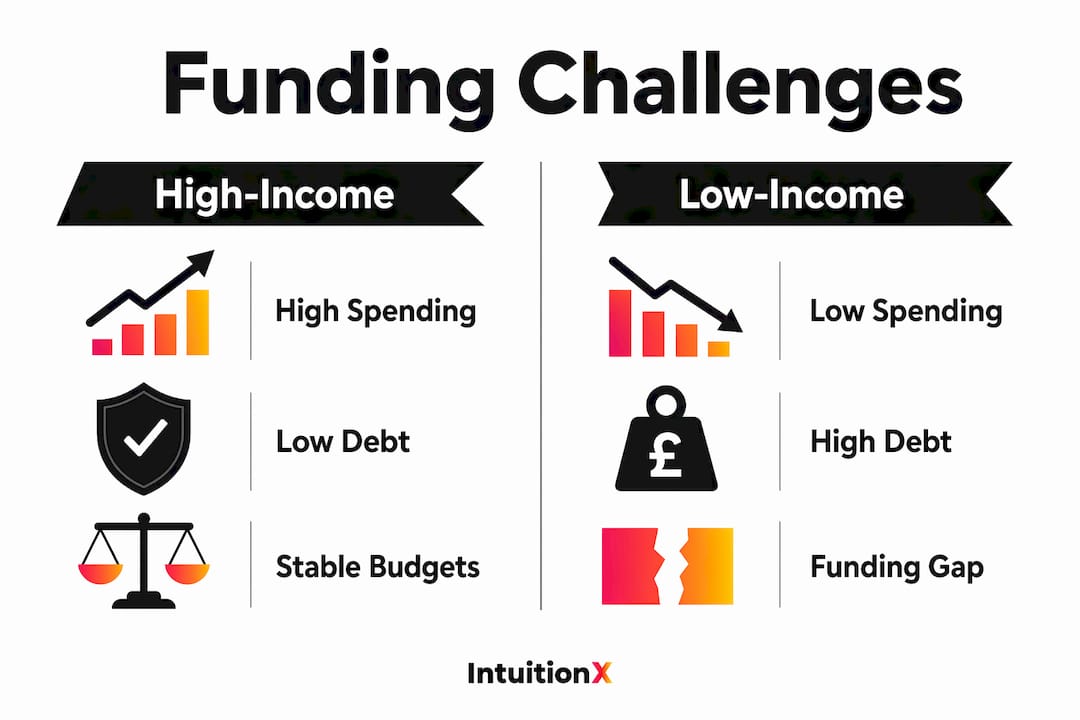
The financing gap is the central obstacle. Low- and lower-middle-income countries face an estimated US$97 billion annual shortfall to meet their SDG 4 targets by 2030. That gap does not represent a lack of ambition. It represents a structural imbalance in how the world distributes educational resources.
High-income countries spend vastly more per learner than their lower-income counterparts. A child in Norway or Switzerland receives a fundamentally different educational experience, not because of talent or effort, but because of the postcode they were born into. This disparity compounds over time. Underfunded schools produce underskilled graduates, who enter underpaid labour markets, who generate insufficient tax revenues to fund the next generation of schools. The cycle is self-reinforcing.
Debt is a critical and often overlooked driver of this problem. Many low-income countries spend more on debt servicing than on their entire education budget. UNESCO has called for global reforms including a UN Framework Convention on Sovereign Debt to address this structural constraint. Until debt burdens are restructured, education budgets in the most vulnerable countries will remain squeezed regardless of political will.
| Country income group | Typical education spending per learner | Key constraint |
|---|---|---|
| High-income | High (thousands of US$ per year) | Efficiency and equity within systems |
| Upper-middle-income | Moderate | Fiscal pressure and demographic growth |
| Lower-middle-income | Low | Revenue mobilisation and debt servicing |
| Low-income | Very low | Financing gap of US$97 billion annually |
Pro Tip: Focusing exclusively on international aid as the solution to the global education funding gap misses the point. Domestic fiscal reform, including broadening the tax base and improving spending efficiency, is where the most durable progress is made.
Understanding educational equity frameworks helps clarify why unequal resource distribution is not just a funding problem. It is a governance and accountability problem that requires political solutions, not just financial ones.
How is education funding sourced, and what reforms are needed?
The structure of education financing is more domestic than most people realise. 97% of education funding comes from domestic sources, with international aid and loans representing a small share of the total. This fact carries a significant implication: the path to better education financing runs through national tax systems, not donor conferences.
Current financing flows come from four main channels:
- Government budgets, which remain the dominant source and the most equitable when well-governed
- Household contributions, which are regressive by nature and widen inequality when public funding falls short
- International aid, which is valuable but volatile and should act as catalytic leverage rather than a substitute for domestic investment
- Private investment, particularly in EdTech, which is growing but concentrated in higher-income markets
Digital transformation increases cost pressures across all these channels, requiring innovative financing models and multi-stakeholder collaboration to manage effectively. The shift to digital learning is not free. It demands hardware, connectivity, teacher training, and content development, all of which require sustained funding commitments.
The reforms most needed are structural. Governments must broaden their tax bases, reduce illicit financial flows, and improve the efficiency of existing education spending. Spending more on the wrong things, or on the right things badly administered, does not close the learning gap.
Pro Tip: International aid works best when it de-risks domestic investment rather than replacing it. A donor-funded pilot programme that proves a model and attracts government budget lines is far more valuable than a perpetually donor-dependent initiative.
What practical strategies can policymakers and advocates use?
Translating the case for education investment into policy action requires specific, sequenced steps. Here are the key recommendations for policymakers and advocates working on global education financing in 2026:
-
Set and defend budget targets. Allocating 4% to 6% of GDP to education is the UNESCO-recommended benchmark. Advocate for this target explicitly in national budget processes, not just in education ministry discussions.
-
Engage in fiscal policy debates. Education advocates must participate in conversations about tax reform, debt restructuring, and macroeconomic policy. These are not peripheral issues. They directly determine how much money is available for schools.
-
Prioritise equity in spending allocation. More money spent on the wrong populations or institutions does not improve outcomes. Reforms must direct resources toward underserved communities, girls' education, and early childhood development.
-
Use simulation models for planning. Quantitative simulation models help policymakers compare financing scenarios, identify affordable reforms, and align budgets with learning outcomes. Tools like these shift education planning from aspiration to evidence.
-
Coordinate donor and government efforts. Fragmented aid creates duplication and inefficiency. Aligning international support with country-led education plans, as advocated by the Education 2030 framework, produces better outcomes per dollar spent.
-
Tackle debt at the international level. Advocate for debt relief and restructuring mechanisms that free up fiscal space for social spending. This is a systemic issue that requires engagement beyond education departments.
The importance of access to education is well established. The harder work is building the financing architecture that makes access real and sustained for the children who need it most. Policymakers who treat education budgets as a residual, funded after other priorities, will consistently underdeliver on their commitments.
Global education funding challenges are most acute in crisis and conflict settings, where children face the greatest barriers and where the gap between need and resource is widest. Advocacy must account for these contexts explicitly.
Key takeaways
Funding education globally requires domestic fiscal reform, equitable resource allocation, and coordinated international support to close a US$97 billion annual gap and prevent US$21 trillion in lifetime earnings losses.
| Point | Details |
|---|---|
| Returns on investment | Every US$1 invested in education yields up to US$15 in economic return. |
| Cost of inaction | Lifetime earnings losses from underfunding could reach US$21 trillion globally. |
| Domestic funding dominance | 97% of education financing is domestic, making tax reform the primary lever for change. |
| The financing gap | Low- and lower-middle-income countries face a US$97 billion annual shortfall to meet SDG 4 targets. |
| Policy benchmark | UNESCO recommends allocating 4% to 6% of GDP to education as a baseline for sustainable financing. |
Why the gap between commitment and cash keeps growing
I have spent years watching education summits produce eloquent declarations that dissolve the moment finance ministers sit down to write budgets. The uncomfortable truth is that most governments genuinely believe in education funding in principle, and then consistently deprioritise it in practice. The reasons are structural, not cynical. Debt obligations, short electoral cycles, and competing social demands all crowd out long-term investment.
What I find most frustrating is the persistent framing of international aid as the solution. Aid matters. But when 97% of education funding is domestic, the real work is in tax policy, budget transparency, and public financial management. These are unglamorous topics. They do not generate headlines. But they are where education systems are actually built or broken.
The other thing I would push back on is the tendency to treat education financing as a technical problem requiring technical solutions. It is fundamentally a political problem. Whose children get funded? Which schools receive resources? These are distributional questions, and they are answered in political arenas, not spreadsheets. Advocates who stay in their lane and avoid fiscal debates will always be outmanoeuvred by those who control the money.
The moral case is clear. The economic case is clear. What is missing is the political will to act on both, consistently, over the decades it takes to build a functioning education system from the ground up.
— Angus
How Intuitionx supports the mission to fund education globally

At Intuitionx, we believe that understanding the importance of global education funding is only the first step. The harder challenge is building tools and systems that actually reach the children who need them most. That is why Intuitionx has committed 10% of its revenue to the International Rescue Committee's educational programmes, directing support to children in crisis and conflict settings where the financing gap is most acute.
Our AI tutor, Omniscience, is built on Oxbridge-level pedagogy and memory science, designed to deliver the kind of learning experience that wealthy families pay up to $150 an hour for, to every student with a screen. If you are serious about closing the education gap, explore Intuitionx and see how evidence-informed technology can complement the policy work you are already doing.
FAQ
Why is funding education globally so important?
Funding education globally is the single most effective investment for sustainable development. Every US$1 invested in education yields up to US$15 in economic return, while underfunding costs governments over US$1.1 trillion annually in lost productivity.
What is the annual education financing gap for low-income countries?
Low- and lower-middle-income countries face an estimated US$97 billion annual financing gap to meet their SDG 4 targets by 2030, according to UNESCO. This gap reflects structural inequalities in domestic revenue capacity and debt burdens, not simply a lack of political will.
Where does most education funding actually come from?
97% of education funding comes from domestic sources, primarily government budgets. International aid and private investment represent a small share and work best as catalytic leverage for domestic financing rather than a replacement for it.
What GDP benchmark should governments target for education spending?
UNESCO recommends that governments allocate between 4% and 6% of GDP to education as a baseline for sustainable financing. This target must be paired with governance reforms and efficient spending to translate budgets into learning outcomes.
How does debt affect education budgets in low-income countries?
Many low-income countries spend more on debt servicing than on education, leaving insufficient fiscal space for schools, teachers, and learning materials. UNESCO has called for international debt restructuring mechanisms, including a UN Framework Convention on Sovereign Debt, to address this constraint directly.