

TL;DR:
- Adequate and equitable educational funding is crucial for providing quality education and reducing societal disparities. Research shows that sustained investment improves student outcomes and diminishes achievement gaps over time, especially when funds target high-need populations. Structural issues like property tax dependence and underinvestment hinder funding effectiveness, making fair distribution essential for lasting educational equity.
Educational funding is the deliberate allocation of public and private resources to schools and education systems, and it is the single most powerful lever for determining whether a child receives a quality education or is left behind. UNESCO is unambiguous on this point: without sufficient, well-distributed finance, equity in education remains a political aspiration rather than a lived reality. The Education Law Center defines adequacy as not merely spending money, but spending it where need is greatest. For educators, policymakers, and parents, understanding why educational funding matters is not an abstract exercise. It is the foundation of every decision that shapes a child's future.
What are the proven benefits of funding education adequately?
Education funding is one of the highest-return investments a society can make. Each additional year of schooling increases annual earnings by roughly 9 to 10%, with up to £15 of economic return generated for every £1 invested. That figure reframes the entire debate: school budgets are not costs to be minimised, they are capital allocations with measurable returns.

The benefits of funding education extend well beyond individual earnings. UNESCO, the OECD, and the Commonwealth Secretariat jointly estimate that leaving children behind in education costs the global economy approximately $10 trillion per year, with a potential global GDP gain of $6.5 trillion annually if participation improves. That is not a rounding error. It is the economic equivalent of losing one of the world's largest national economies every single year through inaction.
The social returns are equally compelling:
- Poverty reduction. Better-funded schools in low-income communities produce graduates with higher lifetime earnings, breaking intergenerational poverty cycles.
- Health outcomes. Educated populations make better health decisions, reducing public health costs and improving life expectancy.
- Gender equality. Targeted funding for girls' education in lower-income countries correlates directly with reduced child marriage rates and improved maternal health.
- Civic participation. Students who complete quality schooling are more likely to vote, volunteer, and engage constructively in democratic institutions.
"Education is not preparation for life; education is life itself." The data from UNESCO and the OECD confirm this is not sentiment. It is economics.
The importance of school funding also shows up in student achievement data. Schools with adequate resources attract and retain qualified teachers, maintain up-to-date learning materials, and provide support services such as counselling and special educational needs provision. These are not luxuries. They are the infrastructure of learning.
How does equitable funding address disparities among student populations?
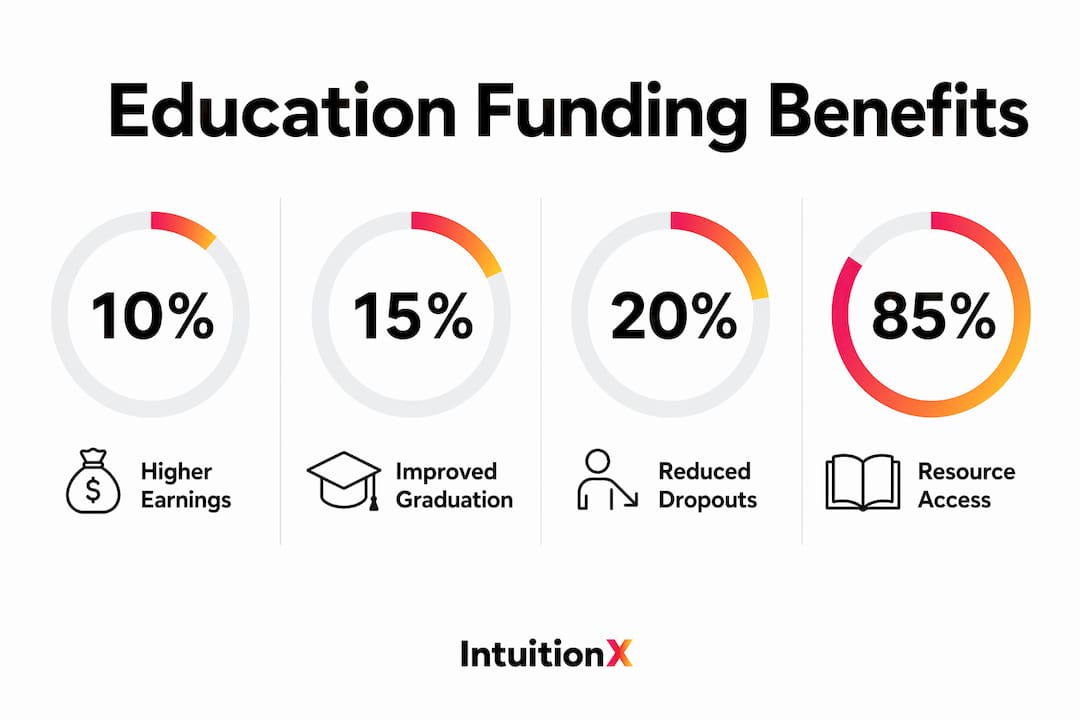
Equitable funding is not the same as equal funding. This distinction is the cornerstone of the Education Law Center's framework for fair school finance. A child living in poverty, a student with a disability, a pupil learning English as an additional language, or a young person experiencing homelessness each costs more to educate adequately than a child without those additional needs. Treating all pupils as identical in a funding formula is not fairness. It is a mechanism for entrenching disadvantage.
The Education Law Center's Making the Grade 2025 report makes this concrete. A fair and adequate funding formula requires both sufficient baseline funding for all students and meaningfully increased resources for high-poverty districts. The formula must account for poverty, disability, language proficiency, and homelessness to genuinely level the playing field.
Here is how equitable funding works in practice:
- Weighted pupil funding. States and local authorities assign a base per-pupil amount, then apply multipliers for high-need categories. A pupil with a severe learning disability might attract 1.5 to 2 times the base allocation.
- Poverty weighting. Schools serving high concentrations of pupils from low-income families receive additional funds to cover extended learning time, family support workers, and enrichment programmes.
- Language support funding. Pupils learning English as an additional language require specialist teaching, which carries a direct cost that must be built into the formula.
- Geographic adjustments. Rural schools often face higher per-pupil costs due to smaller class sizes and transport requirements. Equitable formulas account for this.
- Stability provisions. Some funding models include hold-harmless clauses that prevent sudden drops in school budgets when enrolment declines temporarily.
Pro Tip: If you are a school governor or local authority officer reviewing your funding formula, ask specifically whether your model includes weighted allocations for poverty, disability, and language need. A formula without these weights is structurally inequitable, regardless of the headline per-pupil figure.
The impact of getting this right is significant. States that have reformed their funding formulas to include robust equity weights have seen measurable reductions in achievement gaps between low-income and higher-income pupils over periods of roughly a decade. The mechanism is straightforward: more resources reach the students who need them most, and outcomes improve as a direct result. Understanding educational equity frameworks in depth helps policymakers design formulas that genuinely serve every child.
How do education finance reforms improve student achievement?
The Learning Policy Institute has produced some of the most compelling longitudinal evidence on the impact of educational finance reform. States including Connecticut, Massachusetts, New Jersey, and Mississippi each undertook significant school finance reforms over the past two decades, and the results are instructive for any policymaker considering similar action.
The core finding is this: school finance reforms that increase and equalise per-pupil spending lead to improved outcomes and reduced achievement gaps, with effects becoming statistically significant over approximately a decade. The implication is that funding reform is not a quick fix. It is a sustained commitment that pays dividends over time.
| State | Reform focus | Outcome observed |
|---|---|---|
| Massachusetts | Increased base funding and equity weights | Consistently top-ranked nationally in reading and maths |
| New Jersey | Court-ordered funding equalisation (Abbott districts) | Significant narrowing of gaps between low and high-income districts |
| Connecticut | Equalisation grants to low-wealth towns | Improved graduation rates in targeted districts |
| Mississippi | Literacy-focused funding with accountability | Dramatic improvement in fourth-grade reading scores nationally |
What these states share is not simply more money. They paired funding increases with coherent system changes: curriculum reform, teacher professional development, and expanded social services. The Learning Policy Institute is clear that funding changes alone are necessary but not sufficient. The money must be accompanied by a clear theory of improvement.
Pro Tip: When advocating for funding reform in your district or local authority, cite longitudinal state-level data rather than single-year snapshots. Policymakers respond to sustained trend evidence, and the Massachusetts and New Jersey cases provide exactly that.
The role of government in education funding is therefore not just to write cheques. It is to design systems where money flows to need, is spent on evidence-based interventions, and is tracked against measurable outcomes. That is a more demanding task than simply increasing a budget line, but it is the only approach that produces lasting change.
What challenges affect educational funding effectiveness?
Understanding why schools need funding is only half the challenge. The other half is understanding why funding so often fails to reach the students who need it most. Several structural barriers consistently undermine the impact of educational finance.
- Property tax dependence. In the United States, funding formula mechanics tied to local property tax bases cause funding gaps to widen over time, particularly for high-need schools in areas with declining property values or falling enrolment. A school serving more disadvantaged pupils in a low-wealth area receives less money precisely when it needs more.
- Enrolment-driven formulas. When budgets are calculated purely on pupil numbers, schools experiencing enrolment decline face budget cuts even if their fixed costs remain constant. This hits rural and urban schools in post-industrial communities particularly hard.
- Federal funding limitations. Federal education funding contributes modestly to equity by targeting poverty-related needs, but it does not and cannot eliminate state-level funding disparities. Title I in the United States is a meaningful support, but it represents a fraction of total school budgets.
- Global underinvestment. Only 40% of countries allocate 4 to 6% of GDP or 15 to 20% of public expenditure to education, the benchmarks UNESCO identifies as sufficient. The majority of the world's governments are spending below the level required to deliver quality education at scale.
- Implementation gaps. Even well-designed funding formulas can be undermined by poor implementation, opaque accountability mechanisms, or political resistance at the local level.
The significance of educational budgets is therefore not just about the headline number. It is about formula design, distribution mechanisms, accountability frameworks, and the political will to sustain reform over the years it takes to produce results. Exploring international benchmarks on educational access reveals how far most systems still have to travel.
Key takeaways
Educational funding is the foundational investment that determines whether schools can deliver quality, equitable education, and the evidence from UNESCO, the Learning Policy Institute, and the Education Law Center confirms that underfunding has measurable, lasting costs for individuals and societies alike.
| Point | Details |
|---|---|
| Economic returns are substantial | Each year of schooling yields 9 to 10% higher earnings, with up to £15 returned per £1 invested. |
| Equity requires weighted formulas | Funding must account for poverty, disability, language need, and homelessness, not just pupil numbers. |
| Reform takes a decade to show results | States like Massachusetts and New Jersey show that sustained funding reform reduces achievement gaps over time. |
| Property tax dependence widens gaps | Formulas tied to local wealth systematically disadvantage high-need schools in low-wealth areas. |
| Global underinvestment is widespread | Only 40% of countries meet UNESCO's recommended education spending benchmarks. |
Why funding is the argument we cannot afford to lose
I have spent years watching the same conversation repeat itself in policy circles and school board meetings. Someone presents the data on per-pupil spending disparities. Someone else argues that money alone does not guarantee outcomes. Both sides are technically correct, and both sides miss the point.
The evidence from the Learning Policy Institute, UNESCO, and the Education Law Center does not say money is magic. It says that without adequate, equitably distributed funding, no amount of curriculum reform, teacher training, or parental engagement can compensate for the structural deficit. You cannot build a house without materials, regardless of how skilled the architect is.
What I find most striking is the cost of inaction. The $10 trillion annual economic loss from children not learning is not an abstraction. It is the sum of millions of individual futures foreclosed before they began. And it is entirely preventable. The states and countries that have committed to sustained, equitable funding reform have the data to prove it.
For parents, the message is this: your advocacy for school funding is not a local concern. It is a contribution to a system that either compounds advantage or compounds disadvantage, one budget cycle at a time. For educators, the message is that funding arguments are your arguments. The evidence is on your side. For policymakers, the message is the most direct of all: the formula you design today will determine outcomes for a generation of children. Design it with that weight in mind.
— Angus
How IntuitionX supports the case for better education

IntuitionX was built on the conviction that every child deserves access to the kind of learning that wealthy families take for granted. Backed by Sir Anthony Seldon and powered by Oxbridge-trained academic intelligence, our AI tutor "Omniscience" delivers Socratic, personalised learning 24 hours a day. We have also committed 10% of our revenue to the International Rescue Committee's educational programmes, putting funding directly into the hands of children in crisis and conflict countries. If you believe that quality education should not depend on a postcode or a parent's income, IntuitionX is where that belief becomes practice.
FAQ
Why does educational funding matter so much?
Educational funding determines whether schools can hire qualified teachers, maintain resources, and support high-need pupils. UNESCO data shows each additional year of quality schooling increases earnings by 9 to 10%, making adequate funding a direct driver of individual and societal outcomes.
How does funding affect education quality in practice?
Schools with sufficient budgets attract experienced teachers, provide specialist support for pupils with additional needs, and maintain up-to-date learning materials. Schools without adequate funding cannot offer these provisions, which widens the gap between advantaged and disadvantaged pupils over time.
What is the difference between adequate and equitable funding?
Adequate funding means all schools receive enough resources to deliver quality education. Equitable funding means high-need schools receive more, reflecting the higher cost of educating pupils facing poverty, disability, or language barriers. The Education Law Center identifies both as non-negotiable for a fair system.
Can funding reform really close achievement gaps?
Yes, with time. The Learning Policy Institute's research on Connecticut, Massachusetts, New Jersey, and Mississippi shows that sustained finance reforms reducing per-pupil spending disparities produce measurable improvements in achievement gaps over approximately a decade.
Why do funding gaps persist despite government investment?
Funding gaps persist because many formulas rely on local property tax revenues, which disadvantage schools in low-wealth areas. Federal contributions improve within-state equity but cannot resolve systemic state-level disparities, as the Education Law Center's Making the Grade 2025 report confirms.