

TL;DR:
- Parents can support their child's exam preparation by encouraging planning and discussion without offering direct content advice, ensuring compliance with JCQ rules. Building a structured routine at home that fosters independence and active recall helps students develop confidence and skills, particularly in humanities subjects. Arranging logistics and special accommodations in advance ensures exam day runs smoothly, with emphasis on clarity, consistency, and trust in the student's ability.
A Level exam season can feel just as stressful for parents as it does for students. You want to help, but you're not always sure where the line is between supportive and overstepping. Get it wrong, and you risk undermining your child's confidence or, worse, falling foul of official exam rules. This guide cuts through the confusion. We'll walk you through exactly what JCQ (the Joint Council for Qualifications, the body that sets the rules for UK exams) permits, how to build a revision routine that actually works, and how to handle exam-day logistics without adding to the pressure.
Table of Contents
- Understanding official JCQ rules for parent support
- Building the ideal exam preparation routine at home
- Checklist for exam-day readiness: logistics every parent should cover
- Navigating special arrangements and extra support fairly
- A fresh perspective: why clarity and consistency matter more than 'extra help'
- Next steps: support your child's revision journey
- Frequently asked questions
Key Takeaways
| Point | Details |
|---|---|
| Follow JCQ guidelines | Always check what support is officially allowed to avoid unintentional breaches. |
| Prioritise routine and logistics | A well-planned home routine and exam-day prep reduce last-minute anxiety and boost results. |
| Coordinate early for extra support | If your child needs access arrangements, start the process with school as soon as possible. |
| Clarity over quantity | Consistent, clear routines help students more than giving ‘extra help’ that might cross boundaries. |
Understanding official JCQ rules for parent support
Let's clarify exactly what the official boundaries are for parent support. The rules are clearer than many parents realise, and understanding them early saves a lot of anxiety later.
JCQ guidance is explicit that parents may encourage planning and timing and discuss coursework, but must not give direct advice on what should or should not be included. That's an important distinction. You can say, "Have you thought about how you'll structure your time on this?" You cannot say, "I think you should include this argument in your essay."
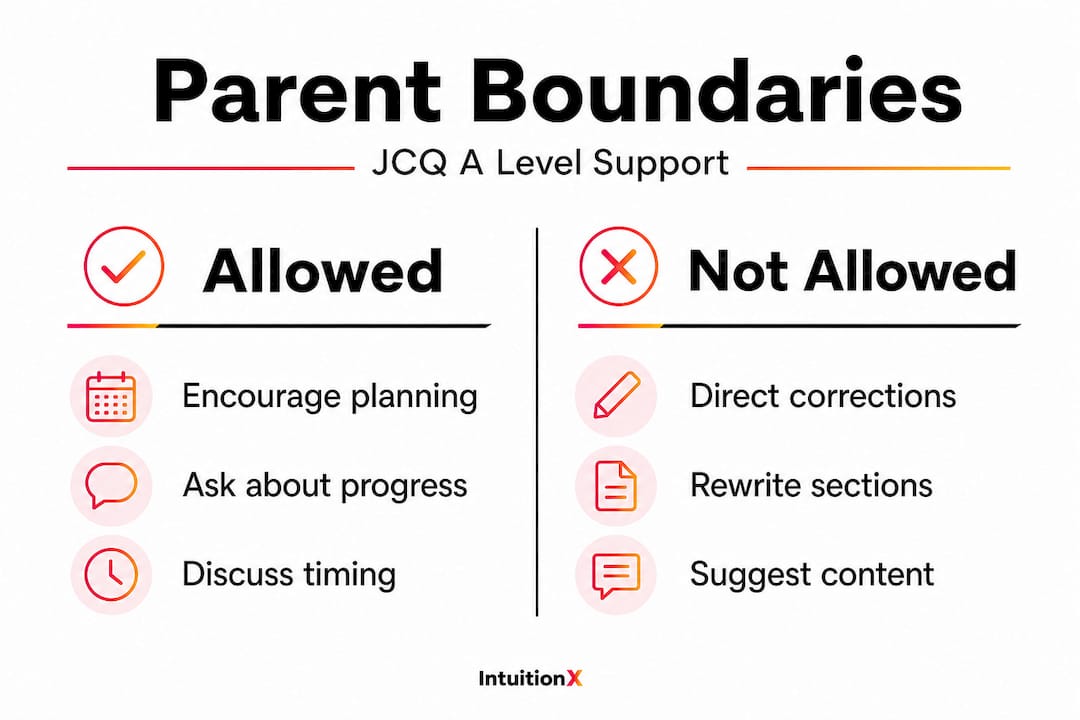
For humanities subjects especially, where coursework often involves extended essays and personal analysis, this boundary matters enormously. Students need to develop their own academic voice. When parents start shaping content, they inadvertently weaken the very skill the examiner is looking for.
Here's a practical comparison to keep on your fridge:
| Allowed | Not allowed |
|---|---|
| Asking how your child is progressing | Reading their draft and suggesting what to add or remove |
| Discussing their revision schedule and timing | Telling them which arguments or sources to use |
| Helping them organise their workspace | Writing or editing any part of their coursework |
| Encouraging them to speak to their teacher | Contacting teachers to advocate for specific content choices |
| Providing access to books or materials | Directing them to specific passages to include |
| Praising their effort and persistence | Comparing their work to a model answer and correcting it |
If you're ever unsure whether a particular kind of help crosses the line, go to the source. Ask your child's teacher or the school's exams officer for clarification. Don't improvise. Schools have a designated exams officer precisely for this reason.
Pro Tip: When in doubt, ask your child's teacher or exams officer for clarification rather than improvising advice. A quick email can save a great deal of stress later in the year.
It also helps to use engagement checklists to track whether your child is staying on top of their workload, without crossing into content territory. And if your child seems nervous about asking questions in class or at home, there are practical ways to support nervous learners that build genuine confidence rather than reliance on you.
Building the ideal exam preparation routine at home
With boundaries set, you can structure practical home support that builds your teenager's independence. The key word is independence. The goal of your support is to create conditions where your child can do their best thinking, not to do the thinking for them.

For humanities students, revision looks different from sciences. It's less about memorising formulas and more about building fluency with arguments, themes, historical contexts, and analytical frameworks. That means the revision environment matters as much as the revision itself.
A five-step daily routine template for exam season:
- Agree a start time together. Consistency reduces resistance. Even 9am on a Saturday feels more manageable when it's a shared expectation rather than a parental demand.
- Separate subjects into blocks of 45 to 60 minutes. Humanities revision benefits from focused bursts followed by breaks. The Pomodoro method (working in 25-minute intervals with five-minute breaks) works particularly well for essay-heavy subjects.
- Build in an active recall session. Passive re-reading is one of the least effective revision methods. Encourage your child to write practice answers, create flashcards, or talk through topics aloud. This is how knowledge actually sticks.
- Schedule a daily review at the end of each session. Five minutes where your child notes what they covered, what confused them, and what they want to revisit the next day. This builds metacognition, the ability to think about one's own learning, which is a genuine predictor of exam success.
- End with something enjoyable. Revision that leads to a reward (a walk, a meal together, a TV episode) is far more sustainable than revision that leads to guilt about not doing more.
JCQ's guidance on exam preparation emphasises that students need to know what they need and follow instructions clearly. At home, parents can reinforce this by ensuring the practical environment is ready well in advance of exam days.
Here's a quick reference table for home revision resources:
| Resource type | Mandatory | Helpful | Optional |
|---|---|---|---|
| Past papers and mark schemes | ✓ | ||
| Quiet, dedicated study space | ✓ | ||
| Subject-specific revision guides | ✓ | ||
| Digital flashcard tools | ✓ | ||
| Timer or study app | ✓ | ||
| Printed essay plans | ✓ | ||
| Background music (instrumental) | ✓ | ||
| Organisational tools and kits | ✓ |
For more structured guidance on how to build this kind of routine, our A Level study tips resource covers proven strategies in detail. And if your child is studying history, English literature, psychology, or another humanities subject, our guide to humanities learning strategies goes deeper on what genuinely works for those disciplines.
Pro Tip: Build regular check-ins for stress and workload into the week, but let your child set the agenda. Ask "What do you need from me this week?" rather than telling them what you think they need. The difference in how they respond will surprise you.
Checklist for exam-day readiness: logistics every parent should cover
Even with great home routines, last-minute surprises can cause stress. Cover these logistics in advance to avoid them.
The night before each exam and the morning of it are surprisingly high-stakes moments. Forgotten equipment, missed alarms, and travel delays are entirely avoidable with a little preparation. JCQ's candidate preparation guidance includes clear reminders about equipment, planners, and having emergency contacts ready.
The night before: things to check together
- All required stationery is in a clear pencil case (black pens, pencils, ruler, calculator if permitted)
- Any subject-specific equipment is ready (e.g., geometry instruments for maths, though humanities students rarely need these)
- The candidate number, exam centre number, and seat number are noted if provided
- Exam start time and location are confirmed (some schools use multiple rooms or off-site venues)
- Travel route is planned, with a backup option if public transport fails
- A nutritious evening meal is planned and screens are off by a reasonable hour
- Alarm is set, ideally with a backup
The morning of the exam
- A proper breakfast is eaten (even a small one, as glucose supports concentration)
- All equipment is double-checked before leaving the house
- The student knows who to contact at school if there is a problem, such as a late arrival or illness
- Emotional check-in: a calm, brief conversation rather than last-minute revision cramming
Critical note: Remind your child that following invigilator instructions to the letter is non-negotiable. Ignoring instructions, even accidentally, can result in marks being withheld. JCQ rules exist to ensure fairness for every student, and your child's compliance protects them as much as anyone else.
For more support on building learning workflow tips that carry through to exam day, our practical guide has step-by-step advice. You might also find the section on active learning for A Levels useful in the final weeks before exams. Some parents also find exam-day organisational aids helpful for keeping everything in order.
Navigating special arrangements and extra support fairly
Some students need specific adjustments or support. Here's how to secure them the right way.
Access arrangements, such as extra time, a reader, or a scribe, can make a genuine difference for students with learning differences or medical conditions. But there is a critical rule that many parents don't know about until it's too late. Access arrangements must mirror the student's normal way of working. Missteps in this area can lead to arrangements being refused, even when a student genuinely needs support.
What does "normal way of working" mean? It means the support your child uses in class, day to day, throughout the course. If a student has never used a reader in lessons, requesting one just before exams is unlikely to be approved. JCQ requires schools and SEN (Special Educational Needs) coordinators to document evidence of the support being used consistently throughout the academic year.
Dos and don'ts for requesting access arrangements:
- Do speak to your child's form tutor or SEN coordinator at the start of the course, not in the spring term
- Do keep records of any diagnoses, assessments, or educational psychologist reports
- Do ask the school what documentation they need and when the deadline for applications is
- Do ensure your child's teachers are aware of any support needs so they can document classroom usage
- Don't assume a GP letter alone will be sufficient; formal assessment is usually required
- Don't wait until your child is struggling to raise the conversation; early evidence is essential
- Don't request arrangements that don't reflect how your child actually works in lessons
For students who have gaps in their learning due to illness, disruption, or previous school experiences, bridging those gaps early in the course is far more effective than seeking last-minute accommodations.
Pro Tip: Document support patterns in humanities subjects from the very start of the course, not just when exam panic sets in. A teacher's notes from October carry far more weight than a parent's request in April.
A fresh perspective: why clarity and consistency matter more than 'extra help'
We've seen a clear pattern in how parents approach A Level support. The ones whose children do best are rarely the ones who do the most. They're the ones who do the right things consistently.
There's a common belief that more involvement equals better outcomes. More checking in. More resources. More advice. More concern. In practice, the opposite is often true. When parents over-manage revision, students lose ownership of their own learning. They start waiting to be told what to do next rather than developing the self-direction that A Level examiners, and university tutors after that, are specifically looking for.
The research on this is clear, but you don't need data to see it. Think about the last time someone hovered over you while you were trying to concentrate. It doesn't help. It signals doubt. And teenagers, who are already anxious about whether they're doing enough, absorb that doubt immediately.
What actually works is structure without control. You provide the consistent routine, the calm environment, and the emotional steadiness. Your child provides the content, the effort, and the agency. That split matters. It's what turns a stressful exam season into one where your child finishes each exam knowing they did it themselves.
Personalised exam support works precisely because it meets students where they are, on their terms, rather than imposing a one-size-fits-all approach. The facilitator role is a powerful one. Don't underestimate it.
Our honest advice? Resist the urge to fix things. Create the conditions. Trust the process. And trust your child more than you think you should.
Next steps: support your child's revision journey
You don't have to figure all of this out alone. If you're looking for expert, affordable, and genuinely effective revision support for your A Level student, IntuitionX is built precisely for this moment.
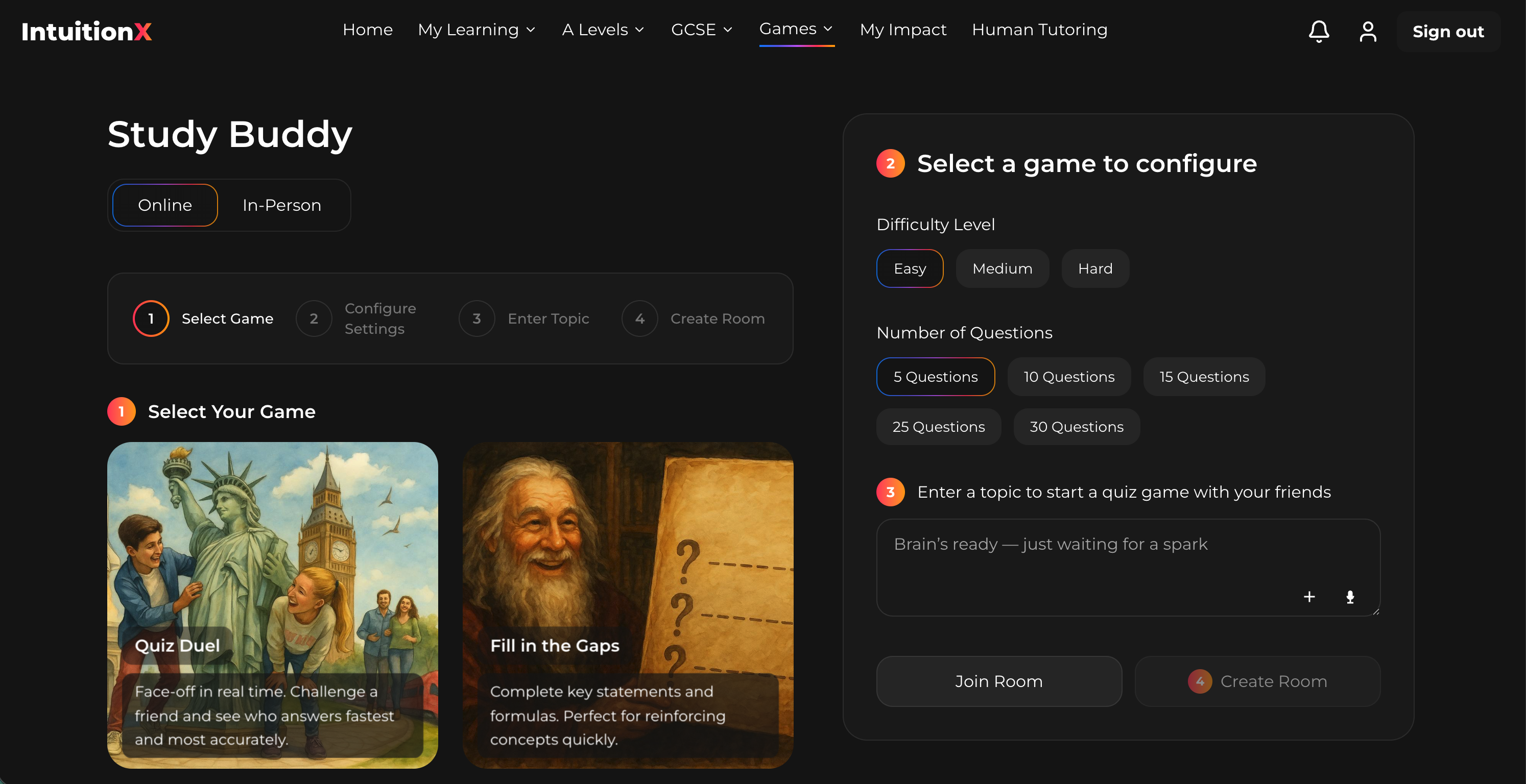
IntuitionX is a 24/7 Socratic AI tutor built on Oxbridge-level intelligence, backed by Sir Anthony Seldon and developed from the insights of academics who earned A*s and Firsts in their subjects. Unlike generic AI that writes essays for students, IntuitionX asks the right questions to build real understanding. It meets your child's needs without crossing JCQ boundaries, and it costs a fraction of private tutoring. Visit IntuitionX today and give your child the thinking partner they deserve.
Frequently asked questions
Can I check my child's coursework for mistakes?
You may discuss timing and planning with your child, but you cannot give direct advice about content, corrections, or what should be included or removed, according to JCQ rules.
What should my student bring on exam day?
They should bring all required stationery, their candidate details, and any permitted equipment, and know who to contact at school for emergencies or travel delays.
How do I arrange extra time for my child?
Contact the school's SEN coordinator as early as possible and ensure all support reflects your child's normal way of working throughout the course, backed by consistent documented evidence.
Is it okay to revise with my child at home?
Absolutely, but you can help structure their revision and discuss approaches while the student must generate content and answers themselves, as JCQ permits discussion of planning but not direct inclusion advice.