

TL;DR:
- Self-directed learning requires strong metacognitive awareness and intrinsic motivation to succeed independently.
- Successful learners plan with SMART goals, assess progress regularly, and utilize diverse resources and strategies.
Taking control of your own education sounds exciting until you actually try it. Without a teacher setting deadlines or a structured timetable keeping you on track, many learners freeze up, lose motivation, or spin their wheels without making real progress. This guide to self-directed learning gives you everything you need to avoid those pitfalls. You will learn what self-directed learning (SDL) actually involves, how to prepare your mindset, how to build a plan that works, and how to know when it is working.
Table of Contents
- Key takeaways
- Prerequisites for self-directed learning
- A step-by-step plan for executing SDL
- Assessing and adjusting your progress
- Resources, tools, and support for SDL
- What I have learnt from years of watching people learn independently
- How Intuitionx supports your self-directed learning
- FAQ
Key takeaways
| Point | Details |
|---|---|
| Mindset comes first | Metacognitive awareness and intrinsic motivation are the foundation before any strategy can work. |
| Plan with SMART goals | Identify knowledge gaps and set specific, measurable objectives before selecting resources. |
| Assess yourself regularly | Combine self-reflection, peer feedback, and structured tools to measure genuine progress. |
| Use the right resources | Digital platforms, learning communities, and mentorship all strengthen independent study outcomes. |
| SDL is an ongoing cycle | Expect to revisit and revise your goals and strategies repeatedly as your understanding deepens. |
Prerequisites for self-directed learning
Before you open a single textbook or enrol on an online course, you need to get a few things in order. SDL is not simply studying without a teacher. It is a skill set. And like any skill, it requires preparation.
The most important prerequisite is metacognitive awareness. This means knowing how you learn, recognising when you are genuinely understanding something versus just passively reading it, and catching yourself when focus drifts. Research from the Education Endowment Foundation shows that metacognitive strategies add roughly eight months of additional academic progress when properly embedded in learning practice. That is not a small gain.
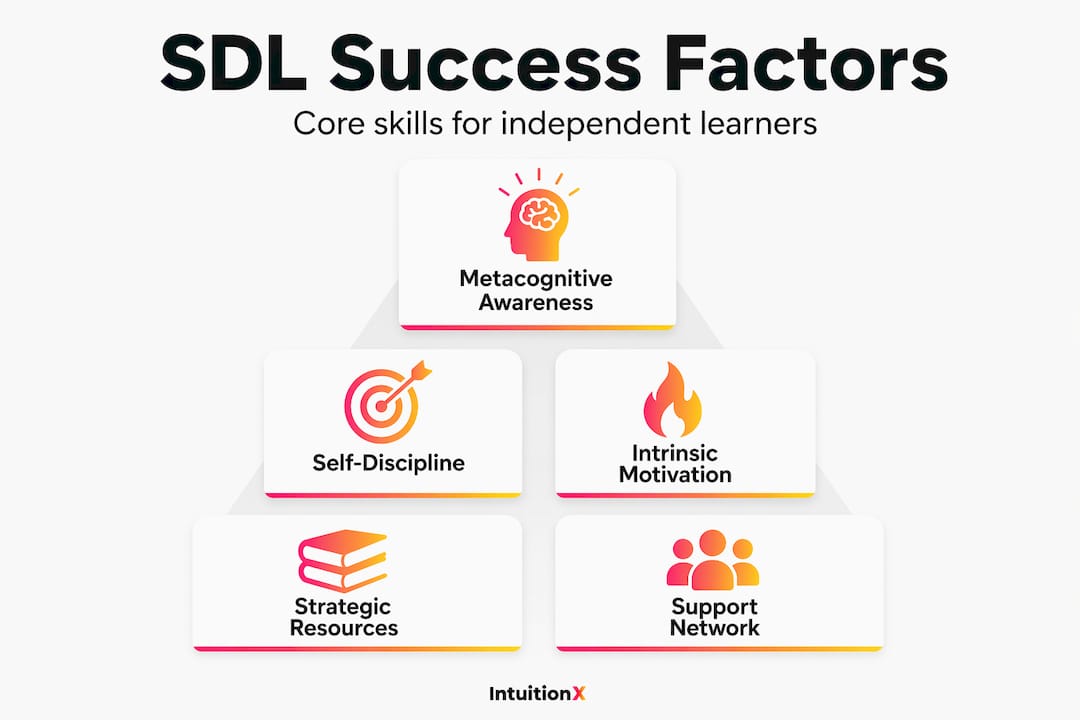
You also need a clear source of intrinsic motivation. Extrinsic motivation, such as exam pressure or a parent expecting results, fades quickly when you are studying alone. Intrinsic motivation, the genuine curiosity or personal goal driving you, is what sustains effort when no one is watching.
Here is what to get in place before you begin:
- A learning journal or notebook. This does not need to be elaborate. A simple record of what you studied, what confused you, and what clicked helps you track your own growth.
- A time management system. Blocking specific hours for self-study, even loosely, prevents the classic trap of "I'll do it later."
- Access to reliable materials. Whether that is a library card, a subscription to an online learning platform, or a shortlist of reputable websites, know where your resources live before you start.
- An understanding of the two main SDL formats. Facilitated SDL involves some external structure, such as a tutor, cohort, or mentor. Self-paced SDL is fully independent. Neither is superior. Facilitated SDL tends to outperform self-paced approaches for learners who need accountability and scaffolding, but self-paced works well for highly motivated individuals with clear goals.
Pro Tip: Before committing to fully self-paced study, honestly assess your self-discipline. If you routinely delay tasks without external pressure, consider finding a study partner or mentor to add light accountability.
A step-by-step plan for executing SDL
This is where theory becomes practice. Follow these steps in order and you will have a functioning SDL system rather than a vague intention to "study more."
-
Conduct a needs assessment. Write down what you want to learn and, crucially, what you already know. Identify the gap between the two. Be specific. "I want to understand calculus" is too broad. "I need to understand differentiation rules before I can tackle integration" is a gap you can actually close.
-
Set SMART learning objectives. A systematic review of SDL confirms that learners who actively set goals, select resources, and evaluate progress independently develop stronger and more lasting knowledge. SMART stands for Specific, Measurable, Achievable, Relevant, and Time-bound. "Complete three chapters on organic chemistry by Sunday evening" beats "get better at chemistry" every time.
-
Select and organise your learning resources. Books, video lectures, podcasts, open courseware, and peer communities all have a place. Match the resource to the learning objective, not to personal habit. If you tend to default to YouTube, ask yourself whether a structured textbook might serve that particular topic better.
-
Choose your learning strategies deliberately. Spaced repetition, project-based learning, the Feynman Technique (teaching the concept back to yourself in simple language), and retrieval practice are all proven methods. Explore active learning strategies to find which methods match your subject and style.
-
Build a study schedule. Block out sessions in advance. Mix shorter focused bursts (25 to 50 minutes) with deliberate breaks. Avoid marathon sessions that feel productive but lead to shallow processing.
-
Execute and maintain motivation. This is where most people struggle. Motivation for self-directed learning is not a fixed resource. It fluctuates. Tie each study session to a clear outcome so you finish with a sense of progress. Celebrate small wins. Revisit your original "why" when momentum drops.
Pro Tip: Sequence your resources so that each one builds on the last. Jumping between unrelated materials creates the illusion of learning without the substance.
The table below maps common learning objectives to the most effective strategies for each:
| Learning objective | Recommended strategy | Best resource type |
|---|---|---|
| Memorising facts or vocabulary | Spaced repetition with flashcards | Apps such as Anki, digital flashcard decks |
| Understanding complex concepts | Feynman Technique and retrieval practice | Textbooks, structured online courses |
| Developing practical skills | Project-based and applied learning | Tutorials, real-world projects, community feedback |
| Building critical thinking | Socratic questioning, debate, essay writing | Academic papers, discussion forums, a tutor or mentor |
| Preparing for assessments | Timed practice tests, past papers | Official exam resources, question banks |
Assessing and adjusting your progress
Many learners skip this part entirely. They study, they feel busy, and they assume progress is happening. It often is not. Genuine SDL requires you to stop periodically and measure what you have actually learnt.

Self-assessment is your starting point. Reflect honestly after each study session. Did you meet your objective? Can you explain what you learnt without looking at your notes? Reflection and iterative evaluation drive deeper learning and help you refine goals over time.
The challenge is that self-assessment alone has blind spots. Research examining SDL assessment confirms that combining self-, peer, and external assessments yields the most accurate picture of genuine learning. When possible, seek external feedback, whether from a mentor, a study group, or a structured assessment tool.
Here are the most reliable assessment methods for independent learners:
- Reflective journals. Write briefly after each session about what you understood, what confused you, and what you want to revisit. Over time this becomes an honest log of your development.
- Concept maps. Draw the relationships between ideas you have been studying. Gaps in the map reveal gaps in understanding.
- Practice tests and quizzes. Test yourself under conditions that mimic real assessment. This is one of the most evidence-backed methods for confirming knowledge retention.
- Portfolios. Collect evidence of your work over time, whether that is essays, projects, or problem sets. Portfolios show growth rather than just a snapshot.
- Peer review. Share your work with a fellow learner and ask for honest feedback. Giving feedback to others is equally valuable; it forces you to articulate standards.
Research confirms there is no gold standard for SDL assessment. The best approach combines multiple methods rather than relying on any single one.
| Assessment method | Strengths | Limitations |
|---|---|---|
| Self-reflection journal | Builds metacognitive habits; low effort | Prone to bias; easy to inflate progress |
| Peer review | External perspective; improves communication | Quality depends on peer's knowledge level |
| Practice tests | Directly tests recall; mirrors real assessment | May not capture deep conceptual understanding |
| Portfolio | Shows growth over time; multidimensional | Time-consuming to compile and review |
| Concept maps | Reveals structural understanding | Hard to evaluate without a comparison benchmark |
Resources, tools, and support for SDL
You do not have to learn in isolation. In fact, the most effective self-directed learners build a support ecosystem around themselves, even when studying independently.
Digital platforms have transformed access to learning. Open educational resources, including courses from universities posted freely online, mean that a motivated learner in any location can access world-class content. Smartphone apps and online communities have been shown to improve SDL outcomes, particularly when learners use them alongside peer and mentor support rather than as a replacement for human connection.
The most useful resources to have in your toolkit include:
- Open course platforms offering structured syllabi across hundreds of subjects
- Flashcard and spaced repetition apps for retaining factual knowledge efficiently
- Academic search engines and digital libraries for accessing peer-reviewed reading
- Online study communities and forums where you can ask questions and find accountability partners
- A mentor or subject-matter expert you can consult when stuck. Even one monthly conversation can prevent weeks of spinning in the wrong direction.
Equity matters here too. Not every learner has the same access to paid platforms or high-speed internet. Prioritise free and open resources where possible, and look for scholarship access programmes on paid platforms if cost is a barrier.
Personalised learning strategies are also worth exploring. SDL works best when it is genuinely tailored to your goals, your pace, and your learning profile. A generic study plan borrowed from someone else is a starting point at best.
Finally, do not underestimate the value of structured support when you feel stuck. Both facilitated and self-paced approaches have real merit, and choosing the right balance depends on your readiness and the complexity of what you are learning. There is no weakness in asking for guidance. The most autonomous learners know exactly when to seek it.
What I have learnt from years of watching people learn independently
I have spent a long time observing learners who set out to teach themselves something ambitious. History students tackling whole A Level syllabi alone. Professionals retraining mid-career. Teenagers bored in class who wanted to go further, faster.
The pattern I see most often is this: people invest heavily in finding the perfect resources and almost nothing in assessing whether the learning is actually sticking. They collect courses, bookmark articles, and build elaborate reading lists. Then, months later, they cannot recall the core concepts because they never tested themselves rigorously.
My honest view is that SDL requires more discipline than classroom learning, not less. The absence of external accountability does not free you. It puts the full weight of your progress on your own habits. That is empowering when it works and brutal when it does not.
The learners who succeed tend to do three things consistently. They plan with specificity. They assess themselves without vanity. And they treat setbacks not as failure but as diagnostic information. A poor result on a practice test is not embarrassing. It is data. Use it.
SDL also prepares you for something no school timetable can: lifelong independent learning in a world where knowledge evolves faster than any curriculum can keep up with. That skill is worth the discomfort of building it properly.
— Angus
How Intuitionx supports your self-directed learning
Self-directed learning is powerful. But even the most motivated learner benefits from a thinking partner who asks the right questions at the right moment.
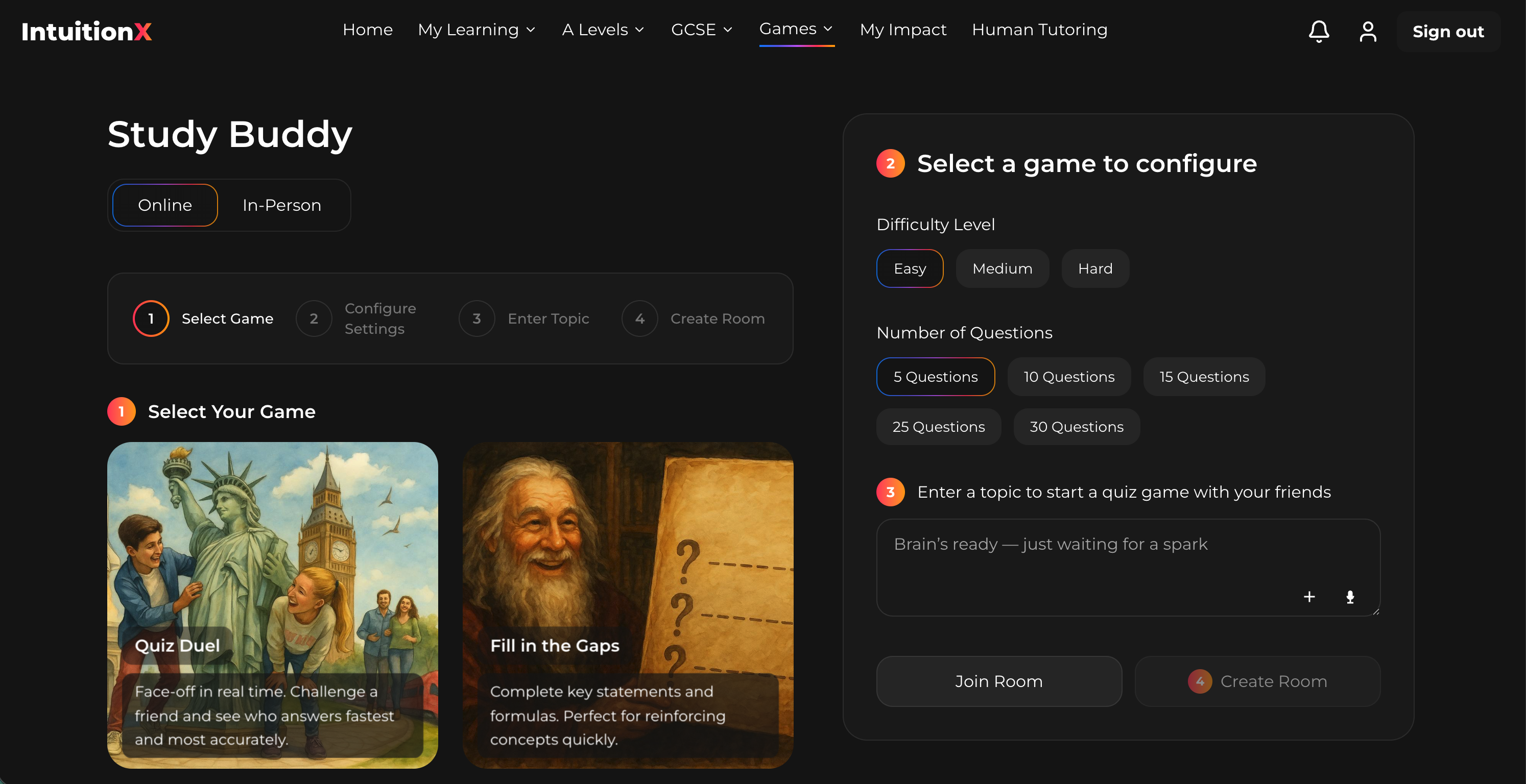
Intuitionx is a 24/7 AI tutor built on Oxbridge-level intelligence, designed to support learners who want to go further without waiting for a classroom. Unlike generic AI that simply provides answers, Intuitionx uses Socratic questioning to help you think more deeply, challenge your assumptions, and genuinely understand what you are studying. You can set learning goals, track your progress, and get the kind of rigorous intellectual challenge that was previously only available to students with expensive private tutors. Whether you are studying independently for the first time or refining an existing practice, start learning with Intuitionx and experience what elite, learner-centred education actually feels like.
FAQ
What is self-directed learning?
Self-directed learning is a process where learners independently identify their knowledge gaps, set goals, select resources, and evaluate their own progress. It can be fully self-paced or supported by a mentor or facilitator.
What are the main steps for self-directed learning?
The core steps are: assess your current knowledge, set SMART objectives, choose appropriate resources and strategies, follow a study schedule, and regularly evaluate your progress. Repeating this cycle deepens learning over time.
What are the benefits of self-directed learning?
SDL builds metacognitive skills, intrinsic motivation, and the ability to learn continuously throughout life. Research confirms it prepares learners for rapidly evolving knowledge environments where formal curricula cannot keep pace.
How do I stay motivated when learning independently?
Tie each study session to a specific, achievable outcome. Revisit your original goals when motivation dips, track visible progress through journals or portfolios, and consider a study partner or mentor for light accountability.
What are the best resources for self-directed learning?
Open educational platforms, spaced repetition apps, academic libraries, peer communities, and mentors all support effective self-study. The most effective approach combines digital tools with human connection rather than relying on technology alone.