

TL;DR:
- Traditional tutoring relies on short-term memorization, leading to superficial learning and low engagement.
- AI tutoring with Socratic methods offers consistent, personalized education that builds genuine understanding and skills.
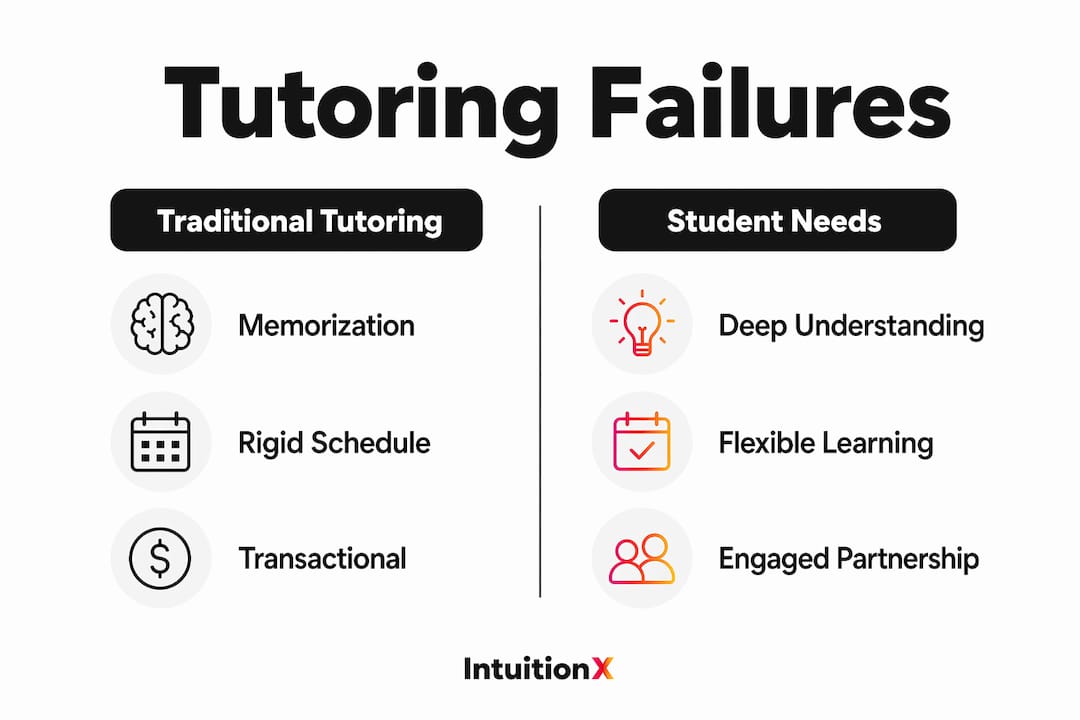
Traditional tutoring fails because it prioritises short-term memorisation over lasting understanding, leaving students no better equipped after months of sessions than before they started. This pattern is so common it has a name in educational psychology: the "bulimic" learning model, where students consume information for a test and discard it immediately after. The consequences are real. In the UK, 73% of students are not actively engaged in learning. In the US, 80% report feeling bored and 91% feel nervous asking questions in class. These are not minor inconveniences. They are signs that conventional tutoring, as it is widely practised, is not working.
Why traditional tutoring fails: the core problem
The most fundamental drawback of conventional tutoring is that it treats learning as a transaction. A tutor arrives, explains a topic, sets some practice questions, and leaves. The student feels briefly reassured. Then the exam arrives and the knowledge has gone.
This is the bulimic model in action. Students memorise for tests and forget soon after, despite significant financial investment from their families. The learning never sticks because it was never built on genuine understanding in the first place.
The problem runs deeper than individual tutors being poor teachers. The entire structure of traditional tutoring, its timing, its goals, and its methods, is designed around completing homework and preparing for the next assessment. That is a very narrow target. Real academic confidence requires critical thinking, problem solving, and the ability to apply knowledge in unfamiliar contexts. Conventional tutoring rarely builds any of those.
Does rigid scheduling limit how well tutoring works?
Yes. Scheduling is one of the most underestimated challenges in traditional tutoring, and it directly reduces learning outcomes. Research on high-dosage tutoring shows that frequent, consistent sessions embedded within the school day produce the strongest results. Most traditional programmes cannot deliver this.
Here is why the scheduling problem is so damaging:
- Infrequent sessions mean students forget material between appointments, so each session restarts rather than builds.
- Fixed weekly slots do not match when students actually need help. A student stuck on a concept at 9pm on a Tuesday cannot wait until Saturday morning.
- Physical space constraints in schools mean tutoring is often squeezed into corridors, spare classrooms, or lunch breaks, none of which support focused learning.
- Sporadic attendance caused by school trips, illness, or timetable clashes breaks the consistency that makes tutoring effective.
- Poor alignment with classroom teaching means the tutor is often working on different material from the teacher, creating confusion rather than clarity.
High-dosage tutoring requires consistent scheduling, physical space, and coordination with classroom instruction. Most traditional implementations simply cannot sustain this. The result is a watered-down version of what tutoring could achieve.
Pro Tip: If you are evaluating a tutoring programme, ask specifically how it aligns with your child's current classroom curriculum. If the tutor cannot answer that question, the sessions are likely to create fragmented learning rather than reinforce it.
Why tutoring doesn't work for building real skills
Traditional tutoring focuses on rote memorisation and homework completion rather than developing critical thinking, creativity, and communication. These are the skills that actually transfer across subjects and into adult life. Tutoring that ignores them is solving the wrong problem.

The ineffectiveness of standard tutoring on skill-building comes down to a structural issue. When a tutor's job is to get a student through the next test, there is no incentive to slow down and build genuine understanding. Metacognitive skills, knowing how you learn, recognising when you are confused, and knowing how to ask the right questions, are rarely taught in conventional sessions.
This matters enormously. Students who lack metacognitive skills cannot effectively ask for help. Tutoring models that depend on students initiating questions miss the learners who need support most. The student sits in silence, the tutor assumes comprehension, and the session ends with nothing resolved.
| Skill | Traditional tutoring approach | What students actually need |
|---|---|---|
| Critical thinking | Rarely addressed; focus is on correct answers | Practise questioning assumptions and evaluating evidence |
| Metacognition | Assumed, not taught | Explicit coaching on how to identify and articulate confusion |
| Problem solving | Modelled by tutor, not practised by student | Student-led attempts with guided feedback |
| Communication | Passive listening | Dialogue, debate, and Socratic questioning |
Pro Tip: Ask your tutor to explain their approach to Socratic questioning. A tutor who only explains and never asks questions is doing the thinking for your child, not with them.
Does the tutor-student relationship affect learning outcomes?
Absolutely. The tutor-student relationship is one of the strongest predictors of whether tutoring actually works. Traditional tutoring often defaults to a hierarchical model where the tutor instructs and the student receives. That model limits engagement and ownership.
The research is clear: collaborative, personalised approaches that empower students produce better outcomes than didactic instruction. When a student feels like a partner in their learning rather than a passive recipient, they engage more deeply, retain more, and build genuine confidence.
What does a collaborative tutoring approach actually look like in practice?
- The tutor asks questions rather than immediately providing answers.
- The student is encouraged to explain their thinking out loud, which surfaces misconceptions.
- Sessions are shaped by the student's confusion, not a pre-set syllabus.
- The tutor adapts their style to the student's personality and learning preferences.
- Progress is discussed openly, so the student understands where they are and why.
Most conventional tutoring does none of this consistently. Tutors are often hired for their subject knowledge, not their pedagogical skill. A brilliant mathematician is not automatically a brilliant teacher. The shift from instructor to learning partner is essential but frequently absent in traditional models. You can explore how effective tutoring builds engagement to understand what that shift looks like in practice.
What are the hidden costs of traditional tutoring?
The financial and organisational barriers to effective tutoring are rarely discussed openly, but they are significant. Wealthy families spend up to $150 an hour on private tutors. That figure does not include assessment fees, travel costs, or the long-term contracts that many tutoring agencies require upfront.
These hidden costs and rigid contracts do not guarantee academic success. They guarantee access to a person who may or may not be qualified, consistent, or aligned with your child's school curriculum. The quality variation across private tutors is enormous, and parents have very little way of assessing it before committing.
Here is a practical breakdown of the organisational issues that reduce traditional tutoring's value:
- Tutor turnover is high in the private market. Students who build rapport with one tutor often find themselves starting over with a stranger mid-year.
- Qualification inconsistency means two tutors charging the same hourly rate may have vastly different levels of subject expertise and teaching skill.
- No curriculum alignment is the norm. Most private tutors work independently of the school, creating fragmented learning where classroom and tutoring content do not reinforce each other.
- Assessment fees are charged separately by many agencies, adding cost without adding learning value.
- Long contracts lock families into programmes before outcomes can be evaluated, reducing the incentive for providers to demonstrate results quickly.
Treating tutoring as an add-on rather than a core part of a student's learning creates misalignment and inconsistent gains. For practical guidance on managing these costs, the Intuitionx guide on affordable tutoring choices is worth reading before you sign anything.
Key takeaways
Traditional tutoring fails most students because it is built around short-term test preparation rather than the deep, consistent, and collaborative learning that actually produces lasting academic confidence.
| Point | Details |
|---|---|
| Bulimic learning model | Students memorise for tests and forget immediately after, making financial investment largely wasted. |
| Scheduling is a core failure | Infrequent, fixed sessions cannot deliver the high-dosage consistency that research shows is needed. |
| Skill-building is neglected | Rote memorisation dominates; critical thinking, metacognition, and problem solving are rarely taught. |
| Relationship quality matters | Hierarchical instruction limits engagement; collaborative, student-led dialogue produces better outcomes. |
| Hidden costs reduce value | Tutor turnover, qualification gaps, and poor curriculum alignment erode the return on tutoring spend. |
What I have learned from watching tutoring fail up close
I have spent years watching bright, motivated students leave tutoring sessions feeling temporarily reassured and permanently no further forward. The pattern is always the same. The tutor explains. The student nods. The exam arrives. The grade disappoints. Everyone is confused about why.
The honest answer is that most tutoring is not designed to produce deep learning. It is designed to reduce parental anxiety and give students a sense of activity. Those are not the same thing as academic progress. The bulimic model is not a flaw in the system. It is the system.
What actually works is something most traditional tutoring never attempts: genuine Socratic dialogue, where the student does most of the talking and the tutor does most of the listening. When a student is asked to explain a concept back in their own words, misconceptions surface immediately. When a tutor just explains, those same misconceptions stay hidden until the exam.
The other thing I have noticed is that the students who benefit most from tutoring are rarely the ones who need it most. Confident, articulate students can ask good questions and direct the session. Struggling students often cannot articulate their confusion, so they sit quietly and the session passes them by. Any tutoring model that relies on the student to initiate help will always fail the most vulnerable learners. That is not a small problem. It is the central one.
— Angus
Intuitionx: a different approach to the tutoring problem
If the issues above sound familiar, you are not alone. The good news is that the problems with conventional tutoring are well understood, and they are solvable.
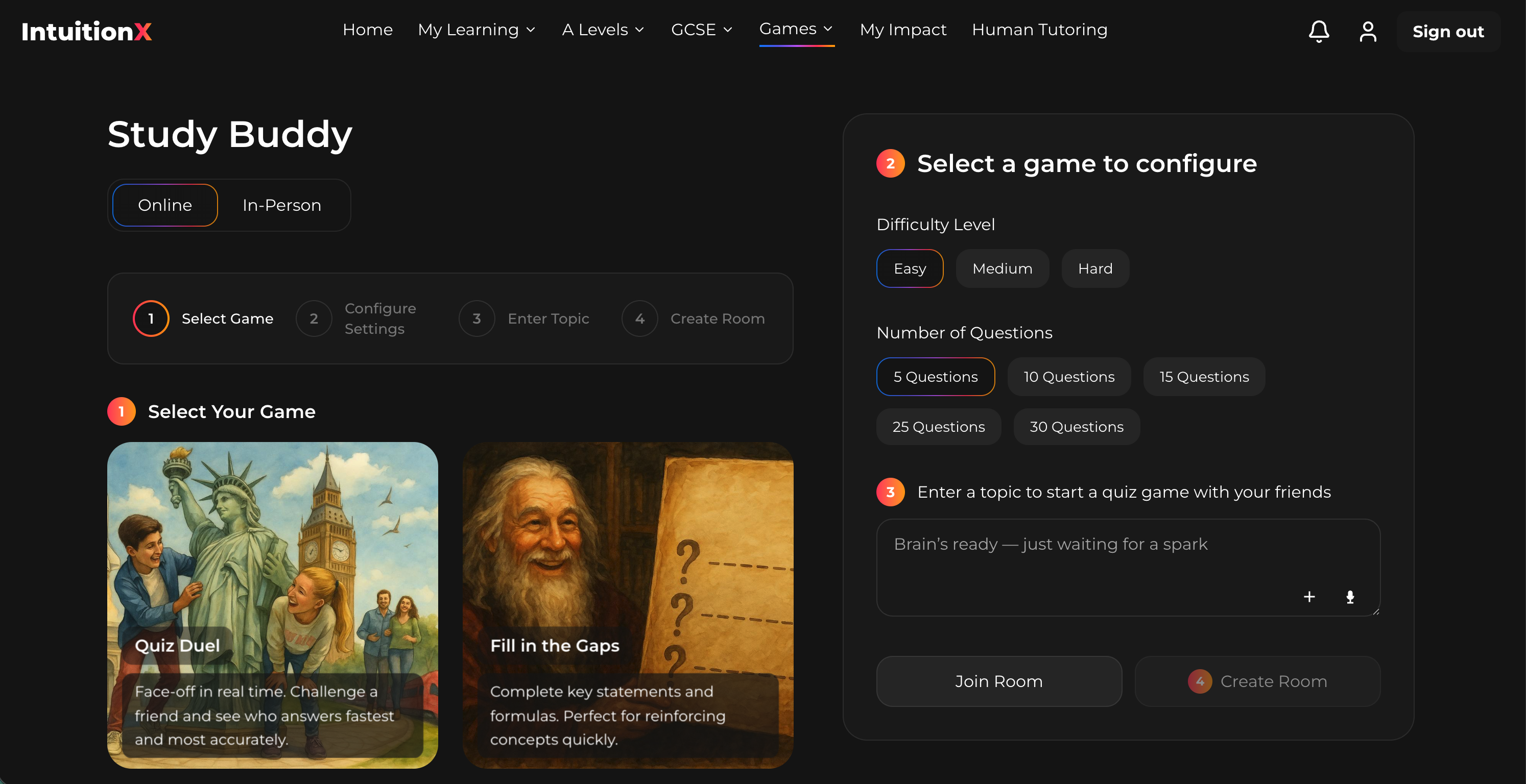
Intuitionx is a 24/7 Socratic AI tutor built on Oxbridge-level academic expertise. It does not wait for students to ask the right question. It uses the pedagogical methods of the world's greatest educators to guide students through genuine understanding, not surface memorisation. Sessions are available whenever a student needs them, not just on a fixed weekly schedule. Sir Anthony Seldon, described by the BBC as "one of Britain's leading educationalists", has said: "If you are serious about staying ahead in the age of AI, try IntuitionX today." You can start learning with Intuitionx right now, at any hour, without a contract.
FAQ
Why does traditional tutoring fail so many students?
Traditional tutoring fails because it focuses on short-term test preparation rather than building genuine understanding. The bulimic learning model means students memorise content for exams and forget it shortly after, regardless of how much money is spent.
What is high-dosage tutoring and why does it matter?
High-dosage tutoring means frequent, consistent sessions embedded within the school day and aligned with classroom teaching. Research shows it produces significantly better outcomes than the infrequent, standalone sessions that most traditional tutoring programmes deliver.
How does the tutor-student relationship affect results?
Collaborative, personalised tutoring that treats students as active participants produces stronger engagement and retention than hierarchical instruction. Students who feel like partners in their learning build genuine confidence rather than temporary familiarity with test content.
What are the main hidden costs of private tutoring?
Beyond the hourly rate, families often face assessment fees, long-term contracts, and the cost of tutor turnover. Poor alignment between the tutor and the school curriculum also reduces the value of sessions, even when the tutor is technically qualified.
Can AI tutoring solve the problems that traditional tutoring creates?
AI tutoring addresses scheduling and consistency problems effectively, but only if it uses active pedagogical methods rather than passive content delivery. Intuitionx uses Socratic questioning and memory science to build real understanding, rather than simply providing answers that bypass learning altogether.