

TL;DR:
- Oxbridge tutoring specializes in reasoning, interview simulations, and supercurricular engagement, surpassing standard syllabus revision. Traditional tutoring primarily targets exam technique, curriculum coverage, and improving grades, suitable for most students. Effectiveness depends on programme design and targeted practice, with online high-dosage options matching in-person results at lower costs.
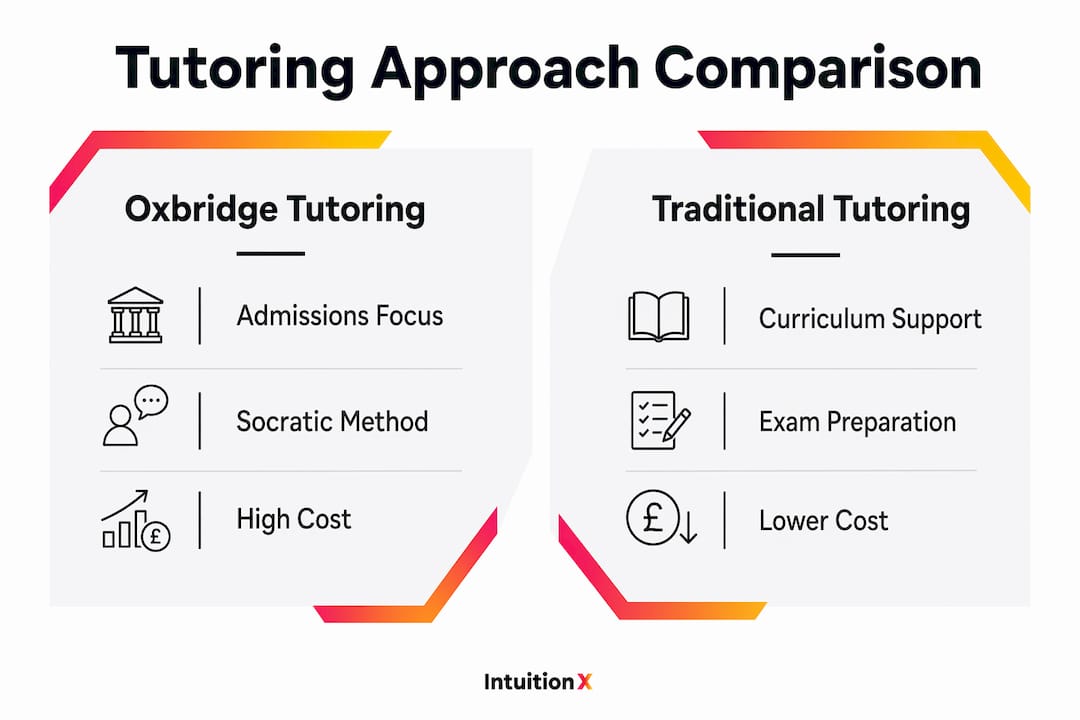
Oxbridge tutoring is defined as a specialised form of academic coaching that prepares students for admissions tests, Socratic interviews, and supercurricular engagement at Oxford and Cambridge, going well beyond standard syllabus revision. The debate around oxbridge vs traditional tutoring matters because the two approaches serve fundamentally different goals, use different pedagogical methods, and carry very different price tags. Traditional tutoring targets exam technique, past paper practice, and curriculum coverage. Oxbridge tutoring targets reasoning under pressure, subject depth, and the specific demands of assessments like the TMUA, ESAT, LNAT, and UCAT. Knowing which approach fits your child's goals could save you thousands of pounds and months of misdirected effort.
What are the key differences between Oxbridge and traditional tutoring?
The core distinction is not prestige. It is purpose. Traditional tutoring methods are built around the school syllabus: a tutor identifies gaps, works through past papers, and drills exam technique. The goal is a better grade in a defined assessment. That is genuinely useful, and for most students it is exactly what they need.

Oxbridge tutoring operates on a different logic entirely. The focus is on reasoning beyond the curriculum, which means students must engage with material they have never seen before, articulate their thinking aloud, and revise their arguments in real time based on tutor feedback. This mirrors the actual Oxbridge interview format, where tutors probe the edges of a student's understanding rather than testing memorised content.
Here is how the two approaches differ in practice:
- Content scope. Traditional tutoring covers the A-Level or GCSE syllabus. Oxbridge tutoring extends into university-level reading, supercurricular projects, and subject-specific admissions tests.
- Session format. Traditional sessions focus on worked examples and past papers. Oxbridge sessions simulate timed assessments and interviews, with the tutor playing the role of a challenging examiner.
- Tutor qualifications. Traditional tutors are often strong graduates or subject specialists. Oxbridge tutors are typically Oxford or Cambridge graduates with direct experience of the admissions process they are preparing students for.
- Skill emphasis. Traditional tutoring builds exam confidence and content recall. Oxbridge tutoring builds argumentation, intellectual curiosity, and the ability to think clearly under pressure.
Pro Tip: Ask any prospective Oxbridge tutor to describe a session in detail. If they describe past paper practice and note-taking, that is traditional tutoring with an Oxbridge label. Genuine Oxbridge preparation involves think-aloud reasoning, iterative feedback, and timed responses to unseen material.
The tutoring styles comparison matters most when a student is applying to Oxford or Cambridge. For a student aiming to improve their Maths A-Level grade, traditional tutoring is the right tool. For a student preparing for a Cambridge Natural Sciences interview, it is not enough.
How effective are Oxbridge and traditional tutoring based on research?
Both approaches work. The question is under what conditions, and for whom.
Research on tutoring effectiveness consistently shows that small-group tutoring produces significant gains, with two-student groups achieving a 0.23 standard deviation improvement in mathematics. That is a meaningful result. It means a student at the 50th percentile moves to roughly the 59th percentile. For context, most school interventions produce gains of 0.1 to 0.2 standard deviations, so well-designed tutoring outperforms the average classroom intervention.
High-dosage tutoring models show statistically significant achievement gains of 0.06 to 0.09 standard deviations across 27,000 students, whether delivered in person or virtually. This is a critical finding for parents who assume face-to-face Oxbridge tutoring is automatically superior to online alternatives.
"Virtual tutoring can be as effective as in-person in high-dosage settings, pushing parents to evaluate programme design rather than assuming in-person Oxbridge tutoring is superior." — Overdeck Family Foundation / University of Chicago, 2023–24
The table below summarises what the evidence says about each tutoring model:
| Tutoring model | Evidence of effectiveness |
|---|---|
| Small-group traditional tutoring | 0.23 SD gain in maths; statistically significant in randomised trial |
| High-dosage virtual tutoring | 0.06–0.09 SD gain across 27,000 students; matches in-person results |
| Online tutoring for students with no prior support | 0.14 SD gain at six months; significant for previously unsupported learners |
| Oxbridge-specific test and interview prep | Requires targeted alignment to specific test formats; generic prep underperforms |
One finding stands out above all others: implementation quality matters more than frequency or tutor brand. A well-structured traditional tutoring programme with clear skill targets will outperform a loosely organised Oxbridge tutoring package that simply adds more sessions. For Oxbridge preparation specifically, targeted practice materials must align precisely to the test format and college requirements. A student preparing for the LNAT needs different practice from one preparing for the TMUA. Generic reasoning exercises are not enough.
You can explore more on high-dosage tutoring evidence and how session design shapes outcomes.
What are the cost considerations in Oxbridge vs private tutoring?
Cost is where the comparison becomes uncomfortable. Specialist Oxbridge tutors in London regularly charge £80 to £150 per hour. A full preparation programme covering admissions tests, interview practice, and supercurricular guidance can run to £2,000 to £5,000 per student. Traditional tutoring typically costs £30 to £60 per hour, with most students requiring 10 to 20 sessions before a major exam.
The instinct is to assume higher cost equals higher quality. The evidence does not support that. Research from the Overdeck Family Foundation shows that lower-cost tutoring models at around $1,200 per student can match the outcomes of models costing $2,000 per student. The difference is programme design, not price. This finding should change how you evaluate any tutoring offer.
Here is a practical framework for assessing value:
- Calculate cost per effective minute. A £120 session that spends 40 minutes on admin and catch-up delivers less value than a £60 session with 55 minutes of targeted practice. Divide the session cost by the number of minutes spent on active, targeted work.
- Check dosage against the assessment timeline. Oxbridge admissions tests typically open in September and close in October or November. A tutoring plan that begins in July and runs to October with three sessions per week is structured for impact. One that begins in September with weekly sessions is not.
- Demand a written plan. A written tutoring plan should map each session to a specific skill, test format, or reasoning target. If a tutor cannot produce one, the programme is generic.
- Compare total cost, not hourly rate. A traditional tutoring programme at £40 per hour over 20 sessions costs £800. An Oxbridge programme at £100 per hour over 30 sessions costs £3,000. The question is whether the additional £2,200 produces a meaningfully better admissions outcome for your child's specific situation.
Pro Tip: Before committing to any tutoring programme, ask for a session-by-session breakdown showing which admissions test or skill each session addresses. If the tutor cannot provide this, the programme is not Oxbridge-specific, regardless of what it is called.
For more guidance on affordable tutoring choices for UK families, Intuitionx has a practical breakdown of what to look for.
How to decide which tutoring style fits your child's goals
The decision comes down to one question: what is your child actually being assessed on?
If the goal is stronger A-Level grades, better GCSE results, or improved confidence in a specific subject, traditional tutoring is the right choice. It is well-evidenced, cost-effective, and widely available. The tutoring group size and session frequency matter more than the tutor's university background.
If the goal is an Oxford or Cambridge offer, the requirements are specific and non-negotiable:
- Admissions test preparation. Cambridge alone uses multiple course-specific tests including the TMUA, ESAT, LNAT, and UCAT, with requirements varying by course and college. A student who has not practised the exact format of their required test is at a serious disadvantage.
- Interview simulation. Oxbridge interviews test reasoning with new material under time pressure. Students who have only practised content recall will struggle. They need experience reasoning aloud, updating their thinking, and producing structured responses on the spot.
- Supercurricular engagement. Oxford and Cambridge tutors look for genuine intellectual curiosity beyond the syllabus. This means reading academic papers, attending lectures, and developing independent projects in the subject area. A good Oxbridge tutor guides this process.
- Learner personality. Some students thrive under the pressure of Socratic questioning. Others find it destabilising before they are ready. Be honest about where your child is. Starting with traditional tutoring to build subject confidence before moving to Oxbridge-style preparation is a legitimate and often more effective sequence.
Parents should also monitor progress actively. Ask for written feedback after each session, track which skills are improving, and reassess the plan every four to six weeks. The best tutoring relationships are collaborative, not passive.
Key takeaways
Oxbridge tutoring delivers the most value when it is precisely mapped to specific admissions tests, interview formats, and supercurricular goals. Generic preparation, regardless of the tutor's background, underperforms targeted, well-structured programmes every time.
| Point | Details |
|---|---|
| Purpose determines the right choice | Traditional tutoring suits exam improvement; Oxbridge tutoring suits admissions preparation. |
| Implementation quality beats frequency | Small, targeted sessions outperform frequent generic ones, as shown in randomised trials. |
| Virtual tutoring is equally effective | High-dosage online programmes match in-person results; do not pay a premium for location alone. |
| Cost reflects design, not just prestige | Lower-cost programmes with strong structure can match expensive alternatives in outcomes. |
| Demand a written plan | Any credible Oxbridge tutoring programme should map sessions to specific tests and skill targets. |
Why I think most families are asking the wrong question about tutoring
When parents come to me asking about the advantages of Oxbridge tutoring versus traditional methods, they are usually focused on the tutor's CV. Did they go to Oxford? Did they get a First? Those things matter, but they are not the deciding factor. I have seen students work with genuinely brilliant Oxford graduates and make almost no progress, because the sessions were unstructured and the student had no idea what they were being prepared for.
The question that actually matters is: does this programme match the specific assessment my child will face? Cambridge's admissions process is not one thing. It is a collection of course-specific tests, college-specific interview styles, and subject-specific reading expectations. A student applying for Law at Cambridge needs LNAT preparation and practice constructing legal arguments under time pressure. A student applying for Engineering needs ESAT preparation and the ability to apply physics and maths to problems they have never seen before. These are not interchangeable.
What I find genuinely exciting about where tutoring is heading is the shift toward personalised learning approaches that adapt to the individual student rather than delivering a fixed curriculum. The best tutoring, whether Oxbridge-focused or traditional, has always done this. The difference now is that technology makes it possible at a scale and cost that was previously unimaginable.
My honest recommendation: if your child is two or more years away from Oxbridge applications, start with traditional tutoring to build subject depth and confidence. Introduce Oxbridge-specific preparation in the year before application, with a written plan, clear dosage targets, and regular feedback. Do not spend £3,000 on Oxbridge tutoring for a Year 10 student who has not yet mastered their A-Level content. Sequence matters as much as quality.
— Angus
How Intuitionx supports your tutoring decisions
Choosing between tutoring approaches is stressful. Intuitionx takes the guesswork out of it.
Intuitionx is a 24/7 Oxbridge-pedigree Socratic AI tutor built on the knowledge of Oxford and Cambridge graduates who earned Firsts in their subjects. It asks the questions that build real understanding, adapts to your child's level, and never just writes the essay for them. Whether your child needs to build subject confidence through traditional methods or prepare for an Oxbridge interview, Intuitionx maps the learning to the goal. Backed by Sir Anthony Seldon, described by the BBC as "one of Britain's leading educationalists," Intuitionx gives every student access to elite-level tutoring without the £150-per-hour price tag.
FAQ
What is the main difference between Oxbridge and traditional tutoring?
Oxbridge tutoring prepares students for admissions tests such as the TMUA, LNAT, and UCAT, as well as Socratic interviews that test reasoning with unseen material. Traditional tutoring focuses on syllabus coverage, past paper practice, and exam technique for standard qualifications.
Is Oxbridge tutoring worth the higher cost?
Only when it is precisely structured. Research shows that lower-cost, well-designed programmes can match expensive alternatives in outcomes. The value comes from programme design and assessment alignment, not the hourly rate.
Can online tutoring be as effective as in-person Oxbridge tutoring?
Yes. High-dosage virtual tutoring produces statistically significant gains equivalent to in-person delivery across large student populations. The quality of the programme matters far more than whether sessions happen face-to-face.
When should my child start Oxbridge-specific tutoring?
Most students benefit from beginning Oxbridge-specific preparation in the academic year before they apply, typically Year 12. Starting earlier with traditional tutoring to build subject depth is a sound strategy before introducing admissions-focused coaching.
How do I know if a tutoring programme is genuinely Oxbridge-focused?
Ask for a written plan that maps each session to a specific admissions test, skill target, or interview format. A credible programme will specify whether it is preparing for the TMUA, ESAT, LNAT, or another assessment, with clear dosage targets and measurable progress markers.