

TL;DR:
- By 2026, tutors serve as facilitators blending personalized guidance with AI tools to enhance student learning. They focus on motivation, complex feedback, and building student agency, relying less on content delivery. State investments and hybrid models are making tutoring more accessible and effective across diverse socioeconomic backgrounds.
The role of tutors in 2026 is defined by their ability to blend personalised human guidance with AI-powered tools to accelerate student learning far beyond what either approach achieves alone. Tutoring has shifted from a simple one-to-one instruction model to a facilitation role where the tutor acts as a thinking partner, motivator, and learning architect. High-dosage tutoring delivers approximately five additional months of academic progress, making it one of the most evidence-backed interventions in education today. The tutoring profession in 2026 is not shrinking because of AI. It is expanding, specialising, and becoming more impactful than ever.
How has the role of tutors in 2026 evolved?
The tutor's role has moved well beyond explaining content. Today's tutors act as scaffolding partners, using AI for routine tasks while directing their own energy towards motivation, critical thinking, and complex problem solving. This shift is not accidental. Research confirms that the human relationship remains the primary driver of student persistence and long-term success, regardless of how much technology is layered into the process.

The most effective tutors in 2026 do not try to compete with AI on speed or recall. They focus on what AI cannot replicate: reading a student's frustration, adjusting tone mid-session, and knowing when to push harder or back off. These are high-judgement skills that take years to develop, and they are precisely what separates a transformative tutor from a competent one.
This evolution also means tutors now carry a broader professional identity. They are curriculum interpreters, feedback specialists, and increasingly, guides who help students learn how to use AI tools critically rather than passively. That last skill is becoming a defining feature of the tutoring profession in 2026.
What does an effective tutoring session look like?
Structure is the foundation of every high-impact tutoring session. Evidence-based sessions follow a clear rhythm: roughly 10% warm-up and review, 30% instruction on new content, 30% guided practice, 20% independent practice, and 10% wrap-up. Sessions that skip retrieval practice or feedback show significantly lower learning gains. This is not a loose guideline. It is the architecture that separates productive sessions from expensive conversations.
Here is how experienced tutors implement this structure in practice:
- Open with retrieval, not recap. The first ten minutes should ask students to recall previous material from memory, not re-read notes. This strengthens retention far more than passive review.
- Introduce new content in small chunks. Break concepts into digestible units and check understanding before moving forward. Overloading a student in the instruction phase wastes the entire session.
- Guide before releasing. Work through practice problems together before asking the student to attempt them independently. Jumping straight to independent practice without scaffolding is one of the most common tutoring errors.
- Use process-oriented feedback. Effective tutors use structured elicitation techniques such as "think-aloud" prompts to surface misconceptions. Praising a correct answer without exploring the reasoning behind it teaches nothing.
- Co-construct the summary. The final five minutes should involve the student articulating what they learned, not the tutor summarising it for them. This closes the retention loop.
Experienced tutors treat the session plan as a flexible guide rather than a strict script. If a student is stuck on a concept, retrieval practice in the first ten minutes takes priority over moving to new material. Adaptability within structure is the mark of a skilled tutor.
Pro Tip: Ask your tutor to share the session plan before each meeting. Students who know the structure in advance arrive more prepared and retain more from the session.
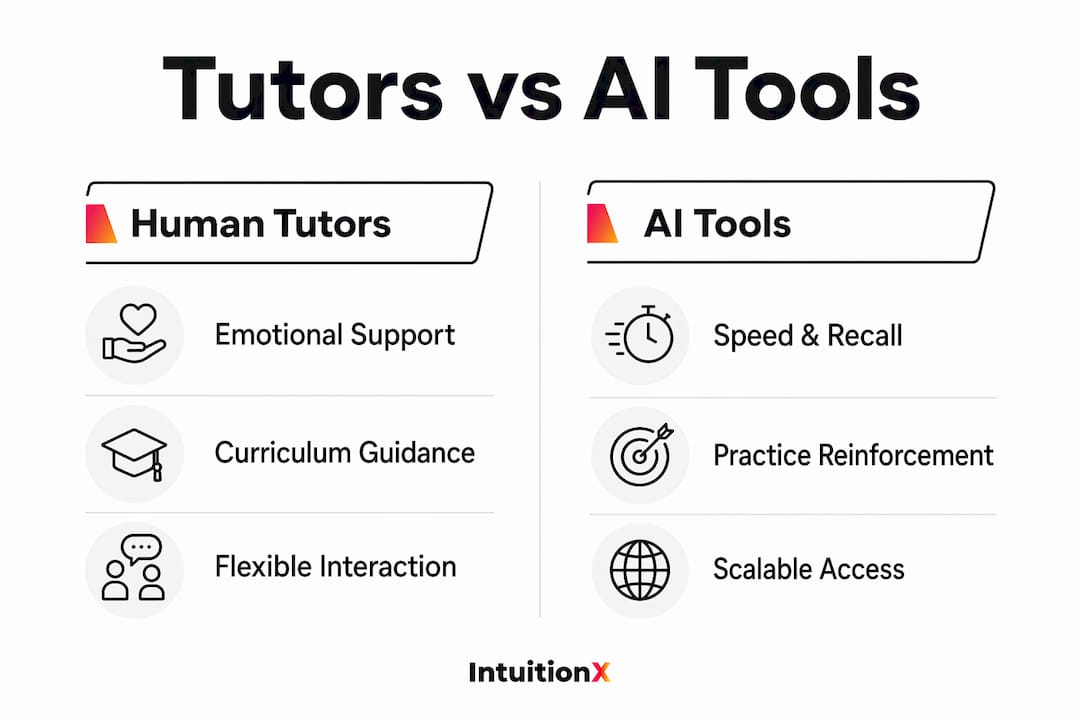
Human tutors vs AI tutoring tools: which is better?
This is the wrong question. The right question is: what does each do best, and how do you combine them?
Well-designed AI tutors produce learning gains comparable to human one-on-one tutors on targeted skills, with effect sizes of 0.3 to 0.5 standard deviations. That is genuinely impressive for routine drilling and concept reinforcement. But poorly designed AI tutors actively harm learning, which means the quality of the tool matters enormously.
| Dimension | Human tutor | AI tutoring tool |
|---|---|---|
| Motivation and emotional support | Strong. Reads emotional cues and adjusts approach | Weak. Cannot genuinely respond to frustration or anxiety |
| Routine drilling and practice | Time-consuming and inefficient | Highly effective and infinitely patient |
| Complex assessment and feedback | Strong. Identifies nuanced misconceptions | Limited. Struggles with open-ended or multi-step reasoning |
| Availability | Restricted to scheduled sessions | Available 24/7 |
| Personalised pacing | Strong. Adapts in real time to student responses | Moderate. Depends heavily on how well the tool is designed |
| Cost | £30 to £150 per hour depending on subject | Typically low or subscription-based |
The hybrid model is where the real gains are. Hybrid tutoring approaches allow a single tutor to serve two to three times more students with better outcomes, because AI handles drilling between sessions while the human tutor focuses on motivation and assessment. This is not a compromise. It is a genuine upgrade for both tutor and student.
The key principles for making a hybrid model work are:
- AI handles repetition and low-stakes practice between sessions
- Human tutors focus session time on feedback, discussion, and higher-order thinking
- Progress data from AI tools informs the tutor's session planning
- Students are taught to use AI critically, not as an answer machine
For parents wondering whether to choose a human tutor or an AI tool, the answer is both, used intentionally. You can explore the digital vs human tutor debate in more depth to understand how educators are thinking about this balance.
What do tutors earn in 2026?
Tutor pay in 2026 varies significantly by subject, sector, and delivery mode. General K-12 tutors earn £20 to £50 per hour, STEM and A-Level specialists earn £50 to £80, and test preparation or university admissions coaches command £60 to £150. Online tutoring typically pays 10 to 20% less than in-person work, reflecting lower overhead but also reduced perceived value in some markets.
| Tutor type | Typical hourly rate | Notes |
|---|---|---|
| General K-12 | £20 to £50 | Widest supply, most competitive market |
| STEM and A-Level | £50 to £80 | Higher demand, fewer qualified tutors |
| Test prep and admissions | £60 to £150 | Premium for outcomes-focused coaching |
| AI literacy tutor | 20 to 30% above base rate | Fastest-growing niche in 2026 |
The most striking trend is the premium for AI literacy tutoring. Tutors who teach students how to prompt, critique, and work effectively with AI tools command 20 to 30% above standard subject rates. This is a new and fast-growing niche that did not exist at scale three years ago.
Freelance tutors set their own rates and keep all earnings, but carry the burden of finding clients and managing administration. Company-employed tutors earn less per hour but benefit from a steady pipeline of students and professional support. Tutors with credentials from recognised associations such as the National Tutoring Authority also command higher rates, signalling professional training beyond experience alone.
Pro Tip: If you are a tutor looking to increase your rates, developing AI literacy as a teachable skill is the fastest route to a premium in 2026. Students and parents are actively seeking guidance on using AI responsibly.
How are schools and governments funding tutoring access?
State and institutional investment in tutoring has shifted from emergency pandemic funding to deliberate, sustained budget lines. High-dosage tutoring now receives dedicated state funding in the United States, with Florida allocating $20 million and Louisiana committing $45 million to high-dosage tutoring programmes. This signals a political consensus that tutoring is not a luxury supplement but a core educational intervention.
The shift from federal ESSER stimulus funding to state-level budget lines is significant. It means tutoring programmes are no longer dependent on temporary emergency money. They are being built into the structural fabric of public education.
Key developments shaping access and equity in 2026 include:
- School-embedded tutoring programmes that run during the school day, removing transport and scheduling barriers for lower-income families
- Integration of tutoring data with school management systems, allowing teachers and tutors to align on student progress
- Growing recognition that scheduling and curriculum alignment are the primary implementation challenges, not funding alone
- Districts appointing dedicated tutoring co-ordinators to manage dosage, quality, and tutor-teacher communication
The equity challenge remains real. Wealthy families still spend up to $150 per hour on private tutors, while students from lower-income backgrounds rely on whatever school-funded provision exists. Closing that gap requires not just money but thoughtful programme design, trained tutors, and technology that scales without sacrificing quality. Platforms like IntuitionX are part of that solution, offering Oxbridge-level AI tutoring at a fraction of the cost of private instruction.
Key takeaways
The most effective tutoring in 2026 combines structured human-led sessions with AI-powered practice, and neither element works as well without the other.
| Point | Details |
|---|---|
| Hybrid model delivers most | Combining human tutors with AI tools allows tutors to serve more students with stronger outcomes. |
| Session structure drives results | Evidence-based sessions with retrieval practice and process feedback outperform unstructured conversations. |
| AI literacy commands a premium | Tutors who teach students to use AI critically earn 20 to 30% above standard subject rates. |
| State funding is growing | Florida and Louisiana have committed tens of millions to high-dosage tutoring as a permanent budget line. |
| Human relationship remains central | Motivation, persistence, and complex feedback still depend on the human tutor's relational skills. |
Why I think we are still underestimating the tutor's role
I have spent a long time watching the education debate swing between two poles: "AI will replace teachers" and "nothing replaces a great teacher." Both positions miss the point. The tutors who are thriving in 2026 are not the ones defending their territory against technology. They are the ones who have absorbed it into their practice and become more effective because of it.
What concerns me is the number of students and parents who treat tutoring as a content delivery service. You pay for an hour, you get explanations. That model was always limited, and it is even more limited now that AI can explain most concepts on demand. The real value of a tutor in 2026 lies in their ability to build student agency. Can they get a student to think independently? Can they make a nervous fifteen-year-old feel confident enough to attempt a hard problem without being prompted? That is the skill worth paying for.
I also think the importance of tutors in learning is still undervalued in policy conversations. Governments are funding high-dosage tutoring because the evidence is overwhelming, but the implementation often strips out the relational elements that make tutoring work. A tutor who follows a script and ticks boxes is not the same as one who genuinely knows their student. Parents should ask tutors directly: how do you adapt when a student is disengaged? The answer tells you everything.
— Angus
How IntuitionX supports modern tutoring
If you are looking for a way to extend the impact of tutoring beyond scheduled sessions, IntuitionX is built for exactly that. Our AI tutor, Omniscience, is trained on the knowledge and pedagogical methods of Oxford and Cambridge graduates, and it uses Socratic questioning to build genuine understanding rather than just providing answers.
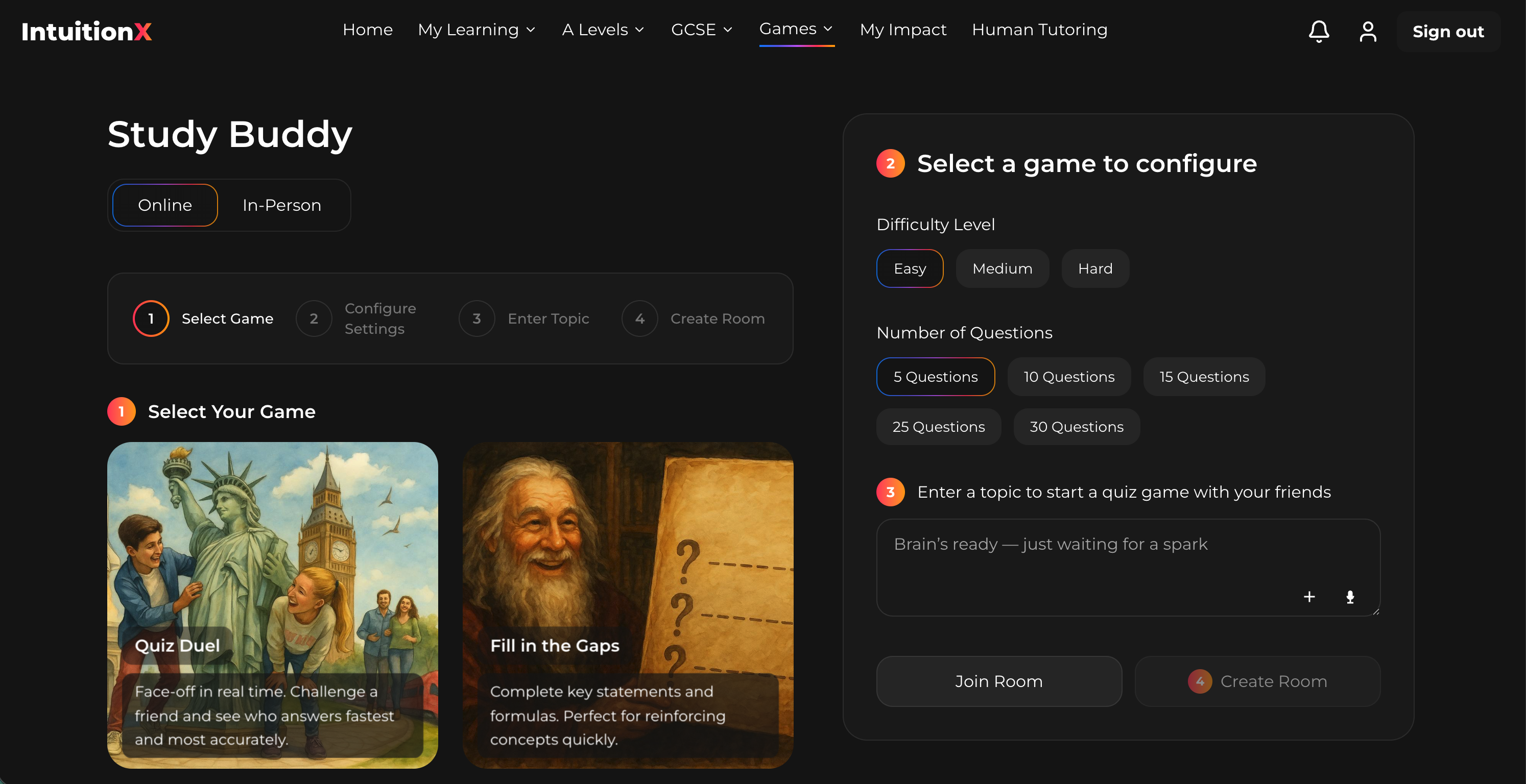
IntuitionX works as the ideal complement to human tutors. It handles practice, reinforcement, and retrieval between sessions so that your tutor can focus on the high-value work: feedback, motivation, and critical thinking. It is available 24/7, costs a fraction of private tutoring rates, and is backed by Sir Anthony Seldon, described by the BBC as one of Britain's leading educationalists. Start learning with IntuitionX today and see what structured, Oxbridge-level AI tutoring feels like.
FAQ
What is the role of tutors in 2026?
Tutors in 2026 act as facilitators who blend personalised human guidance with AI tools to accelerate learning. Their core value lies in motivation, complex feedback, and building student agency rather than simply delivering content.
Will AI replace human tutors?
AI will not replace human tutors. Research confirms that the human relationship remains the primary driver of student persistence and success, while AI handles routine drilling and practice between sessions.
How much does a tutor cost in 2026?
Tutor rates range from £20 to £50 per hour for general K-12 subjects, £50 to £80 for STEM and A-Level, and £60 to £150 for test preparation and admissions coaching. Online tutoring typically costs 10 to 20% less than in-person sessions.
What makes a tutoring session effective?
Effective sessions follow a structured rhythm of retrieval practice, guided instruction, independent practice, and co-constructed summary. Process-oriented feedback, where tutors explore the reasoning behind answers rather than just marking them correct, is critical to strong learning gains.
How is tutoring becoming more accessible?
States like Florida and Louisiana have committed tens of millions of dollars to high-dosage tutoring as a permanent budget line, moving beyond pandemic-era emergency funding. School-embedded programmes and AI tutoring platforms are also reducing cost and scheduling barriers for lower-income families.