

TL;DR:
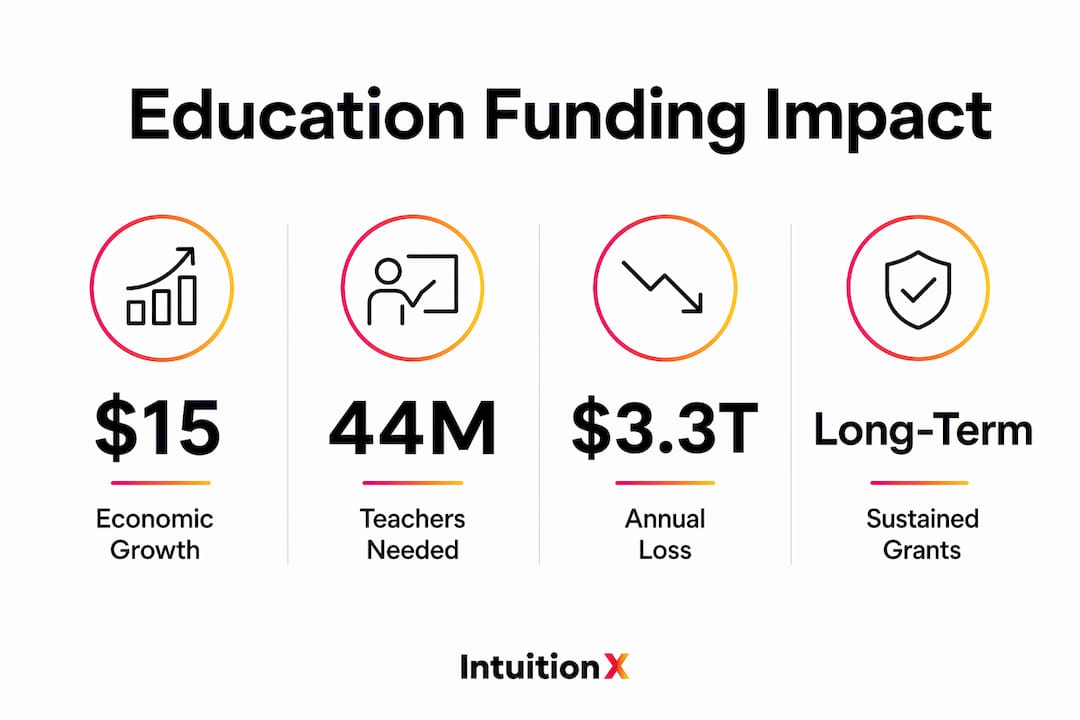
- Funding education nonprofits offers high returns by generating up to fifteen dollars in economic growth per dollar invested.
- Long-term, unrestricted support improves nonprofit effectiveness by reducing staff turnover and building community trust.
Funding education nonprofits is defined as the strategic allocation of philanthropic capital to organisations that deliver equitable access to quality learning, and it is one of the highest-return investments in global development. Every $1 invested in education generates up to $15 in economic growth. That figure alone reframes the question. This is not charity. This is a compounding asset. With 272 million children currently out of school and international aid to education projected to fall 25% by 2027, the case for private philanthropic funding has never been stronger. Organisations like the International Rescue Committee and UNESCO are already sounding the alarm. The gap between need and supply is widening, and education nonprofits are the most direct mechanism to close it.
What are the measurable benefits of funding education nonprofits?
The returns from investing in education are concrete, not theoretical. Each additional year of schooling increases an individual's annual earnings by 9–10%. That is a personal income gain that compounds across a lifetime and feeds back into local economies through spending, taxation, and entrepreneurship.

The social returns are equally significant. Education investments reduce poverty, improve health outcomes, and promote gender equality, touching every one of the United Nations Sustainable Development Goals beyond education itself. Closing gender gaps in education alone could boost global GDP by 23%. That is not a marginal gain. It is a structural shift in how economies function.
Here is what the evidence shows across three core dimensions:
- Economic growth: Educated populations drive higher productivity, attract foreign investment, and generate greater tax revenues, reducing dependence on welfare systems.
- Individual advancement: Students who complete secondary education earn significantly more over their lifetimes and are less likely to fall into cycles of poverty.
- Gender equity: Girls who receive quality education marry later, have fewer children, and invest more in their own children's education, creating generational uplift.
The importance of funding education through nonprofits specifically lies in their ability to reach populations that government systems and commercial providers overlook. Nonprofits operate in conflict zones, rural communities, and under-resourced urban areas where the need is greatest and the infrastructure is thinnest.
What global challenges do education nonprofits address?
The scale of the global education crisis is frequently underestimated. 44 million additional teachers are needed by 2030, requiring $120 billion annually in salaries alone. Currently, only 4 out of 10 countries meet the 4% GDP benchmark for education spending. The shortfall is not a rounding error. It is a systemic failure.
The consequences of inaction are measurable. A $3.3 trillion annual loss is attributed to the lack of basic literacy and numeracy skills in the global workforce. Achieving universal secondary education by 2030 could prevent over 200,000 disaster-related deaths in the next two decades. Education is, in the most literal sense, a matter of survival.
| Education need | Current status | Funding gap |
|---|---|---|
| Teachers required by 2030 | 44 million additional needed | $120 billion annually |
| Children out of school | 272 million globally | Significant and growing |
| GDP benchmark met | 4 in 10 countries | Majority of nations underfunding |
| International aid trajectory | Falling 25% by 2027 | Private philanthropy critical |
The data on global education challenges makes one thing clear: government funding alone will not close this gap. Private philanthropic capital directed through effective nonprofits is not supplementary. It is load-bearing.
Pro Tip: When evaluating where to direct funds, look specifically at organisations working in countries where international aid is declining fastest. These are the regions where your contribution creates the most marginal impact.
How does sustained funding affect nonprofit effectiveness?
Short-term project funding is one of the most damaging patterns in philanthropy. Philanthropy is shifting toward systems change, and for good reason. When donors fund isolated projects with fixed end dates, nonprofits are forced into a cycle of constant grant-seeking, staff turnover, and programme discontinuity. The communities they serve bear the cost.
Long-term, unrestricted funding avoids the volatility and staffing churn that impair impact delivery over time. Stable organisations retain experienced teachers, counsellors, and programme managers. They build institutional knowledge. They earn community trust. None of that is possible when an organisation is perpetually uncertain about its next 12 months of income.
A common donor misconception is that overhead spending signals inefficiency. The opposite is often true. An organisation that invests in its own infrastructure, staff development, and data systems is better positioned to deliver consistent outcomes than one that strips all administrative costs to satisfy donor optics. Funding operational sustainability is not a compromise on impact. It is a prerequisite for it.
- Retain experienced staff: High turnover in education nonprofits directly reduces programme quality and student outcomes.
- Build data infrastructure: Organisations that track outcomes over time can demonstrate impact and attract further investment.
- Sustain community relationships: Trust between a nonprofit and its community takes years to build and days to lose.
- Enable long-term planning: Multi-year funding allows organisations to design programmes with genuine developmental arcs rather than short-term deliverables.
Pro Tip: Ask any nonprofit you are considering funding how they plan to sustain their work if your grant ends. Their answer will tell you more about their organisational health than any annual report.
What should philanthropists look for in education nonprofits?
Effective giving relies on transparency and measurable outcomes. The best education nonprofits connect your gift directly to student success through clear metrics, not vague mission statements. You should be able to trace a donation to a specific outcome: a child enrolled, a teacher trained, a school rebuilt.
Sophisticated donors prioritise impact data over narrative. Graduation rates, employment outcomes, and long-term socio-economic improvements are the metrics that matter. These figures are increasingly available through specialised nonprofit databases and organisational profiles. If an organisation cannot provide them, that is itself a signal.
Governance structure also matters. Establishing a nonprofit arm improves donor trust by separating governance from daily operations. It unlocks eligibility for major grants and tax-deductible donations. Organisations with clear legal separation between their charitable and operational functions are better positioned to attract and steward large philanthropic gifts.
| Evaluation factor | What to look for | Red flag |
|---|---|---|
| Impact metrics | Graduation rates, employment data | Mission statements only |
| Governance | Separate nonprofit arm, clear board | Blurred operational lines |
| Financial transparency | Published accounts, audited reports | Unavailable or outdated filings |
| Long-term strategy | Multi-year plans with milestones | Project-by-project approach |
| Community engagement | Local partnerships, feedback loops | Top-down programme design |
When you are supporting education initiatives in crisis or conflict settings, add one more criterion: organisational resilience. Can this nonprofit operate when conditions deteriorate? The International Rescue Committee, for example, maintains active programmes in over 40 countries, including active conflict zones. That operational depth is not accidental. It is the product of sustained, long-term investment.
Key takeaways
Funding education nonprofits delivers the highest philanthropic return when it is long-term, unrestricted, and directed toward organisations with transparent impact metrics and strong governance.
| Point | Details |
|---|---|
| Economic return on investment | Every $1 invested in education generates up to $15 in economic growth globally. |
| Scale of global need | 272 million children are out of school, creating a $3.3 trillion annual skills deficit. |
| Sustained funding matters | Long-term, unrestricted grants prevent staff turnover and programme discontinuity in nonprofits. |
| Governance signals credibility | Nonprofits with separate legal arms attract larger gifts and unlock major grant eligibility. |
| Impact metrics over mission | Prioritise graduation rates and employment data over narrative when evaluating nonprofits to fund. |
Why I think most donors are funding education the wrong way
I have spent years watching well-intentioned philanthropists make the same mistake. They fund the story, not the system. A compelling case study, a moving photograph, a charismatic founder. These things attract donations. They do not, on their own, produce durable educational change.
The organisations that genuinely move the needle are often the least glamorous. They are the ones investing in teacher training pipelines, data management systems, and community liaison roles. They are building the infrastructure that makes learning possible, not just the visible outputs that make donors feel good. That distinction matters enormously.
I also think donors underestimate how much their funding behaviour shapes nonprofit culture. When you fund short-term projects with rigid deliverables, you are training organisations to optimise for reporting rather than impact. When you offer multi-year, flexible support, you are giving them permission to do the harder, slower work that actually changes outcomes. The importance of funding education globally is not just about the quantum of money. It is about the quality of the relationship between donor and recipient.
My honest advice: visit the organisations you fund. Ask uncomfortable questions. Request to see the data behind the headline numbers. The best nonprofits will welcome that scrutiny. The ones that deflect it are telling you something important.
— Angus
How Intuitionx connects philanthropy to real educational impact
Intuitionx was built on the belief that education is a right, not a privilege. Our agreement with the International Rescue Committee commits 10% of revenue to educational programmes in crisis and conflict countries, making every subscription a direct contribution to the children who need it most.

If you are serious about funding educational charities with measurable impact, Intuitionx gives you a model to understand. We combine Oxbridge-level academic rigour with a funding structure designed for global equity. Sir Anthony Seldon, described by the BBC as "one of Britain's leading educationalists," backs our approach. Explore how our learning platform turns educational investment into outcomes you can see, and join a community that is funding access to elite education for every child, everywhere.
FAQ
Why fund education nonprofits rather than governments directly?
Education nonprofits reach populations that government systems cannot, including children in conflict zones, rural communities, and marginalised groups. They operate with greater flexibility and can direct funds to the highest-need areas without bureaucratic delay.
What return does education investment generate?
Every $1 invested in education generates up to $15 in economic growth, and each additional year of schooling increases individual earnings by 9–10%. These returns make education one of the highest-yield philanthropic categories available.
How do I evaluate an education nonprofit's effectiveness?
Look for organisations that publish graduation rates, employment outcomes, and long-term socio-economic data. Transparent impact metrics linked directly to student success are the clearest indicator of a well-run, results-focused organisation.
Does overhead spending reduce a nonprofit's impact?
No. Organisations that invest in staff development, data systems, and operational infrastructure consistently deliver better outcomes. Penalising nonprofits for overhead costs encourages them to underinvest in the very capabilities that make sustained impact possible.
What is the biggest risk of short-term project funding?
Short-term funding forces nonprofits into cycles of grant-seeking and staff turnover that directly reduce programme quality. Long-term, unrestricted funding is the single most effective way to build the organisational stability that produces lasting community change.