
TL;DR:
- Outcome-based learning focuses on designing curricula around measurable student achievements. It shifts progress from time spent to mastery demonstrated through real-world skills and competencies.
Outcome-based learning is defined as an educational approach that organises all teaching, curriculum, and assessment backward from explicit, measurable results that students must achieve. Known formally as Outcome-Based Education (OBE), it shifts focus from content coverage to demonstrable mastery of skills, knowledge, and competencies. Rather than asking "what will we teach?", OBE asks "what must students be able to do by the end?" That single question changes everything. Frameworks like ABET and OpenEduCat have built entire accreditation and platform structures around this principle, and the evidence for its effectiveness is growing.
How does outcome-based learning differ from traditional education?
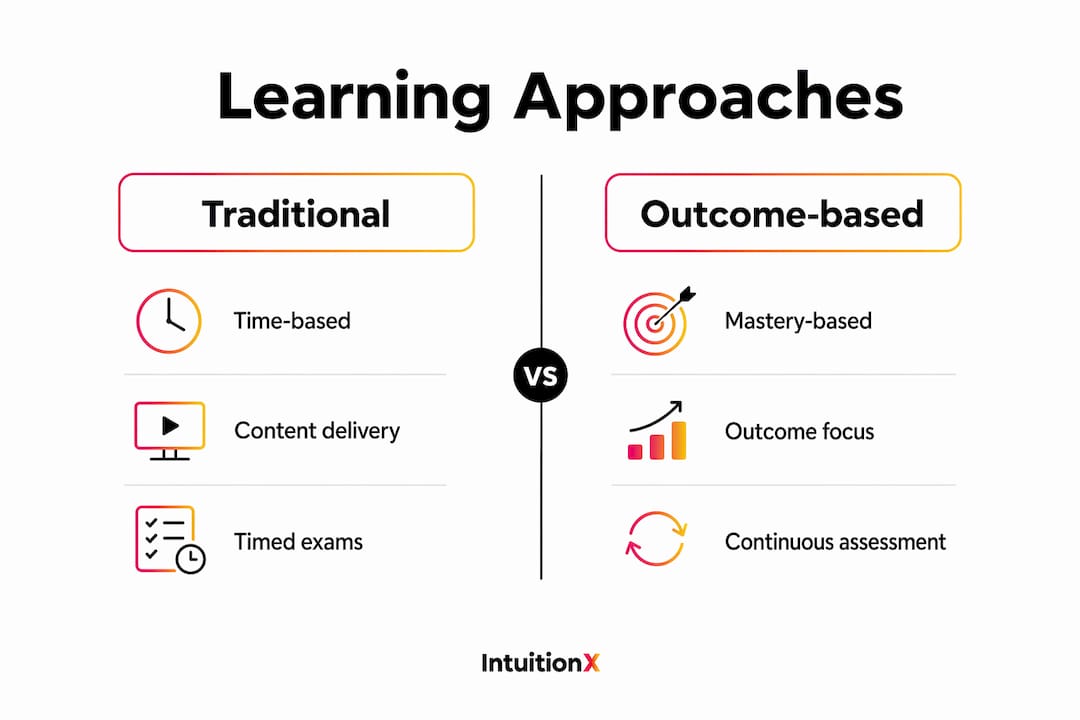
Traditional education moves students forward based on time. Spend a term on algebra, sit an exam, move on regardless of whether mastery was achieved. Outcome-based learning rejects that model entirely. Students must prove mastery before they progress, which means the pace of learning adapts to the learner, not the calendar.
The teacher's role changes too. In a traditional classroom, the teacher delivers content and moves on. In an OBE classroom, the teacher acts as a facilitator, providing support, feedback, and varied instruction until each student demonstrates the required outcome. That is a significant shift in both mindset and daily practice.
Assessment also looks different. Traditional systems rely heavily on timed exams that measure recall under pressure. OBE uses competency demonstrations, portfolios, projects, and performance tasks that reflect real-world application. The goal is to show you can do something, not just remember it.
| Feature | Traditional education | Outcome-based learning |
|---|---|---|
| Progression | Time-based | Mastery-based |
| Teacher role | Content deliverer | Facilitator and coach |
| Assessment | Timed exams and recall | Competency demonstrations |
| Curriculum design | Content first | Outcomes first (backward design) |
| Pacing | Fixed for all learners | Flexible and personalised |
Pro Tip: If you are a parent reviewing a school's approach, ask one question: "What specific outcomes will my child be able to demonstrate by the end of this year?" A school using genuine OBE will answer clearly and confidently.
What are the main principles of outcome-based learning?
OBE is built on four core principles. Understanding them helps educators implement it properly and helps parents and students know what to expect.
- Backward design. Curriculum starts with the end outcome and works backward to plan activities and assessments. This is the opposite of traditional planning.
- Alignment. Every lesson, activity, and assessment must directly serve the stated learning outcome. Nothing is included just because it has always been taught.
- Mastery learning. Students are not penalised for needing more time. They receive additional support until they achieve the outcome.
- Student-centredness. Successful OBE requires educators to adopt a philosophy where the learner's demonstrated achievement, not the teacher's delivery, is the measure of success.
These principles work together. Remove one and the model weakens. A school that writes outcome statements but still progresses students by term date has not adopted OBE. It has just relabelled its old system.
The components that bring these principles to life include: clearly written outcome statements, learning activities aligned to those outcomes, formative and summative assessments, timely feedback loops, and flexible progression pathways. Each component must connect to the others. A well-written outcome statement is useless without an assessment that actually measures it.
Pro Tip: The most common implementation error is retrofitting existing content into OBE labels without redesigning the curriculum from scratch. Backward design requires starting over, not relabelling what already exists.
What are the benefits of outcome-based learning for students and educators?
The benefits of outcome-based learning are concrete and well-supported. OBE graduates demonstrate improved critical thinking, stronger problem-solving skills, and greater workforce readiness compared to peers from traditional programmes. Those are not abstract gains. They translate directly into job performance, adaptability, and confidence in new situations.

For students, the clarity of OBE is itself a benefit. You know exactly what you need to achieve. There is no ambiguity about what "doing well" means. That clarity reduces anxiety and helps students direct their effort more effectively. In a world where 91% of students in the US report feeling nervous about asking questions in class, a system that makes expectations transparent is genuinely valuable.
For educators, OBE provides a clear framework for planning and evaluation. Teachers know whether their instruction is working because the outcomes are measurable. That feedback loop supports professional growth and makes it easier to identify students who need additional support before they fall behind.
Accreditation bodies such as ABET and SACSCOC mandate or actively encourage OBE frameworks across higher education. That institutional backing means OBE is not a passing trend. It is the direction that serious educational institutions are moving in, and understanding it now gives students, parents, and educators a genuine advantage.
OBE also builds habits that last beyond formal education. When learners are trained to focus on what they can actually do rather than what grade they received, they develop a lifelong learning mindset that serves them in every career and life stage.
How does outcome-based learning work in practice?
Putting OBE into practice follows a clear sequence. The steps below reflect how educators and institutions implement it effectively.
- Define the outcomes. Write specific, measurable statements describing what students will be able to do. For example: "The student will be able to analyse a primary source document and identify the author's bias."
- Design the assessments. Before planning any lessons, decide how you will know when a student has achieved the outcome. This might be a written analysis, an oral presentation, or a practical task.
- Plan the learning activities. Build lessons and tasks that directly prepare students for those assessments. Every activity must serve the outcome.
- Deliver with flexibility. Use personalised learning strategies to support learners who need more time or a different approach. OBE does not mean everyone learns the same way.
- Assess and give feedback. Use formative assessments throughout, not just at the end. Feedback should be specific, timely, and tied directly to the outcome criteria.
- Allow re-demonstration. If a student has not yet met the outcome, provide additional support and a further opportunity to demonstrate mastery. This is the defining feature of genuine OBE.
The challenge most educators face is step six. Allowing re-demonstration requires time, resources, and a cultural shift in how "completion" is defined. Teachers must act as facilitators who stay with learners until mastery is reached, rather than moving the whole class forward on a fixed schedule. That requires institutional support, not just individual goodwill.
Clear learning outcomes are the foundation of every other step. Vague outcomes produce vague assessments and vague results. Specificity is the difference between a system that works and one that merely looks like it does.
How does outcome-based learning compare to competency-based learning?
These two terms are often used interchangeably, but they describe different emphases. OBE defines the specific outcomes that students must achieve, the "what" of learning. Competency-based learning (CBL) focuses on the mastery path, the "how" of demonstrating that achievement.
Think of it this way. OBE says: "By the end of this course, you will be able to write a persuasive argument." CBL says: "You will demonstrate this skill through a series of performance tasks, and you may progress at your own pace once each task is completed to the required standard."
| Feature | Outcome-based learning | Competency-based learning |
|---|---|---|
| Primary focus | Defining end targets | Demonstrating mastery through performance |
| Pacing | Flexible, outcome-driven | Self-paced, performance-driven |
| Assessment design | Tied to stated outcomes | Tied to competency standards |
| Curriculum structure | Backward-designed from outcomes | Built around competency frameworks |
| Common setting | Schools and universities | Vocational training and professional development |
In practice, the two approaches overlap significantly. Many programmes blend both, using OBE to set the destination and CBL to define the route. Competency-based learning focuses on mastery pacing and performance demonstration, while OBE defines the end targets more firmly but allows flexible paths to reach them. Understanding the distinction helps educators choose the right framework for their context.
Key takeaways
Outcome-based learning works because it aligns every element of teaching and assessment to specific, measurable results that students must genuinely achieve before moving forward.
| Point | Details |
|---|---|
| Core definition | OBE designs curriculum backward from explicit, measurable learning outcomes. |
| Key difference from traditional models | OBE uses mastery-based progression; traditional education uses time-based progression. |
| Main benefits | Students gain critical thinking, workforce readiness, and clarity of expectations. |
| Biggest implementation risk | Retrofitting old curricula with OBE labels without redesigning from outcomes first. |
| OBE vs competency-based learning | OBE defines the end target; CBL focuses on how mastery is demonstrated. |
Why OBE is harder than it looks, and worth it anyway
The honest truth about outcome-based learning is that it is genuinely difficult to implement well. I have seen institutions announce an OBE transition, produce a set of outcome statements, and then continue teaching and assessing exactly as they always did. That is not OBE. That is rebranding.
The real challenge is cultural. Parents who grew up with time-based schooling often feel unsettled when their child is told they need more time to demonstrate a skill before progressing. That discomfort is understandable. It requires educators to communicate clearly and patiently about why mastery matters more than pace. The International Network for Outcome Based Education frames this as a "Success for All Learners" philosophy, and that framing is useful. It reframes slower progression not as failure but as commitment to genuine achievement.
What I find most compelling about OBE is what it does to the relationship between teacher and student. When the outcome is clear and the teacher's job is to help every student reach it, the dynamic shifts from performance to partnership. Students stop asking "what do I need to do to pass?" and start asking "what do I need to understand to actually do this?" That is a profound change.
My advice to educators starting this process: do not try to retrofit your existing curriculum. Start with one unit, one outcome, and design everything from scratch. Get that right before scaling. And to parents: ask your child's school what outcomes they are working toward this term. The answer will tell you everything you need to know about whether genuine OBE is happening in that classroom.
— Angus
How Intuitionx supports outcome-focused learning
Intuitionx is built around the same principle that makes OBE work: every interaction should move a learner closer to a specific, measurable outcome.
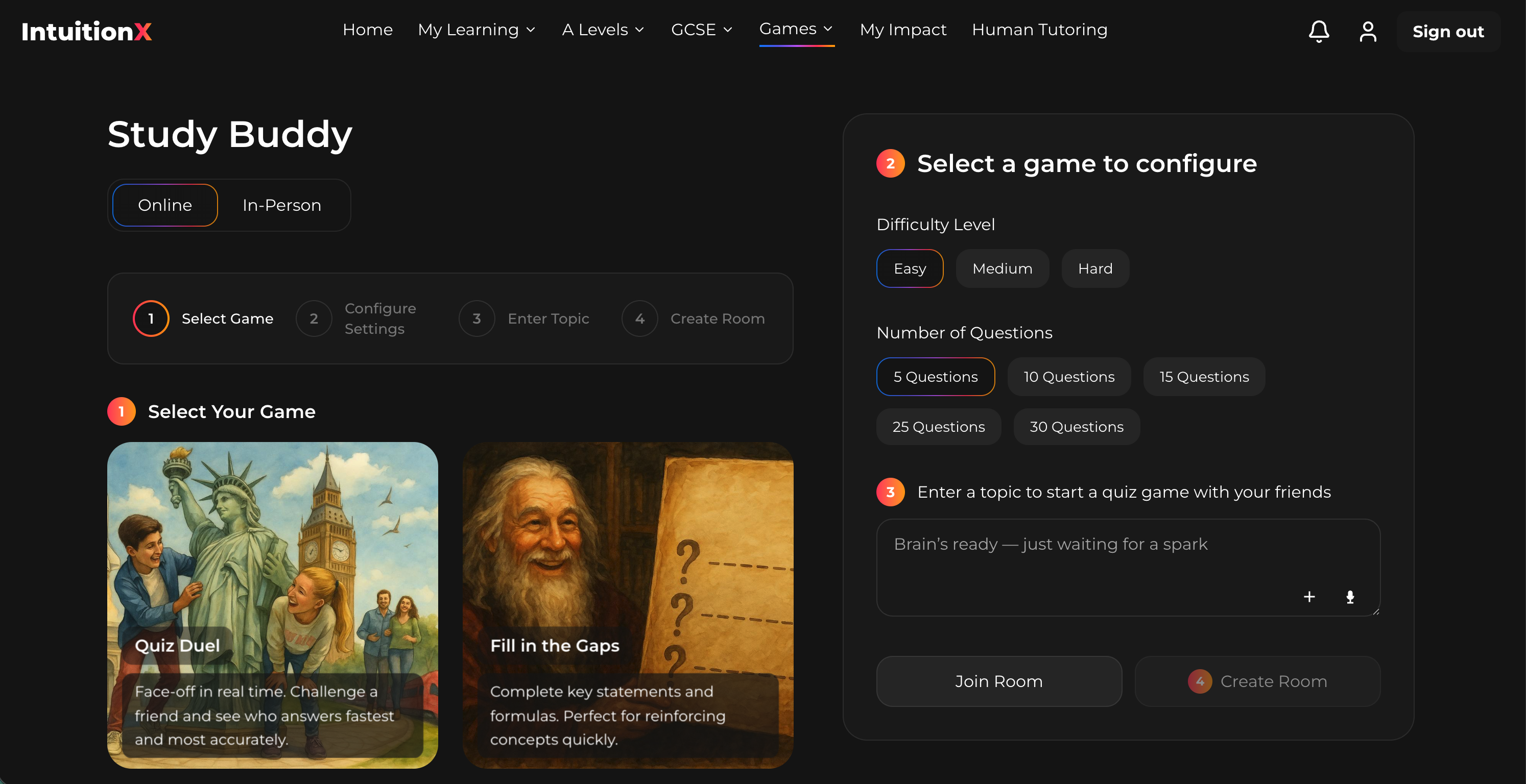
Intuitionx's AI tutor, Omniscience, uses Socratic questioning to guide students toward genuine understanding rather than surface recall. It adapts to each learner's pace, provides immediate feedback, and never moves on until mastery is demonstrated. That is OBE in action, available 24/7. Sir Anthony Seldon, described by the BBC as "one of Britain's leading educationalists", has backed Intuitionx directly, stating: "If you are serious about staying ahead in the age of AI, try IntuitionX today." Whether you are an educator designing outcomes or a student working toward them, start learning with Intuitionx and experience what mastery-focused education actually feels like.
FAQ
What is outcome-based learning in simple terms?
Outcome-based learning is an educational approach where all teaching and assessment are designed around specific, measurable results that students must achieve. The curriculum is built backward from those results, not forward from content.
How does outcome-based learning differ from traditional schooling?
Traditional schooling moves students forward based on time spent in class. Outcome-based learning requires students to demonstrate mastery of a skill before progressing, regardless of how long that takes.
What are the main benefits of outcome-based learning?
OBE graduates show stronger critical thinking, problem-solving, and workforce readiness. Students also benefit from clear expectations, which reduces anxiety and helps them direct their effort more effectively.
Is outcome-based learning the same as competency-based learning?
They are related but distinct. OBE defines the specific outcomes students must reach, while competency-based learning focuses on how students demonstrate mastery through performance tasks and self-paced progression.
Which accreditation bodies support outcome-based education?
ABET and SACSCOC are among the accreditation bodies that mandate or actively encourage OBE frameworks in higher education institutions.