

TL;DR:
- A pedagogical approach is the underlying philosophy guiding every classroom decision an educator makes. It influences the methods used and shapes how students engage and retain knowledge through deliberate practice.
A pedagogical approach is defined as the overarching method and philosophy an educator uses to facilitate learning, shaping not just what is taught but how and why. Pedagogy, the formal term for this discipline, covers the art and science of teaching and sits distinct from curriculum (what is taught) and instruction (the classroom execution). Whether you are a student trying to understand why your lessons feel a certain way, or an educator refining your practice, understanding pedagogical approaches is the foundation of effective education. With 73% of UK students not actively engaged in learning, the stakes for getting pedagogy right have never been higher.
What is a pedagogical approach, and how is it defined?
A pedagogical approach is the theoretical framework that guides every decision an educator makes in the classroom. It answers the question: "Why am I teaching this way?" That question matters far more than most people realise.
Pedagogy sits above both curriculum and instruction. Curriculum defines the content. Instruction describes the delivery. Pedagogy is the belief system underneath both. A teacher who believes students learn best by doing will make fundamentally different choices than one who believes knowledge must be transmitted from expert to novice.
Pedagogy integrates theory and practice to ensure methods directly support student learning and long-term retention. That integration is what separates deliberate teaching from simply presenting information. Understanding the definition of pedagogical approach helps educators move from habit to intention.
UNESCO and major educational bodies consistently frame pedagogy as the connective tissue between learning theory and classroom reality. Without a clear pedagogical framework, teaching becomes reactive rather than purposeful.
What are the main types of pedagogical approaches?
Pedagogical approaches fall broadly into two categories: teacher-centred and child-centred, with a growing body of practice combining both. Knowing the difference helps you choose the right tool for the right moment.
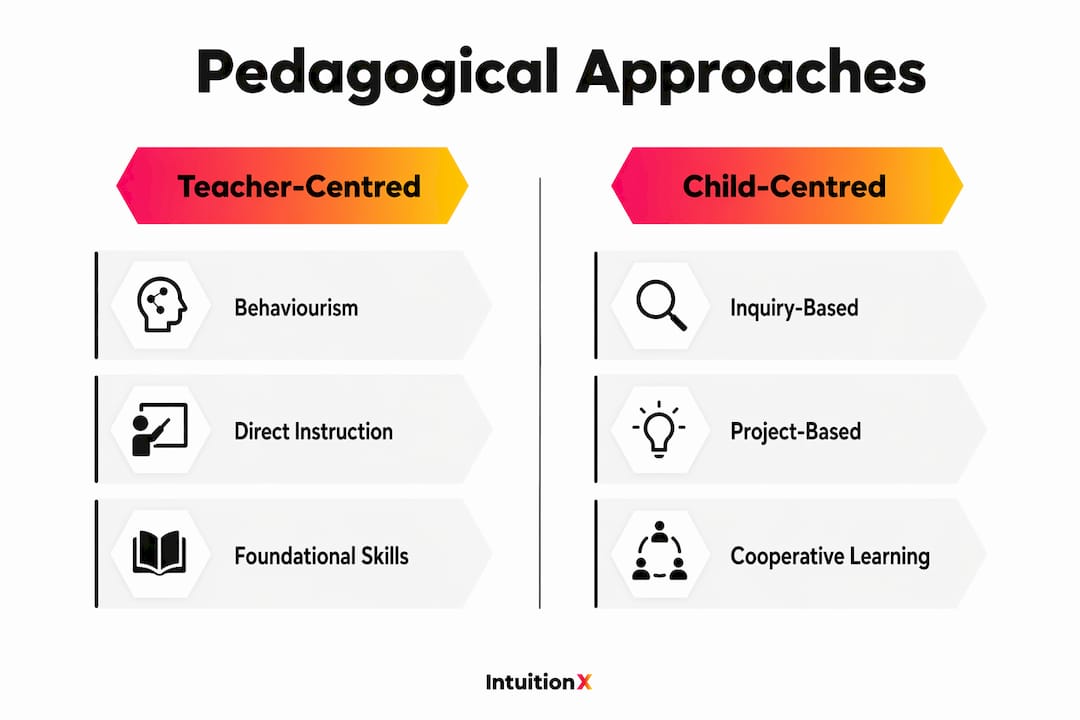
Teacher-centred approaches
Teacher-centred pedagogy places the educator as the primary authority and source of knowledge. The most common forms include:
- Behaviourism: Learning is shaped through reinforcement and repetition. Think drills, memorisation, and reward systems.
- Direct instruction: The teacher explicitly models skills and knowledge, then guides students through practice. This works well for foundational concepts in mathematics or grammar.
- Lecture-based teaching: Information flows from teacher to student. Effective for large groups and factual content, but limited in fostering critical thinking.
These approaches suit contexts where accuracy and foundational knowledge matter most. A student learning the periodic table or grammatical rules benefits from clear, structured delivery.
Child-centred approaches
Child-centred pedagogy shifts authority toward the learner. The teacher becomes a guide rather than a transmitter. Key approaches include:
- Constructivism: Students build knowledge through experience and reflection, associated with theorists such as Jean Piaget and Lev Vygotsky.
- Inquiry-based learning: Students pose questions, investigate, and draw conclusions. Science lessons built around experiments are a classic example.
- Social constructivism: Learning happens through collaboration and dialogue. Group projects and peer discussion are its natural home.
Project-based, inquiry-based, and cooperative learning foster active engagement and critical thinking by encouraging student autonomy. That autonomy builds confidence alongside knowledge.
Blended and hybrid approaches

The most effective pedagogy is often a hybrid, combining teacher guidance with student exploration. Direct instruction works for foundational concepts while constructivist inquiry supports concept mastery. Skilled educators scaffold learning, starting with teacher support and gradually releasing responsibility to students.
Pro Tip: If you are unsure which approach suits your context, start by asking what your students already know. Prior knowledge determines whether direct instruction or inquiry will land better.
How do pedagogical approaches influence teaching methods?
A pedagogical approach is the theory. A teaching method is the practice. The relationship between them is direct: your pedagogy determines which methods you reach for and why.
Instructional strategies fall into five categories: direct instruction, indirect instruction, interactive instruction, experiential learning, and independent study. Each maps to a different pedagogical belief about how students learn best.
- Direct instruction suits behaviourist pedagogy. The teacher models, students practise, and feedback is immediate.
- Indirect instruction aligns with constructivism. Students observe, investigate, and form their own conclusions with teacher facilitation.
- Interactive instruction reflects social constructivism. Discussion, debate, and peer teaching are its core tools.
- Experiential learning connects to inquiry-based pedagogy. Field trips, simulations, and hands-on projects put students inside the learning.
- Independent study supports self-directed learning goals. Research projects and personal reading fall here.
Effective pedagogical decision-making requires intentional strategy selection that considers curriculum, learner interests, and prior learning evidence. A method chosen without that context is just guessing.
The gap between theory and practice is where most teaching struggles. An educator who believes in inquiry-based learning but defaults to lecturing under time pressure is not practising their pedagogy. Reflective practice closes that gap. Reflective teaching involves reviewing evidence of learning outcomes, not just behaviour or engagement, and that distinction separates expert pedagogy from novice teaching.
Pro Tip: After each lesson, ask one question: "What evidence do I have that students actually learned something?" That single habit builds reflective practice faster than any training course.
Why does understanding pedagogical approaches matter?
Understanding teaching methodologies is not just an academic exercise. It has direct consequences for how well students learn and how confident they feel in the classroom. In the US, 91% of students report feeling nervous about asking questions in class. That statistic points directly to a pedagogical failure: environments built around teacher authority rather than learner safety.
The importance of pedagogical strategies shows up in several concrete ways:
- Learning outcomes: Pedagogy shapes cognitive development. A child-centred approach builds critical thinking; a teacher-centred approach builds foundational accuracy. Both matter, and the balance determines what students can do with their knowledge.
- Learner diversity: No two students learn identically. There is no one-size-fits-all pedagogy; educators must select approaches intentionally based on students' needs and curricular goals.
- Assessment alignment: Pedagogy guides not just content delivery but also assessment and feedback. When assessment aligns with pedagogy, evaluation genuinely supports learning rather than simply measuring it.
- Reflective improvement: Educators who understand their own pedagogical framework can identify what is not working and change it. Those who do not are stuck repeating the same approaches regardless of results.
For students, understanding the pedagogical approach behind your lessons helps you learn how to learn. Recognising that a teacher uses Socratic questioning, for example, tells you to come prepared with your own thinking, not just memorised answers. That awareness is a genuine academic advantage. Intuitionx builds this kind of metacognitive awareness directly into its learning model, helping students engage with the method behind the lesson, not just the content.
What are practical examples of different pedagogical approaches?
Theory becomes useful when you can see it in action. The table below maps common pedagogical approaches to their methods and best-use contexts.
| Approach | Key method | Best-use context |
|---|---|---|
| Behaviourism | Direct instruction, drills | Foundational skills: maths facts, spelling, grammar |
| Constructivism | Inquiry-based learning, problem-solving | Science, philosophy, complex analysis |
| Social constructivism | Collaborative projects, peer discussion | Humanities, group research, debate |
| Experiential learning | Simulations, field work, role play | Vocational subjects, history, geography |
| Blended or hybrid | Scaffolded instruction with student inquiry | Most secondary and higher education contexts |
A secondary school history teacher might open a lesson with direct instruction on the causes of the First World War, then shift to a structured debate where students argue different national perspectives. That single lesson uses behaviourist and social constructivist pedagogy in sequence. Neither approach is abandoned; both serve a purpose.
Traditional pedagogies focus on teacher authority and content transmission, while modern approaches emphasise learner engagement and adaptability. Technology-enhanced pedagogy adds another layer. Digital tools can support inquiry-based learning through access to primary sources, or reinforce direct instruction through adaptive practice. The pedagogy still drives the choice of tool, not the other way around. Choosing a tool because it is new, rather than because it serves a pedagogical purpose, is one of the most common mistakes in modern education.
For younger learners, play-based and project-based approaches connect abstract concepts to lived experience. For university students, independent study and seminar-based discussion reflect a pedagogy of self-direction and critical dialogue. Age and subject both shape which approach fits best. Understanding active learning strategies helps educators match method to moment with confidence.
Key takeaways
A pedagogical approach is the theoretical framework that drives every teaching decision; choosing it intentionally is the single most important thing an educator can do to improve learning outcomes.
| Point | Details |
|---|---|
| Pedagogy is not curriculum | Pedagogy is the "why" behind teaching; curriculum is the "what." Confusing them leads to unfocused lesson design. |
| Two core categories exist | Teacher-centred and child-centred approaches each serve different learning goals and contexts. |
| Hybrid approaches work best | Combining direct instruction with inquiry-based methods produces stronger outcomes than either alone. |
| Reflective practice is non-negotiable | Reviewing evidence of learning, not just engagement, is what separates expert teaching from routine delivery. |
| Pedagogy shapes assessment too | Aligning evaluation methods with your pedagogical approach ensures assessment supports learning, not just measures it. |
Pedagogy is personal, and that is both its strength and its challenge
I have spent years watching educators wrestle with the question of which approach is "correct." The honest answer is that the question itself is wrong. An educator's pedagogical style is as individual as their accent, shaped by philosophy, background, and the specific students in front of them. Treating pedagogy as a fixed formula produces rigid teaching that fails the moment the classroom changes.
The most common pitfall I see is ideological attachment. An educator who commits entirely to child-centred learning and refuses to use direct instruction when students need foundational clarity is not being principled. They are being inflexible. The reverse is equally true. A teacher who only lectures is not transmitting knowledge efficiently; they are avoiding the discomfort of relinquishing control.
Viewing teacher-centred and child-centred approaches as mutually exclusive is a genuine misconception. Skilled educators scaffold: they start with structure and progressively hand responsibility to students. That movement from dependence to autonomy is the real goal of pedagogy, whatever the subject.
My practical advice is this: pick one approach to examine deeply this term. Teach a unit using primarily inquiry-based methods if you normally lecture, or vice versa. Review the evidence of learning at the end. Not the engagement, not the noise level, but the actual learning. That single experiment will teach you more about your own pedagogy than a year of reading theory.
Pedagogy is a lifelong practice, not a qualification you earn once. The educators who improve most are those who stay genuinely curious about why their methods work, and honest when they do not.
— Angus
How Intuitionx supports pedagogically grounded learning
Intuitionx is built on the pedagogical principles that research consistently identifies as most effective: Socratic questioning, memory science, and adaptive challenge. It is not a content delivery tool. It is a thinking partner that applies elite pedagogy to every conversation, drawing on the knowledge of academics who earned Firsts from Oxford and Cambridge.

For students who feel bored or nervous in class, Intuitionx creates a space where asking questions is the point, not an embarrassment. For educators, it models the kind of Socratic dialogue that child-centred pedagogy demands but classroom time rarely allows. Sir Anthony Seldon, described by the BBC as "one of Britain's leading educationalists," has backed Intuitionx directly. If you want to experience what pedagogically rigorous AI learning feels like, try Intuitionx today.
FAQ
What is the definition of a pedagogical approach?
A pedagogical approach is the theoretical framework and philosophy that guides how an educator teaches, including the methods, strategies, and beliefs that shape every classroom decision. It is distinct from curriculum, which defines content, and instruction, which describes delivery.
What are the main types of teaching approaches?
The main types are teacher-centred approaches, such as behaviourism and direct instruction, and child-centred approaches, such as constructivism and inquiry-based learning. Most effective teaching combines both in a blended or hybrid model.
Why does pedagogy matter for student engagement?
Pedagogy directly shapes whether students feel active participants in their learning or passive recipients. Child-centred and hybrid approaches consistently produce higher engagement and deeper understanding than purely teacher-centred methods.
How do I choose the right pedagogical approach?
Choose based on three factors: your students' prior knowledge, the curricular goals, and the subject matter. Foundational content suits direct instruction; complex or open-ended topics suit inquiry-based or collaborative methods.
How does pedagogical approach relate to assessment?
Pedagogy guides assessment design as well as teaching. When assessment aligns with the chosen pedagogical approach, evaluation genuinely supports learning outcomes rather than simply measuring content recall.