

TL;DR:
- Elite pedagogy emphasizes explicit knowledge transmission and cognitive discipline to develop critical thinking and leadership skills. It promotes structured instruction over discovery learning, fostering equity by providing all students with foundational cultural knowledge. This approach aims beyond academic success to cultivating judgment and responsible governance in learners.
Elite pedagogy is defined as a transmission-based instructional approach that cultivates critical thinking, good judgement, and leadership capacity through explicit teaching of cultural knowledge and cognitive discipline. Unlike progressive or discovery-based methods, it does not leave learners to construct understanding independently. It transmits the intellectual heritage of a discipline directly, building the mental habits that distinguish genuinely educated minds. For humanities educators and students, understanding this approach is the difference between producing graduates who can think and those who can merely perform tasks.
What is elite pedagogy and how does it work?
Elite pedagogy is the deliberate cultivation of advanced critical faculties through structured, explicit instruction rather than open-ended discovery. The Hungarian research institute Tanulás Kutatóintézet describes it as balancing future leadership needs with the egalitarian demands of modern society. That balance is not accidental. It is the defining tension at the heart of elite pedagogy explained properly.

The approach rests on a core conviction: that the most important thing a teacher can do is transmit knowledge directly, clearly, and in sequence. Students do not discover the structure of an argument or the logic of historical causation by accident. They learn it because a teacher shows them, repeatedly and explicitly. This is the definition of elite pedagogy in practice.
A second pillar is cognitive discipline. The new definition of elite status has shifted from financial wealth to the capacity for sustained, focused thought. Cognitive capacity developed through a deliberate "habit of thinking" shielded from digital distraction is now the marker that separates elite learners from the rest. That shift matters enormously for how you design a curriculum and how you run a classroom.
Explicit instruction vs. discovery learning
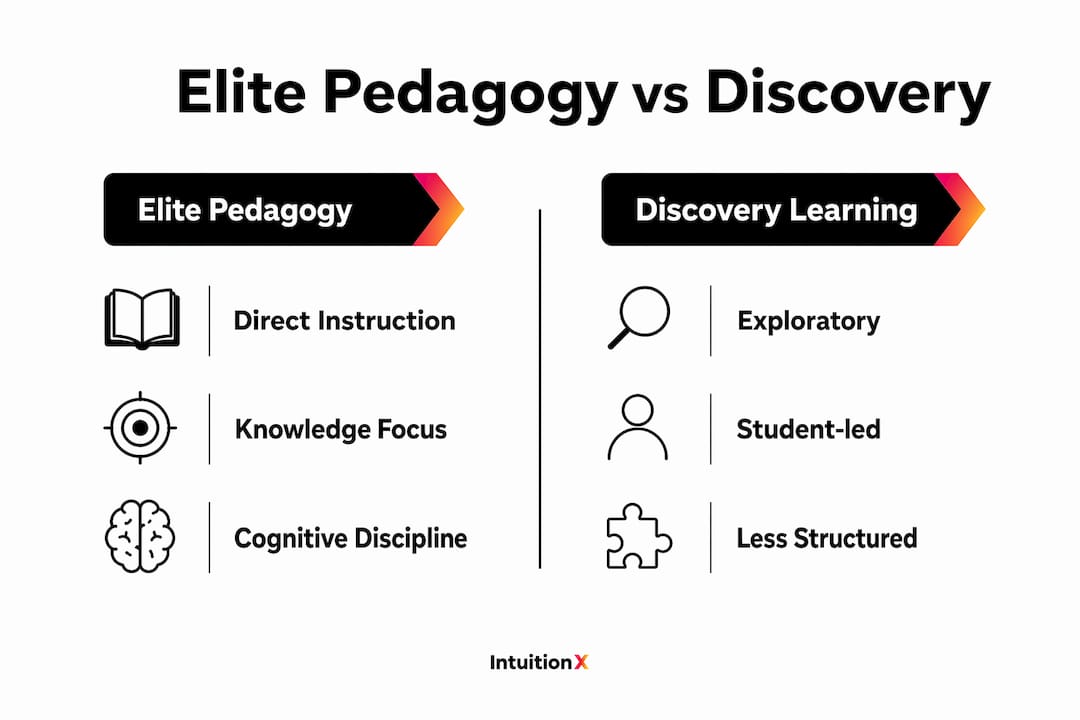
The contrast between elite pedagogy and discovery learning is not a matter of preference. It is a matter of evidence. Here is how the two approaches differ across the dimensions that matter most to humanities educators.
| Dimension | Elite Pedagogy | Discovery Learning |
|---|---|---|
| Knowledge transmission | Direct, sequenced, teacher-led | Student-led, emergent |
| Cultural capital | Explicitly taught to all | Assumed as prior knowledge |
| Equity impact | Levels the playing field | Favours privileged learners |
| Critical thinking | Built through structured practice | Expected to arise organically |
| Assessment | Tests mastery of defined content | Tests process and exploration |
Pro Tip: When designing a humanities unit, map the foundational knowledge students need before they can think critically about a text or period. Teach that knowledge first, explicitly. Do not assume it.
Does elite pedagogy address educational inequality?
This is where the definition of elite pedagogy becomes genuinely surprising. Most people assume that "elite" means exclusive. The opposite is true when the method is applied correctly.
Discovery learning is frequently marketed as equitable, but research shows it reinforces privilege by favouring learners who already possess high cultural capital. A student from a household full of books, dinner-table debate, and museum visits can navigate an open-ended task. A student without that background cannot. The method does not level the playing field. It hides the fact that the field was never level to begin with.
Explicit, structured instruction does the opposite. It gives every student the knowledge they need to participate. It does not assume. It teaches. That is why transmission pedagogy is increasingly understood as a tool for equity, not elitism.
The challenges and solutions in this space are worth naming directly:
- Challenge: Disadvantaged students lack the cultural background knowledge that discovery tasks assume. Solution: Teach background knowledge explicitly before any open-ended task.
- Challenge: Teachers trained in progressive methods may resist structured instruction as "old-fashioned." Solution: Ground the case for explicit teaching in research, not tradition.
- Challenge: Broad cultural education can feel irrelevant to students focused on employability. Solution: Frame cultural knowledge as the foundation of judgement, not decoration.
- Challenge: Digital distraction erodes the sustained attention that elite pedagogy requires. Solution: Build attention as a skill through structured reading and discussion protocols.
- Challenge: Equity goals can be undermined by low expectations dressed up as student-centred learning. Solution: Hold high expectations for all students and provide the instruction needed to meet them.
The educational equity frameworks that matter most are those which combine high expectations with the explicit instruction needed to meet them. Elite pedagogy, properly understood, does exactly that.
What is elite pedagogy's mission beyond academic results?
Academic results are a by-product of elite pedagogy, not its primary goal. The deeper mission is the cultivation of good judgement and the capacity to govern, in the broadest sense of that word.
Philosopher Eric Schliesser argues that elite universities carry a mission of spiritual authority and the art of government that goes far beyond knowledge production or human capital formation. That mission is not about producing clever graduates. It is about producing people who can think clearly under pressure, weigh competing values, and act with integrity when the stakes are high. Many universities have abandoned this mission, substituting free speech rhetoric for the harder work of teaching students to witness and speak truth.
The risk of narrow specialisation is real and well-documented. Broad cultural education alongside technical expertise is what prevents future leaders from becoming sophisticated technicians with no moral compass. A historian who knows only historiography, or a philosopher who knows only analytic logic, is not educated in the elite sense. They are trained.
For humanities educators, this distinction is clarifying. Your subject is not a soft option or a luxury. It is the primary site where the habits of mind required for leadership are formed. Close reading, argument analysis, historical empathy, ethical reasoning: these are not decorative skills. They are the core of what elite pedagogy in education is designed to produce.
Pro Tip: In seminars, resist the urge to summarise student contributions. Instead, ask students to respond directly to each other's arguments. This builds the habit of genuine intellectual engagement, not just performance.
How can educators apply elite pedagogy in the humanities?
Applying elite teaching methods in a humanities classroom does not require a complete overhaul. It requires a shift in priorities and a few deliberate practices.
| Strategy | What It Looks Like in Practice |
|---|---|
| Knowledge-first sequencing | Teach historical context or philosophical background before asking for analysis |
| Structured discussion protocols | Use Socratic seminars with assigned positions to build argument skills |
| Attention training | Assign sustained close reading without digital devices, building up duration over time |
| Explicit modelling | Show students how you read a primary source, think aloud, and construct an argument |
| Cultural breadth requirements | Include texts from multiple traditions to build the wide reference frame elite thinking requires |
Here are five numbered strategies you can implement immediately:
- Start every unit with a knowledge audit. Find out what students already know and fill gaps explicitly before moving to analysis or discussion.
- Model your own thinking. Read a passage aloud and narrate your interpretive process. Students need to see expert thinking, not just its results.
- Assign sustained reading without interruption. Begin with 20 minutes of uninterrupted reading per session and build from there. Attention is a trainable capacity.
- Require students to engage with primary sources directly. Do not let secondary commentary substitute for the original text. Elite pedagogy demands direct encounter with difficult material.
- Teach argument structure explicitly. Use frameworks like PEEL (Point, Evidence, Explanation, Link) or the Toulmin model to give students a scaffold for rigorous written argument.
Pedagogy principles that are grounded in evidence, rather than folk wisdom, consistently produce stronger outcomes. As the SAGE publication Understanding Pedagogy argues, pedagogy must be reclaimed as a rigorous science, not left to intuition or habit. That reclamation starts in your classroom, with the choices you make about what to teach and how to teach it.
Key takeaways
Elite pedagogy works because it combines explicit knowledge transmission with the cultivation of cognitive discipline, producing learners capable of genuine critical thought and responsible leadership.
| Point | Details |
|---|---|
| Core definition | Elite pedagogy is explicit, transmission-based teaching focused on critical faculties and good judgement. |
| Equity argument | Explicit instruction levels the playing field by teaching cultural knowledge rather than assuming it. |
| Leadership mission | The goal extends beyond grades to cultivating the prudence and judgement required for governance. |
| Discovery learning risk | Discovery methods favour privileged learners and mask inequality behind a veneer of student-centred practice. |
| Practical application | Knowledge-first sequencing, attention training, and explicit modelling are the key classroom tools. |
Why elite pedagogy still makes me uncomfortable, and why that is the point
I have spent years thinking about how the best educators teach, and elite pedagogy still produces a slight unease in me. That unease is worth examining.
The word "elite" carries baggage. It sounds exclusionary, hierarchical, designed for the few. But the research keeps pointing in the same direction: the methods associated with elite education, explicit instruction, broad cultural grounding, sustained attention, the cultivation of judgement, are precisely the methods most likely to benefit students who have been failed by every other approach.
What troubles me more, honestly, is the alternative. Discovery learning sounds generous. It sounds like it trusts students. But trusting students to discover what they have never been taught is not generosity. It is a quiet form of abandonment dressed up in progressive language.
The other thing I have come to believe is that pedagogy is not a soft concern. It is a science, and it has been treated too casually for too long. The shift toward evidence-based instructional methods is overdue. The humanities, in particular, have sometimes resisted this shift, as if rigour in teaching method were somehow at odds with the freedom of humanistic inquiry. It is not. The most intellectually free students I have encountered are those who were taught the most explicitly.
Elite pedagogy's mission, preparing people to think well and govern wisely, has never been more urgent. We live in an age of information overload and shortened attention. The capacity to read carefully, argue honestly, and judge prudently is not a luxury. It is a survival skill for any functioning democracy.
— Angus
How Intuitionx brings elite pedagogy to every learner
Elite pedagogy has historically been the preserve of those who could afford it. Intuitionx exists to change that. Built on Oxbridge-level academic expertise and backed by Sir Anthony Seldon, Intuitionx delivers 24/7 Socratic tutoring that applies the principles of explicit instruction, cognitive rigour, and genuine intellectual challenge to every student, regardless of background or budget.

Wealthy families spend up to $150 an hour on private tutors who use exactly these methods. Intuitionx makes the same quality of thinking partnership available to anyone with a device and a desire to learn. Whether you are an educator looking to deepen your practice or a student ready to think at a higher level, start learning with Intuitionx today and experience what elite pedagogy actually feels like in practice.
FAQ
What is the simplest definition of elite pedagogy?
Elite pedagogy is a transmission-based teaching approach that explicitly cultivates critical thinking, cultural knowledge, and good judgement, rather than relying on students to discover these independently.
How does elite pedagogy differ from progressive teaching methods?
Elite pedagogy prioritises direct, structured instruction and cultural knowledge transmission, while progressive methods favour student-led discovery. Research shows discovery learning disadvantages students who lack prior cultural capital.
Is elite pedagogy only for elite schools?
No. The principles of explicit instruction and cognitive discipline benefit all learners, and are particularly valuable for disadvantaged students who lack the background knowledge that discovery-based methods assume.
Why is explicit instruction central to elite pedagogy?
Explicit instruction ensures that foundational knowledge is taught rather than assumed, giving every student the tools needed for genuine critical thinking regardless of their background.
Can elite pedagogy be applied in a standard humanities classroom?
Yes. Strategies such as knowledge-first sequencing, Socratic discussion, sustained reading practice, and explicit argument modelling can all be implemented within standard humanities teaching without specialist resources.