

TL;DR:
- Pedagogy encompasses teaching approaches, theories, feedback, and assessments that together create meaningful learning experiences.
- Understanding and applying evidence-based principles like constructive alignment, cognitive science techniques, and psychological safety can significantly improve educational outcomes both in and outside classrooms.
Most people think pedagogy simply means "how you teach." That misunderstanding leads to lessons that feel organised on paper but fail to produce real learning. In reality, pedagogy covers teaching approaches, theories, feedback, and assessment methods together. It is the full operating system behind meaningful education. Whether you are a classroom teacher, a parent supporting your child at home, or a student trying to understand why some lessons stick and others do not, getting pedagogy principles explained clearly is one of the most powerful things you can do for learning outcomes.
Table of Contents
- Key takeaways
- Pedagogy principles explained: the foundations
- Evidence-based strategies rooted in cognitive science
- Traditional versus modern pedagogical approaches
- Applying pedagogy principles at school and at home
- My perspective on pedagogy and what educators often miss
- Learning built on the principles that actually work
- FAQ
Key takeaways
| Point | Details |
|---|---|
| Pedagogy is broader than method | It covers theory, assessment, feedback, and learner wellbeing alongside teaching technique. |
| Constructive alignment matters | Linking learning outcomes, teaching activities, and assessments produces stronger, more measurable results. |
| Cognitive science improves retention | Retrieval practice, dual coding, and scaffolding outperform passive review for long-term learning. |
| Psychological safety is non-negotiable | Learners who feel safe to fail and question engage more deeply and retain more. |
| Pedagogy should lead technology | Tools like AI work best when pedagogy drives their use, not the other way around. |
Pedagogy principles explained: the foundations
Let us start with the definition. Pedagogy involves decisions about delivery, theories of learning, and assessment. It is not a single strategy you pick from a list. Experienced teachers develop their own principles over time, drawing from research, reflection, and the realities of their classrooms.
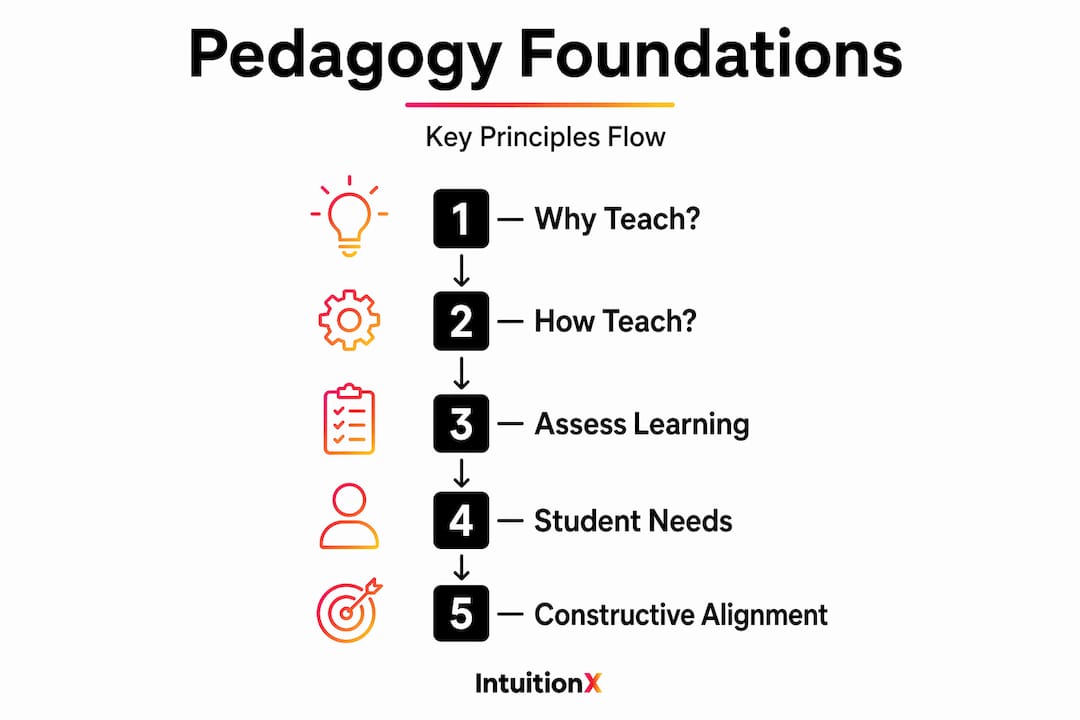
At its core, pedagogy asks three questions: Why are we teaching this? How should we teach it? And how do we know learning has happened? Every decision an educator makes, from the order of a lesson to the type of question they ask, flows from answers to those questions.
The four classical approaches
Understanding pedagogy principles starts with knowing the four major theoretical traditions that have shaped modern teaching.
- Behaviourism focuses on observable outcomes. Learning is measured through responses to stimuli. Think drills, repetition, and reward systems. It works well for foundational skills and rote knowledge but struggles to build critical thinking.
- Constructivism (associated with Jean Piaget) argues that learners build knowledge by connecting new information to what they already know. A pupil does not receive knowledge passively. They construct it actively through experience.
- Social constructivism (Vygotsky's contribution) adds the dimension of collaboration. Learning happens in dialogue, not isolation. The famous "zone of proximal development" describes what a learner can achieve with guidance that they cannot yet do alone.
- Liberationist pedagogy (Paulo Freire's model) positions education as a tool for critical consciousness and empowerment. It challenges learners to question received wisdom and become agents of change, not passive recipients of information.
None of these is universally superior. Each has a context where it shines.
Constructive alignment and student-centred learning
One of the most practically useful concepts in understanding pedagogy principles is constructive alignment. Constructive alignment organises learning with student-centred approaches aligned to outcomes and assessments. It means your learning objectives, your teaching activities, and your assessments must all point in the same direction.
A history teacher who wants students to "evaluate the causes of World War One" must design lessons that practise evaluation, then set assessments that actually test evaluation. If the lesson only covers facts and the test only asks for recall, alignment has broken down.
| Approach | Core belief | Strength | Limitation |
|---|---|---|---|
| Behaviourism | Learning is observable behaviour change | Clear, measurable outcomes | Misses deeper thinking |
| Constructivism | Learners build knowledge actively | Develops understanding | Requires time and scaffolding |
| Social constructivism | Learning is socially situated | Builds collaboration skills | Dependent on group dynamics |
| Liberationist | Education is empowerment | Motivates critical agency | Hard to assess formally |
Evidence-based strategies rooted in cognitive science
Knowing the theories is the starting point. Translating them into the classroom or at home is where pedagogy gets genuinely exciting.
Cognitive science has given educators a reliable toolkit. Near-peer educators deliberately apply cognitive science principles, including retrieval practice, dual coding, and concrete examples, to manage cognitive load and structure learning effectively. These are not trends. They are among the most replicated findings in educational psychology.
The cognitive toolkit
- Retrieval practice means testing yourself on material rather than re-reading it. Every time you retrieve information, you strengthen the memory trace. Low-stakes quizzes, flashcards, and "brain dumps" all count.
- Dual coding combines verbal and visual information. A diagram alongside an explanation beats either one alone, because two memory pathways are activated simultaneously.
- Concrete examples anchor abstract concepts. When a maths teacher shows how percentages apply to a supermarket discount before introducing the formula, learners grasp the concept faster and retain it longer.
- Scaffolding provides temporary support while a learner builds competence, then gradually removes it. Think of it as training wheels that come off once balance is established.
Cognitive strategies, when sequenced deliberately, activate prior knowledge, present multi-modal information, and anchor it in meaningful context. The key word is sequenced. Random use of good techniques produces mediocre results. Deliberate sequencing produces mastery.
Psychological safety and the humanistic framework
Here is where many well-read educators still get it wrong. You can have perfect lesson design and still produce a room full of students too anxious to think.

Creating low-stakes environments and adapting teaching to learner needs fosters inclusivity and genuine engagement. Psychological safety is not background friendliness. It is intentionally constructed through deliberate choices. Telling students their wrong answers are "interesting starting points." Celebrating questions. Designing tasks where failure is expected and normalised.
Universal design for learning extends this by asking: have I designed this lesson so that every learner in the room can access it? That means considering different languages, learning differences, and prior experiences before the lesson starts, not after.
Pro Tip: If students are not asking questions in your class, that is data. It almost certainly means the environment does not yet feel safe enough. Try starting lessons with anonymous written questions to lower the barrier.
Traditional versus modern pedagogical approaches
Pedagogical approaches explained in isolation rarely capture how real teaching works. Most experienced educators blend approaches based on context, not ideology.
Behaviourism is not dead. It is alive in every phonics lesson, times-table drill, and language laboratory. The mistake is applying it beyond its natural scope. When a teacher uses only behaviourist methods to teach essay writing, they get formulaic responses that score adequately but demonstrate no real thinking.
Constructivism and social constructivism power the best discussion-based lessons, project work, and peer learning. Constructivist pedagogy places learners at the centre and uses psychological safety to allow trying, failing, and questioning. These approaches take longer. They produce deeper understanding.
| Scenario | Best-fit approach | Why |
|---|---|---|
| Teaching the alphabet | Behaviourism | Repetition and reward build automaticity |
| Exploring climate change ethics | Liberationist / constructivist | Critical thinking and personal agency matter |
| Group science experiment | Social constructivism | Peer dialogue builds shared understanding |
| Revision before exams | Cognitive science techniques | Retrieval practice maximises retention |
Blending for real classrooms
The most effective teachers do not plant their flag in one camp. They read the room. A lesson on Shakespeare might begin with a behaviourist vocabulary drill, move into a constructivist close reading exercise, and end with a liberationist discussion about whose stories get told.
For parents supporting learning at home, this matters too. Drilling multiplication facts (behaviourism) and then asking "where did we use multiplication at the shops today?" (constructivism) is not contradictory. It is pedagogically sound sequencing.
Pro Tip: When helping your child revise at home, resist the urge to let them re-read their notes. Instead, close the book and ask them to tell you what they remember. That ten-minute conversation is worth more than an hour of passive reading.
Applying pedagogy principles at school and at home
Understanding pedagogy is one thing. Using it is another. Here is how to put what are pedagogy principles into practice across different contexts.
For educators
- Start with outcomes. Write clear learning objectives before planning any activity. Ask: what should a student be able to do by the end of this lesson that they could not do at the start?
- Design backwards. Once your outcome is clear, design teaching activities and assessments so each element measures the same intended competence. This is constructive alignment in practice.
- Use formative assessment continuously. Exit tickets, quick polls, paired discussion, and low-stakes quizzes all give you real-time data on whether learning is happening. Do not wait for the end-of-term test to discover a gap.
- Build in retrieval. Space your lessons so that earlier material resurfaces regularly. A five-minute recall activity at the start of each lesson compounds into significant long-term retention.
- Check the emotional temperature. Are students asking questions? Are they willing to be wrong? If not, address the climate before addressing the content.
For parents and students
- Ask your child or yourself: "What did I learn today, and how does it connect to what I already knew?" That single question activates constructivist processing.
- Prioritise sleep and study spacing over marathon revision sessions. Memory consolidates during rest.
- Seek out explanations that use worked examples and visuals alongside text. Dual coding works at home too.
- Normalise confusion. Not knowing something is the beginning of learning, not evidence of failure.
The role of pedagogy in learning extends well beyond the classroom walls. Parents who understand these principles become powerful co-educators.
My perspective on pedagogy and what educators often miss
I've spent years watching talented educators exhaust themselves trying to perfect their delivery, their resources, their slide decks, while overlooking the single biggest variable in a classroom: whether their students feel psychologically safe enough to actually think.
In my experience, the fundamental teaching principles that produce the most measurable change are not the flashiest. Retrieval practice is unglamorous. Constructive alignment requires painstaking planning before a lesson even starts. Building genuine psychological safety takes weeks of consistent behaviour from the teacher, not a single warm welcome in September.
What I've learned is that pedagogy is not a bag of tricks. It is a set of principled commitments about what learning is and what your role is within it. The teachers I've seen transform student outcomes are the ones who believe that pedagogy should lead tool use. They pick their strategies based on what learners need, not what is fashionable or what the latest platform promises.
The most common pitfall I observe is treating cognitive strategies and emotional support as separate concerns. They are not. You cannot optimise retrieval practice in a room where students are afraid to be wrong. The cognitive and the socio-emotional work together, or neither works well at all.
My honest advice? Start with one principle. Implement it consistently for four weeks. Reflect on what changed. That deliberate cycle of apply, observe, and adjust is itself the most powerful pedagogical habit you can build.
— Angus
Learning built on the principles that actually work
If you have read this far, you already understand pedagogy better than most. The next step is putting it into practice with the right support.

Intuitionx was built on exactly these foundations. Our AI tutor, Omniscience, applies evidence-based pedagogical approaches drawn from Oxbridge-level academics. Every interaction uses Socratic questioning, retrieval-based dialogue, and adaptive scaffolding to meet learners where they are. We do not just deliver content. We create the conditions where real learning happens. Whether you are a teacher looking to sharpen your practice, a parent wanting better outcomes for your child, or a student who is done being bored and stressed, try Intuitionx today and experience what pedagogy-first learning actually feels like.
FAQ
What does pedagogy mean in simple terms?
Pedagogy is the full practice of teaching, covering not just methods but also the theories, feedback, and assessment approaches behind how learning is designed and delivered.
What are the main pedagogy principles?
The core principles include student-centred learning, constructive alignment of outcomes and assessments, use of cognitive science strategies like retrieval practice, and the deliberate construction of psychologically safe learning environments.
How does constructive alignment work in practice?
Constructive alignment means designing activities and assessments so that every element of a lesson consistently targets the same intended learning outcome, from how you teach to how you test.
Which pedagogical approach is best for home learning?
A blend works best. Use structured repetition for facts and skills, connect new knowledge to real-life contexts using constructivist principles, and always create a low-pressure environment where questions are welcomed and mistakes are treated as part of the process.
How is AI changing pedagogical approaches?
When designed correctly, AI tools follow pedagogy rather than replace it. Pedagogy should drive AI integration by identifying curriculum stuck points first and then applying technology to address them, rather than letting the tool dictate the approach.