
TL;DR:
- Study anxiety is a common performance stress that can be managed through specific, evidence-based techniques.
- Building solid lifestyle habits like sleep, exercise, and micro-goal planning helps reduce background stress and enhances focus.
- Implementing active recall, breathing exercises, and realistic study routines enables students to function effectively despite anxiety.
Study anxiety is more common than you think. You sit down to revise, your mind goes blank, your heart races, and suddenly the textbook in front of you feels like an enemy. This guide to overcoming study anxiety gives you practical, evidence-based strategies to stop that cycle. You will learn what triggers anxiety, how to set yourself up with the right habits, and which techniques actually work when the pressure is on. No vague advice. No impossible routines. Just clear steps you can start today.
Table of Contents
- Key takeaways
- Understanding your study anxiety
- Planning and lifestyle foundations
- Techniques to use during study and exams
- Common mistakes and how to avoid them
- Building long-term anxiety resilience
- My honest take on study anxiety
- How Intuitionx can support your learning
- FAQ
Key takeaways
| Point | Details |
|---|---|
| Know your triggers | Identifying what sparks your anxiety is the first step to managing it effectively. |
| Build lifestyle foundations | Sleep, exercise, and nutrition make a bigger difference to anxiety than most students realise. |
| Use active recall | Practising retrieval beats passive rereading and builds genuine confidence before exams. |
| Breathe through panic | Diaphragmatic breathing practised regularly produces measurable reductions in test anxiety. |
| Track and adjust | Monitor your progress honestly and change tactics if something is not working for you. |
Understanding your study anxiety
Before you can tackle study anxiety, you need to understand what it actually is. Study anxiety is a form of performance anxiety where worry about academic outcomes interferes with your ability to concentrate, retain information, and perform under pressure. It is not a personal failing. It is a learned stress response, and it can be unlearned.
Common triggers include:
- Upcoming exams or deadlines that feel too close
- Fear of disappointing parents, teachers, or yourself
- Comparing your progress to classmates
- Feeling underprepared or behind on the syllabus
- A history of poor results creating a negative feedback loop
The symptoms show up in three ways. Physically, you might notice a racing heart, shallow breathing, sweaty palms, or a tight chest. Emotionally, expect feelings of dread, low confidence, or a sense that everything depends on this one test. Cognitively, the most frustrating symptom is the blank mind: information you studied just vanishes the moment the pressure is on.
Here is the good news. Anxiety can serve a functional role if kept at manageable levels. A small amount of pressure sharpens focus and motivation. The goal is not to eliminate every trace of nerves. It is to stop anxiety from taking over.
Pro Tip: Keep a short anxiety journal for one week. Note when your anxiety spikes, what triggered it, and how intense it felt on a scale of one to ten. Patterns will emerge quickly, and patterns can be changed.
Practise self-compassion too. Experts recommend radical self-compassion with tiny, manageable goals as a starting point. Beating yourself up for feeling anxious only adds a second layer of stress on top of the first.
Planning and lifestyle foundations
Anxiety does not begin at the exam desk. It builds over weeks of disorganised studying, poor sleep, and skipping meals. Getting the foundations right removes a huge amount of that background stress before you even open a textbook.
Build a realistic study schedule in four steps:
- List every topic or module you need to cover before your exam or deadline.
- Estimate how long each topic genuinely needs, and be honest with yourself.
- Spread those blocks across your available weeks, leaving buffer days for review.
- Break each study block into micro-goals of 5 to 10 minutes to make starting feel less daunting.
Micro-goals are underrated. When a task feels enormous, your brain interprets it as a threat and anxiety spikes. A ten-minute goal to summarise one paragraph of notes? That your brain can handle. Momentum builds from there.
Sleep, exercise, and nutrition at a glance:
| Habit | Recommendation | Why it helps |
|---|---|---|
| Sleep | 7 to 9 hours nightly, screen-free 30 minutes before bed | Sleep deprivation increases anxiety and impairs memory consolidation |
| Exercise | 30 minutes of moderate aerobic activity, 3 to 4 times per week | Reduces subjective anxiety and boosts cognitive processing immediately |
| Nutrition | Regular meals with protein, complex carbohydrates, and limited caffeine | Stable blood sugar supports mood regulation and sustained focus |
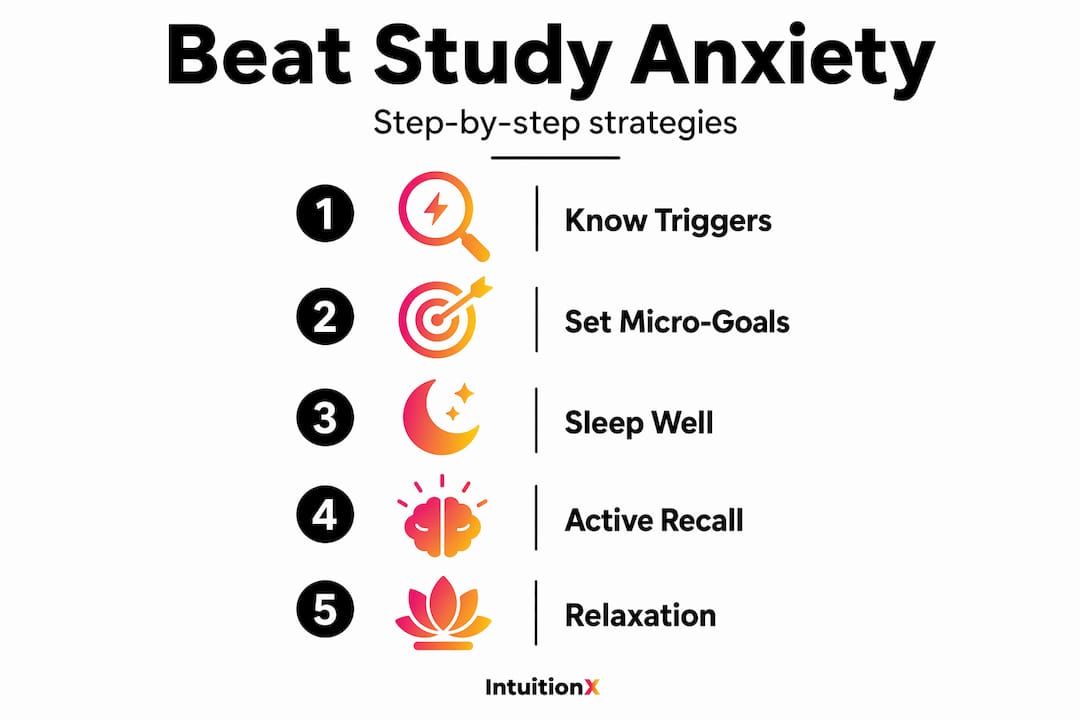
Sleep deserves special attention. Many students sacrifice it to cram more hours, which is counterproductive. A tired brain retains less, processes more slowly, and is far more vulnerable to anxiety. Protecting your sleep is not laziness. It is strategy.
Regular exercise is one of the most underused tools for managing study stress. A half-hour of aerobic exercise measurably reduces test anxiety and speeds up cognitive processing in students. You do not need a gym membership. A brisk walk counts. For practical strategies on building a productive learning workflow, the Boost your teen's learning workflow guide from Intuitionx is worth reading.
Pro Tip: Schedule your first study block to start no later than mid-morning. Willpower and focus peak earlier in the day for most people, so use that window for your hardest material.
Techniques to use during study and exams
This is where you build your toolkit. These are the techniques to reach for when anxiety starts climbing, whether you are sitting at your desk revising or staring at an exam paper.
Breathing techniques:
- Diaphragmatic breathing: Breathe deeply into your belly rather than your chest. Inhale for four counts, hold for two, exhale for six. Research shows that diaphragmatic breathing practised over weeks significantly reduces test anxiety in students.
- 7-7 breathing: Inhale for seven counts, exhale for seven. Use this when you feel acute panic starting, especially during an exam. It activates the parasympathetic nervous system and slows the stress response within minutes.
Mindfulness and progressive muscle relaxation are worth adding to your routine too. With progressive muscle relaxation, you tense and then release each muscle group from your feet upward. This physical release signals to your nervous system that you are safe, which directly counteracts the fight-or-flight response driving your anxiety.
Comparing study methods for anxious students:
| Method | Anxiety impact | Effectiveness |
|---|---|---|
| Passive rereading | Increases anxiety (false familiarity) | Low |
| Highlighting notes | Minimal benefit, often procrastination | Low |
| Active recall / flashcards | Builds genuine confidence | High |
| Practice papers under timed conditions | Reduces overcoming exam nervousness | High |
| Spaced repetition | Reduces last-minute panic | High |
Active recall methods build genuine confidence and reduce test-day panic far better than passive rereading. When you force yourself to retrieve information without looking at your notes, you train your brain to access that information under pressure. That is exactly what an exam demands. For more on applying these approaches effectively, the A Level study tips resource from Intuitionx is practical and specific.
Time-blocking aligned to your natural peak energy reduces procrastination stress and improves the quality of each session. Pair that with positive affirmations before you start. They feel awkward at first, but they genuinely interrupt negative self-talk patterns. Try: "I have prepared for this. I can handle what I do not know."
For students who experience acute panic attacks before or during exams, interoceptive exposure therapy is an evidence-based approach worth knowing about. It involves deliberately inducing the physical sensations associated with panic in a safe environment to reduce the fear response over time.
Pro Tip: Before an exam, spend two minutes writing down your worries on paper. Research from the University of Chicago found that expressive writing before a test frees up cognitive resources that anxiety was consuming.
Common mistakes and how to avoid them
Even students with the best intentions make errors that amplify their anxiety rather than reduce it. Recognising these patterns is half the battle.
- Passive studying disguised as work. Rereading notes, colour-coding highlights, and recopying summaries feel productive but deliver very little. Many students rely on ineffective study techniques because anxiety makes them avoid the harder, more effective methods like testing themselves. Do not let comfort masquerade as preparation.
- Cramming the night before. Last-minute cramming spikes cortisol, disrupts sleep, and does not transfer information to long-term memory. The material you panic-study at midnight is mostly gone by morning.
- Ignoring symptoms. Persistent anxiety that prevents you from studying at all, causes physical symptoms, or significantly affects your daily life deserves professional attention. Cognitive behavioural therapy effectively reduces test anxiety and its results hold at follow-ups of eight months or more. Seeking help is not weakness.
- Negative self-talk spirals. "I am going to fail", "I am not smart enough", "Everyone else finds this easy" are cognitive distortions, not facts. Challenge each one. What evidence actually supports that thought? Usually, very little.
- Procrastination mistaken for rest. Scrolling your phone to avoid studying is not rest. It maintains anxiety without giving your brain any recovery. Genuine breaks include walking, stretching, a short nap, or eating.
For support with nervous learners and confidence, the Intuitionx blog explores the connection between manageable anxiety and improved motivation in detail.
Building long-term anxiety resilience
Managing study anxiety is not a one-off fix. It is an ongoing practice that gets easier the more consistently you work at it.
- Track your anxiety weekly. Use a simple one to ten scale to note your anxiety level before and after each study session. Over time you will see which techniques are genuinely helping and which are not.
- Review your study schedule monthly. Are your micro-goals realistic? Are you leaving enough buffer time? Adjust without guilt when life gets in the way.
- Protect your non-negotiable habits. Sleep, exercise, and at least one genuine rest day per week are not rewards for good studying. They are the infrastructure that makes studying possible.
- Use your support network. Talking to a teacher, counsellor, or trusted friend about academic pressure is not dramatic. It is effective. Combining lifestyle changes, breathing, and cognitive strategies produces the best long-term outcomes, and human connection is part of that picture.
- Reframe your relationship with anxiety. Some nervousness before a test means you care about the outcome. That is not a problem. The goal is to keep it at a level where it sharpens your focus rather than shutting it down entirely.
Resilience is not the absence of anxiety. It is returning to your baseline faster and more confidently every time anxiety spikes.
My honest take on study anxiety
I have worked with hundreds of students who believed their anxiety was a character flaw. It is not. But I have also seen students use anxiety as a reason to avoid the techniques that would actually help them. That is the trap worth warning you about.
The most common misunderstanding I encounter is the belief that calming down is the goal. It is not. The goal is functioning while anxious. The breathing, the micro-goals, the active recall — none of these eliminate anxiety. They shrink it to a size you can work with.
What I have found genuinely works is specificity. Vague plans create vague confidence. When a student tells me "I am going to study harder this week," I know their anxiety will stay high. When they tell me "I am going to do twenty flashcards on photosynthesis at 4pm on Tuesday," something shifts. Specific plans reduce the mental load that feeds anxiety.
The students who improve fastest are not the ones who follow a perfect routine. They are the ones who experiment, notice what works for them personally, and keep adjusting. Your anxiety is not identical to anyone else's. Your strategy should not be either.
There is no single approach that works for every student. But there is always a personal approach that works for you. The work is finding it.
— Angus
How Intuitionx can support your learning
Feeling anxious about studying often comes from feeling underprepared or unsure how to approach difficult material. That is exactly the gap Intuitionx was built to close.
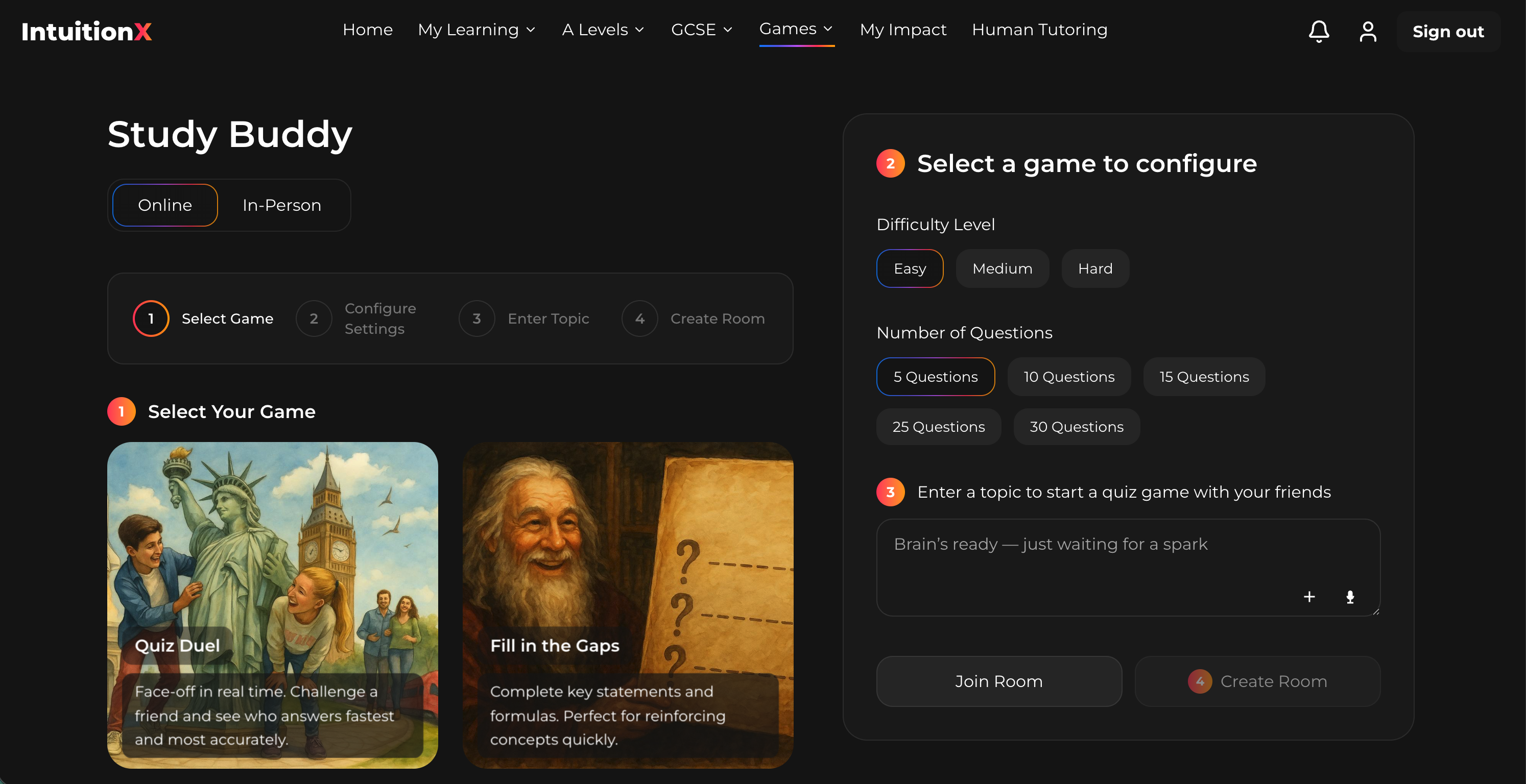
Intuitionx is a 24/7 Socratic AI tutor built on Oxbridge-level expertise. Rather than writing answers for you, it asks the right questions to help you actually understand the material, building the genuine confidence that is the best long-term remedy for study anxiety. Backed by Sir Anthony Seldon and built with memory science at its core, it gives every student access to the kind of personalised support that used to cost £150 an hour. Start learning with Intuitionx today and discover what it feels like to walk into an exam actually prepared.
FAQ
What is study anxiety and how do I know if I have it?
Study anxiety is a form of performance-related stress that causes physical symptoms like a racing heart, emotional symptoms like dread, and cognitive symptoms like memory blanks. If these feelings regularly interfere with your ability to study or perform in exams, study anxiety is likely a factor.
How can I calm down quickly before or during an exam?
Use 7-7 breathing: inhale for seven counts and exhale for seven counts. Practising diaphragmatic breathing regularly in the weeks before an exam produces the strongest results, but even a few cycles in the moment will slow your stress response noticeably.
Does exercise actually help with study stress?
Yes. Thirty minutes of moderate aerobic exercise reduces subjective anxiety and improves cognitive processing speed in students immediately after the session. Even a brisk walk counts and requires no equipment.
When should I seek professional help for exam anxiety?
If anxiety is preventing you from studying consistently, causing frequent panic attacks, or significantly affecting your daily life, speak to a GP, school counsellor, or mental health professional. Cognitive behavioural therapy is well-evidenced for test anxiety with lasting results at follow-up.
What is the most effective study method for anxious students?
Active recall, such as flashcards and practice papers done without notes, consistently outperforms passive methods. It builds real confidence rather than false familiarity, which is the main reason students panic when the exam paper arrives.