

TL;DR:
- Academic engagement is a complex, multidimensional process that involves cognitive, behavioural, affective, and agentic involvement in learning. It influences not only academic success but also mental health, self-regulation, and long-term personal growth. Effective measurement requires multiple approaches, and both students and educators can improve engagement through targeted, active strategies.
Academic engagement is one of those terms that gets used constantly in schools and universities, yet rarely explained properly. Most people assume it simply means turning up and putting your hand up occasionally. It doesn't. What is academic engagement, really? It's a multidimensional construct that shapes how deeply you connect with learning, how you feel about it, and whether you actively drive it forward. Get a clear grasp of this, and you'll understand why some students thrive while others coast along without ever truly learning.
Table of Contents
- Key takeaways
- The real definition of academic engagement
- Why academic engagement matters
- The challenge of measuring academic engagement
- How to improve academic engagement
- Academic engagement vs related concepts
- My honest take on why this gets misunderstood
- How Intuitionx can help you engage more deeply
- FAQ
Key takeaways
| Point | Details |
|---|---|
| Engagement has four dimensions | Cognitive, behavioural, affective, and agentic engagement each contribute uniquely to learning success. |
| Attendance alone isn't engagement | A student can be physically present but cognitively and emotionally absent, which skews how we measure progress. |
| Engagement predicts outcomes | Strong academic engagement is linked to better performance, persistence, and psychosocial development. |
| Measurement is genuinely difficult | Inconsistent definitions across research mean engagement is often measured in ways that miss the full picture. |
| Both students and educators play a role | Engagement improves when students take initiative and when educators design interactions that demand genuine thinking. |
The real definition of academic engagement
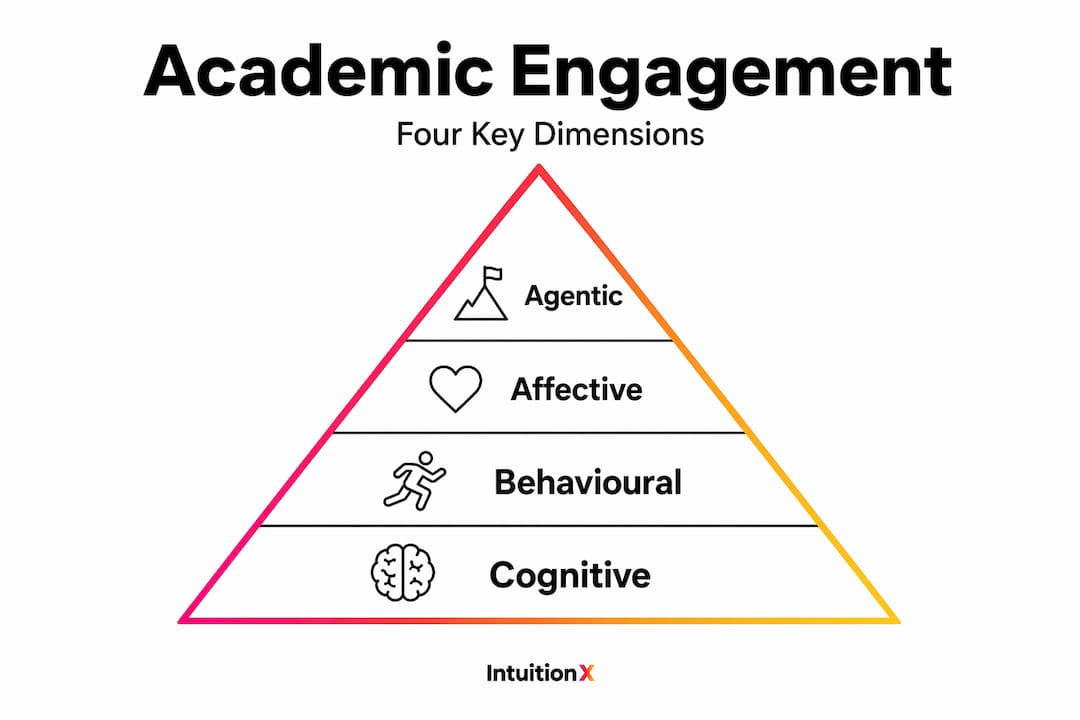
Researchers broadly agree that academic engagement is multidimensional, comprising cognitive, behavioural, and affective dimensions. A more recent framework adds a fourth: agentic engagement. Each one matters. None of them alone tells the full story.
Here's how they break down:
- Cognitive engagement refers to the mental effort you invest. Are you processing information deeply, connecting new ideas to what you already know, using strategies like self-testing or elaboration? Or are you skimming the surface?
- Behavioural engagement covers the visible stuff: attending class, completing tasks, participating in discussions, submitting work on time.
- Affective engagement is about your emotional relationship with learning. Do you find the subject interesting? Do you feel anxious before exams? Do you feel a sense of belonging in your learning environment?
- Agentic engagement is arguably the most powerful. This is where students proactively ask questions, express opinions, request feedback, and take ownership of their learning rather than waiting to be guided.
The table below contrasts these dimensions at a glance:
| Dimension | Core question | Example behaviour |
|---|---|---|
| Cognitive | Am I thinking deeply? | Using past papers to test recall, not just rereading notes |
| Behavioural | Am I showing up and doing the work? | Consistent attendance, meeting deadlines |
| Affective | How do I feel about learning? | Feeling curious about a topic or anxious before a test |
| Agentic | Am I actively shaping my learning? | Asking the teacher to explain a concept differently |
These dimensions interact constantly. A student who is behaviourally engaged but cognitively disengaged is going through the motions. A student who is affectively engaged but lacks agentic confidence may love a subject yet never push beyond the minimum. Real engagement means all four dimensions are firing together.
Why academic engagement matters
The importance of academic engagement goes well beyond getting better grades. Research describes engagement as the "holy grail of learning", influencing not just academic performance but skills development, self-concept, and long-term personal growth.
Here's what the evidence tells us about the benefits of academic engagement:
- Students who are genuinely engaged show stronger academic persistence. They are less likely to drop out and more likely to push through difficulty.
- Engagement supports better mental health outcomes. When students feel connected to their learning and their academic community, anxiety and disengagement decrease.
- Agentic engagement in particular builds self-regulation. Students who practise asking questions and taking initiative develop metacognitive skills that serve them far beyond any single subject.
- Deep cognitive engagement produces transferable thinking skills. Students learn how to think, not just what to think.
The numbers add weight to this. In the UK, 73% of students are not actively engaged in their learning. In the US, 80% of students report feeling bored in class and 91% say they feel nervous about asking questions. These aren't just statistics about satisfaction. They are signals of lost potential, at scale.
Pro Tip: If you're a student, notice which of the four engagement dimensions feels weakest for you. Fixing the bottleneck in your own engagement profile is more effective than generic study advice.
The challenge of measuring academic engagement
Here's where things get complicated. Understanding academic engagement is one thing. Measuring it accurately is another challenge entirely. A 2026 PLOS ONE study highlights how inconsistent definitions across research make it genuinely difficult to measure engagement with precision.
The biggest trap educators fall into is relying on simplistic indicators like attendance. A student can be physically present in every lecture and mentally somewhere else entirely. Conversely, a student who misses one session but engages deeply in independent study may be far more cognitively engaged than their attendance record suggests.
| Measurement approach | What it captures | What it misses |
|---|---|---|
| Attendance records | Behavioural presence | Cognitive and affective states |
| Assignment completion rates | Task-level behavioural engagement | Quality of thinking invested |
| Self-report surveys | Affective and cognitive self-perception | Actual behaviour patterns |
| Observation and interaction | Visible participation and agentic behaviour | Internal cognitive processes |
There's also an important distinction to draw. Engagement in learning activities is meaningfully different from engagement with the broader academic community, such as joining societies, attending events, or forming peer study groups. Both matter, but they are not the same thing and should not be measured with the same tools.
Pro Tip: Educators: combine at least two measurement methods, for example a short reflective survey alongside participation tracking, to get a more honest picture of where your students actually are.
How to improve academic engagement
Both students and educators can take concrete steps to build stronger engagement. The research points to specific, evidence-based approaches rather than vague encouragements to "try harder" or "make lessons more fun."
For students looking to improve academic engagement, these steps make a measurable difference:
- Practise agentic behaviours deliberately. Ask at least one question per class or study session, even if it feels uncomfortable. The discomfort fades. The habit builds.
- Self-monitor your cognitive engagement. After studying, close your notes and explain the concept out loud. If you can't, you weren't cognitively engaged. Go back.
- Acknowledge your affective state honestly. If anxiety or boredom is blocking engagement, name it and address it directly rather than pushing through with low-quality effort.
- Connect new learning to what you already know. This is one of the most powerful cognitive engagement strategies. Linking new concepts to existing knowledge deepens processing significantly.
- Seek feedback proactively. Don't wait for grades. Ask teachers or peers to challenge your thinking before assessment.
For educators, the approach is just as specific. Research from the University of Washington confirms that regular instructor-initiated interactions are one of the most effective drivers of engagement in online learning. The key word is instructor-initiated. You cannot assume students will engage independently, particularly in digital environments. Design interactions that require genuine thinking, not just passive reading.
Designing activities that target all four engagement dimensions simultaneously produces the best results. A group problem-solving task, for example, can generate affective engagement through collaboration, cognitive engagement through challenge, behavioural engagement through participation, and agentic engagement through student-led discussion. One well-designed activity can do the work of four mediocre ones. You can explore more on this through these evidence-based engagement strategies.

Academic engagement vs related concepts
Engagement is often confused with motivation, participation, and social engagement. They are related. They are not the same thing.
| Concept | Definition | Relationship to academic engagement |
|---|---|---|
| Motivation | The desire or drive to learn | Motivation can lead to engagement, but a student can be motivated yet still not engage deeply |
| Participation | Observable actions in class | Participation is part of behavioural engagement, but engagement is broader |
| Social engagement | Connection with peers and academic community | Overlaps with affective engagement but is a separate construct |
| Academic engagement | Deep, multidimensional involvement in learning | The overarching construct that includes cognitive, behavioural, affective, and agentic elements |
Why does this matter? Because if a teacher thinks participation equals engagement, they may celebrate a lively classroom discussion while missing the fact that half the students are parroting answers without understanding. If a student equates motivation with engagement, they might feel ready to work without ever actually doing the deep cognitive processing that produces real learning.
Precise understanding here improves practice at every level. It helps students self-diagnose accurately and helps educators design better interventions.
It's also worth noting the distinction between community-level engagement and learning engagement. The Carnegie Foundation defines community engagement as collaborative university partnerships with public and private sectors to serve the broader public good. That's a genuinely different use of the term from what we're discussing here, and conflating the two leads to muddled thinking about what actually drives student learning outcomes.
My honest take on why this gets misunderstood
I've spent years watching the engagement conversation get flattened in educational settings, and the pattern is predictable. Schools celebrate behavioural metrics because they're easy to count. Attendance percentages go up, assignment completion rates improve, and everyone feels progress is being made. But when you look closely at cognitive and affective engagement, the picture is far less encouraging.
What I've found is that students who understand the four-dimensional nature of their own engagement become significantly better learners, almost immediately. When a student recognises that they are behaviourally compliant but cognitively passive, that awareness itself creates a shift. It's not about working harder. It's about working in a way that actually connects.
The uncomfortable truth is that a lot of traditional schooling optimises for behavioural engagement because it's manageable and visible. Cognitive and agentic engagement require more trust, more discomfort, more genuine dialogue between student and educator. That's harder to build. But it's where all the outcomes actually live.
My advice to any student reading this: stop asking "am I doing enough?" Start asking "am I actually thinking?"
— Angus
How Intuitionx can help you engage more deeply
If you've recognised gaps in your own engagement profile, you're already ahead of most students. The next step is doing something about it.

Intuitionx is a 24/7 Socratic AI tutor built on Oxbridge-level pedagogy. It doesn't write your essays for you. It asks the questions that make you think, targeting cognitive and agentic engagement specifically. Every conversation is designed around the way the world's best educators actually teach: with challenge, memory science, and genuine intellectual dialogue. Whether you're a student wanting to transform your learning results or an educator looking for tools that go deeper than participation tracking, Intuitionx is built precisely for this. Try it at IntuitionX and start learning like the 1%.
FAQ
What is the definition of academic engagement?
Academic engagement is a multidimensional construct involving cognitive, behavioural, affective, and agentic dimensions. It describes how deeply a student thinks, participates, feels, and takes initiative in their learning.
Why is academic engagement important?
Strong academic engagement is linked to better academic performance, greater persistence, improved mental health, and the development of self-regulation skills that extend well beyond any single subject.
How is academic engagement measured?
Measuring academic engagement accurately is genuinely difficult because definitions vary across research. Reliable measurement combines multiple methods, including self-report surveys, behavioural tracking, and direct observation, to capture the full range of dimensions.
What is the difference between motivation and academic engagement?
Motivation is the desire to learn, whereas academic engagement is the active, multidimensional process of learning itself. A student can be highly motivated yet still fail to engage cognitively or agentically.
What promotes academic engagement most effectively?
Agentic behaviours such as asking questions and seeking feedback, combined with educator-initiated interactions and activities that require deep thinking, are among the most evidence-based drivers of genuine academic engagement.