
TL;DR:
- The US education decline began in 2013, well before the pandemic, and COVID-19 only deepened existing gaps.
- Recovery since 2022 is uneven, with middle-income districts lagging behind high- and low-income districts due to resources and support deficits.
- Addressing root causes like socioeconomic inequality, digital divide, instructional approaches, and absenteeism is essential for meaningful reform.
Most people assume COVID-19 created the education crisis. The truth is more uncomfortable. US learning decline started in 2013, years before any lockdown, and the pandemic simply accelerated a fall that was already well underway. Understanding education gaps properly means confronting that reality head-on. Whether you are a teacher, a policymaker, or a parent trying to make sense of what is happening in classrooms, this article gives you the context, the causes, and the evidence-based responses that actually work.
Table of Contents
- Key takeaways
- How education gaps have evolved over time
- Why educational divides exist: the root causes
- The real impact of education inequality
- Evidence-based solutions for education gaps
- My perspective on systemic change
- How IntuitionX can help close the gap
- FAQ
Key takeaways
| Point | Details |
|---|---|
| Gaps predate the pandemic | US achievement was declining from 2013, so returning to pre-pandemic levels is not a sufficient goal. |
| Recovery is uneven | High- and low-income districts are recovering faster than middle-income districts, revealing a U-shaped pattern. |
| Multiple causes interact | Socioeconomic inequality, the digital divide, poor instructional design, and absenteeism all compound each other. |
| Curriculum and teaching matter | Structured, knowledge-rich teaching reduces attainment gaps more reliably than discovery-led approaches. |
| Technology alone is not enough | Devices without digital skills training and quality content widen gaps rather than close them. |
How education gaps have evolved over time
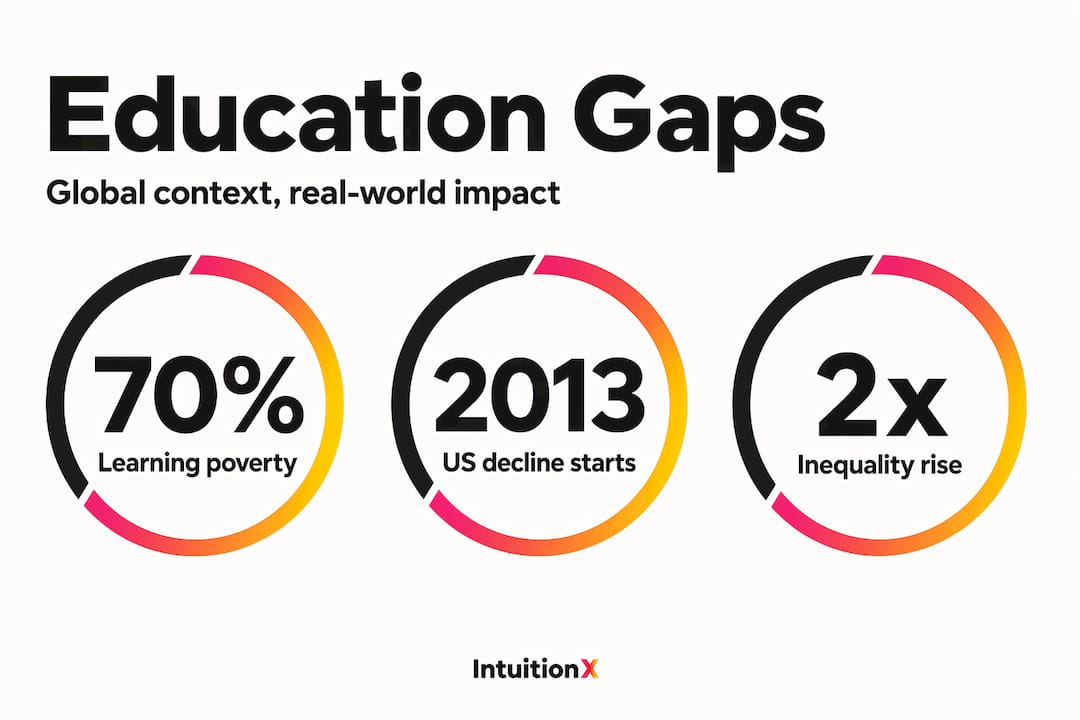
The idea that education gaps are a post-pandemic problem is one of the most persistent and damaging misconceptions in the field. Grade 8 reading scores are at their lowest since 1990, and Grade 4 scores have fallen to pre-2003 levels. The decline traces back to around 2013, linked to the dismantling of test-based accountability systems and the rapid rise of social media among young people. COVID-19 did not create these gaps. It deepened them dramatically.
Globally, the picture is even starker. Learning poverty rose to 70% in low- and middle-income countries by 2022, with extended school closures averaging 224 days affecting 1.6 billion learners worldwide. When children miss months of foundational instruction, the knock-on effects last for years.
In the US, the post-2022 recovery period has revealed a striking and counterintuitive pattern. The recovery is not uniform. It is U-shaped.
| District type | Recovery since 2022 |
|---|---|
| High-income districts | Strong improvement |
| Low-income districts | Moderate to strong improvement |
| Middle-income districts (30–70% subsidised lunches) | Weakest recovery, lagging behind |
Middle-income districts have seen the least improvement since 2022, caught in a difficult middle ground. They lack the targeted federal support that benefits the lowest-income schools, yet they do not have the private resources of wealthier districts. Understanding the education divide means recognising that vulnerability does not always look the way we expect it to.
Why educational divides exist: the root causes
There is no single cause behind education disparities. The drivers are layered, and they reinforce each other. Here are the most significant ones.
- Socioeconomic inequality. Families with higher incomes can afford private tutors, enrichment programmes, and better-resourced schools. Wealthy families spend up to $150 an hour on private tutors, while disadvantaged students have far less support outside the classroom.
- The digital divide. This goes well beyond device access. Over one-third of teachers report insufficient internet access to support student needs, and 60% of students face slow connectivity. Low-income and marginalised students bear the brunt of this.
- Instructional approaches. Student-led discovery over structured direct teaching can widen attainment gaps for disadvantaged pupils. Students who lack academic support at home depend far more heavily on explicit, well-sequenced instruction in the classroom.
- Policy and system mindsets. Education reform is often hindered by defensive, system-protection thinking rather than genuine funding limitations. Political battles dominate at the expense of evidence-based change.
- Chronic absenteeism. Student absenteeism remains at 23% in 2024–25, compared to 15% before the pandemic. Researchers estimate that if absenteeism alone had returned to pre-pandemic levels, academic recovery would be measurably larger.
The digital divide deserves particular attention because it is so often misunderstood. Giving every child a laptop does not close the gap. Merely providing devices without training limits the effectiveness of digital inclusion efforts. Without digital literacy skills and quality instructional content, technology can actually widen the gap by giving wealthier students more sophisticated tools while others use the same devices for passive consumption.
Pro Tip: When assessing barriers to education in your school or district, map the problem across all three layers of the digital divide: access, skills, and meaningful instructional use. Most schools only address the first.
The real impact of education inequality
The consequences of education disparities are not just academic. They are deeply personal, and they compound over time.
Students growing up in learning poverty face reduced lifetime earnings, narrower career choices, and diminished civic participation. This is not a marginal effect. It reshapes life trajectories.

Motivation is another casualty. Credential-focused education systems risk harming intrinsic motivation, reducing peer relationships, and deepening social divisions. When school becomes a transaction, something to survive rather than genuinely engage with, students disengage. The data backs this up sharply. In the UK, 73% of students are not actively engaged in learning. In the US, 80% of students report being bored, and 91% say they feel nervous about asking questions in class.
That last figure should stop every educator in their tracks. Nearly every student, sitting in silence, afraid to ask for help.
"The harm in education inequality is not just in what students don't learn. It is in what they come to believe about themselves as learners."
Absenteeism and poor digital literacy compound this picture. Students who miss school consistently fall further behind, and those who lack the skills to use technology for genuine learning miss out on educational technology trends that are reshaping access to high-quality instruction. The gap between engaged and disengaged students is not just a performance gap. It is a confidence gap, and it widens every year.
Evidence-based solutions for education gaps
There are genuine, research-backed approaches that work. The challenge is committing to them at scale.
- Reform literacy instruction. States that have implemented science of reading reforms, including Tennessee, Mississippi, and Louisiana, have seen measurable improvements. States without these reforms continued to decline. Early literacy is foundational. Getting it right has a multiplier effect.
- Invest in targeted tutoring and small group support. High-dosage tutoring, specifically three or more sessions per week, produces consistent gains for disadvantaged students. Personalised tutoring approaches that adapt to individual needs show particular promise when deployed at scale.
- Adopt structured, knowledge-rich curricula. Knowledge-based, well-structured curricula significantly raise attainment and reduce inequality compared to learner-led, cross-curricular approaches. Evidence from Scottish schools shows this clearly. Expert, teacher-led instruction matters most for pupils who have the least support at home.
- Close the digital divide properly. Go beyond distributing devices. Train teachers in digital pedagogy, give students structured digital literacy programmes, and audit whether technology use in your school actually promotes learning or replaces it.
- Address absenteeism directly. Work with families, community organisations, and mental health professionals to understand why students are missing school. Attendance is not just a compliance issue. It is a learning equity issue.
A simple comparison illustrates the gap between surface-level and genuine digital inclusion:
| Approach | What it addresses | What it misses |
|---|---|---|
| Device distribution | Hardware access | Skills, content quality, instructional design |
| Internet access schemes | Connectivity | Meaningful use, teacher training |
| Full digital inclusion model | Access, skills, and pedagogy | Nothing. This is the actual goal. |
Pro Tip: When evaluating solutions for education gaps in your context, ask one question: does this approach give every child the same quality of instruction and support that a wealthy family would pay for privately? If not, the gap remains.
My perspective on systemic change
I have spent a long time looking at why education systems fail students, and the honest answer is rarely "not enough money." It is almost always about entrenched mindsets and political incentives that prioritise system stability over student outcomes.
The uncomfortable reality is that returning to pre-pandemic attainment levels is not actually a success. Those levels were already in decline. What we need is not recovery. We need genuine reform, and that requires adults being honest about what has not been working for years.
What gives me genuine optimism is the evidence from districts that have committed to structured teaching, early literacy reform, and deliberate community engagement. These are not wealthy districts doing extraordinary things. They are committed educators making smart, evidence-led decisions. That is replicable.
Technology, used thoughtfully, is one of the most powerful tools we have for addressing learning gaps at scale. But it has to be the right kind of technology. Not passive content delivery or AI that simply does the work for students. The kind that asks questions, probes thinking, builds real understanding, and adapts to the individual in a way no class of thirty pupils could ever allow one teacher to do alone.
The students who need the most support are often the least likely to ask for it. That is the gap we have to close first.
— Angus
How IntuitionX can help close the gap

If what you have read here has confirmed what you already suspect, that the system is not working for too many students, then Intuitionx was built precisely for this moment. Intuitionx is a 24/7 Socratic AI tutor trained on Oxbridge-level academic knowledge, designed to give every student the kind of personalised, challenging, and genuinely engaging instruction that wealthy families pay top tutors to provide. No passive essay writing. No generic responses. Real learning, through real dialogue. Visit IntuitionX to see how it works, and discover why Sir Anthony Seldon calls it essential for anyone serious about staying ahead in the age of AI.
FAQ
What are education gaps and why do they matter?
Education gaps are measurable differences in academic achievement, access, and opportunity between groups of students, typically linked to income, geography, or background. They matter because they directly shape lifetime outcomes, from earnings to health to civic participation.
Did COVID-19 cause the current education crisis?
No. US achievement was already declining from 2013 onwards. The pandemic significantly worsened existing disparities but did not create them.
What is the most effective solution for closing education gaps?
Research consistently supports a combination of structured, knowledge-rich teaching, early literacy reform, and high-dosage tutoring. Technology accelerates progress when paired with proper teacher training and quality instructional design, not when used as a substitute for either.
Why are middle-income districts recovering more slowly?
Middle-income districts lack targeted federal funding directed at high-poverty schools but also lack the private resources of wealthy areas. This U-shaped recovery pattern leaves them caught in the middle, with the least support and the slowest progress since 2022.
How does absenteeism affect learning recovery?
Chronic absenteeism affects 23% of US students in 2024–25, up from 15% pre-pandemic. Researchers estimate that returning to pre-pandemic attendance rates alone would produce a measurable gain in academic recovery across all districts.