

TL;DR:
- Flexible, autonomy-supportive study strategies lead to better engagement and less stress for children.
- Creating a distraction-free environment and incorporating active revision techniques significantly enhance learning outcomes while promoting independence.
You want your child to do well at school. But sitting down with them at homework time can quickly turn into a battle of wills. How much help is too much? When does encouragement tip over into pressure? These are the real questions parents face, and the answer is rarely found in a rigid routine or a stack of revision guides. The good news is that research-backed study tips for parents point in a clear direction: flexible, autonomy-supportive strategies consistently outperform pressure and micromanagement. This guide gives you exactly that.
Key takeaways
| Point | Details |
|---|---|
| Flexible routines beat rigid schedules | Weekly planning with adaptable study blocks reduces conflict and sustains engagement better than daily timetables. |
| Environment matters as much as technique | A quiet, distraction-free space with materials ready in advance significantly improves focus and concentration. |
| Active revision works; rereading does not | Encourage past papers, flashcards, and self-quizzing rather than passive note-reading for better memory retention. |
| Autonomy-supportive parenting reduces distraction | Offering choices and validating feelings improves homework time management and lowers distraction. |
| Micro-moments sustain learning across breaks | Integrating literacy into everyday tasks like cooking or shopping keeps skills sharp without extra pressure. |
1. Build a flexible study routine that actually fits your family
The phrase "study habits guide for parents" gets thrown around a lot, but most advice defaults to the same rigid template: same desk, same time, every day. Real family life does not work like that.
Short, structured study blocks of 30 to 60 minutes, combined with regular breaks, are more effective than marathon revision sessions. Your child retains more, stays focused longer, and is far less likely to hit a wall of frustration.
Here is what a realistic weekly approach looks like:
- Identify three or four realistic study windows across the week, not just after school on weekdays.
- Let your child have input into when those windows fall. Buy-in matters enormously.
- If Tuesday goes wrong because of football practice or a difficult day, shift that block to Saturday morning. No drama, no guilt.
- Keep blocks to one subject where possible so your child can build momentum rather than context-switch constantly.
The key insight from the research is this: flexible weekly planning works better than rigid daily schedules because it allows the whole family to adapt without abandoning the plan entirely.
Pro Tip: Treat the weekly study plan like a portfolio. If a session gets missed, the target is still to hit the weekly total. This removes the all-or-nothing thinking that derails so many children's revision.
2. Create a home environment that sets your child up to focus
You do not need a purpose-built study room. You do need a space that signals "this is work time" clearly and consistently.
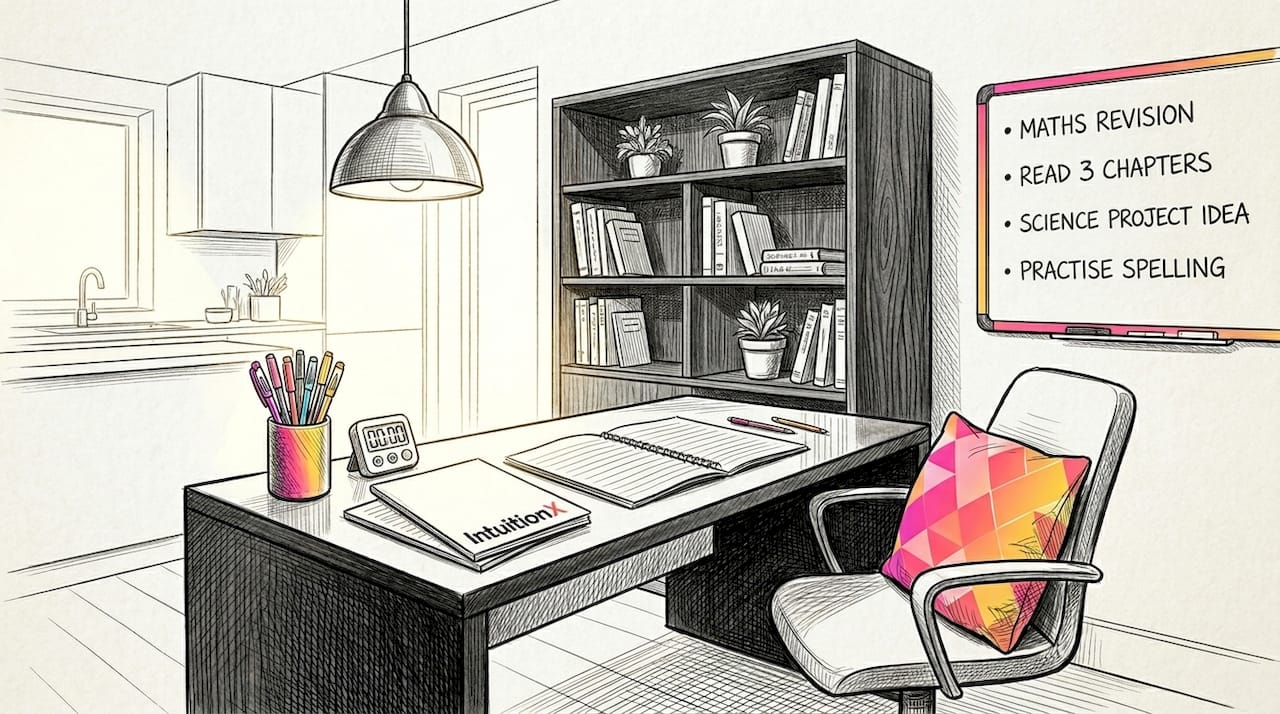
A quiet, well-lit study area free from phone distractions, with all necessary materials prepared in advance, makes a measurable difference to concentration. The prep matters as much as the place.
Consider these practical adjustments:
- Put the phone in another room, or use an app that locks distracting platforms during study blocks.
- Have the right equipment ready before the session starts: textbooks, stationery, a glass of water. Searching for a ruler mid-session breaks concentration and gives an excuse to wander off.
- If your home is noisy, low-level background sounds or white noise can help some children focus better than silence.
- Talk to younger siblings about study time being protected time. Even small children can understand "your brother is working right now."
Exam preparation also has a practical dimension most parents overlook. Preparing exam day practicalities such as a good breakfast, travel time, and the right equipment reduces student anxiety and helps your child arrive calm and ready.
Pro Tip: Do a five-minute "study setup" ritual together before each session. Clear the desk, close irrelevant tabs, check the task list. It sounds small but it creates a mental transition from home mode to work mode.
3. Use active revision techniques, not passive ones
Most children revise by reading their notes. It feels productive. It almost never is.
Active revision techniques like past papers, flashcards, self-quizzing, and teaching concepts aloud to another person have consistently stronger effects on memory and exam performance than rereading. Your role as a parent here is not to teach the content. It is to create the conditions where active recall happens.
What does that look like in practice?
- Ask your child to explain a topic to you as if you know nothing. You do not need to assess whether their answer is right. The act of retrieving and articulating the information is what builds the memory.
- Sit with them while they do a timed past paper, then leave the marking to them using the mark scheme. Self-assessment builds metacognitive skills.
- Flashcard apps make self-quizzing easy and portable, useful for short gaps between other activities.
Autonomy-supportive parenting has a measurable positive correlation with time spent on homework (β=0.37, p<.01) and a significant negative correlation with distraction (β=0.30, p<.01). In plain terms: when you offer choices and validate your child's feelings rather than directing their every move, they study more and get distracted less.
"Effective parental support includes empathic listening and offering meaningful choices rather than pressure." — Support me and I'll do better
Pro Tip: Instead of asking "have you done your revision?", try "what are you planning to work on tonight?" It is a small shift in language, but it hands ownership back to your child rather than positioning you as the enforcer.
For a deeper look at which revision methods are worth your child's time, the Intuitionx breakdown of revision techniques that work is worth exploring together.
4. Weave learning into everyday family routines
Homework support for parents does not always mean sitting at a desk. Some of the most effective learning happens in the gaps of ordinary life.
Integrating literacy into everyday tasks like writing a grocery list, reading a recipe, or following instructions for a flat-pack shelf maintains skills without adding extra time pressure. This matters most during school holidays when skills can slide without anyone noticing.
Here are some low-effort, high-impact habits:
- Turn on closed captions while watching TV. This reinforces word recognition and spelling passively and without any effort from you or your child.
- Involve your child in writing the shopping list or planning a meal. Real-world writing tasks carry more meaning than worksheets.
- Read alongside your child rather than just telling them to read. Parallel activity normalises reading as something adults do too, not just a chore for children.
- For younger children especially, micro-moments of learning woven into the school run or mealtime conversation are genuinely effective at maintaining continuity.
These habits work particularly well during summer holidays when the risk of learning loss is highest. They do not feel like studying to your child, which is exactly why they work.
Pro Tip: Set a family reading window of just 15 minutes before bed. Everyone reads their own book. No testing, no pressure. It builds the habit and keeps reading feeling like a pleasure rather than a task.
5. Introduce the Pomodoro technique for structured focus
Time management is one of the most underdeveloped skills in young learners, and one of the most straightforwardly teachable. The Pomodoro technique is a simple but effective tool that fits neatly into a parental study skills toolkit.
The method works like this:
- Set a timer for 25 minutes of focused work.
- When the timer goes, take a five-minute break. Get up, move, do something different.
- After four cycles, take a longer break of 20 to 30 minutes.
- Before starting each block, agree on one specific goal. "Revise biology" is too vague. "Complete ten flashcards on the cell cycle" is precise enough to act on.
The Pomodoro technique improves retention and reduces burnout by protecting both focus and recovery time. The key mistake parents make when introducing this method is setting the interval too long for the child's age or the subject's complexity.
| Child's age | Recommended focus block | Break length |
|---|---|---|
| 7 to 10 years | 15 to 20 minutes | 5 minutes |
| 11 to 13 years | 20 to 25 minutes | 5 minutes |
| 14 to 16 years | 25 to 30 minutes | 5 to 10 minutes |
| 17 years and above | 30 to 45 minutes | 10 minutes |
Pro Tip: Let your child control the timer. When they start and stop it themselves, they feel in charge of their own focus, not managed by you. It is a small but meaningful shift in ownership.
6. Prioritise the quality of your involvement, not the quantity
This is perhaps the most counterintuitive of all the educational strategies for parents in this guide: doing less is often more effective.
Home environment and attitude often have as much impact on study success as the revision techniques themselves. A calm, encouraging atmosphere where effort is recognised consistently beats a high-pressure household where grades are the only currency.
What this looks like in practice:
- Celebrate effort and improvement, not just results. "You stuck at that for 40 minutes, that is impressive" matters more than "what did you get?"
- When your child is stuck, resist jumping in with the answer. Ask "what do you think you should try first?" This builds problem-solving habits rather than dependency.
- Autonomy-supportive behaviours help adolescents internalise study tasks and increase their motivation and self-regulation over time.
- If your child does not want you involved in a particular subject, that is fine. Your job is to create the conditions for learning, not to deliver it.
For parents supporting older students, Intuitionx's guide on A Level exam preparation gives subject-specific support strategies that complement everything covered here.
My honest take on supporting your child's study
I have seen a lot of well-meaning parental involvement backfire, not because the parents did not care, but because they cared so visibly that the child stopped feeling like studying was their own project. The pressure to perform becomes the loudest thing in the room.
What actually works, in my experience, is the quieter approach. Set up the environment. Ask the right questions. Then step back. Your child needs to feel that their academic progress belongs to them.
I have also seen parents treat flexibility as failure. If the Tuesday session did not happen, they feel they have let their child down. They have not. Rigid parental pressure often backfires. Focusing on creating positive conditions and encouragement leads to better buy-in every time.
The relationship you maintain with your child during exam periods matters more than any specific technique. A child who trusts that you are on their side, not judging their performance, is far more likely to come to you when they are genuinely struggling.
Celebrate the effort. Protect the relationship. The grades will follow.
— Angus
Give your child a thinking partner that never runs out of patience
Knowing the right strategies is one thing. Having support available at 10pm when your child is stuck on a GCSE chemistry question is another.

Intuitionx is a 24/7 AI tutor built on Oxbridge-level pedagogy that asks questions rather than just giving answers. It guides your child to think through problems themselves, building exactly the kind of independent learning habits this guide has covered. Whether it is a quick check on a flashcard session, help structuring a revision plan, or deep Socratic dialogue on a tricky concept, Intuitionx is the study support tool your child can turn to any time. Try it alongside the strategies in this guide and see the difference active, supported learning makes.
FAQ
How long should my child study each session?
Study blocks of 30 to 60 minutes with short breaks in between are more effective than long uninterrupted sessions. Younger children may need shorter blocks of 15 to 20 minutes.
What is the best revision technique parents can encourage?
Active methods such as past papers, flashcards, and self-quizzing produce better memory retention than rereading notes. Encouraging your child to explain topics back to you is one of the most effective techniques available.
How can I help without taking over my child's revision?
Autonomy-supportive parenting works better than directive involvement. Offer choices, ask questions rather than giving answers, and let your child set the agenda for their own study sessions.
How do I keep my child learning during school holidays?
Integrating literacy into everyday tasks such as writing shopping lists, reading recipes, and watching TV with closed captions maintains skills without adding formal study pressure.
What is the Pomodoro technique and is it suitable for children?
The Pomodoro technique uses timed focus blocks followed by short breaks. It is suitable for children of all ages when the block length is adjusted for their age and the subject, starting as short as 15 minutes for younger learners.