

TL;DR:
- Socratic tutoring involves guided questioning that helps teenagers develop understanding through their own reasoning. It enhances critical thinking, confidence, and analytical skills especially in humanities subjects like history and literature. Proper preparation, discipline, and the strategic use of AI tools support effective at-home sessions that foster genuine independent thought.
Socratic tutoring is defined as a method of guided questioning where a parent or tutor helps a teenager arrive at understanding through their own reasoning, rather than by receiving direct answers. In humanities subjects such as history, philosophy, and literature, this approach builds the critical thinking, communication, and analytical skills that traditional instruction often neglects. Research confirms that Socratic learning outcomes include increased confidence, resilience, and genuine ownership of learning. This parent guide to Socratic tutoring walks you through everything you need: preparation, session structure, common pitfalls, and how tools like Intuitionx can support you along the way.
What is a parent guide to Socratic tutoring?
The Socratic method, named after the Greek philosopher Socrates, is the recognised educational term for what many parents call "guided questioning." In practice, it means you ask your teenager a question, listen carefully to their answer, and then ask another question that pushes their thinking one step further. You are not the expert delivering facts. You are the facilitator helping them discover meaning themselves.

For humanities subjects, this matters enormously. When a teenager studies the causes of the First World War or analyses a speech by Martin Luther King Jr., there is rarely one correct answer. There are interpretations, arguments, and evidence to weigh. The Socratic method trains teenagers to do exactly that. Parents who shift from lecturer to facilitator give their children something far more valuable than correct answers: the ability to construct their own.
The benefits of Socratic dialogue are not abstract. Teenagers who practise this method regularly develop stronger essay writing, more confident classroom participation, and better performance in subjects that demand argument and interpretation. That is precisely why elite schools and Oxbridge tutorials have used this approach for centuries.
How to prepare before your first Socratic session
Preparation is the single most common failure point for parents attempting Socratic tutoring at home. The good news is that you do not need to be a subject expert. You need a clear structure, the right questions, and the right mindset.
Start with these preparation steps:
- Choose a focused topic. Pick one specific question or text rather than a broad theme. "What motivated Napoleon's ambitions?" works far better than "Let's talk about Napoleon."
- Generate your question sequence. AI can create Socratic lesson plans in under five minutes. Use a tool to draft five to eight questions that move from recall to analysis to evaluation.
- Anticipate your teenager's responses. Think through two or three likely answers to each question so you can follow up naturally without freezing.
- Set ground rules together. Formal ground rules covering respectful listening, turn-taking, and the explicit absence of "wrong answers" create the psychological safety teenagers need to think aloud without fear.
- Prepare your environment. Remove distractions, sit at a table rather than on sofas, and have the source text or notes visible to both of you.
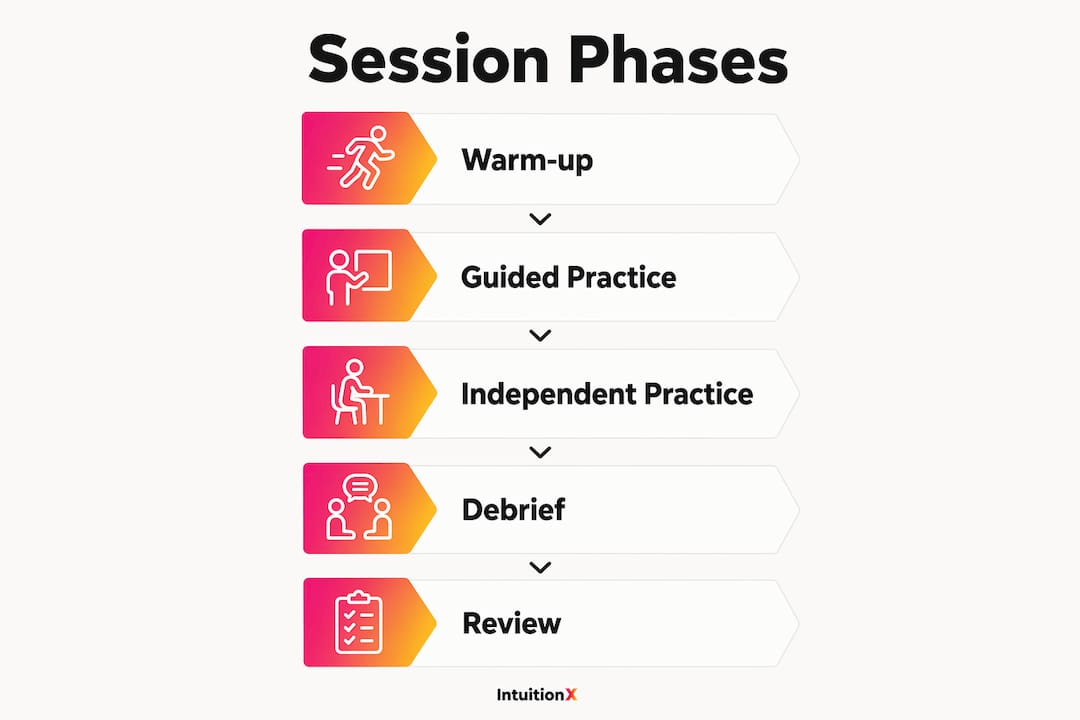
The recommended session length is approximately 60 minutes, structured as follows:
| Phase | Time allocation | Purpose |
|---|---|---|
| Warm-up and review | 10% (6 minutes) | Activate prior knowledge and settle focus |
| New content introduction | 30% (18 minutes) | Present the text, source, or topic |
| Guided practice | 30% (18 minutes) | Core Socratic questioning exchange |
| Independent practice | 20% (12 minutes) | Student writes or reasons alone |
| Wrap-up | 10% (6 minutes) | Consolidate and set next steps |
This 10/30/30/20/10 structure is grounded in tutoring research and keeps active practice at the centre of the session, where learning actually happens.
Pro Tip: Before each session, write your opening question on a piece of paper and place it face down. Revealing it at the start creates a small sense of occasion and signals to your teenager that this is a structured, purposeful conversation.
How to run an effective Socratic session at home
Running a session well comes down to discipline: yours, not your teenager's. Follow this sequence and you will see results within a few weeks.
- Open with a warm-up question. Ask something your teenager can answer confidently. "What do you remember about last week's discussion on the French Revolution?" This activates memory and builds early momentum.
- Introduce the new content together. Read a short passage aloud, or ask your teenager to summarise a chapter they have prepared. Keep this phase conversational, not instructional.
- Ask your first Socratic question. Start with a clarification question: "What do you think the author means by that?" or "Can you explain what you mean by that in your own words?" These open the dialogue without pressure.
- Follow up with probing questions. Once your teenager has offered an idea, deepen it. "What evidence supports that?" "Could someone argue the opposite?" "What would change your mind?" These are the core questions for Socratic tutoring in humanities.
- Allow silence. Waiting 30 to 60 seconds after asking a question is critical. Teenagers need time to build internal logical connections. Resist the urge to fill the gap.
- Move to independent practice. Ask your teenager to write a short paragraph arguing a position, or to list three pieces of evidence for a claim. This consolidates the thinking they have done aloud.
- Wrap up with reflection. Ask: "What is the strongest argument you made today?" and "What question are you still unsure about?" This builds metacognitive awareness and sets up the next session naturally.
For humanities specifically, strong question types include: interpretive questions ("What does this text reveal about the society that produced it?"), evaluative questions ("Was this decision morally justified?"), and speculative questions ("How might history have unfolded differently if...?"). These question types map directly onto the skills assessed in GCSE and A Level humanities examinations.
Pro Tip: Keep a simple notebook of your teenager's best responses. Reading these back to them at the start of a later session is one of the most powerful confidence-building tools available. It shows them their own intellectual growth in their own words.
Common mistakes parents make with the Socratic method
Even well-prepared parents fall into predictable traps. Recognising them early saves weeks of frustration.
- Rushing through silence. This is the most common error. Parents often fill silence before a teenager has had time to think, which teaches them to wait for the answer rather than construct one.
- Using questions to trap rather than explore. Effective Socratic dialogue is rooted in genuine curiosity about the student's reasoning, not in catching them out. If your teenager senses interrogation, they will shut down.
- Turning sessions into lectures. The 30% guided practice phase must be a genuine exchange. If you are speaking more than your teenager during this phase, the session has become a monologue.
- Overloading with content. One focused question explored deeply beats five questions skimmed superficially. Depth is the entire point.
- Ignoring teen anxiety. 91% of US students report feeling nervous about answering questions in class. Your home sessions must feel categorically different: safer, warmer, and genuinely curious in tone.
"The goal is not to test what your teenager knows. The goal is to help them discover what they think." This distinction changes everything about how you ask questions and how you respond to answers.
Building psychological safety through respectful dialogue is not a soft nicety. It is the structural condition that makes Socratic learning possible. Without it, teenagers perform rather than think.
How should parents use AI tools in Socratic tutoring?
AI tools are genuinely useful for parents preparing Socratic sessions, but only when used correctly. The critical rule is this: AI acts as a coach, not an answer machine.
The AI "no-answer" rule means that when your teenager uses AI during preparation or independent practice, the tool should offer hints, prompts, and questions rather than complete responses. This preserves the reasoning process that Socratic tutoring is designed to build. Students should also back every AI-assisted claim with at least two non-AI sources to maintain academic rigour.
Here is how different tools serve different purposes in a Socratic tutoring context:
| Tool | Best use in Socratic tutoring | What to avoid |
|---|---|---|
| AI question generators | Drafting question sequences and dialogue scripts before sessions | Letting AI answer questions during sessions |
| Grammarly | Supporting written expression in independent practice phases | Using it to rewrite rather than refine a teenager's own ideas |
| Intuitionx | Providing Oxbridge-level Socratic dialogue and personalised questioning 24/7 | Treating it as a homework completion tool |
| Source databases (JSTOR, BBC History) | Supplying non-AI evidence for humanities claims | Using as a substitute for reading primary texts |
Parents who want to explore educational AI tools in more depth will find that the most effective ones share one characteristic: they prompt thinking rather than replace it. Intuitionx is built on exactly this principle, drawing on Oxbridge pedagogical methods to ask the questions that push teenagers to reason independently.
Pro Tip: Before each session, use an AI tool to generate a "devil's advocate" question on your topic. This gives you a ready-made challenge to introduce when your teenager's thinking needs stretching, without requiring you to be a subject specialist yourself.
For parents new to using AI in education, the AI tutoring guide for UK parents is a practical starting point for understanding how to integrate these tools without undermining the learning process.
Key takeaways
Socratic tutoring works because it replaces passive information transfer with active reasoning, and parents who master the facilitator role see measurable gains in their teenager's critical thinking, confidence, and humanities performance.
| Point | Details |
|---|---|
| Define your role clearly | You are a facilitator, not a lecturer. Your job is to ask questions, not deliver answers. |
| Use the 10/30/30/20/10 structure | A 60-minute session with 50% dedicated to active practice produces the strongest learning outcomes. |
| Protect silence | Allow 30 to 60 seconds after each question. Silence is where independent reasoning happens. |
| Apply the AI no-answer rule | Use AI to generate questions and hints, never to provide answers during sessions. |
| Build psychological safety | Ground rules and a genuinely curious tone are prerequisites, not optional extras. |
Why the facilitator shift is harder than it looks
I have worked with parents who are brilliant, well-read, and deeply invested in their teenager's education. And almost every one of them struggles with the same thing in the first few sessions: the urge to explain. When a teenager gives a half-formed answer, every instinct says "let me just clarify that for you." Resisting that instinct is genuinely difficult. It feels like withholding help.
But here is what I have observed consistently. The teenagers who are given space to wrestle with an incomplete idea, who are asked "what do you mean by that?" rather than given a correction, develop something that no amount of explanation can produce: earned confidence. They know they arrived at the answer themselves. That knowledge changes how they approach the next question, and the one after that.
The parents who see the fastest progress are not the ones with the most subject knowledge. They are the ones who prepare their questions carefully, stay genuinely curious during sessions, and treat silence as a sign that thinking is happening rather than a problem to solve. That mindset shift, from expert to curious companion, is the real work of Socratic tutoring.
I also think AI tools, used well, make this more accessible than it has ever been. A parent who knows nothing about the causes of the English Civil War can still run a superb Socratic session on it, because the questions do the work. The conversational curriculum approach proves this: preparation time drops, session quality rises, and parents feel far less intimidated by the process.
— Angus
Try Intuitionx: Socratic tutoring built for teenagers
If you want your teenager to experience Socratic dialogue at its best, Intuitionx is built precisely for this.

Intuitionx is a 24/7 AI tutor modelled on Oxbridge pedagogical methods, designed to ask the questions that build real thinking rather than hand over answers. It generates personalised Socratic question sequences, adapts to your teenager's reasoning in real time, and supports humanities learning with the depth and rigour of an elite private tutor. Sir Anthony Seldon, described by the BBC as one of Britain's leading educationalists, has endorsed it directly. Whether your teenager is preparing for GCSEs, A Levels, or simply wants to think more clearly, start learning with Intuitionx today.
FAQ
What is Socratic tutoring in simple terms?
Socratic tutoring is a method where a parent or tutor guides a student to understanding through a sequence of questions rather than direct instruction. The student does the thinking; the tutor shapes the direction of that thinking.
How long should a Socratic tutoring session last?
Effective sessions last around 60 minutes, structured so that active practice, including guided and independent questioning, takes up at least 50% of the time. Shorter sessions of 30 to 40 minutes work well for younger teenagers or introductory topics.
Do I need to be a subject expert to use the Socratic method?
No. AI tools can generate question sequences in under five minutes, meaning parents can facilitate strong Socratic sessions on topics they know little about. The questions drive the session, not the parent's subject knowledge.
What subjects benefit most from Socratic tutoring?
Humanities subjects including history, philosophy, literature, and religious studies benefit most, because these disciplines reward interpretation, argument, and evidence-based reasoning rather than factual recall alone.
How do I handle it when my teenager refuses to engage?
Start with questions they can answer confidently to build early momentum, and make the ground rules explicit: there are no wrong answers, only incomplete ones. Psychological safety is the prerequisite for engagement, and it is built through consistent, non-judgemental questioning over multiple sessions.